If ever there was a presentation where the visual would completely dominate the presentation, it was a talk I saw at least ten years ago at the University of Victoria by one of the people who was closely involved in the cleaning of Michelangelo's frescos on the Sistine Chapel. The slides (and this was still before PowerPoint had killed slide carousels; these were real 35 mm film slides) were, of course, glorious. When the first one went up, showing one of the frescos before and after cleaning, the whole audience let out an audible gasp.
The speaker paused and said, "You are a good audience."
I remember him. I remember his dry sense of humour, his Italian accent, his self-deprecation. At one point, he showed a video of the cleaning where he was seated, watching someone else work, and joked when he gestured in the video about the hard work he had to do supervising. (He had lifted his hand, pointed, and set it back down.) I remember an answer he gave to a questions from an audience member about how remove plaster that had been added to censor nudes; he said they would not even try it, because that would not be true to the spirit of Michelangelo's work.
I wish I could remember his name, but that's not really the point. I remember him and what he had to say.
Extraordinary talks are almost never extraordinary because of the slides. They're memorable because of the personality of the speaker and the story he or she has to tell.
It's not just me saying this. About this time last year, I was teaching a seminar class. I asked the students to name someone that they thought was a good speaker, and tell me why they admired that particular person. It was very interesting. Their responses fell into a few broad categories. Enthusiasm. Humour. Expertise. Sincerity.
"Great visual aids" or "great slides" never came up. Not once.
The point came up again when I was at the SICB meeting earlier this month. One of the most popular talks was by Steve Vogel, who studies biomechanics, and is well-known for his intoxicatingly clear writing on books like Life's Devices. I had never seen him speak before, though I was always impressed by his prose. I was not surprised that there was standing room only for his talk, which was in one of the bigger rooms. He was talking about ballistic trajectories, and how biological organisms don't really follow classic physics of things being shot. And it was an excellent talk, delivered with a great sense of fun.
In discussing talks with some of the people I met, I mentioned my theory that the visual aids are really secondary. Dmitri (a Russian grad student now in Canada) commented on Vogel's talk, "If you just looked at the slides, you'd think it was a pretty ordinary talk." And he was right; none of them really stood out. It was his personality and clarity that shone through when he talked.
I'll explore a variation on this theme in part three of this erratic series.

27 January 2006

26 January 2006
Is the eleventh time the charm?
I just had my eleventh proposal to the National Science Foundation submitted. I've had nine rejections so far, but maybe this will be the lucky one. Though I doubt it, as I was so strapped for time that I just never quite got around to phoning the program director, which everyone tells me is key to getting a proposal funded.
Yet I persist anyway.
Also whipped together an internal proposal for equipment money. Also spent a good chunk of today trying to fix a mess concerning graduate student pay and experimenting with a new voice recorder for podcasting and getting tomorrow's lecture up and running... and so it goes.
The fun never stops.
21 January 2006
The Zen of Presentations, Part 1: You’re showing, not editing
A blog I’ve really been enjoying late – and the title has nothing to do with my enjoyment – is Presentation Zen. I’ve already found much of use, and such thoughtful writing is always a delight. In my business, I think a lot about presentations. I have to lecture somewhere between three to nine times a week, and I have to admit, being able to give a talk at a conference or at a seminar or someplace is one of the things that sometimes keeps me going.
The funny thing is, I’ve often said to students, “Giving a good talk is not one of life’s great mysteries.” There are certain traps that can be easily avoided, so I am always puzzled by why so many talks I’ve seen suck. Yet while I do believe giving a talk isn’t a mystery, mastery of presentation skills is much trickier.
One of the things you have to do as an academic is to figure out what you do not suck at. I’m reasonably certain I do not suck at giving talks. My recent experience at the SICB meeting is the sort of thing that makes me believe presenting is something I’m reasonably good at. I had quite a few conversations about presentations with fellow attendees at that meeting. I thought I would use this journal as a way to start putting some of these down as a resource. So thoughts on presentations will be a semi-regular feature for a while.
On to this entry’s tip. A real simple one (because I’m up late and should probably go to bed or something).
1. Take advantage of *.pps
Much has been written about the ubiquity of PowerPoint, and how badly people use it. Edward Tufte, for instance, published a little pamphlet on just that matter that’s already sold through once. Since PowerPoint isn’t going away, I do wish that people would take a little more time to learn how to use it.
When you save a PowerPoint file, there are actually several options. 99% of people that I’ve seen save the file with the default extension, *.ppt. But if you scroll down a few, you find a very useful option: PowerPoint Show (*.pps). You can open this file in PowerPoint and edit it just like a *.ppt file. But if you double click the file or shortcut directly, something wonderful happens.
The slide show starts.
That’s it. Simple. But I wish more people would take advantage of it.
If you double click on a *.ppt file, it opens PowerPoint, in some configuration of editing panes. You can typically see a whole bunch of slides on the sorter tray, menus, and more – which I as an audience member don't care about. Sometimes, as a presenter, I don't want someone to have the slightest clue about what my upcoming slides are until they see them – but opening up a *.ppt file often blows a surprise out of the water.
Then after you’ve opened up PowerPoint to start your *.ppt show, you then have to start the thing. Then I, as an audience member, have to wait through the boring process of watching someone trying to hit a little tiny icon in the lower left hand corner of the screen, or run around trying to find a menu option. (Very few people know you can just hit F5 to start.) It always seems like the operator is fumbling to get the thing started.
Finally, because you don’t have to fiddle around trying to start the show within PowerPoint, you’re saving a few precious seconds. That doesn’t sound like much, but in a conference situation where there are many speakers and time limits are enforced, those few seconds of efficiency should not be underestimated.
Credit where it’s due: I have to thank my colleague Bob Edwards for drawing my attention to this little trick.
The funny thing is, I’ve often said to students, “Giving a good talk is not one of life’s great mysteries.” There are certain traps that can be easily avoided, so I am always puzzled by why so many talks I’ve seen suck. Yet while I do believe giving a talk isn’t a mystery, mastery of presentation skills is much trickier.
One of the things you have to do as an academic is to figure out what you do not suck at. I’m reasonably certain I do not suck at giving talks. My recent experience at the SICB meeting is the sort of thing that makes me believe presenting is something I’m reasonably good at. I had quite a few conversations about presentations with fellow attendees at that meeting. I thought I would use this journal as a way to start putting some of these down as a resource. So thoughts on presentations will be a semi-regular feature for a while.
On to this entry’s tip. A real simple one (because I’m up late and should probably go to bed or something).
1. Take advantage of *.pps
Much has been written about the ubiquity of PowerPoint, and how badly people use it. Edward Tufte, for instance, published a little pamphlet on just that matter that’s already sold through once. Since PowerPoint isn’t going away, I do wish that people would take a little more time to learn how to use it.
When you save a PowerPoint file, there are actually several options. 99% of people that I’ve seen save the file with the default extension, *.ppt. But if you scroll down a few, you find a very useful option: PowerPoint Show (*.pps). You can open this file in PowerPoint and edit it just like a *.ppt file. But if you double click the file or shortcut directly, something wonderful happens.
The slide show starts.
That’s it. Simple. But I wish more people would take advantage of it.
If you double click on a *.ppt file, it opens PowerPoint, in some configuration of editing panes. You can typically see a whole bunch of slides on the sorter tray, menus, and more – which I as an audience member don't care about. Sometimes, as a presenter, I don't want someone to have the slightest clue about what my upcoming slides are until they see them – but opening up a *.ppt file often blows a surprise out of the water.
Then after you’ve opened up PowerPoint to start your *.ppt show, you then have to start the thing. Then I, as an audience member, have to wait through the boring process of watching someone trying to hit a little tiny icon in the lower left hand corner of the screen, or run around trying to find a menu option. (Very few people know you can just hit F5 to start.) It always seems like the operator is fumbling to get the thing started.
Finally, because you don’t have to fiddle around trying to start the show within PowerPoint, you’re saving a few precious seconds. That doesn’t sound like much, but in a conference situation where there are many speakers and time limits are enforced, those few seconds of efficiency should not be underestimated.
Credit where it’s due: I have to thank my colleague Bob Edwards for drawing my attention to this little trick.
19 January 2006
Reflexes
I have felt very reactive this week, particularly the last couple of days. It seems like there's someone walking into my office wanting to talk to me. And while I don't mind talking to people, lots of things are just not getting done! This graduate program thing in particular is taking up far more time than anticipated.
Well, I guess that's what weekends are for: to catch up...
16 January 2006
Frantic?
Not yet. But I am spending a lot more time than I expected trying to get everything updated for General Biology, and introductory course I've done many times before. This time, though, we have a new textbook, and I'm working hard to try to pull a lot of available resources from the publisher into my class website, for instance. And that isn't easy.
There's a grant deadline due next week, too.
Going home now. I think. (I was planning to leave an hour ago...)
12 January 2006
Lab photo from SICB 2006
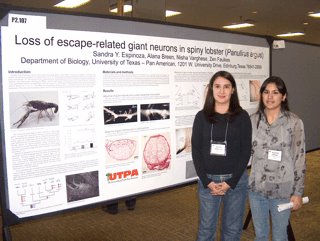 I was very pleased to finally be able to take students with me to a meeting. This picture shows our SICB poster, Sandra (first author on the poster) on the left, and my HHMI undergraduate student Veronica on the right. I was very pleased that for once, the instructions gave the exact right size of the poster boards! Our massive poster fit like a hand in a glove in its space, as you can see. I haven't always been so lucky, and have had poster edges dangling off poster boards before. (Yes, I'm looking at you, Third International Tunicate Conference organizers!)
Besides boasting about our poster and my students, posting this picture gives me a good excuse to test Blogger's picture loading, which seems to work fairly well. Click on the picture to enlarge.
Who's the joke on?
Our current provost, Rodolfo Arevalo, starts his new job at Eastern Washington University on April 1st. Hmmmmm...
10 January 2006
Ah, Rudy, we hardly knew ya...
A guy goes away for a few days, and suddenly everything is topsy turvey.
Our provost, Rudolfo Arevalo, is leaving to become the 25th president of Eastern Washington University. I wish him a speedy transition to his new institution. While Arevalo has done some very positive things for our institution, he's done it in an amazingly heavy-handed manner that he alienated a lot of people.
New president a couple of years ago, now a new provost. With Arevalo's departure, only a few of the "old guard" at our campus is still around. We'll see if the revolution continues.
Home again, home again, jiggedy jig
I spent the last week in Orlando at the Society for Integrative and Comparative Biology conference. I gave a talk which went very well. First, almost everyone I talked to remembered my talk title -- "Do shovel-nosed lobsters shovel with their noses?" -- so I can take some pride in finding a title with a high stickiness factor. My presentation also was very well received, with one person calling it "inspiring," (or perhaps inspirational, I can't exactly remember) and another person saying, "I hope you teach," and saying she thought my passion "went through the room" and infected others. I have to say that after spending almost two months thinking about that presentation, and then boom, having it all over in 15 minutes, you milk those compliments for as long as you possibly can.
Also, my grad student Sandra gave a poster which was also well received. We did quite a bit of useful networking, including with an associate editor of the journal to which we plan to submit the paper, who gave us some very good and helpful advice. It will be a while before we find out if she managed to make her way into the finals of The Crustacean Society's best student poster competition.
I have been back in town now for a little over 12 hours after about a week with only one brief internet session, and am playing the inevitable game of catch-up. More on the conference later!
02 January 2006
Was 2005 real?
It's seems a bit of a shame that a couple of the biggest science stories of the year were about fake science. The year closed out with accusations of massive scientific fraud in Korean stem cell research (see articles here). Another big science-related story was the continuing fight over intelligent design. I make no bones that I am excited about the results of a recent court case (extensively covered at The Panda's Thumb) which says (among other things) in no uncertain terms, "Intelligent design ain't science."
Although it's easy to be cynical about the widespread peddling of -- I was about to type "disinformation," but I think I'll be blunt and call them "lies" -- that these stories represent, there is good news to both of them. Systems in place to check these thing worked. Investigation uncovers possible fraud. A trial recognizes when people are trying to push religious belief under the disguise of science.
Looking at the evidence seems to work -- although there are certainly times I wished it worked a bit faster.
2006 so far
I was over in Wal-Mart looking for some stuff, and they had taken down all the Christmas decorations in one section of the store that I walk through. What's replaced it? Barbecue supplies. I kid you not. It seems utterly appropriate considering that the temperature was 30°C on New Year's Day. Just a portent what I have to look forward to this year: heat, heat, heat.
On the other side of looking forward to 2006, though, I have two papers to be published in the next couple of months, which means that 2006 is already shaping up to be a decent year for me, publication wise. My all time record was four papers in one year, and that was the year after I finished my Ph.D. Two is about average, so I'm hoping I can push things above average in the later months of the year.
Meanwhile, I'm just getting my goodies ready to fly to Florida tomorrow to attend the Society for Integrative and Comparative Biology meeting. I've been to this conference once before and liked it a lot. So I'd better get back to putting a couple of final finishing touches on that talk!
30 December 2005
Hi. My name is Zen. I'm a workaholic.
I was looking around the department a lot this week. I was alone most of the time. Usually the only one there. I made a joke to one of the graduate students about there being too many lazy people in the department. But. I'm getting a little upset. I am starting to wonder if I have a problem. Am I a workaholic? I sort of associate the term with people who really want to work all the time, and I don't feel like that. But too much, it seems like all I have is work, and there's less and less to look forward to outside of work. And I'm not sure what to do about it.
Happy New Year.
28 December 2005
More "No"s
Rejection for the holidays! It's all so soap opera-y. Yes, I have had yet another grant application turned down, this one from the National Science Foundation. I'd asked for $147,500.
Meanwhile, what did I spend yesterday and will spend all of today doing? Writing a recommendation letter to the NSF for a student. I hope I do better for my student than I do for myself.
26 December 2005
No snow, no science
My parents have been visiting for Christmas, and we spent Christmas eve at the World Birding Center, and saw lots of things I hadn't seen before: lovely green jays, javelinas, leaf cutter ants, and ant lion pits, and various other things. Warm and pleasant and well worth it.
Christmas was very relaxed and enjoyable. No repeat of last last year's freak snow fall.
Now things start winding up again. I have a letter of recommendation due at the end of this week for a fellowship for my graduate student Sandra, and we start getting ready to go to the SICB meeting next week. (Eeeek! So soon?!)
23 December 2005
Big as a really big thing
Things are looking up, for the most part. After several weeks of clouds -- to the point where I only has vague sort of memories about some blazing ball of fire that used to inhabit the sky -- the sky has cleared up and we have some lovely sunshine.
Yesterday was also good for work related reasons. My student Sandra and I were preparing to print our poster for the upcoming Society for Integrative and Comparative Biology meeting. This is actually part of a student presentation competition for The Crustacean Society, so the urge to have a good poster has a slightly greater importance than normal. We also have the luxury of lots of poster board space, if the SICB website is to believed -- so we took full advantage of that. In other words, we have a big poster. I mean, really big. Longer than I'm tall. By many inches. And I'm sort of pointlessly tall.
I was convinced that we were going to spend all day trying to print this poster. After all, it is coming up to Christmas, almost nobody's around. Even though Sandra did check that George, the computer lab manager, would be around to help us, you always sort of worry that you'll find a problem that could be fixed if only person X was in their office and not off in another state visiting family for Christmas.
Plus, there was the possible complicating factor of this poster being so big. We decided that it was, in all likelihood, the single biggest poster ever printed in the lab. The file was many megabytes -- 13.6, to be precise. And being an old school computer user, there was a time when working with a file that big was just asking for trouble. And while it's less of a problem now, it's always a concern in the back of your mind.
But we almost got it printed in one shot. We had to abort the first attempt after a couple of inches, because there was still some tape at the end of the paper roll. But the second attempt came off without a hitch.
Now all we have to do is to hope that the poster boards are actually as big as advertised. Because if not, we could kind of be screwed. And I have to put a few finishing touches on my own talk. This is pretty exciting -- two presentations at one meeting. It's been a while since I've been able to boast of that!
19 December 2005
More rejection
Today I was informed that a pre-proposal didn't make it past the internal review for a "limited submission" grant program from the Department of Defense. Friday, I got back a letter of rejection on a letter of intent I had written. I was one of 116 applicants, and the foundation invited twenty of those to submit full proposals.
Additional: And I found out this afternoon that I was kicked back for an internal Faculty Development grant proposal.
Fighting for simplicity
On Friday, I received the proofs for my latest article; this one will be going into the journal Crustaceana. Luckily, this one seems to have made an errorless transition from manuscript to proof. I was unable to find a single error. Of course, this probably means that I will find a devastating one when the article is actually in print.
The funny thing about the two articles I currently have in print is that both of them had some editorial changes that are symptomatic of a bigger problem.
In one paper, the editor recommended changing “leg” to “pereiopod.” Of course, if you look up pereipod, you’ll see they’re defined as “legs,” essentially. I made the change because it’s a small thing to fight with an editor about. And “pereiopod” is slightly more accurate. But I have had papers published using the word “legs" instead of “pereiopods.”
In the other paper, a similar event occurred. The editor changed “abdomen” to “pleon.” “Pleon”? Heck, even I had to look that one up. I thought “abdomen” was more than technical enough; it is certainly a more precise anatomical term than "tail," which is essentially what most people would think of if I pointed to the abdomen / pleon of a lobster or crayfish or such. This one was during the editorial changes for typesetting, so I had no idea it was to be done until I actually received the proofs.
In his famous essay, “Politics and the English Language,” George Orwell proposed several simple rules, one of which was “Never use a foreign phrase, a scientific word, or a jargon word if you can think of an everyday English equivalent.” I try to follow that sort of advice when I write, with a little success (I think). After all, I do want my papers to be read somewhat widely, and as a relative latecomer in biology, I am always conscious of just how much technical terminology is out there.
Is the extra level of precision really worth making the paper just that little bit more obscure, just that extra step more arcane and unreadable without a dictionary by your side? I.m obviously inclined to believe that it’s not, otherwise I wouldn’t have picked the words I did in the first place. But getting a paper published is hard enough as it is, so it is very difficult to justify hardcore battles over this sort of terminology.
When my papers comes out, I’m giving permission to everyone to go in to their library copy and replace “pereiopds” with “legs” in indelible marker. Strike out “pleon” and put in “abdomen” – or maybe even “tail.”
The funny thing about the two articles I currently have in print is that both of them had some editorial changes that are symptomatic of a bigger problem.
In one paper, the editor recommended changing “leg” to “pereiopod.” Of course, if you look up pereipod, you’ll see they’re defined as “legs,” essentially. I made the change because it’s a small thing to fight with an editor about. And “pereiopod” is slightly more accurate. But I have had papers published using the word “legs" instead of “pereiopods.”
In the other paper, a similar event occurred. The editor changed “abdomen” to “pleon.” “Pleon”? Heck, even I had to look that one up. I thought “abdomen” was more than technical enough; it is certainly a more precise anatomical term than "tail," which is essentially what most people would think of if I pointed to the abdomen / pleon of a lobster or crayfish or such. This one was during the editorial changes for typesetting, so I had no idea it was to be done until I actually received the proofs.
In his famous essay, “Politics and the English Language,” George Orwell proposed several simple rules, one of which was “Never use a foreign phrase, a scientific word, or a jargon word if you can think of an everyday English equivalent.” I try to follow that sort of advice when I write, with a little success (I think). After all, I do want my papers to be read somewhat widely, and as a relative latecomer in biology, I am always conscious of just how much technical terminology is out there.
Is the extra level of precision really worth making the paper just that little bit more obscure, just that extra step more arcane and unreadable without a dictionary by your side? I.m obviously inclined to believe that it’s not, otherwise I wouldn’t have picked the words I did in the first place. But getting a paper published is hard enough as it is, so it is very difficult to justify hardcore battles over this sort of terminology.
When my papers comes out, I’m giving permission to everyone to go in to their library copy and replace “pereiopds” with “legs” in indelible marker. Strike out “pleon” and put in “abdomen” – or maybe even “tail.”
12 December 2005
Misery gets company
Still feeling tired and wobbly and not well at all. Apparently, though, I'm not the only one. A whole mess of the people who were at Chap's (our happy hour pub) on Friday got sick. Me, Jason, Fred, Kristy, Jon... I guess someone was infectious.
10 December 2005
Wobbly
I am regretting going to happy hour yesterday. When I came home, my throat hurt fairly badly and I got about two hours of good sleep. I would have liked to stay at home, but I got an email saying, "Your grant application hasn't been submitted correctly." Again. So here I am in my office trying to upload a silly little PDF file for the third time. I hope this one works as it ought.
Meanwhile, my grad student is taking the GRE. Fingers crossed for her.
08 December 2005
Doing something right
Because it's the end of the semester, I always encourage my students to rate me, not just on the standard class forms, but through websites like Pick-a-Prof and Rate My Professors. This morning, I was tooling around on the latter site, and clicked on "highest rated schools"... and found that my institution is ranked second highest out of almost 800 listed.
I'm gobsmacked. I mean, when you face so many problems at a place like this, you sometimes wonder if anything is going right. It's nice to see some evidence that something is going right, in the minds of our students, at least.
Incidentally, Rate My Professors is worth checking out for the funny reviews if nothing else.
Subscribe to:
Comments (Atom)