Study in contrasts yesterday.
We had the first meeting of Journal Club yesterday. A paper had been sent by email earlier in the week, and we moved the time forward a bit to try to make it a bit more friendly to students.
Start time rolls around, and there are six faculty and one student – the one who picked the paper for discussion.
Another student shows up about 10-15 minutes late.
Last semester, when we had a few more students showing up, it was often like trying to pull teeth to get student to venture an opinion.
After Journal Club, I drove down to a coffee shop where there was a meeting of the Ethics Bowl team. Our university placed in the regional competition, and will be competing in the national competition in March.
By the time I got there, there was the team’s coach and about five students involved in animated discussion of the cases. A few more students showed up a later. People occasionally have to be reminded to let the other person talk.
And the score at half-time:
Ethics Bowl, several hundred; Journal Club, nil.
It’s damned depressing. I crave that intellectual back and forth in our department. I’ve tried to encourage it and foster it. And apparently I have earned a great big fail on that count.

30 January 2010

Single use clothing

Lesson #3
You need to wear a suit.
I never get why academics insist on wearing clothes to an interview that they’ll never wear again if they get the job.
Image from here.
29 January 2010
More journals that smell like spam
A while ago, I shared a loopy email from an Indian scientific publisher asking me to publish in their journal. I got another one, and it’s an interesting study in convergence. For entirely different reasons, this one also convinces me not to take it seriously.
This is a group called Science Publications. The email they sent is actually simple, clean, and correctly spelled. Although that it’s signed only by “Editor,” not a person with, you know, a name is a bit of a worry.
 Since I do neurobiology, I had a look at the American Journal of Neuroscience. And almost every page on that website makes my bullshit detector ping.
That’s one journal. Another annoys me by spelling “online” as “OnLine” in its title: a weird compound neologism that nobody uses.
It’s be great that the publishing revolution creates the potential for new journals. But from a research author’s point of view, it’s the wild, wild west out there. And it’s not clear yet who are the honest settlers and who are the cattle barons and con men.
This is a group called Science Publications. The email they sent is actually simple, clean, and correctly spelled. Although that it’s signed only by “Editor,” not a person with, you know, a name is a bit of a worry.

- The current issue has exactly one article. For a journal that is supposed to be published every six months, one article is a pretty slim haul.
- Claims to be at volume 6, but clicking the “back issues” page shows nothing of volumes 1 through 5.
- The editorial board contains three people. No institutional affiliations are given. Compare this to the journal Neuroscience, which lists an editor-in-chief, an associate editor, seventeen section editors, and seventy-three members of the editorial board, and each one has an institution listed by the name.
- The authors’ instructions refuse to accept references that are not on the internet.
- The critical page is, naturally, “Method of payment.” So, there will be a fee for publishing or processing or something. But they don’t tell you how much it is. If it’s on the site, it’s hidden pretty deep.
That’s one journal. Another annoys me by spelling “online” as “OnLine” in its title: a weird compound neologism that nobody uses.
It’s be great that the publishing revolution creates the potential for new journals. But from a research author’s point of view, it’s the wild, wild west out there. And it’s not clear yet who are the honest settlers and who are the cattle barons and con men.
Credit convergence
Bora Zivkovic, he of A Blog Around the Clock, Open Laboratory and Science Online unconferences, beat my Science letter to the punch by about two years.
Maybe more indication that this is an idea whose time has come?
Maybe more indication that this is an idea whose time has come?
Food fit for a king
You know what one of the good things about being a boss / mentor / educator / professor / teacher / supervisor is?
Sometimes, you get students who are more excited over something than you are.
And they remind you that maybe you’ve done something kind of cool.

Thanks, Sakshi.
I got this in celebration of my letter in Science and in tribute to this post.
Sometimes, you get students who are more excited over something than you are.
And they remind you that maybe you’ve done something kind of cool.

Thanks, Sakshi.
I got this in celebration of my letter in Science and in tribute to this post.
28 January 2010
Letter in Science!

My letter is in response to an editorial by Science’s editor-in-chief Bruce Alberts earlier this month (Alberts B. 2010. Promoting scientific standards. Science 327: 12. http://dx.doi.org/10.1126/science.1185983). I propose that credit in scientific papers might be better served by using credits for something like cinema instead of literature.
The PDF is behind a paywall, but you can listen to it on the podcast! It is dead last, but if you want to use the wonders of fast-forwarding, you’ll find it at 29:48 from the start.
I’m pretty pleased that I submitted it as a letter instead of just blogging about it.
Faulkes Z. 2010. Taking a Cue from the Silver Screen. Science 327: 523. http://dx.doi.org/10.1126/science.327.5965.523-a
Follow-up posts
Credit converegence
Chittin’ and chattin’ with Open Lab 2009 editor, Scicurious

How did you get the job of editing this year's Open Lab anthology? Did you seek it out, or were you approached?
Bora (Zivcovic) actually asked me to edit this year’s edition, and I was really flattered that he asked. It’s been a big job to live up to, and it’s definitely been a learning experience, but I’m very glad I said yes.
How do you and the judges sift through the hundreds of entries to come down to 50?
The judging process varies from year to year. This year I parceled out posts (no one got their own, obviously) to the judges and had them score for the first round, and then took the top scores to narrow it down for the second round. It was a very difficult process, and the final 50 were very hard to pick!
How important is the mix of selections for the anthology? Do you consciously try to balance out, say, “life as a scientist” posts with pure “research analysis” posts?
We do try to achieve some balance, because I’m sure if you wanted to, you could have an entire anthology on the evolution/creation debates. We wanted a good balance with representation of what went on during the year, but we also just looked for some great examples of writing. But of course, we can't consider a post for inclusion unless its submitted. So if we had low numbers of, say, neuroscience posts submitted one year, it might be harder to get a balance. All the more reason to submit lots of posts for next year! Make sure your stuff gets good representation!
I’ve already started a list of posts made in December and January that I plan to nominate for next year!
What changes get made to posts in the transition from blog to book?
Well, the biggest change is obviously the links, and of course any photos that the writers don’t have the rights to. We also need to look carefully at context, we don’t want all the posts to begin with “so last week there was this blow up in the media/blogosphere/the scientific world.” Other than that, I have been working very hard to make the transition easy, and to stay relatively hands off with editing. What makes so many of these bloggers so incredible is the unique voices that they bring to the table, and so I try to make sure that that unique voice and point of view comes through in the final piece.
Has being the editor for this project been easier or harder than you expected?
I’d say it was about as much work as I thought it would be, thought it has entailed a little more cat-herding than I expected! But I’ve learned a lot that I think will be useful.
Even an editor is allowed to have favourites. Is there any particular entry that you have a soft spot for? (Your own post and mine are exempted from this discussion!)
I might have a favorite or two, but I won't say until it’s out!!
Thanks Sci! Scicurious blogs at Neurotopia.
27 January 2010
Dinosaur colours – more exciting than an Apple tablet!
Called it!
Here’s the story in Nature. Really surprised it’s not the cover story, frankly.
Ed Yong breaks the news on Not Exactly Rocket Science.
Here’s the story in Nature. Really surprised it’s not the cover story, frankly.
Ed Yong breaks the news on Not Exactly Rocket Science.
Movie rentals and journals

I also dislike that it forces me into paying for a recurring monthly subscription. Why won’t you let me just rent one movie?!
And yet... I have a subscription and do business with this company. Despite my annoyances (and the ads do annoy me – a lot), they are pretty much the only business that does what they do. They provide a service that is useful to me. So I hold my nose and pay their subscription fee.
This parallels my attitude towards many research journals, particularly regarding open access. I would like it if journals were open access, just as I would like it online DVD rental business wouldn’t buy those damned pop-under ads. But a lot of those journals do provide useful services. They do good jobs on the editorial side, good production values, and good distribution, even if not open access.
There are some researchers who advocate never publishing in any journal that isn’t open access. But how much perfection do you demand in any product?
26 January 2010
Tuesday Crustie: Oh yes it is

Since last week I put up a picture of something claiming to be Blepharipoda occidentalis, but wasn’t, I thought it was only fair to put up something to show what the spiny sand crab really looks like.
I know the image isn’t great, but converting photos to digital when I was a grad student wasn’t as easy or as good as now.
Academic reproduction
Continuing with yesterday’s theme about expectation rifts and institutional diversity, Mike the Mad Biologist inadvertently provides another example of how the situation at Major Research Universities dominates discussions. He writes a piece about how funding generates excess numbers of scientists.
What is missing from this analysis, though, is a population view. The size of a population depends on birth, death, immigration, and emigration. The quote above focuses on just one aspect of that: academic “birth,” and even that is incomplete.
 To continue using the reproductive metaphor, not every academic “parent” will have offspring. Indeed, many academics, because of the institution they are at, will never train a Ph.D. student in their life. We have a situation much like that of highly competitive animals like bull elephant seals: you have super winners who have many offspring, and super losers, who have none.
Photo from Flikr, used under a Creative Cpmmons license.
As long as the economic incentives are for academic researchers to produce far more PhDs than are needed to replace themselves**, we will continue to have this problem. ...
** Even a modest training regime – let’s say, one student for a six year period with no overlap between students – will result in five students during a faculty member’s career.
What is missing from this analysis, though, is a population view. The size of a population depends on birth, death, immigration, and emigration. The quote above focuses on just one aspect of that: academic “birth,” and even that is incomplete.
 To continue using the reproductive metaphor, not every academic “parent” will have offspring. Indeed, many academics, because of the institution they are at, will never train a Ph.D. student in their life. We have a situation much like that of highly competitive animals like bull elephant seals: you have super winners who have many offspring, and super losers, who have none.
Photo from Flikr, used under a Creative Cpmmons license.
25 January 2010
The brown bear... of communism! Texas Board of Education's case of mistaken identity
I have not commented much on the Texas State Board of Educations review of standards other than science, because I claim no expertise in things besides science. But this story is too interesting not to pass on.
In its haste to sort out the state's social studies curriculum standards this month, the State Board of Education tossed children's author (Bill) Martin, who died in 2004, from a proposal for the third-grade section. Board member Pat Hardy, R-Weatherford, who made the motion, cited books he had written for adults that contain "very strong critiques of capitalism and the American system."
Trouble is, the Bill Martin Jr. who wrote the Brown Bear series never wrote anything political, unless you count a book that taught kids how to say the Pledge of Allegiance, his friends said. The book on Marxism was written by Bill Martin, a philosophy professor at DePaul University in Chicago.
A bad defense of two-sided science journalism

I have a somewhat different take on the "other side" controversy. Part of the reason the media went looking for an opposite view on climate change was because two-sidedness was easy to convey.
On one side are most of the world's atmospheric scientists, who say that human-initiated emissions of greenhouse gases have started to seriously change the world's climate. On the other is a much smaller number of scientists who are saying that there is no evidence yet that humans are responsible for any of the slight warming we seem to have seen, and that future effects might not be so dire.
Participants in the debate can bring forward different amounts and examples of evidence, but there are definitely two sides to the issue.
Instead of defending this thread, though, Strauss then goes into a discussion of “wicked problems,” using cattle as an example. His example boils down to, “We know cattle produce greenhouse gasses, and there’s a lot of disagreement over how to manage that.”
And thus, Strauss misses the point entirely.
He confuses the small scale where the science is in progress with the large scale where the science is much more... emphatic, shall we say. (For I know I’ll get dog-piled, rightfully, if I say anything like “settled” or “certain.” Science doesn’t deal in certainties, and we must always admit when we could be wrong. Bring your evidence.)
The whole cattle story is something where I think it’s fair to say, the science is not settled. There are real difficulties in knowing what to do. I don’t think you’ll find scientists who are going to call such reporting “two sides” on a small scale issue a problem.
What irritates scientists so profoundly is the insistence on “two sides” on the big picture issues. In the case of climate change, the big picture are that climate is warming due to burning fossil fuels. Strauss does not appear to contend this point.
But it’s on reporting of this big picture where scientists get mad – where the expertise of people actually doing real science (collecting and analyzing data) is always sharing space with flat-out denialists: people from “think tanks” who either deny climate change is happening, or deny that fossil fuel burning is causing it, or deny that it’s a problem. Strauss need look no further than the comments to his article, where commenters have tossed around accusations of fraud and conspiracy by scientists.
By way of analogy, scientists contending that the earth is round get annoyed when the media brings in a flat-earther to show there are “two sides” to the story. Strauss would seem to justify the flat-earther presence by pointing out the difficulty in measuring exactly how much wider the Earth is around the equator than the poles.
The expectation rift and institutional diversity

What some people take for granted as things new faculty must have to survive as scientists are pipe dreams for other people. And it seems to be difficult to convince some people that such variation even exists out there in the university ecosystem.
Many students starting in doctoral programs expect that they are going to go down the same track as their boss: running an externally funded lab. But, according to the recent National Science Foundation Science and Engineering Indicators 2010 report:
Academic institutions employed about 42% of individuals with S&E doctorates, including those in postdocs or other temporary positions.
That’s all academic institutions, not just the major research universities. There are a lot of questions that data set doesn’t answer, but the point remains that staying in academia is not the most common thing people do with doctorates. Supervisors do bit of a disservice to their doctoral and postdoctoral fellows if they don’t convey the other options that are out there. (In some ways, I can’t blame the supervisors: they often don’t have experiences at other kinds of institutions besides big research intensive ones.)
The more I thought about it, the more I wondered if the science blogosphere is tilted towards discussing research at particular kinds of institutions. I read a lot of blogs that are set at euphemistically set at MRU (Major Research University), where the complexities of how to get R01s are dissected in detail, and papers seem to be headed for Science or Nature.
This got me thinking about diversity. The much praised Science Online 2010 conference contained a panel on diversity in STEM, which is mainly concerned with racial, ethnic, and gender issues. Something that comes up as a virtue about blogging is that it can help people, particularly those who are in a minority of some sort, “normalize” their experiences. “Wow, it’s not just me, other people run into the same problems.”
I want to put forward a case for the importance of institutional diversity. (Bad term for it, but can’t think of something better yet.) My impression is that there’s not a lot of science bloggers writing about the experience of doing research at institutions that are not massive research players at the national or international level. It’s important for researchers at such places to do so, because researchers at such places are already marginalized, career wise. I am not saying that the level is anywhere near like the sort of marginalization that can be experienced by, say, a racial minority; just there are similar underlying patterns of behaviour.
A researcher could be looked down upon for not aspiring to become a R01 funded PI at an MRU. Those who did aim for such a job, and didn’t get it, might feel that they are a failure. Ideas or advice from someone at a research extensive university may not be taken as seriously as that of someone from an ostensibly more prestigious, or older, or bigger, or better-funded institution.
Just as a seemingly innocent question like, “When are you two having kids?” can bring along with it all sort of soft-pressure social expectations, so too can “How many postdocs do you have?” emphasize expected norms.
23 January 2010
Histology hazards
On Twitter, I commented, “When I do histology and see what the chemicals do, I am amazed that more people in the field didn't manage to kill themselves.” Here’s the kind of stuff I’m talking about.

Those were originally two separate pieces. Culprit: Propylene oxide.

The one on the right started off looking like the one on the left. Culprit: Osmium tetroxide.

Those were originally two separate pieces. Culprit: Propylene oxide.

The one on the right started off looking like the one on the left. Culprit: Osmium tetroxide.
22 January 2010
How I lost and what I’ve learned
P.Z. Myers wrote recently that he started the Pharyngula blog in 2003. Considering that this is one of the best known and widely read science blogs, I thought to myself...
 “How did I screw up?”
I’ve been blogging since 2002. That puts me on the “online science” map early, and I missed some opportunities. It took me a long time to figure out what I’m doing. I really only got serious about it in the last two years, and it took more than a year before I started to feel the work pay off. Here’s some of the things I’ve learned.
1. I’m not interesting. A lot of earlier posts were of the “Here’s what’s going on with me for the last week” variety. Meh – who cares? Increasingly, I think that while I am not interesting, I can use my knowledge to tell interesting stories. Participating more in Researchblogging.org has been very helpful in this regard.
2. A blog should be an offer to help, not a cry for help. Corollary to the above. When I started writing more outward looking posts, I started getting more feedback.
3. Blogs are a waste of time... but not a complete waste of time. Blogging is inefficient. There are lots of other things out there to look at, so it takes time and hard work to build an audience.
4. Community. Posting on other people’s blogs and being on Twitter have helped me slowly find some like-minded souls, who are often kind enough to spread the word when I get something right. I’m not a chatty guy, and networking is not something I do easily or naturally, but it’s been very rewarding.
Speaking of community, BioChem Belle also had a nice post on social networking. If you're a scientist, go take her poll!
I’'ll also take this moment to point to Chad Orzel, who’s also been blogging since 2002, talking a bit in Inside Higher Education article about why he blogs, and how it led to his writing a book.
 “How did I screw up?”
I’ve been blogging since 2002. That puts me on the “online science” map early, and I missed some opportunities. It took me a long time to figure out what I’m doing. I really only got serious about it in the last two years, and it took more than a year before I started to feel the work pay off. Here’s some of the things I’ve learned.
1. I’m not interesting. A lot of earlier posts were of the “Here’s what’s going on with me for the last week” variety. Meh – who cares? Increasingly, I think that while I am not interesting, I can use my knowledge to tell interesting stories. Participating more in Researchblogging.org has been very helpful in this regard.
2. A blog should be an offer to help, not a cry for help. Corollary to the above. When I started writing more outward looking posts, I started getting more feedback.
3. Blogs are a waste of time... but not a complete waste of time. Blogging is inefficient. There are lots of other things out there to look at, so it takes time and hard work to build an audience.
4. Community. Posting on other people’s blogs and being on Twitter have helped me slowly find some like-minded souls, who are often kind enough to spread the word when I get something right. I’m not a chatty guy, and networking is not something I do easily or naturally, but it’s been very rewarding.
Speaking of community, BioChem Belle also had a nice post on social networking. If you're a scientist, go take her poll!
I’'ll also take this moment to point to Chad Orzel, who’s also been blogging since 2002, talking a bit in Inside Higher Education article about why he blogs, and how it led to his writing a book.
21 January 2010
No postdoc? No problem!
Professor in Training tries to warn people starting tenure-track what they’re in for (second installment here). Unsurprisingly, the first two points both revolve around money, and a big chunk of that concerns postdocs.
For those of you who one day hope to be tenure-track, have you thought about what you can do if you can’t have postdocs?
Your first response might be, “I wouldn’t take a job where I couldn’t have a postdoc.” Are you sure you want to limit your opportunities that much? Especially in the current economy?
You can survive and conduct research without postdocs, but you have to think about it. It’s very helpful to have ideas for $5 projects in your pocket as well as $50,000 projects. There’s a lot of research that can be done with time and elbow grease instead of big bucks.
Undergraduates can be awesome in the lab. The trick is to recruit them early, in their first year. That way, you have the potential to work with someone for three or four years. Still, you can get a lot of good work with people who are around for a year.
There are programs a-plenty to support undergraduate researchers, both financially and intellectually. Beta Beta Beta publishes a journal of undergraduate research. If the work with an undergrad student goes well, some might stay for graduate work.
Institutions that don’t have postdocs are also unlikely to have doctoral programs, but there are often master’s programs. Master’s students have more experience, but the turnover rate is often faster than for undergraduates. There are also far fewer funding opportunities than for undergraduates or doctoral students.
Big labs in big universities train so many people that they get to think that those are the one and only model for scientific success. That does not need to be the only way to do research.
For those of you who one day hope to be tenure-track, have you thought about what you can do if you can’t have postdocs?
Your first response might be, “I wouldn’t take a job where I couldn’t have a postdoc.” Are you sure you want to limit your opportunities that much? Especially in the current economy?
You can survive and conduct research without postdocs, but you have to think about it. It’s very helpful to have ideas for $5 projects in your pocket as well as $50,000 projects. There’s a lot of research that can be done with time and elbow grease instead of big bucks.
Undergraduates can be awesome in the lab. The trick is to recruit them early, in their first year. That way, you have the potential to work with someone for three or four years. Still, you can get a lot of good work with people who are around for a year.
There are programs a-plenty to support undergraduate researchers, both financially and intellectually. Beta Beta Beta publishes a journal of undergraduate research. If the work with an undergrad student goes well, some might stay for graduate work.
Institutions that don’t have postdocs are also unlikely to have doctoral programs, but there are often master’s programs. Master’s students have more experience, but the turnover rate is often faster than for undergraduates. There are also far fewer funding opportunities than for undergraduates or doctoral students.
Big labs in big universities train so many people that they get to think that those are the one and only model for scientific success. That does not need to be the only way to do research.
Dinosaur colours next week?
Back in grad school, I remember reading a comment by paleo artist David Paul, who said something to the effect of, “In reconstructing dinosaurs, what colour they were is the most asked, the least important, and the least knowable.”
Fast forward to September, 2009. Carl Zimmer posts on his blog, The Loom, “Old Colors: First Birds, Then Dinosaurs?”, which ended with a great big tease:
And I thought, “Does the good Mr. Zimmer know something about this that I don’t?”
And then, today’s Nature podcast ended with:
Ack!
I cannot tell you how much I am awaiting next week’s issue of Nature.
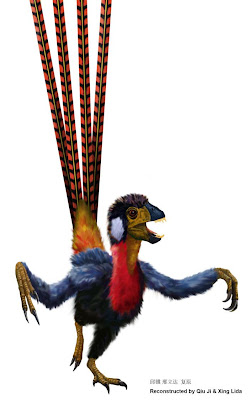
Fast forward to September, 2009. Carl Zimmer posts on his blog, The Loom, “Old Colors: First Birds, Then Dinosaurs?”, which ended with a great big tease:
There are now lots of dinosaur fossils that have what just about all scientists agree now are feathers. If they’re preserved well enough, you should be able to put them under a microscope and see melanosomes. And if you can make out their patterns…
Stay tuned.
And I thought, “Does the good Mr. Zimmer know something about this that I don’t?”
And then, today’s Nature podcast ended with:
Next time, tune in for news on coloured dinosaur feathers...
Ack!
I cannot tell you how much I am awaiting next week’s issue of Nature.

20 January 2010
Mulling over certainty and uncertainty in teaching
I start teaching general biology today, one of the largest introductory classes on campus. This class focuses on biochemistry, cell biology and molecular biology.
And I so badly want to tear it down and start again from scratch.
One of the traditional marks of an education is having facts internalized, at your fingertips. But this article hits on some of my frustrations:
And I’m as guilty of that as the next guy. I tell students, “This is how it is.” It’s a simple, straightforward thing to do: be a tour guide of information. “And over on your left, you’ll see the valence electrons...” And I’m grateful to this post on Usable Learning that has computers in the title, but is really about pushing the notion that there must always be right answer.
That’s another, increasingly important mark of an educated person: being able to cope with situations where there is no right answer.
I think one way to get comfortable with uncertainty is to really get at the way evidence is gathered and analyzed. By looking at process. I want to figure out how to show students evidence. I want to be able to say, “Okay, here’s how we know that there are these steps in glycoloysis,” or, “This is how we know there are three binding sites in ribosomes.”
Many textbooks say they showing process, but it’s usually splashed in here and there, in teensy pieces. And I can see why. If I were to try to figure out those original experiments that worked out the pathways in photosynthesis, I probably couldn’t do it. And I’m not sure if it’s worth it in a lot of cases.
On the one hand, I do want students to have a certain amount of material internalized, because I think you need that intellectual infrastructure. But I think they’re not getting anywhere near enough practice with dealing with analysis to prepare them for tackling new problems. I’m completely conflicted.
And I so badly want to tear it down and start again from scratch.
One of the traditional marks of an education is having facts internalized, at your fingertips. But this article hits on some of my frustrations:
Too many college students are introduced to science through survey courses that consist of facts “often taught as a laundry list and from a historical perspective without much effort to explain their relevance to modern problems.” Only science students with “the persistence of Sisyphus and the patience of Job” will reach the point where they can engage in the kind of science that excited them in the first place, she said.
And I’m as guilty of that as the next guy. I tell students, “This is how it is.” It’s a simple, straightforward thing to do: be a tour guide of information. “And over on your left, you’ll see the valence electrons...” And I’m grateful to this post on Usable Learning that has computers in the title, but is really about pushing the notion that there must always be right answer.
That’s another, increasingly important mark of an educated person: being able to cope with situations where there is no right answer.
I think one way to get comfortable with uncertainty is to really get at the way evidence is gathered and analyzed. By looking at process. I want to figure out how to show students evidence. I want to be able to say, “Okay, here’s how we know that there are these steps in glycoloysis,” or, “This is how we know there are three binding sites in ribosomes.”
Many textbooks say they showing process, but it’s usually splashed in here and there, in teensy pieces. And I can see why. If I were to try to figure out those original experiments that worked out the pathways in photosynthesis, I probably couldn’t do it. And I’m not sure if it’s worth it in a lot of cases.
On the one hand, I do want students to have a certain amount of material internalized, because I think you need that intellectual infrastructure. But I think they’re not getting anywhere near enough practice with dealing with analysis to prepare them for tackling new problems. I’m completely conflicted.
19 January 2010
Tuesday Crustie: Oh no it isn’t
Occasionally, as an academic, you have these moments of shock, when you recognize something that you have personally worked on and that you know about. These moments are often followed by disappointment, when you realize that it is completely wrong.
I was walking along the walkway on the South Padre Island World Birding Center, and come across this on a sign.

I was so pleased to see the name of the species I spent about six years working with for my Ph.D., and published four papers about: Blepharipoda occidentalis. And Blepharipoda are sometimes called mole crabs, though they more typically called sand crabs.
Then, the disappointments start.
First, that picture is not Blepharipoda occidentalis. That picture is probably some species of Hippa, which is not even in the same family as Blepharipoda.
Second, Blepharipoda occidentalis is a species that lives in California, not the Gulf of Mexico.
Third, there are no species of Hippa on South Padre Island, either. There are mole crabs on South Padre Island, but they’re Lepidopa and Emerita.
So this sign is wrong at least three different ways. The sign had the logo for NOAA on it. It’s surprising, because agencies like this usually have access to experts and the scientific literature.
And in among realizing all this, you also realize that you’re one of maybe a half dozen people in the world who would know or care.
Photo by Kevin Faulkes. Thanks, Dad.
I was walking along the walkway on the South Padre Island World Birding Center, and come across this on a sign.

I was so pleased to see the name of the species I spent about six years working with for my Ph.D., and published four papers about: Blepharipoda occidentalis. And Blepharipoda are sometimes called mole crabs, though they more typically called sand crabs.
Then, the disappointments start.
First, that picture is not Blepharipoda occidentalis. That picture is probably some species of Hippa, which is not even in the same family as Blepharipoda.
Second, Blepharipoda occidentalis is a species that lives in California, not the Gulf of Mexico.
Third, there are no species of Hippa on South Padre Island, either. There are mole crabs on South Padre Island, but they’re Lepidopa and Emerita.
So this sign is wrong at least three different ways. The sign had the logo for NOAA on it. It’s surprising, because agencies like this usually have access to experts and the scientific literature.
And in among realizing all this, you also realize that you’re one of maybe a half dozen people in the world who would know or care.
Photo by Kevin Faulkes. Thanks, Dad.
Subscribe to:
Comments (Atom)