Circus of the Spineless #51, the circus for all things invertebrate, is up at Deep Sea News.
Carnival of the Blue #37, for all things salty and aquatic, is hosted by blogfish this month.
Normally, I’d also be plugging the Carnival of Evolution, but I kind of already did by hosting it.

08 June 2010

07 June 2010
Paper trail, or: Did they say that? Peer-reviewed journal edition

 Everybody makes mistakes. But the peer-reviewed scientific literature tries to reduce mistakes by having fairly rigorous rules for citation. Citing original sources increases transparency and greatly facilitates fact-checking.
For instance, in one of our recent papers, we pointed out that a reference given in another paper did not support the point being made (as far as we could tell). Probably most practicing scientists have a story like that. But how common is that sort of error?
A new paper by Todd and company claims that the error rate for peer-reviewed scientific journals in marine biology is about one in four.
That’s a bit of a surprise.
 To come up with this number, they looked at one reference given in support of a claim from three articles of two issues of 33 journals (198 references total – pity they couldn’t have found a way to squeeze in two more to make it an even number). The authors say the reference was selected at random, but they didn’t really, because they only picked assertions that were supported by one reference, so a bit of selection is going on.
Although the title of the article claims one quarter of citations is “inappropriate,” the picture is not as bleak as the title suggests. In fact, only 6% of references did not support the claim being made; a figure closer to one in twenty than one in four.
The “one in four” comes from their claim that 75% of reference support the claim in the paper making them. The remaining 25% that they deem “inappropriate,” however, fall into several categories, and not all of those categories are equally problematic.
About 10% of citations are ambiguous, although the Todd and colleagues say they tended to give benefit of the doubt to those doing the citing. Annoying, but perhaps not damaging to the scientific literature.
The remainder of citations (7.6%) they deem “inappropriate” are cases where the claim is not supported by original data in the paper being cited, but in another paper that the cited paper itself cites. These are almost certainly people citing review articles. Todd and company argue that this is “inappropriate,” but this is surely debatable. Off the top of my head, here are some positive reasons to cite reviews:
- Review articles often more cohesive than original articles
- Easier to read text with a single citation than a long list of citations
- Saves space
- Can save time and effort for readers to track down only one article instead of a long series
Todd and company did look at impact factor of the journal the original paper doing the citing appeared in, with the unstated hypothesis being that “good” journals (i.e., higher impact factors) would have fewer inappropriate citations than “bad” journals. No relationship, which I think goes to show reviewers, and the review process, is a pretty homogeneous lot. (Every journal has a reviewer 2 who hates the paper.)
When initial discussion of this broke out on Twitter, Carin Bondar’s initial response was, “Impact factor is screwed!” I don’t think so. Impact factor would screwed only if there was some sort of systematic bias in which journals are being inappropriately cited. As far as I can tell, everything in this paper seems to suggest the errors are occurring at random. (Impact factors can be abused, but they provide a rough measure for authors to figure out if a journal has any credibility, which is a major problem in this day of experimentation in scientific publishing.)
Journal editors and reviewers should be the gatekeepers here. Reviewers should have some understanding of the relevant literature for the paper they are reviewing. But there are too few people to review too many papers, and it may be unreasonable for reviewers to do more than just a spot check. Maybe journals, particularly those of published by some of the extremely profitable academic publishers, could hire professional fact checkers. That a journal that had full-time fact checkers could easily be a selling point as a good impact factor.
That this article shows how easy it is to go and fact check these things shows, more than anything else, that the citation system works. We just don’t take enough advantage of the opportunities.
Reference
Todd P, Guest J, Lu J, & Chou L. 2010. One in four citations in marine biology papers is inappropriate. Marine Ecology Progress Series 408: 299-303. DOI: 10.3354/meps08587
Photo by gadl on Flickr, used under a Creative Commons license.
04 June 2010
Why is this taking so long?
 Are American scientists twice as good as British scientists?
Because the Americans are spending about twice as long working on the doctorates then the Brits are.
DrugMoney said the length of a doctorate has fluctuated from five and a half to seven years. I asked if this was U.S. data, but haven’t seen an answer yet. Those kind of numbers are also typical of Canada, too.
But the typical length of a doctorate in the U.K. is about three years. That kind of length is typical for Australia, too.
DrugMonkey also said:
I'm willing to accept that 4 years may be too short of an interval(...)
I’m not willing to accept that. Because I don’t automatically think my colleagues who got degrees in other countries with shorter doctorates are crummy half-rate scientists.
I didn’t exactly rush to finish my own degree (I was pretty happy as a graduate student, and I had a lot to learn), but I don’t think that the expectation that a degree should take that the better part of a decade is healthy. It reminds of the report I talked about before that talked about “maintaining incentives for entry into scientific careers as the training phase extends” rather than shortening the training phase.
The disconnect between policy and ground truth was represented in a recent presentation to some U.S. lawmakers. Not surprisingly, they didn’t know what things are like for incoming scientists:
The members of Congress seemed surprised and, according to Miller, “deeply concerned” and “disappointed” by this and other testimony – which indicates how effectively the viewpoints of the research universities and today's established scientists have dominated the discussion and how little attention tomorrow's scientists' concerns have received.
The lawmakers, two of them UC alumni, all expressed chagrin. Miller in particular seemed flummoxed by Tyler’s presentation. He mentioned briefly that what she revealed appeared to contradict the widely assumed scientist shortage. “It’s almost as if we’re toying with some of the brightest, most talented, and skilled people in our society,” he mused in dismay.
As far as I can tell, the length of expected training for scientists before they can start an independent research career – particularly post-docs – has very little to do with actual amount of training to be done, and a lot more with the strangled job market for researchers.
Photo by ATIS547 on Flickr, used under a Creative Commons license.
03 June 2010
The all-seeing eye gazes upon the land of crickets
It’s good to be omniscient.Only a few natural studies have been able to approach that level of all-knowing knowledge. Peter and Rosemary Grant come fairly close in some seasons studying finches on the smaller Galapagos Islands. A new paper must must surely be a contender for god-like knowledge of a population of animals.
Rodríguez-Muñoz and colleagues basically became all-seeing and all-knowing to figure out what evolutionary pressures were being brought to bear on a population of crickets (Gryllus campestris). In other words, who’s getting it on with whom? Who’s being eaten? Those sorts of things.
 To do this, they pulled off a rather astonishing video recording set-up of over 60 infra-red cameras that allowed them to monitor between 150-200 crickets all the time.
Let me say that again.
Every. Single. Cricket.
All. The. Time.
 And lest you think this is in a controlled lab setting? No! This is a field in Spain! And lest you think this is just a series of snapshots of the population? No! They tagged each individual so they were able to identify them by name! And lest you think was some a few days? No! This was over two summers! And, just to top put a cherry on top, they did DNA work to identify parents and offspring.
And some say they did it while keeping six plates on rods spinning simultaneously and telling jokes.
Once you’ve got thousands of hours of video of crickets... what do you want to know? Because you probably have a good shot at answering the question, almost regardless of what it is.
A classic prediction in evolution and ethology is that most females have some reproductive success, but males tend to vary wildly in their success, with some being “super winners” and some being “super losers” (It’s rather like research.)
They did indeed find this pattern, but a surprise was that the female success was not as uniform as expected: many females had no offspring. They also found that the females had more offspring when they mated with multiple males. This is an effect that has been suggested in other research, but the comprehensive nature of this study makes this one of the best examples for the phenomenon to date. Indeed, females tended to have as many mates as males.
 Another surprise was that dominant males had fewer offspring than subordinate males. The authors don’t have a ready explanation for why this is, more or less shrugging and saying, “Dominance doesn’t always predict mating success.”
Are there similar surprises waiting in survivorship? The story doesn’t seem to be as well fleshed out as the mating story. For instance, there’s not a major breakdown of the causes of death; mostly it’s just lifespan information.
The main behaviour that appeared to be linked to lifespan was singing in the males. Longer-lived males had sung more over their lives. This suggests that the ability to sing a lot is a good indicator of general health. And, for short-lived males, this was also correlated with more offspring. Oddly, though, there was no correlation between the amount of singing and amount of offspring for long-lived males.
With so many surprises, I’m sure there will be other papers to emerge from this massive recording session. And it will be interesting to see if other researchers can apply this high level of surveillance to other species that are larger or more mobile.
Reference
Rodriguez-Munoz, R., Bretman, A., Slate, J., Walling, C., & Tregenza, T. (2010). Natural and sexual selection in a wild insect population Science 328(5983): 1269-1272. DOI: 10.1126/science.1188102
Third picture by Gilles San Martin on Flickr, used under a Creative Commons license.
To have and have not. Mostly not.

This article resonates with me, because I’m in a “have not” institution with ambition. While Texas as a state isn’t faring badly, Texas is a big state, and some regions, like southern Texas, don’t fare as well.
My mind boggled from this quote from Ian Blair, who runs a proteomics core facility at University of Pennsylvania:
“My view is that mass spectrometers are like handbags,” he says. “You can’t have too many.”
The article uses North Dakota and South Dakota as examples of “have not” states, and describes several things that people do to keep noticed:
Kevin Young, a UND professor, says he wears a North Dakota t-shirt when attending meetings, since people always remember the guy from North Dakota. “It’s like going to see a panda.”
Ultimately, however, if push ever comes to shove, you know what side you’re on in the race:
There’s no way the school can fairly compete with major players, (Van Doze) says. “They’ve got tanks for weaponry, and we’ve got BB guns.”
BB guns? Count yourself lucky, good sir! Or we shall come after you with our pointed sticks!
02 June 2010
Judging brain scans
I knew the day would come, but wasn’t sure when.
Yesterday, a court ruled against using fMRI data as a lie detector as evidence in a criminal case (see also here).
Several other commentators elsewhere seem pleased with this ruling; I’m tempted to say overly so, at times.
A couple of things are worth noting.
First, fMRI was being used as a lie detector in this case. But fMRI’s potential scope reaches was beyond just lie detection. There are many reasons why information gleaned from a brain scan could be relevant in a court setting. For instance, check out this example of a mock court case where a brain scan is used, not to determine the truth of falsehood of specific statements, but to suggest something about a defendant’s ability to control and plan.
Second, the research on fMRI is ongoing, as are technical improvements. While this ruling says that fMRI as a lie detector is not admissible for now, I wonder when, if ever, people will have another go at getting it admitted.
3 Quarks Daily contest update
 Voting has started for this contest. Lots of good reading there. Please vote as you will, but the important thing is to vote.
I self-nominated a post of my own. Not sure it’s necessarily my best, but it was one that I was kind of fond of.
01 June 2010
Carnival of Evolution #24
Welcome to the June edition of...

Hm. You know, something’s not right here. That logo could use a little something... extra. (Click to enlarge.)

There. That’s better.
Probably the biggest story in evolution in May was the publication of the much ballyhooed Neanderthal genome. You know, the one where everyone overlooked the phenomenal technical achievement of getting a complete genome of an ancient species... and headed straight for the sleaze.
The question on every headline writer’s lips was, “Did humans have sex with Neanderthals?” If you think the answer is yes, you owe it to yourself to read “Nerdy” Christie Wilcox’s fine analysis of the question.
 Speaking of scandals, a paper on oral sex in fruit bats was at the center of a personal dispute that got called, inevitably, fruitbatgate. Regardless of your opinions on that matter, the science is definitely worth looking at, which Jason does at The Thoughtful Animal. (And not in a pervy way.)
And we're still not done with scandals. A creationist claimed biologists “don’t have a clue” about the evolutionary origin of bone. This would be a scandal... if it were true. Which provides a nice segue into...
I am shocked, shocked, I say, to learn that – contrary to creationist claims – we have many interesting clues about the origin of bone in vertebrates. (Regular readers of this blog may have already seen this post.)
 Bones aren’t the only way to hold an organism together. Kevin Zelnio looks at decidedly un-spongy sponges: the glass sponges, and how they evolved the ability to make their silica skeletons.
But if you go down to even finer levels of detail, you might want to know how cells keep connected to each other. Thoughtomics examines how a molecule that was thought to serve primarily to hold cells together has been discovered in a solitary cell.
The Agricultural Biodiversity blog takes a look at the perpetual pest problem: They evolve to things we throw at them. This time, it’s a cotton pest.
And I rather suspect that many readers of this carnival will also found certain creationist arguments irritating (see above). Pleiotropy examines creationist claims made some organisms too incredible to have evolved.
(The brains are coming. Trust me.)
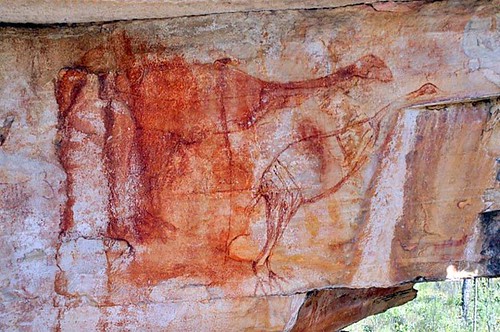 Art can be evidence for evolution, particularly when it’s ancient Australian rock art. A piece of aboriginal art thought to be an emu might be something much more interesting. (And congrats to GrrlScientist for this piece being put up on Slashdot!)
Hill-Stead’s Nature Blog brings us reminds us of the (very loose) link between biology and destiny.
Biochemical Soul is back with a new depiction of the K-T extinction. It looks like this:

Hm. You know, something’s not right here. That artwork could use a little something... extra. (Click to enlarge.)

There. That’s better.
Leave it to protists – and by extension, protist bloggers – to mess up any categorical system.
Skeptic Wonder tackles convergent evolution between big protists and tiny animals. Some good examples of how something that was once thought to have evolved one time was much more common.
And now, the moment you've all been waiting for:
 We are fortunate to have two posts on sign language this month, both inspired by a recent fMRI study examining brain activity for people who use sign language. 360 Skeptic starts the boll rolling,, and AK’s Rambling Thoughts picks it up and runs with it.
While on the topic of language, which is one of the most distinctive human skills, Jerry Coyne examines whether humans evolved to fill a particular cognitive niche.
Evolutionary changes in brains must often force evolutionary changes to occur in other structures, not the least of which for the vertebrates in the skull. The complex relationship between brains, faces, and skulls in primates is discussed over at A Primate of Modern Aspect.
The Thoughtful Animal asks, “Can observing animal behaviour tell us anything about brain evolution?” Make sure you haven’t reached your cuteness threshold for the day before you see the answer.
The Weird Things blog looks at the case for convergent evolution in brains and... computer chips?
And I’m going to pull rank as host, and end with a post of my own, completed just under the wire for today’s carnival: It’s a look at how genes that establish boundaries in developing embryos may be critical to explaining the brain diversity in cichlid fishes.
Thanks for visiting the Carnival of Evolution! Next month, Culturing Science will be hosting the 25th edition. Blog about something silver or something Canadian. Either will be considered appropriately thematic.
Submit your article to the next edition of Carnival of Evolution using the submission form. Past posts and future hosts can be found on the index page.
P.S. – And a great big boo to thethree four five six seven eight nine ten eleven twelve thirteen fourteen fifteensixteen seventeen people who felt compelled to submit posts to the Carnival that had nothing to do with evolution. This is a carnival, not a spam channel. Idjits.
Picture credits
Glass sponge picture by smallislander on Flickr, used under a Creative Commons license.
Sign language picture by Elyse Patten on Flickr, used under a Creative Commons license.

Hm. You know, something’s not right here. That logo could use a little something... extra. (Click to enlarge.)

There. That’s better.
Scandalous
Probably the biggest story in evolution in May was the publication of the much ballyhooed Neanderthal genome. You know, the one where everyone overlooked the phenomenal technical achievement of getting a complete genome of an ancient species... and headed straight for the sleaze.
The question on every headline writer’s lips was, “Did humans have sex with Neanderthals?” If you think the answer is yes, you owe it to yourself to read “Nerdy” Christie Wilcox’s fine analysis of the question.
 Speaking of scandals, a paper on oral sex in fruit bats was at the center of a personal dispute that got called, inevitably, fruitbatgate. Regardless of your opinions on that matter, the science is definitely worth looking at, which Jason does at The Thoughtful Animal. (And not in a pervy way.)
And we're still not done with scandals. A creationist claimed biologists “don’t have a clue” about the evolutionary origin of bone. This would be a scandal... if it were true. Which provides a nice segue into...
Connective
I am shocked, shocked, I say, to learn that – contrary to creationist claims – we have many interesting clues about the origin of bone in vertebrates. (Regular readers of this blog may have already seen this post.)
Bones aren’t the only way to hold an organism together. Kevin Zelnio looks at decidedly un-spongy sponges: the glass sponges, and how they evolved the ability to make their silica skeletons.But if you go down to even finer levels of detail, you might want to know how cells keep connected to each other. Thoughtomics examines how a molecule that was thought to serve primarily to hold cells together has been discovered in a solitary cell.
Annoying
The Agricultural Biodiversity blog takes a look at the perpetual pest problem: They evolve to things we throw at them. This time, it’s a cotton pest.
And I rather suspect that many readers of this carnival will also found certain creationist arguments irritating (see above). Pleiotropy examines creationist claims made some organisms too incredible to have evolved.
(The brains are coming. Trust me.)
Artistic
Art can be evidence for evolution, particularly when it’s ancient Australian rock art. A piece of aboriginal art thought to be an emu might be something much more interesting. (And congrats to GrrlScientist for this piece being put up on Slashdot!)Hill-Stead’s Nature Blog brings us reminds us of the (very loose) link between biology and destiny.
Biochemical Soul is back with a new depiction of the K-T extinction. It looks like this:
Hm. You know, something’s not right here. That artwork could use a little something... extra. (Click to enlarge.)

There. That’s better.
Uncategorizable
Leave it to protists – and by extension, protist bloggers – to mess up any categorical system.
Skeptic Wonder tackles convergent evolution between big protists and tiny animals. Some good examples of how something that was once thought to have evolved one time was much more common.
And now, the moment you've all been waiting for:
Brainy
While on the topic of language, which is one of the most distinctive human skills, Jerry Coyne examines whether humans evolved to fill a particular cognitive niche.
Evolutionary changes in brains must often force evolutionary changes to occur in other structures, not the least of which for the vertebrates in the skull. The complex relationship between brains, faces, and skulls in primates is discussed over at A Primate of Modern Aspect.
The Thoughtful Animal asks, “Can observing animal behaviour tell us anything about brain evolution?” Make sure you haven’t reached your cuteness threshold for the day before you see the answer.
The Weird Things blog looks at the case for convergent evolution in brains and... computer chips?
And I’m going to pull rank as host, and end with a post of my own, completed just under the wire for today’s carnival: It’s a look at how genes that establish boundaries in developing embryos may be critical to explaining the brain diversity in cichlid fishes.
Denoument
Thanks for visiting the Carnival of Evolution! Next month, Culturing Science will be hosting the 25th edition. Blog about something silver or something Canadian. Either will be considered appropriately thematic.
Submit your article to the next edition of Carnival of Evolution using the submission form. Past posts and future hosts can be found on the index page.
P.S. – And a great big boo to the
Picture credits
Glass sponge picture by smallislander on Flickr, used under a Creative Commons license.
Sign language picture by Elyse Patten on Flickr, used under a Creative Commons license.
Comments for second half of May 2010
Research Explainer picks up on the theme that scientists are bad communicators. The examples used, though, may not be indicative of just bad communication skills.
The Scholarly Kitchen looks at a now infamous slide from the military, and concludes it may not be as bad as the mockery would indicate.
BenchFly looks at how to work with undergraduate students. I say it’s the same as working with anyone.
drdrA at Blue Lab Coats asks what cranky reviewer phrases people have encountered.
The Prodigal Academic describes the process whereby 210 applications for tenure-track positions get cuts down to about five for on-site interviews. We do a step they don’t.
The Faculty of 1000 started up a new poster archive, and well, since I run a poster blog, I made a comment about the need to show off, not just the best science, but the best graphics.
Mental Floss reviews the question of crab pain, citing some research I’ve talked about here before, but discussing some more recent stuff (i.e., mine).
Not exactly comments, but I somehow got involved in a Twitter contretemps that became known as bacon blog wars. You may see my name kicked around in relation to that...

Tuesday Crustie: Insect cousin

Speleonectes tanumekes is a remipede. The remipedes are an interesting group of crustaceans for many reasons. They were, for many years, known only from fossils, but, like the coelocanth, were discovered years later alive and well. (Such species are sometimes called “Lazarus taxa” because they “rose from the dead.”) That they were not known to have survived before this could perhaps be excused, because they now only live in underwater caves.
They have started to attract much more attention recently with a paper on arthropod relationships, which suggests that remipedes are the closest living relatives to insects. You can read more about this here and here.
Remipedes also boast one of my favourite genus names in the animal kingdom: Godzillius. It was the name given to a remipede of “monstrous” size: a little over 40 millimetres.
Unfortunately, many of these remipede species are only known from a very restricted number of caves, making them very vulnerable.
Picture from here.
The painless thesis competition
Almost every grad student experiences a certain amount of pain in pulling together their thesis. But does it have to be that way? Boris Gorelik says no!
Boris writes the blog In the Haystack, and is holding a competition for the best tips to help make writing a thesis painless. Boris asked me to help judge the entries, and I’m pleased to do so.
The rules are easy. Post your advice for painless thesis writing on Twitter with the #painlessthesis tag.
You still have several days left to enter; competition closes at the end of the week (6 June 2010). You can read all about it here.
 The winner will receive a copy of Presentation Zen Design; I’ve reviewed this book at the Better Posters blog; Boris reviews it here.
I think I got called on to judge this competition for three reasons. First, I’m our department’s grad program coordinator, so I’m always trying to help students with their theses. Second, the prize is Presentation Zen Design, and well, you know what my name is. Third, I recently co-authored a paper on crustaceans’ lack of nociception, so I guess that makes me an expert on painlessness.
Boris writes the blog In the Haystack, and is holding a competition for the best tips to help make writing a thesis painless. Boris asked me to help judge the entries, and I’m pleased to do so.
The rules are easy. Post your advice for painless thesis writing on Twitter with the #painlessthesis tag.
You still have several days left to enter; competition closes at the end of the week (6 June 2010). You can read all about it here.

I think I got called on to judge this competition for three reasons. First, I’m our department’s grad program coordinator, so I’m always trying to help students with their theses. Second, the prize is Presentation Zen Design, and well, you know what my name is. Third, I recently co-authored a paper on crustaceans’ lack of nociception, so I guess that makes me an expert on painlessness.
31 May 2010
Laying down boundaries for brain evolution in cichlids
Walter Garstang famously said that ontogeny creates phylogeny: you need to understand the development of a structure to understand the diversity of that structure across species.There are a few different ways to change the way a structure is put together. Research on the development of limbs has tended to view morphological changes as being caused by changing boundaries that delineate different regions of the embryo. If you want a bigger forebrain, shift the boundary between the forebrain and the midbrain backward.
Neurobiologists, however, have sometimes suggested that brains differ due to the amount and duration of neurogenesis that goes on during development. If you want a bigger forebrain, make neurons for a longer time in the forebrain than in the midbrain.

 A new paper by Sylvester and colleagues tries to look at the relative importance of these two developmental mechanisms in brain evolution. To do this, they looked at the brains of cichlid fishes. Cichlids are renowned among evolutionary biologists for their diversity and the speed at which it was achieved, and this diversity extends to their brain morphology. They chose six species to study; Cynotilapia afra and Copadichromis borleyi are shown here (click to enlarge). The former is a mbuna, a rock-dwelling fish, and the latter is a sand-dweller; the authors had three species of each.
The brains of the mbuna and non-mbuna differ in their proportions: the mbuna have smaller forebrains (strictly speaking, purists would say the telencephalon) than the non-mbuna.
Sylvester and colleagues visualized the cichlid brains using several that are well-known to be involved in development, like sonic hedgehog (shh), and Wnt and found that the pattern of expression of these did indeed differ in these species, typically following the mbuna / non-mbuna split.
 To test whether these genes caused the differences in brain sizes, the authors exposed embryos of the mbuna species Labeotropheus fuelleborni (right) to lithium chloride, which affects the Wnt pathway. When they did this, they found that the L. fuelleborni brains were looking rather more like non-mbuna brains, which proportionately larger telencephalons.
Sylvester and company argue that this suggests the very early expression of genes that lay out patterns in the nervous system are key regulators of brain evolution. Considering that they sort of set up timing of neurogenesis as an alternate hypothesis in their introduction, however, it’s worth pointing out that they didn’t actually measure neurogenesis or try to manipulate it in a manner similar to what they did for these patterning genes and proteins. It’s possible that neurogenesis is playing a role in shaping diversity of brains in other ways than tested here.
Additional: The journal is publishing a commentary on this paper. While the original article is open access, the commentary, alas, is not.
Reference
Sylvester, J., Rich, C., Loh, Y., van Staaden, M., Fraser, G., & Streelman, J. (2010). Brain diversity evolves via differences in patterning Proceedings of the National Academy of Sciences 107(21): 9718-9723. DOI: 10.1073/pnas.1000395107
Photo of Cynotilapia afra by Calwhiz on FLickr; photo of Labeotropheus fuelleborni by Lee Nachtigal on Flickr; photo of Copadichromis borleyi by Petrichor on Flickr. All used under a Creative Commons license.
Global warming, ocean acidification, and KO’d crayfish
What do global warming, ocean acidification, and KO’d crayfish have in common? Carbon dioxide.A forthcoming paper by Biewbower and Cooper caught my eye because it incidentally supports a contention in the last paper I co-authored on crustacean nociception (Puri & Faulkes 2010). We couldn’t find any evidence that crustaceans responded to acids.
The new paper isn’t actually interested in acids; it’s all about what carbon dioxide does to crayfish. The first question is, can crayfish detect changes in carbon dioxide concentrations at all?
 The authors ran crayfish through a Y-maze: one arm with high CO2 concentrations, and one without. The higher the carbon dioxide concentrations, the more the crayfish tended to avoid that end of the maze, suggesting that yes, the crayfish can detect carbon dioxide in water. They also found that when placed in a pool containing high levels of carbon dioxide, crayfish would leave the water to cross in the air to a chamber with lower levels.
Another possible interpretation is that the crayfish aren’t detecting carbon dioxide in these experiments, but a lack of oxygen. It could also be low pH. When you ramp up the concentration of carbon dioxide in water, create carbonic acid. This is why burning fossil fuels is leading to ocean acidification. Crayfish could have avoided the end of the maze because they detected the low oxygen or low pH rather than the carbon dioxide specifically.
Consequently, they created two control conditions in addition to regular water. First, they created a low-oxygen water by bubbling nitrogen through it. Crayfish did not discriminate between the nitrogen laden water and the regular water. Second, they made one end of the Y maze with normal CO2 concentrations, but acidic pH; about 4.85.
And the crayfish walked right into it.
No difference between the regular water and the acidic. So their study supports ours: decapod crustaceans seem to be mostly ignorant of changes in pH.
Another interpretation might be that the animals are responding to low oxygen; to control for that, the authors also had a control condition with very high nitrogen concentrations in the water, which lowered oxygen, and again, the crayfish didn’t distinguish between that and regular water.
Bierbower and Cooper also found that at high concentrations, carbon dioxide does a number on the crayfish, effectively putting them out of action stopping their heart and ventilation (“breathing,” more or less).
Why are crayfish repelled by high levels of carbon dioxide? Not clear. Bierbower and Cooper suggest that high levels of carbon dioxide might be a cue that an environment is toxic. That said, these are swamp crayfish (Procambarus clarkii), and they probably have a pretty high tolerance for low quality water. It would be interesting to see if crayfish that favour highly oxygenated streams might be more sensitive to carbon dioxide concentrations.
While very interesting to me because of its relevance to a story I’ve been working on (crustacean nociception), this paper might have limited interest to others. Both the introduction and discussion are very general, and don’t convey a strong sense of where this fits into a broader research picture.
References
Bierbower, S., & Cooper, R. (2010). The effects of acute carbon dioxide on behavior and physiology in Procambarus clarkii. Journal of Experimental Zoology Part A: Ecological Genetics and Physiology DOI: 10.1002/jez.620
Puri S, Faulkes Z. 2010. Do decapod crustaceans have nociceptors for extreme pH? PLoS ONE 5(4): e10244. doi: 10.1371/journal.pone.0010244
30 May 2010
The unread masses of scientific literature
Canadian Girl Postdoc resumes her look at slow science. She asks:
 Speaking just for me as a search committee member, I haven’t read papers by job applicants. First, it takes more time than I’m willing to give, and we tend not to have the problem of triple digit numbers of job applications.
Second, we are routinely hiring outside of areas that I am qualified to judge the technical proficiencies of the science. Heck, in many cases, we’re get applications from people whose science I almost literally do not understand at all.
I judge the research of job applicants largely by the number of publications, the titles of their articles, and their research statement, and yes, there’s a tiny little bit of journal “quality.” Taken together, those provide an overview of the kind of research someone is doing, and the questions they are asking.
Journal “quality” based on a very general perception. I don’t look up impact factors. More often, there’s someone on the search committee who knows about the journals people have published in, and weighs in with, “That’s a good, solid, international journal,” or, “Not so good.” Journal titles can reveal a lot about their scope, so you probably don’t want to publish in the Chinese Journal of Irreproducible Crap.
What about the whispers that a job applicant must have a “SNC” (Science, Nature, Cell) paper to be competitive? Obviously, a Science or Nature paper is a nearly universally known entity, so it helps, but it has never been a determining factor in our searches, or even a large factor. A consistent record in strong disciplinary journals has worked for us.
But you know what’s worse than me not reading the papers of our tenure track job candidates?
I rarely even read the papers of my own friends.
I know about the science of people in my department, or the ones I hang out with at conferences from talking to them in the hallways, not from reading their papers front to back.
I don’t read them for a lot of the same reasons I don’t read papers from job candidates: takes a lot of time, their research is far afield from mine, and I have other ways of learning what they’re doing.
I suppose the thing that makes it okay is that I know that they don’t read mine, either.
Although I’ve heard the common refrain from faculty that some members of a search committee do look for quality, I wonder how many of them have actually read any of the papers from the job candidates. And if that assessment of quality is based on the journal’s impact factor or the faculty member's own assessment of the candidate's science?
 Speaking just for me as a search committee member, I haven’t read papers by job applicants. First, it takes more time than I’m willing to give, and we tend not to have the problem of triple digit numbers of job applications.
Second, we are routinely hiring outside of areas that I am qualified to judge the technical proficiencies of the science. Heck, in many cases, we’re get applications from people whose science I almost literally do not understand at all.
I judge the research of job applicants largely by the number of publications, the titles of their articles, and their research statement, and yes, there’s a tiny little bit of journal “quality.” Taken together, those provide an overview of the kind of research someone is doing, and the questions they are asking.
Journal “quality” based on a very general perception. I don’t look up impact factors. More often, there’s someone on the search committee who knows about the journals people have published in, and weighs in with, “That’s a good, solid, international journal,” or, “Not so good.” Journal titles can reveal a lot about their scope, so you probably don’t want to publish in the Chinese Journal of Irreproducible Crap.
What about the whispers that a job applicant must have a “SNC” (Science, Nature, Cell) paper to be competitive? Obviously, a Science or Nature paper is a nearly universally known entity, so it helps, but it has never been a determining factor in our searches, or even a large factor. A consistent record in strong disciplinary journals has worked for us.
But you know what’s worse than me not reading the papers of our tenure track job candidates?
I rarely even read the papers of my own friends.
I know about the science of people in my department, or the ones I hang out with at conferences from talking to them in the hallways, not from reading their papers front to back.
I don’t read them for a lot of the same reasons I don’t read papers from job candidates: takes a lot of time, their research is far afield from mine, and I have other ways of learning what they’re doing.
I suppose the thing that makes it okay is that I know that they don’t read mine, either.
29 May 2010
Save the Stazione Zoologica Anton Dohrn
I received the following email from Roberto Di Lauro, president of Stazione Zoologica Anton Dohrn.
The Stazione Zoologica Anton Dohrn of Naples is at risk of being closed by the Italian Government.
If you agree in signing the petition reported below, please go to http://www.szn.it click on "sign the petition" and fill in the form.
We learned that the Stazione Zoologica Anton Dohrn di Napoli will be suppressed according to the Decree-Law adopting urgent measures on financial stabilization and economic competitiveness, that the Italian Government is in the process of final approval.
The Stazione Zoologica, founded 130 years ago by Anton Dohrn, is among the most prestigious Italian Research Institutes. It acts in the field of marine biological research and is known for the multidisciplinary nature of its activities and for the excellent scientific output.
Current research activities, international and national collaborations, exchanges with scientists of different nationalities, and participation in numerous scientific projects in Europe and worldwide are a clear sign of the nature of the Stazione as an international research institution.
The Stazione Zoologica coordinates the project EMBRC, the only European infrastructure in the biomedical sciences coordinated by an Italian Institution and involving 14 institutions from seven European countries. The EMBRC project is a clear testimony of how the international spirit of the Institute is still alive and present.
Active participation of distinguished scientists, including three Nobel Laureates, as members of the Scientific Council of the Stazione is another demonstration of the relevance of the Institution among the international scientific community.
We manifest our serious concern for the suppression of the Stazione Zoologica, which would greatly reduce the impact of the Italian presence in the international scientific community.
We therefore ask that the Stazione is maintained as an autonomous structure. It is the autonomy, uniqueness, diversity and freedom of research that allowed the Stazione Zoologica to reach its present level of excellence in science and will continue to be among the flagships of the Italian research in the world.

Data underload: Correlation of mood and precipitation, according to Garbage

For those who don’t get the reference...
28 May 2010
Dingoes do detours, dogs don’t
A picture like this used to adorn the office door of some of my fellow graduate students:

The original picture (minus the labels) was taken from a general biology textbook to illustrate detour problems. We look at that and think, “That’s easy. Run around the post. Silly dog.”
Dogs turn out to be fairly bad at detour problems. Squirrels, I understand, solve such problems in a heartbeat, given that they have evolved to navigate complex three-dimensional environments as they leap from branch to branch on trees. But dogs and squirrels are so distantly related and have such different ecologies that one being better than the other doesn’t tell us all that much informative.
Dogs, for instance, are domesticated animals. Domestication is often thought to make animals... well... stupid. Domestic animals often have smaller brains than their wild counterparts. Further, domestic dogs have social relationships with their owners; dogs tend to look at their owners when they experience problems solving a problem.
 Smith and Litchfield pick up on some previous studies that showed wolves tended to do better on detour tasks than domestic dogs. They predicted that the same should be true of another kind of wild dog, Australian dingoes. They also predicted that dingoes would not look at humans when solving the problem.
To make a long story short, the dingos breezed through the tasks, and having humans around provided no particular advantage. Indeed, only one dingo ever even looked at a human when doing the task.
Are dingoes the super-geniuses of the dog world? The authors don’t think that that dingoes are especially bright; they really do think dogs have been made dumber by domestication. They write:
But before closing out, I have to note that “domestic” doesn’t always mean “dumb” in spatial abilities. A little earlier this year, Lewejohann and colleagues tested domestic guinea pigs in the Morris water maze, a standard learning task for small mammals, against wild cavies, the original stock guinea pigs arose from. The authors here mention in the abstract that guinea pigs have smaller brains than cavies (but provide no reference – grrr).
To once again cut a long story short, the guinea pigs did better at learning the Morris water maze task than the cavies.
Of course, there are differences in these two spatial tasks. Traditionally, the detour task is thought to require some level of insight, while the Morris water maze doesn’t. But the guinea pig study certainly helps to show you can’t assume all the domestic animals are going to do worse than their wild counterparts.
Even if that is the case for dogs and dingoes.
Reference
Smith, B., & Litchfield, C. (2010). How well do dingoes, Canis dingo, perform on the detour task? Animal Behaviour. DOI: 10.1016/j.anbehav.2010.04.017
Lewejohann, L., Pickel, T., Sachser, N., & Kaiser, S. (2010). Wild genius - domestic fool? Spatial learning abilities of wild and domestic guinea pigs Frontiers in Zoology: 7 (1). DOI: 10.1186/1742-9994-7-9
Picture by Jared Kelly on Flickr, used under a Creative Commons license.

The original picture (minus the labels) was taken from a general biology textbook to illustrate detour problems. We look at that and think, “That’s easy. Run around the post. Silly dog.”
Dogs turn out to be fairly bad at detour problems. Squirrels, I understand, solve such problems in a heartbeat, given that they have evolved to navigate complex three-dimensional environments as they leap from branch to branch on trees. But dogs and squirrels are so distantly related and have such different ecologies that one being better than the other doesn’t tell us all that much informative. Dogs, for instance, are domesticated animals. Domestication is often thought to make animals... well... stupid. Domestic animals often have smaller brains than their wild counterparts. Further, domestic dogs have social relationships with their owners; dogs tend to look at their owners when they experience problems solving a problem.
 Smith and Litchfield pick up on some previous studies that showed wolves tended to do better on detour tasks than domestic dogs. They predicted that the same should be true of another kind of wild dog, Australian dingoes. They also predicted that dingoes would not look at humans when solving the problem.
To make a long story short, the dingos breezed through the tasks, and having humans around provided no particular advantage. Indeed, only one dingo ever even looked at a human when doing the task.
Are dingoes the super-geniuses of the dog world? The authors don’t think that that dingoes are especially bright; they really do think dogs have been made dumber by domestication. They write:
It is unclear whether domestic dogs have lost the ability to work independently to solve problems, or whether they are simply hindered or handicapped by their close relationship with humans.
But before closing out, I have to note that “domestic” doesn’t always mean “dumb” in spatial abilities. A little earlier this year, Lewejohann and colleagues tested domestic guinea pigs in the Morris water maze, a standard learning task for small mammals, against wild cavies, the original stock guinea pigs arose from. The authors here mention in the abstract that guinea pigs have smaller brains than cavies (but provide no reference – grrr).
To once again cut a long story short, the guinea pigs did better at learning the Morris water maze task than the cavies.
Of course, there are differences in these two spatial tasks. Traditionally, the detour task is thought to require some level of insight, while the Morris water maze doesn’t. But the guinea pig study certainly helps to show you can’t assume all the domestic animals are going to do worse than their wild counterparts.
Even if that is the case for dogs and dingoes.
Reference
Smith, B., & Litchfield, C. (2010). How well do dingoes, Canis dingo, perform on the detour task? Animal Behaviour. DOI: 10.1016/j.anbehav.2010.04.017
Lewejohann, L., Pickel, T., Sachser, N., & Kaiser, S. (2010). Wild genius - domestic fool? Spatial learning abilities of wild and domestic guinea pigs Frontiers in Zoology: 7 (1). DOI: 10.1186/1742-9994-7-9
Picture by Jared Kelly on Flickr, used under a Creative Commons license.
Students JAQing off in class
 I know, I know. Even I’m getting tired of me fisking Texas State Board of Education members when they say dubious things about the teaching of evolution.
But for a change, this time it’s not Don McLeroy! Instead, it’s Ken Mercer (pictured), who is interviewed as part of his re-election campaign in District 5.
What is your position on the teaching of evolution?
I get upset when the newspapers say we put religion in the textbooks. It’s a lie. I challenge every editorial board to go online—the standards are online—and find religion in astronomy, chemistry, biology. It is not there.
Mercer is correct. There is no explicit religion in the science standards, although I note he gives no examples of newspapers that have said this. I have not seen any newspapers that claimed this. (I have seen some make mistakes, and have pointed them out.)
What I have read repeatedly is that State Board of Education’s relentless copy-editing of the standards is religiously motivated. I wonder if Mercer would dispute this. I doubt anyone can build a serious case that things like removing references to the estimated age of the universe were done for secular reasons.
I firmly believe kids in America have the right to raise their hands in the classroom and ask honest questions. I was rather shocked that the opposition didn’t want that. It wasn’t just evolution; it was global warming. I was shocked that in America if you’re either for or against those things, the biggest thing is they didn’t want kids to raise their hands and ask honest questions.
Ah, yes.
“Just asking questions.”
Sounds fair-minded. Who will object to students asking questions?
I doubt anyone is concerned about genuine inquiries prompted by curiosity. But notice how Mercer singles out evolution and global warming. These are areas where people often don’t ask honest questions, but indulge in JAQing off. I like this definition of this tactic (to which I’ve added a little emphasis):
The act of asking leading questions to influence your audience, then hiding behind the defense that they’re “Just Asking Questions," even when the underlying assumptions are completely insane.
Second, Mercer skillfully creates the impression that the previous standards did not allow students to ask questions. But that’s not what standards do. Standards are intended to specify content, not the process in a classroom. And no standards ever could specify what students can or can’t ask.
I’ve snipped the rest of his answer to this question because Mercer goes on to repeat his arguments:
- Newspapers lie (with no actual examples given)
- Students should just be able to ask questions (particularly about things that conservative Christian Republicans don’t like, like evolution and global warming)
But I just wanted to point out this nice little throw-in near the end:
My biggest quote was, “If our kids do not have the freedom to raise their hands in science class and ask honest questions, then we are no longer living in the United States of America.”
I’m just surprised that he didn’t also say the new Texas education standards help support the troops.
Mercer picture from here.
26 May 2010
3 Quarks Daily contest, 2010 version
3 Quarks Daily has started nominations for their second science blogging contest.If you’ve read something you’ve liked on any science blog, consider nominating it. There’s not many perks for blogging, and a little recognition in the form of a nomination goes a long way.
In Tegrity
Subscribe to:
Posts (Atom)