01 October 2020

Student cheating does not justify every step taken to stop it

Consider the following scenario.

You are a young person. Let’s say a woman, for the sake of argument. Like many others, you are mostly working at home. You may not have a lot of your own space at home, if you’re living with family or roommates.

As part of your professional obligations, you are working with a more senior person. Let’s say a man, for the sake of argument.

Your supervisor informs you that you have to install software on your computer that allows him to turn on the camera so he can watch you.

If you are interrupted by anyone, there will be serious professional repercussions. So you may have to do this work someplace private, like your bedroom.

You’re informed that the room has to be well lit and you have to dress a certain way while you’re doing the work.

If you don’t do this, there will be serious professional repercussions.

So you have older man demanding a young woman let him take video of her in her home or he’ll retaliate.

Tell me that’s not creepy.  

Yet that’s exactly what is happening at universities all over North America. Professors are requiring students install some sort of “proctoring software” for exams and tests.

Of course, unlike my hypothetical scenario above, either the student or professor could be a different gender than the one I described. I picked the genders I did because I think it makes the potential for creepiness clearer. 

But the intrusiveness is a problem regardless. 

I wasn’t exaggerating about dictating what you can wear. This example shows professors dictating what students can have on their heads. That’s religious issue for some students, is it not?

That’s on top of issues like this one making the rounds on Twitter. A student got a zero on an exam because she read questions out loud. The software flagged this. 

It’s not clear if the software or the instructor decided that this constituted cheating, but someone, somewhere decided that the only possible reason a student might talk during an exam was to speak to a confederate to cheat. That’s stupid.

There seems to be only one counter to pointing out these concerns.

“But they’ll cheat.”

And many professors will be quick to detail all the times they caught students cheating in one way or another.

Academic integrity is important. I get that. The degree has value because people trust that it represents a fair assessment of a student’s internalized knowledge and abilities.

But the presence of cheating alone doe not justify any and all actions that professors might take in the name of “academic integrity.”

There is such a thing as “proportionate response.”

If you are worried about someone walking on your property, you put up a sign and put locks on your doors. You do not install a minefield to blow up people. Because that would not be a proportionate response to the problem.

Trusting students is hard. Some students will abuse that trust. But there is a line between thoughtful use of measures designed to say, “Cheating is not okay, so don’t do it” and an overblown invasion of students’ lives.

Anyone more worried about students cheating than they are about how to get students excited about the material and learn has already lost the battle. - Amelia Lindsay

Related posts

The academic equivalent of “voter fraud”

28 September 2020

9 circles of hell of a scientific paper publishing

In this YouTube video, “9 circles of hell of a scientific paper publishing, or the world is full of non-elephants,” one of my less pleasant publication stories come up as an example of less than ideal publication processes.

Excerpt from video:

It took almost 3 years to publish an article compared to two years of doing the research in sand crabs. Unfortunately, I am even not able to to check out this article, as it is pay walled for ten dollars. Of course this case is extreme but sometimes even two, three, four months are crucial not only for scientists’ career but also for the impact and relevance of this research for the society that actually paid for it.
The video also features Björn Brembs, who’s consistently been one of the best commentators of academic publishing.

External links

Related posts

1,017 days: when publishing the paper takes longer than the project

19 September 2020

Konrad Lorenz was a Nazi and a Nobel laureate

(This was written for a behaviour class I am teaching this semester.)

Konrad Lorenz was an important figure in the development of the science of animal behaviour. But I also want to acknowledge that he was a member of the German National Socialist party in the 1930s (Kalikow 2020). Which is to say, Konrad Lorenz was a literal Nazi.

Munz described his party affiliation as “an ugly mix of careerism and genuine enthusiasm for the Nazi regime.” Some of his writing (not necessarily his scientific articles, but his letters and the like) showed many anti-Semitic attitudes and arguments for eugenics.

Lorenz was never in the military during World War II. (Correction, 7 October 2020: Lorenz served as a military physician in Poland near the end of the war. Kalikow 2020.) He was not personally pushing people to their deaths. After the war, he said that he was never a party member. It’s not clear to me whether his attitudes ever changed.

I bring this up because there’s a tendency to talk only about scientists’ research contributions, and gloss over or ignore other things they’ve done, particularly when those actions are distasteful or horrible. We like it when people are consistent. We like it when people who create work that is useful, powerful, or enjoyable are also decent human beings.

That is, unfortunately, not always the case.

An author who created a world you love might be racist, homophobic, or transphobic. An actor you enjoy watching might end up doing a perp walk for some crime or misdemeanor. A song you love might be sung by someone who was abusive. And it can makes it hard to sing that song that you love.

But we do ourselves no favours by acting as though only the science matters. It matters when someone was a bigot or a bully or whatever. Real people suffer real hurt because of those attitudes. We have to grapple with the fact that terrible people can do good science.

Part of that is owning up to the dark corners of scientific history. That’s one small part of how we treat people in science better now and in the future.

Reference

Kalikow TJ. 2020. Konrad Lorenz on human degeneration and social decline: a chronic preoccupation. Animal Behaviour 164: 267-272. https://doi.org/10.1016/j.anbehav.2020.01.007

Munz T. 2011. “My goose child Martina”:The multiple uses of geese in the writings of Konrad Lorenz. Historical Studies in the Natural Sciences 41(4): 405–446. https://doi.org/10.1525/hsns.2011.41.4.405 

Sax B. 1997. What is a "Jewish Dog"? Konrad Lorenz and the cult of wildness. Society & Animals 5(1): 3-21. https://doi.org/10.1163/156853097X00196


07 September 2020

Notes from a pandemic: Empty parking lots are the best sign I’ve seen in a while

So across the US, university towns are quickly becoming COVID-19 hotspots because campuses reopened, with crummy plans, and despite warnings for months. Given that South Texas was alreayd a hotspot for COVID-19, with something like 20 deaths reported every day in the country during weekdays for weeks, I was convinced reopening UTRGV – mandated by the UT System very early on – would be a disaster.

Last week, I swung by campus in the middle of the day. This was the second week of class, and the university is nomiall open and holding face-to-face classes.

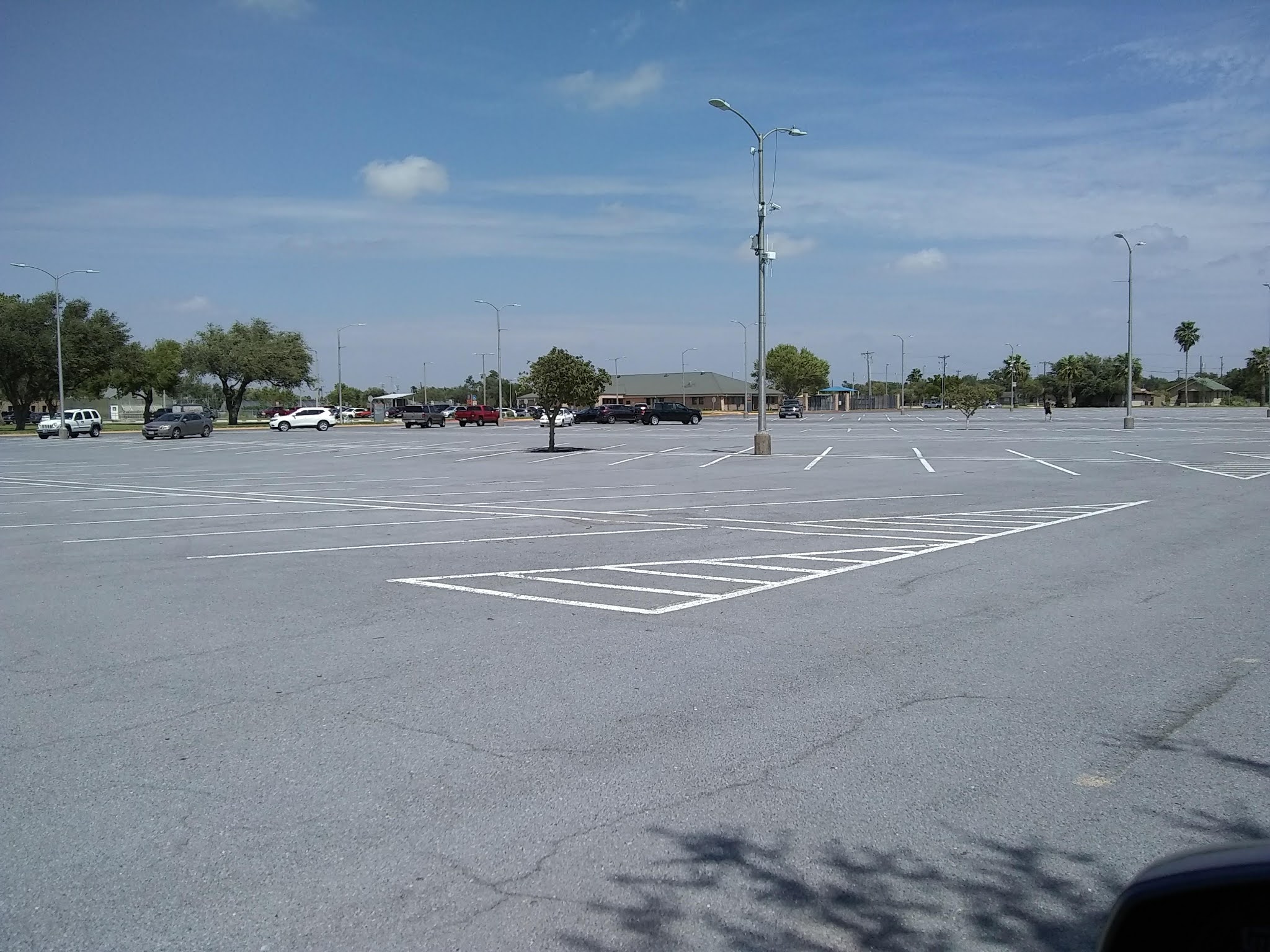
UTRGV parking lot with few cars

That parking lot was as empty as I see in the week after spring semester ends. Almost as empty as the week between Christmas and New Year.

I was incredibly relieved.

Somehow, our faculty and students have made this semster a de factor online semester for the campus. I don’t know how it happend, because there was no coordination, but I’m glad it did.

31 August 2020

New beginnings

Today is my last day as a tenured full professor at The University of Texas Rio Grande Valley.

This is going to be a tough post to write.

Since starting at The University of Texas Pan-American, I’ve made no secret to people here that I would love a reason to move back to Canada. But it’s always been a low-level, “Wouldn’t it be nice if...?” wish. I had been looking and occasionally applying for years.

But this year, a new word kept forming in my head:

Flee.”

I kept wondering throughout the summer, “Is it time to go, regardless of the job I have now?” At one point, I took out a lot of cash from my bank account in case I needed to leave immediately. The sort of money that many people call the “Fuck you” fund in case they have to leave an abusive partner. Things have felt that bad.

Living in the United States in 2020 has broken my belief in this country. 

And I don’t think an election and a vaccine is going to fix it.

It’s not just that the current administration is awful (though it surely is). It’s how so many people have embraced the awfulness. It’s about how the US can’t address its chronic problems. The COVID-19 pandemic didn’t create these problems but it sure as hell threw them into sharp relief.

Over at the Better Posters blog, I’ve been compiling pictures of 2020 events in the United States. They are probably more powerful than anything I might write. 

I accepted a new position at McMaster University in Ontario, Canada. And doing so was the most brutal professional decision of my life. That is the only word I have to describe the decision. Brutal. There was some crying on the couch with me holding my wife in one arm and my dog in the other arm.

Giving up a tenured professorship? I mean, that is the thing that you are just not supposed to do. I like being a professor. I like doing research. I still have questions about those sand crabs and crayfish that I want to answer. It hurts to think that for all I know, I’ll never be able to hold one of those little Lepidopa in my hands again. I like my department colleagues. I like the students I work with.

But this job offer seemed to come at a “now or never” moment. Between taking the time to focus writing the Better Posters book, followed by a global COVID-19 pandemic making both field and lab research difficult, my biological data collection had practically ground to a halt. It looks like 2020 may be the first year in well over a decade that I haven’t published something. I’m not abandoning projects in mid-stream. I don’t have any graduate students who are counting on me to finish their degree. No mortgage I’m stuck with.

McMaster is teaching remotely this semester, so I will still be in Texas for a while at least. But the plan is to move back to Canada. I am anticipating massive reverse culture shock. I know that Canada is not perfect, but Canada at least looks like functioning democracy and not like a collapsing empire.

I am not sure what this move will mean for me professionally. But I am convinced that this move will result in a better quality of life for me, my wife, and family. I want to look after myself and them. This is not just me wanting to move home.

But I am not kidding myself. There is a big leap of faith here. And in any leap of faith, you have to ask what do you believe? Do I believe I am smart enough and hard working enough and resilient enough to make this okay for me, my wife, and family?

Leaps of faith are scary.

As I mentioned a while ago, I have recently rediscovered the music of The Alarm and Big Country (both bands connected by frontman Mike Peters). And as so often happens, music helps.

There will be hurt, there will be pain
There will be a lot of tears, a lot of joy
What we have left cannot be destroyed

Time to move on, to let it bleed
What will be, will be

There is a land, there is a sea
There is a place where we can be
There is a hope, there is a dream

Sometimes
You gotta make the journey with me

The Journey”, Big Country, 2013

Mike Peters: “Sometimes, you’ve got to make the journey. We have to make that leap of faith. We have to cross that line to embrace what is happening now. We’ve crossed that line, and this is a song that lyrically encourages everybody to cross that line. And it acknowledges, ‘Yes, it’s gonna be a tough journey. There will be pain, there will be joy, there will be tears.’ Everything associated in life comes into making this particular journey.”

30 August 2020

He was a king

The death of actor Chadwick Boseman is unexpectedly hard.

Chadwick Boseman in Captain America: Civil War

It was bad enough that he died young, but it was seeing the tributes and reaction on Twitter that brought it home. What he brought with his performances meant so much to so many people – especially his work as T’Challa, the Black Panther, in four movies.

People had wanted to see a hero like him for so long.

Losing a hero is hard. Even (maybe especially) a fictitious one. 

Before I saw Captain America: Civil War, I read an interview with one of the filmmakers, who nailed what Boseman brought to the role of T’Challa. Boseman’s performance didn’t blow you away: it made you lean in. When I saw the movie, that was exactly it. It wasn’t a showy performance, but it was intense and magnetic and compelling.

And what else has been clear in the last few days was that he was so much more than his acting roles and much more than T’Challa. By all accounts, he was just a decent human being.

In one of the most famous scenes in Black Panther, Killmonger says, “Is this y’all’s king?!”

Yes. Yes, he was.

24 August 2020

Thank you, MC Hammer!

Cover to "DanceJam the Music" album
One of the few delights of 2020 has been finding out that rapper MC Hammer is an amazing fan and booster of science.

If there is any academic society that is not trying to line up MC Hammer to give a keynote at their next annual meeting, they are missing out.

Society for Neuroscience, this man is your absolute perfect person to give the “Science and Society” lecture.

Thank you, Hammer, for your support! 

Update, 5 October 2020: Plot twist. Hammer’s also a Christian. Not a fan of evolutionary biology.

21 August 2020

Age is irrelevant to bad research papers

Despite its decisive drubbing in Kitzmiller v. Dover, intelligent design just keeps showing up like the proverbial bad penny. The latest poking of the intelligent design helmet out of the foxhole is a paper in the PNAS, spotted on Twitter.

I don’t like that an intelligent design paper was published in a journal. But nor do I like comments about the age of the author.

Guess that’s what happens when a paper about evolution by an 87-year-old physicist is reviewed by another physicist and a complex systems theorist. (here)

And:

Author is 87. (here)

That the author is in his 80s is trotted out as though it’s an explanation. How? How is the author’s age at all relevant? I don’t know of any data that show people slide into intelligent design beliefs as they get older.

Don’t judge work by the age of authors. That’s ageist.

18 August 2020

Today’s task

“It’s time to ask yourself what you believe.”

Tuesday Crustie: It’s good to be king

This is the happiest spiny lobster ever. And why not? He’s a king!

This is Ise Ebi-daio, mascot of Shima City in Japan. Spotted on Mondo Mascots., a Twitter account that is like potato chips. You can’t have just one. Addictive and always kind of delightful to look at. I learned about this account from the 99% Invisible podcast on yokai.

There are mascots for towns, aquariums, dentists’ offices, even prisons. There are mascots in cities that tell people not to litter or remind them to be quiet on the train. Everything has a mascot and anything can be a mascot.


17 August 2020

New Zealand and lobster welfare

Jasus edwardsii
Oh, is it that time again? When I review a news story about crustacean welfare where someone wants to change policy around treatment of crustaceans who claims to be backed by scientific evidence? Which, upon review, turns out to be a cursory and / or one-sided view of that scientific evidence?

Yes, it’s that time.

New Zealand’s regulations for lobster welfare have been subject to a complaint from the New Zealand Animal Law Society, as reported here. They charge that the current regulations, which require making a lobster “insensible” by cooling, are not met. They argue that chilling causes lobsters “pain.”

I looked at the complaint and am unimpressed with the level of scientific evidence it brings to the table.

First, they argue that any finding on decapod crustaceans apply to lobsters. This is often a reasonable thing to do, but I am hesitant here. 

1. Lobsters are big crustaceans. And when you are talking about cooling, the size of the animals is important because of thermal inertia. A small animal will cool faster than a large one, and that could be highly relevant to the response.

2. Different crustacean species are adapted to different temperature. Colleagues of mine who usually chilled crustaceans to do experiments found chilling didn’t work at all on Anaspides. Not surprising if you know it lives in cold waters in Tasmania.

In “Part 4 – The Code is not based on current scientific knowledge,” the document repeatedly quotes the work of Robert Elwood and colleagues, citing “personal communication” with Elwood. Elwood claims his position is not controversial, but not all crustacean biologists agree with Elwood’s interpretations (Diggles 2018).

Elwood says there is “substantial” research on this topic.

There are still many very basic questions about crustacean neurobiology that are not answered. Do crustaceans have neurons tuned to tissue damage? It looks plausible (Puri and Faulkes 2015), but those neurons hasn’t been fully characterized. There is work to do.

They document cites one that tested the response of crustaceans to low temperature (Roth and Øines 2010) which is the entire subject of the complaint. But there more papers that address responses of crustaceans to low temperature directly (Weineck et al. 2018; Puri and Faulkes 2015). Not mentioning those papers indicates their literature review is either cursory or cherry-picked.

There are so many little things that are asserted with minimal evidence. The document says they have “complex” brains. That’s subjective. The document says that some crustaceans have more neurons than vertebrates – but does not give an example. Sure, I suspect that a fully grown adult lobster has more neurons than a larval zebrafish, say. That sort of claim needs a lot more context to show how it is relevant to the question.

I don’t have any particular opinion about whether lobsters “feel pain.” I want good animal welfare laws. But I do not want policies based on small slivers of the scientific literature coming from a small number of labs.

References

Diggles BK. 2018. Review of some scientific issues related to crustacean welfare. ICES Journal of Marine Science: fsy058. http://dx.doi.org/10.1093/icesjms/fsy058

Puri S, Faulkes Z. 2015. Can crayfish take the heat? Procambarus clarkii show nociceptive behaviour to high temperature stimuli, but not low temperature or chemical stimuli. Biology Open 4(4): 441-448. https://doi.org/10.1242/bio.20149654

Roth B, Øines S. 2010. Stunning and killing of edible crabs (Cancer pagurus). Animal Welfare 19(3): 287-294. https://www.ingentaconnect.com/content/ufaw/aw/2010/00000019/00000003/art00009

Weineck K, Ray A, Fleckenstein L, Medley M, Dzubuk N, Piana E, Cooper R. 2018. Physiological changes as a measure of crustacean welfare under different standardized stunning techniques: cooling and electroshock. Animals 8(9): 158. https://doi.org/10.3390/ani8090158

Related posts

Crustacean pain is still a complicated issue, despite the headlines

What we know and don’t know about crustacean pain

Switzerland’s lobster laws are not paragons of science-based policy

External links

Lobster slaughter methods causing significant pain and distress, Animal Law Society says

Notes from a pandemic: An important academic hoax

Stinging the Predators 15.0

Over the weekend, I added two new hoax papers to my Stinging the Predators anthology. Having spent a few years curating this thing (it’s one of those little side projects that never seems to end), I have often thought while putting in a new entry, “Another sting paper to show there are bad journals? That’s been done. Do more than your predecessors.”

One of the new entries is interesting because it does more than other stings, and vindicates a lot of previous stings in the process.

The story is laid out in some detail by Michaël, a.k.a. MimiRyudo, on his blog. (If your French is not up to snuff, Google Translate may help.) Here is a very short synopsis.

Certain French politicians and physicians promoted the suggestion that there was a drug that could treat COVID-19. The evidence kept rolling in that this suggestion was not a very good one. But several of the drug enthusiasts wrote a paper about the matter and published it in the Asian Journal of Medicine and Health.

Let me pause here before I continue the narrative. This is the first reason this hoax is interesting, because it is a reaction to exactly the sort of scenario that previous hoaxers have said they were trying to warn us about: someone using a low quality journal to push out dubious information that could have serious public health risks. Global pandemic, politicians writing journal articles, journalists jumping on it and publicizing it, because hey, one of the authors is a nationally recognized person.

(I had always considered this scenario unlikely. But then, 2020 is unlikely in many ways. )

The authors of this paper actually compared the review process at Asian Journal of Medicine and Health to The Lancet. For anyone remotely familiar with medical research, this is a jaw drop claim of false equivalence.

A group of people on Twitter decide to prove that Asian Journal of Medicine and Health is not like The Lancet and that the former will take literally anything. So they write a paper that is as absurd and ridiculous as they can be at every possible turn.

Their absurd paper is, of course, published.

This is the second reason this hoax is interesting. It’s not a generic “some journals take anything” hoax. It’s a hoax with a very clear target: the Asian Journal of Medicine and Health – which published a paper being used to fuel a potentially dangerous drug narrative during a public health crisis – can’t be trusted.

That specificity is what, I think, makes this hoax valuable in a way previous hoaxes of poor journals were not. It’s not a hand-waving hypothetical warning. It’s a specific response of actions that could pose real risk to real people. It undercuts the original paper in a way that mere criticism would not.

External links

Le meilleur article de tous les temps (loosely, "The best paper of all time")

Stinging the Predators

10 August 2020

New home page

DoctorZen.net viewed on phone

I’ve been thinking about making my personal website more mobile phone friendly for a while now. After all, more and more people browse the web on their phones. But I have been writing the HTML for my personal home page by hand, and the coding to get something that works for either a desktop or a mobile phone was beyond my skill.

Then I got an email reminder that I had once tinkered with Google Sites. Google is revamping the service, and sent me an email saying, “Hey, you better migrate your page over to the new service.”

I hadn’t touched it in years and had never really gotten anywhere with it. But it did get me to look at the new service and try it.

I’m pretty impressed. 

I had tinkered with automatic website builders before, especially Wix. I got some nice results with Wix, but the interface was so fiddly it drove me crazy. Google Sites was much more straightforward. 

But the big selling point was that the site finally looked good on a mobile phone!

There are many things that bug me about the Google Sites interface. You can’t even look at the underlying HTML, never mind fiddle with it. (You can still look at and edit your HTML in Blogger, which also recently got an overhaul.) You can used the “Embed” button to put in some custom HTML code, but the embedded section is “walled off” from the rest of the page. I’ve figured out how to add script to add Altmetric badges, but they don’t appear the way I want yet. 

It is, of course, very easy to add anything that Google owns and hard to add anything from anywhere else. Putting in a YouTube video has its own dedicated button and plays nice with the layout, but a Vimeo video is a very different, trickier job.

There are currently some deep limits on how much you can adjust the look of the site. You have a very limited set of typefaces, in particular. I am hoping that as this service matures that the options will expand.

I will keep updating my existing, made by hand with love website for the time being, but I decided for now to have my easy-to-remember URL, DoctorZen.net, point to the new site. It’s definitely a work in progress at the moment, and I will be getting

As far as I know, all you need for this service is a plain old Gmail / Google account.

03 August 2020

The Zen of Presentations, Part 73: Seven tips for crushing your Zoom presentation

Last week, I gave a live online presentation for Plant Biology and watched a lot of recorded presentations at the Animal Behavior Society virtual meeting. Based on those experiences, here are some suggestions for how to crush your next Zoom presentation.

1. Don’t use the keyboard to advance slides. Many presenters are recording themselves talking with their device's built in microphone. These mics are very sensitive to sound transmitted through the computer, like keystrokes. I heard many presentations where audible “ka-thunk” sounds punctuated the talk every time a slide advanced. It is both distracting and can obscure what the presenter is saying.

If you must use a keyboard for some reason, use the lightest tough possible. But using a mouse or setting up your slides to auto advance is much better.

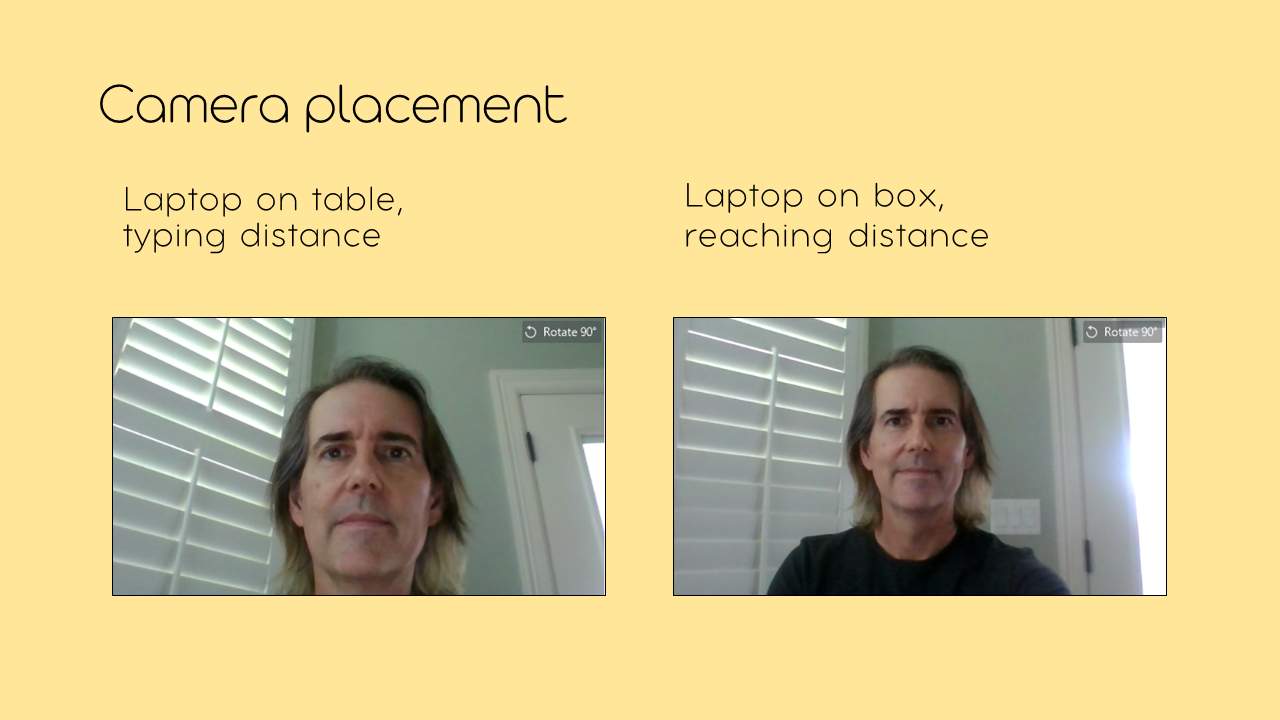
2. Place your camera carefully. Most laptop cameras are wide angle and are placed so low that viewers seeing your ceiling more than you. Some people are so close, or the camera is so poorly positioned, that viewers can’t even see all of the face. You get better images by placing a laptop on a couple of thick books (textbooks are about the right height) or a thin cardboard box, and pushing it back further from you than your usual typing distance. (When you’re the featured speaker in a Zoom presentation, you shouldn’t be typing anyway.)

Comparing images captured with laptop on table at typing distance to laptop on box where you have to reach

3. Look at the camera, not the screen – especially when presenting. Humans are insanely good at judging where other people are looking. To create that sense of personal connection, you want people to feel like you are looking straight at them. You can’t get the when you are looking down at the other participants’ images.

My laptop has a little light that comes on when the camera is recording, so I just look at the light. If your camera does not light up, put a sticky note next to the camera with a note that says, “Look here!”

4. Keep your energy levels up. There are so many distractions when people are online. A low key, “drawn people in” approach can be very effective in person, but will probably fail in an online setting. You need to be one step shy of bouncing off the walls to keep viewers watching you and not checking their email.

5. Gesture beside your head, not in front of it. Cameras love movement. Zoom is a visual medium, like television. But unlike television, webcams in computers are (as mentioned) very wide-angle, and anything that approaches the camera – like your hands – shows up huge, like looking through a door security lens. You don’t want your fingertips bigger than your face.

Comparing images where speaker has hand near camera and where speaker has hand next to head

If you want to use your hands for emphasis, which is a good idea, raise them up by the side of your face so that they look the right size. This can feel weird at first, but with a bit of practice, brings a lot of visual interest to a presentation.

(I think I might have first heard this tip from Carin Bondar.)

6. Make a custom Zoom background. This is what slides in my PowerPoint deck looked like:

Slide with blue and white colours scheme, with handwritten heading font. How long do you want to spend at a poster? Most people vote 5 minutes.

Blues and whites. Hand-written font (Ready for Anything from Blambot) for headings and Corbel font for body.

I made a Zoom background specifically for the presentation, using the same colours and fonts, and added my Twitter handle and conference hashtag. (In retrospect, the hashtag might be a bit bigger.) It is just a nice touch to tie everything together.

Slide with blue and white colours scheme, with handwritten heading font. Shows Twitter handle and conference hashtag.
I got quite a few new followers after the talk, so maybe the background helped. I had my Twitter handle on my first and last slides, too, so hard to say what was most effective.

If you do this, remember you will be roughly in the center and any video of other speakers will most likely be on the right. A background with the focal point right in the middle is kind of a waste, because your face will cover it.

7. Wear headphones. I am surprised that after so many months, I am still hearing feedback and audio howlaround from people in a Zoom meeting not wearing headphones. If you are not wearing headphones, the computer plays the sound through the speakers, which is picked up by your mic, broadcast to the meeting, then played through your speakers and picked up by the mic again. If you are the only one speaking and nobody will ask you questions, this might not happen. But if you’re not taking questions, why are you having a Zoom meeting instead of recording a YouTube video?

If it’s just a regular old meeting, you probably don’t need to take these steps. But if you are the invited speaker at a conference, you want to class it up and do more than the bare minimum.

31 July 2020

Animal Behavior Society virtual meeting, Day 4

Today, I tried to see more cool science!

Unfortunately, one talk I thought was very cool began and I to blog about began with, “Please don’t share these results on social media.”

Mike Smotherman, who once was nice enough to host me at Texas A&M, had a very cool talk about bats using echolocation to detect texture. He suggests that bats’ auditory detection of texture is very like human touch detection of texture.

Susan Finkbeiner showed butterflies could distinguish different wavelengths of ultraviolet light. But only the females could do it! The males could not do this, because only females express two photoreceptors.

My colleague Kelly Weinersmith gave a great summary of her work on crypt keeper parasitoid wasps.  I’m just going to share this screenshot because it looks like she is kung fu fighting.

Kelly Weinersmith

Thienthanh Trinh presented some new work on the increasingly famous fungi that parasitise and manipulate ants. She showed a very cool maze she created to monitor the behaviour of infected ants, and was able to show infected ants wandered more, at all times of day, unlike uninfected ants, which had more of a daily rhythm and focused on food rewards.

My favourite title for a talk today was “Ants Dance Revolution,” and the presenter, Andrew Burchill, ran with that, and created a talk with lots of fun references and sound effects to Dance Dance Revolution.Andrew showed that you can do more with a video presentation than recording a narrated PowerPoint deck. The tank, however, was more about ant-mimicking spiders than ants. He showed that not only do spiders look like ants, they walk in the same weird patterns that some ants do.

I get the impression that there are more presentations about the underlying physiology of animal behavior than in past Animal Behavior Society meetings (but then, I don’t go every year). But there seemed to be much more endrocronology than neurobiology.

One thing that is similar in the virtual and face-to-face conferences: you start to lose track of all the stuff you saw very easily. It might be worse in a virtual conference because of interruptions and such unless you are closely tracking what you have seen in real time.

I did manage to get in to some more of the live Q&A sessions on Zoom. They are turning out to be very variable. Moderators need to make sure there are questions read for each speaker so there is no “dead air” waiting for questions to be typed into the chat box.

I also couldn’t help noticing people’s skill in camera placement. I saw lots of people’s ceilings. Some people, I couldn’t see all their face. Some people were so close I could practically see their skin pores.

Nice piece of news is that the Animal Behavior Society (US) and the Association for the Study of Animal Behaviour (UK) will be hosting a world-wide conference on Twitter in January 2021!

The talks are all up until the end of August, so I am hoping to catch up with a few more talks thatI didn’t catch in their scheduled time slot!

Related posts

Animal Behavior Society virtual meeting, Day 3

I didn’t want to mention this in my ABS Day 1 report, but the bookmarking for the conference is weird. I keep seeing bookmarked talks that I am almost certain I did not bookmark. I asked about this on Twitter, and I was not alone. This is frustrating.

A few observations as the meeting is wearing on.

The talks are 6 minutes long. That’s about half the length of a typical conference presentation, but frankly, I don’t miss the extra time. If anything, 6 minutes still feels too long. A lot of presentations would do well in a graphic abstract or poster format.

I’m finding it hard to get to all the talks I want before the Q&A session.


Screenshot from ABS Q&A session in Zoom

The Q&A sessions are moderated Zoom meetings. They go through each talk from a session in order, taking questions from the chat function. This is mixed. The interaction is pretty good, but if you haven’t seen all the talks in the session, or only have questions about one talk, there is a lot of filler for an audience member to sit through.

The meeting materials will be available until the end of August.

29 July 2020

Animal Behavior Society virtual meeting, Day 2 and Plant Biology 2020, Day 3

A particularly 2020 problem: attending two conferences simultaneously.

As I mentioned yesterday, I am attending the 2020 Animal Behaviour Society meeting. But some time ago, I also agreed to give a workshop talk about graphics at the 2020 Plant Biology meeting.

Get your message across workshop announcement

Now, my talk for Plant Biology was only supposed to be 12 minutes long, so easy to spend most of the day in Animal Behavior, dip in to the Plant Biology Zoom talk, give my presentation, and pop back to animals, right? Quart of an hour times commitment, right? Wrong!

First, I was still practicing my talk this morning. I decided I was going to give a short, snappy talk which was clocking in at 8 minutes instead of 12. But that meant I had to nail the delivery to get it done right. So the morning had no conference attendance.

Second, I had to show up early for my Plant Biology workshop and stay throughout. So the time spent there was not 12 minutes, but an hour and a half.

But the good news was that we have about 325 people in the Plant Biology workshop, with very little dropoff during the hour! As the last speaker, I was kind of worried about people drifting away. And the feedback for the workshop seemed quite positive.

So, I got to see Animal Behaviour talks in the afternoon, right? Wrong! In theory, I should have watched a bunch of talks, but in practice, yesterday and today were “interesting” days that dumped tasks and decisions on me that I did not anticipate would be happening at the start of the week.

Maybe I’ll get a chance to watch more talks tonight.

People talk about “conference fatique” and information overload with a single in person conference. Welcome to 2020, which says, “You want information?! Here, take two!”

External links

Animal Behavior Society virtual meeting, Day 1

A mix of old and new. The Animal Behavior Society (ABS) was the first scientific society I joined and the first scientific conference I attended. So I feel it’s appropriate that ABS is the first online conference I will be attending. And I’ve decided to do daily blog posts rather than tweet things, because I think it will be easier to create a coherent post from my desktop than it would be in a conference hall.

The first thing I want to talk about is also a mix of old and new. The virtual conference home page is new, because this is the first time they have done it, but the graphics?

Animal Behaviour Society virtual meeting landing page, with big "lobby" cartoon taking up most space

A very literal cartoon of a convention center. Not terribly high resolution. It kind of takes me back to 1990s Microsoft efforts like Microsoft Bob:

Microsoft Bob screenshot

It was a time when computers were becoming more common in homes, graphics were getting more sophisticated, and nobody was quite sure how people were going to interact with computers, so they interpreted everything as literally as possible.. Your calendar is shown as a calendar on a wall. Your desktop is a space on a cartoon desk.

I kind of thought we had moved past that. Most user interfaces are either more abstract and less literal (your decktop in Windows no longer has to be shown on top of a desk), or the interface is more graphically sophisticated (think of a 3-D video game environment; maybe Legend of Zelda).

Now, I suppose that for a first online conference, maybe that step back to a more literal convention center cartoon interface will help people. I don’t think it will be the sort of format you see for future conferences, though. We’ll see.

What else does the interface do? Well, there is a bookmarking function for talks you want to see. That’s good. But when you go get a list of your bookmarks, it doesn’t show when the events are. You have to click each entry individually, which defeats the purpose of bookmarking.

The times are all given in Eastern. There is a dropdown menu to change the time zone, but it doesn’t apply to all times. It will change a session time, but not the listed “Office hours,” which is confusing.

The format is that there are pre-recorded talks, live Q&A sessions, and “office hours.” You have to be really on the ball to watch the talks you’re interested in before the Q&A session starts! Hopefully, this is mainly a problem for the start of the meeting, and people can “get ahead” of the presentations before Q&A as the week goes on.

The live Q&A sessions are a little tricky, because all speakers for a session are there at once, each gets a tiny sliver of time, and questions are being taken using the chat function. So when a new speaker is on to take questions, there’s “dead air” when people start typing questions.

However, there is an asyncronous “ask a question” feature – a little like a bulletin board – which works very well. You can leave a question for the presenter, who gets an email with a notification, and then you get notified with a reply. So far, I have had 100% responses to my questions this way.

One nice thing I noticed was that recorded talks allow joint presentations. Just have people record their section, and edit together. Awesome. Nice way of showing teamwork and allowing multiple people to shine.

The system automatically logs you out after inactivity, and its not a very long delay before you’re kicked out.

But enough about the interface! What cool science did I see?

I saw some awesome talks updating me on a science story I have been following for some time: the evolution of Hawai’ian cricket populations that have lost the ability to sing. Some of those populations are evolving a new song, which is such a cool story of evolution in action.

Also saw some interesting talks related mostly to crustacean fighting.

To be honest, I didn’t see as many talks yesterday as I hoped, because yesterday turned out to be a much, much more interesting day that I expected, and I had stuff pulling me away from the computer.

That’s the biggest problem I’m finding: going to a meeting physically forces you to think about just that. An online meeting puts you in competition with the laundry, taking out the garbage, picking up mail, washing dishes, and all the innumerable little things that pull you away from the computer for a few minutes here and there.

External links

27 July 2020

Hanna aftermath

Hurricane Hanna

Hanna went through Saturday night / Sunday morning. From my perspective, it felt like the most substantial storm to hit the county since Dolly in 2008.

We lost power Saturday night and didn’t get it back until early Sunday.

No flooding where we were, though the rain caused some leaks and a little water damage that needs fixing.

And the air conditioner got broken and needed repair.

But all up, fared reasonably well. One preparation tip: download at least one movie to your portable electronic device before the hurricane. Sunday would have been much more tolerable if there was even one thing from Netflix or Amazon Prime or Vudu or something on my iPad.

Of course, personal inconvenience is not the biggest problem. I’m now waiting to see how the COVID-19 cases are going to track out a couple of weeks down the road. Hanna might have made more people shelter in place and reduce cases, or it might mean more people were stuck inside with each other and increase cases. We’ll see.

Update, 28 July 2020: Whoa. I had not gone around the corner to the back of the yard.

Tree snapped by Hurricane Hanna

More damage that I thought at first. That tree is down for the count.

I also had one strange, sad thought. Three years ago, I suspended data collection on a field project that had been running for several years. There was a point where, weirdly, Hanna would have provided an research opportunity. I could have seen the “before” and “after” effect of Hanna on the population of sand crabs out as South Padre Island. Could have been a paper in that alone.

But the project got suspended end of 2017. But even if I hadn’t stopped it then, I might have stopped it this year with COVID-19. I have been trying hard to stay put and I don’t want to go to the beach since they have reopened them, nobody is wearing masks, and there doesn’t seem to be a lot of social distancing,