How it started:

How it’s going:

Second photo from https://x.com/lenakumba/status/1731423282228867322
26 December 2023: Originally posted on 3 December 2034 on the Better Posters blog by accident.

How it started:
Second photo from https://x.com/lenakumba/status/1731423282228867322
26 December 2023: Originally posted on 3 December 2034 on the Better Posters blog by accident.
 The change in my job is slowly starting to have an effect. I’m quoted, as DORA Program Director, in a new article in Physics Today.
As a biologist, I have to say that this is not ever something I aspired or expected in my career. So, that’s interesting.
Feder T. 2023. Global movement to reform researcher assessment gains traction. Physics Today 76(10): 22–24. https://doi.org/10.1063/PT.3.5323
Twitter is now X and its credibility is shattered. Even though a lot of people keep using it, but it’s the grudging use of people who are mostly only doing it because they have to.
So both personally and professionally, I’ve been looking at other social media platforms. In my view, only two are serious contenders for filling the void left by the gross mismanagement of Twitter.
BlueSky is the new science Twitter. It’s filled with the early adopters of Twitter, the Internet experimenters and science communicators. T-shirt and jeans. And the vibe is very much the freewheeling, ever-so-slightly – okay, maybe more than slightly – anarchic vibe of the early science online days.
Mastodon is the new Academic Twitter. (The use of capitals is deliberate.) It’s got the feel of a lot of the late adopters of Twitter. The ones who were sort of persuaded that they could use a social media platform social media for promoting their brand and posting critiques of papers and doing, you know, being a serious scholar online. Polo shirts and slacks. The vibe is ever-so-slight slightly – okay, maybe more than slightly – po-faced and straight-laced.
Now, of course, your mileage may vary. These are my own personal impressions, not back up by any data. And to be clear, I am not saying that either is better than the other. There are clearly communities developing on both platforms that are finding worthwhile discussions.
Thousands of scientists are cutting back on Twitter, seeding angst and uncertainty


The first episode, “Breakaway,” is set on September 13, 1999. (September 13 is now known as “Breakaway Day” among series fans.)
That means, according to a handy duration calculator, that the first episode of Space: 1999 was set 23 years, 10 months, 27 days in the future. Or 8,732 days, if you prefer.
Today marks 8,732 days since September 13, 1999.
The show is now officially more retro than it was ever futuristic.Man, I’m old. But I still love the Eagle transporters, though.

Previously, I organized a roundtable discussion for the tenth anniversary of DORA about institutions trying to “put a thumb on the scale” of researchers’ decisions about what journal to publish in.
For brevity, I called these “bans.” But I know that in many cases, these were not true “bans.” Researchers could still publish in journals from particular publishers, but there was no doubt that the intention was to get researchers not to use particular venues.
Little did I know that an entire nation would use the power of the state in this way.

With some optical character recognition and Google Translate, the letter appears to say roughly this:
CHIEF DIRECTOR OF HIGHER EDUCATION
DIRECTOR GENERAL OF HIGHER EDUCATION
Department of Higher Education
Ministry of Higher Education MalaysiaDate 13 July 2023
PROHIBITION OF USING GOVERNMENT FUNDS TO PUBLISH IN THREE INTERNATIONAL PUBLISHERS
With all due respect I refer to the matter at the base.
2. For the information of YBhg. Tan Sri/Datuk/DatolProf., Post-Cabinet Meeting of the Ministry of Higher Education No. 9/2023 discussed the issue of the involvement of academics who publish articles in predatory journals and poor quality journals. In this regard, the Ministry is very serious about the aspect of academic integrity and authority in research and publication activities. One (1) special committee has been created by the Ministry as an effort to control the publication of poor quality journals in order to improve the level of academic ethics, and to protect the good name of IPT and the country.
3. Therefore, the Ministry does not allow Public Universities to use the Public Fund allocation for any publication published by three (3) publishers namely Hindawi, Frontier and MDPI with immediate effect. The Ministry also advises that each University can play a role in monitoring issues related to the quality of publications more carefully in the future.
4. The cooperation and attention of YBhg. Tan Sri/Datuk/Dato7Prof. regarding this matter is greatly appreciated and preceded by a word of thanks.
"MALAYSIA MADAM" "SERVING THE COUNTRY"
I am the one who trusts,
PROF. DR. Azlinda Binto Azman
Needless to say, this made me think the roundtable was a good idea. And that these policies are problematic. The basis for this decision is completely opaque – at least in this letter. Maybe there are some more background on the Higher Education ministry website, but I haven’t had a chance to search and apply Google Translate to find out if it exists or not.
Hat tip to Mohammed Al-Amr for posting this.
There has been a proliferation of sites trying to take advantage of disaffected users leaving Twitter.
I have been creating accounts, of course, mostly to keep anyone from grabbing my preferred handle. Here’s the update of where you can find me.
Will any of these survive? Or will they go the way of Google Plus?

So, uh, I’ve got a new job. And it6s is the first time an organization has sent out an announcement of my hire.
It’s going to be a big new challenge. Lucky for me I love big new challenges!
The title of this post is the joke I would normally make on Twitter.
Except now the number of tweets people can read is being limited and I don’t want to use anyone’s reading limit up unnecessarily,
https://www.theverge.com/2023/7/1/23781198/twitter-daily-reading-limit-elon-musk-verified-paywall
The reason given for imposing a reading limit sounds weird. But that subscribers get to read 100 times more tweets than everyone else feels like a dumb ploy to get more people to pay for Twitter verification.
I keep waiting to get invitations to Bluesky, which seems to be the best candidate to take over as the major social media platform. And I am glad that I never stopped blogging.
Edit, 2 July 2022: Apparently the reading limits are a direct result of the owner of Twitter not paying the bills. That they were going to stop payments to Google Cloud was reported weeks ago.
Recently I spotted this conference slide shared on Twitter.

A slide with no visuals, just a wide screen of four paragraphs of text.
I thought we had all agreed not to do these any more?
At first I thought this was just crazy, but then I realized there might (and I stress might) be a something else at play here: social media. Typically, a good slide for a presentation is visual and had minimal text. The speaker provides the words, not the slide.
But a disadvantage of slides that are well designed for the audience is that they don’t make much sense without the speaker. They lack context. They aren’t portable.
This slide is the conference equivalent of someone taking screenshots of newspaper articles to get around Twitter’s character limits. Sure, the slide sucks for the audience in the room, but it’s great if you share it on Twitter, since the slide leaves no doubt exactly what the person’s point is.
I’m now very nervous that we’re going to start seeing conference slides backsliding into the old bad habits of “death by PowerPoint¨ with huge blocks of text that people will read, word for word, with the excuse being that “more people will share it on socials.”
Please make your slides for the audience in the room with you. It’s respectful. You want to share something on social media? Design something specifically for Twitter or INstagram or Bluesky or whatever.
I have two new things to read (if you’re so inclined).
First, I have a summary of my last month’s “Publisher bans & DORA” roundtable on the DORA website.
Second, I have a new preprint on regulating crayfish as pets. Saskatchewan banned a couple of crayfish species. Did passing a law do what it was supposed to - change the availability of the crayfish and make them less likely to be introduced? Maybe yes?
This is currently in review, so I hope that there will be an official version of record later. I’ll maybe talk more about the backstory if I can get this into a journal.
Publisher bans & DORA guest blog post
Online advertisements for crayfish decrease after a provincial ban
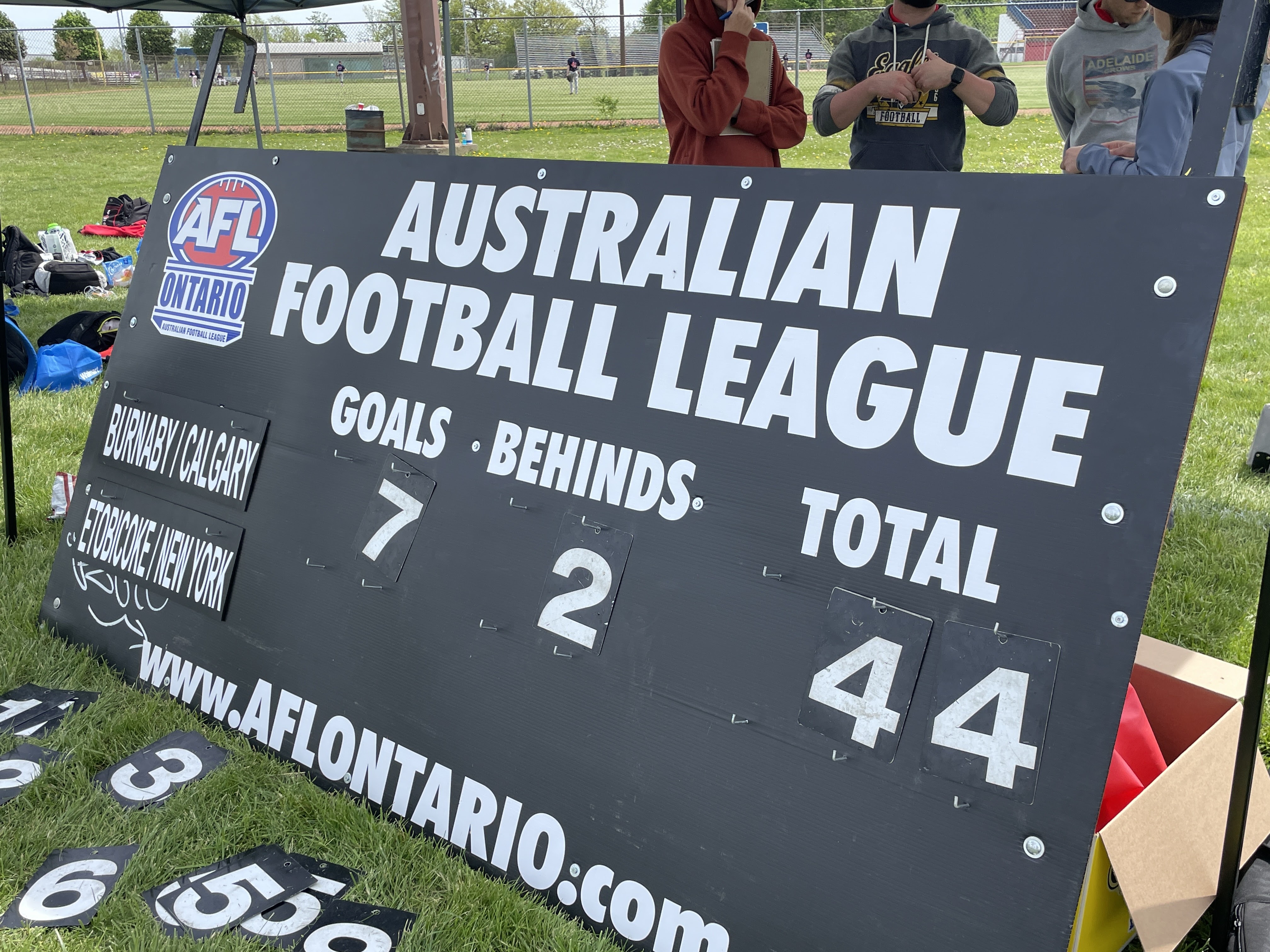
I became a card-carrying member of an AFLW team in season 1. I was finally pleased to see a women’s footy game in person – and a championship game, no less!
Over the weekend, Hamilton hosted the AFL Canada Cup, a tournament for North American women’s teams. I didn’t get to see the whole tournament, but I did make it for the final game between the Calgary Kookaburras (actually joint with Burnaby Eagles) and the Etobicoke Kangaroos.

Unfortunately, things did not go well for the Kangaroos. And this wasn’t the final score, which I think was 50 to zero? Weirdly, I can’t find any definitive report of game results in the tournament.
Steve Harnad has done much for open access. So I was surprised by a new article, in which he wrote:
In the old pre-digital days of S&S (“scientists and scholars” - ZF) publishing, the true costs of providing print-on-paper to would-be users required the services of another profession for the production and delivery. But (let’s cut to the quick) those days are over, forever. Online publication is not altogether cost-free, but the costs are so ridiculously low that all an S&S author needs pay for is a blog service-provider, rather like a phone or email service provider. ...
All other goods and services are now obsolete – or almost obsolete: scaled down to only the tiny, trivial cost per article of managing the peer review, by paying secretaries to run the software for soliciting and monitoring it.
This is such misleading characterization of what is required to run an online publication that I kind of can’t believe he wrote it. I think he knows better – I hope e knows better – but is oversimplifying to try to make a point.
Before I go on, I want to be clear. I am not about to argue here is not that journal prices are fair, or they could not be lower. When I commented on this article on Twitter, Björn Brembs came in and provided what the article lacked: some real values associated with costs.
What I want to comment on is Harnad’s characterization of the infrastructure of an online publishing platform. A blog service and a secretary is pretty much all you need, according to him.
In the last decade, there have been no shortage of people providing online scholarly platforms. Many of those are trying hard to move away from legacy academic publishing and the costs associated with those traditional journals.
Very few have been able to make the “blog and secretary” model work. There are possible exceptions, judging from this description of the Journal of Machine Learning Research. Keep in mind, though, that this description is now over ten years old. I am sure there are other niches for the “blog and secretaries” model, but I don’t think this is the way forward for all scholarly communication.
Preprint servers provide open access for readers without fee to authors. They are no legacy publishers, and would seem to be prime candidates for Harnad’s proposed ultra-lightweight publishing model.
This article describes how several preprint servers were struggling to get enough money to run. Since the article appeared in 2020, a of them – INA-Rxiv, ArabiXiv – are no longer taking new submissions.
Brembs mentioned Humanities Common as a model. It has expenses of about US$750,000 and is run by three major committees. This still seems a far cry from the picture Harnad paints of using off the shelf software and a skeleton staff.
Likewise, larger preprint servers have higher costs and a bureaucracy to sustain them. The big one, arXiv has a budget of US$4.8 million.
I would love to survey of researchers on their estimates of the costs of a preprint server and how many people it takes to keep them running. Prediction: I bet a lot of them would underestimate the cost and time it takes to do so, perhaps influenced by descriptions like Harnad’s.
Publishers can’t be blamed for clinging to the golden goose
Popular preprint servers face closure because of money troubles

Thanks to my panelists Payal Joshi, Katherine Stephan, and Jennifer Coston-Guarini for joining me and keeping the discussion lively and interesting!
A video of the roundtable is on YouTube. I edited the video, but edits may not be processed by YouTube yet. If
you see "dead air" at the start of the video, jump to 7:29.
I have saved some material on Figshare. Currently, it’s just the introductory material about events that inspired the roundtable. It may expand in the coming days.
I’ve been expecting new bills in the US that re-introduce “intelligent design” into schools. Reason? The Kennedy v. Bremeton School District ruling in 2022.
Surprisingly, a lot of people do not seem to think this is likely.
But state legislators sure noticed the court case.
You may have heard that there was a bill introduced into the Texas legislature to require schools to display the Ten Commandments of the Bible (88R SB1515). It’s passed the Senate.
The analysis of the bill includes a section on the intent of the bill. And it’s super clear: the bill is being pushed because the Kennedy ruling said the Supreme Court was abandoning the Lemon test.
This legislation only became legally feasible with the United States Supreme Court's opinion last year in Kennedy v. Bremerton School District, 142 S. Ct. 2407 (2022), which overturned the Lemon test under the Establishment Clause (found in Lemon v. Kurtzman, 403 U.S. 602 (1971)) and instead provided a test of whether a governmental display of religious content comports with America's history and tradition.
If the loss of the Lemon test was an open invitation for lawmakers to display religion in schools, why on earth would they stop with displays? Why would you not start to push for religious instructions in public schools?
Everyone grumbles about paying for a single scientific article.
But you used to not be able to do that. Articles were bundled in journals, and if you wanted to read an article, you typically needed to find the entire journal issue. Your options to do that were limited.
You could subscribe to a journal in your field. Maybe. Journals superficially look like magazines, but they were rarely priced like magazines. Journals had small print runs, so the economics of printing journals were very different than printing magazines. So a year’s subscription for a journal would not run tens of dollars, but could be thousands or even tens of thousands of dollars for a year. (The Journal of Comparative Neurology was famously expensive. And continues to be, last I looked.)
If an article wasn’t in a journal you subscribed to (because nobody could subscribe to all the journals they would need), you had to hope a library subscribed to the journal if you needed a single article from that journal. But libraries didn’t subscribe to everything, either.
That left either interlibrary loans or sending postcards to authors asking for reprints. Both were time consuming. It could take weeks to get a reply, if you got one at all. It didn’t always yield results.
Yes, I know everyone wants knowledge to be free and we haven’t gone far enough and all that.
When you compare what getting a single article used to involve,being able to just spend some money to get a single article that you need on demand?
That improved people’s ability to get to the scientific literature.
I have been blogging about conference posters for fourteen years. Many people have told me that my blog helped them win a poster award.
Today, I finally shared a poster award!

The “Publication Star” award is for the poster that the judges most want to see written up in a manuscript and published in a journal. That award category is the most academic thing ever. “You win an award! Your prize is... to get back to writing, you layabout!” 😶
You can read the poster at the conference website. This version has a seven and a half minute video by lead author Emily Messina explaining the works.
The poster is also part of our FigShare collection of material related to this project. You can compare and contrast versions 1 and 2 of the poster, presented at European meeting in January and the American meeting this month.
The Texas senate passed Senate Bill 18 a couple of days ago. If approved, the law would eliminate tenure in Texas public universities starting fall of 2024.
This is deeply disappointing. Both the bill itself and the weirdly limited reaction from higher ed. Higher ed leaders should be on every news channel, every talk show, writing op eds about why tenure is valuable. The response is nowhere near what it needs to be.
Is the loss of tenure on par with states that are allowing kids to work in factories again? No. But it’s part of the same small minded and regressive mentality.
Anyway, you can check the progress of the Texas bill on the Texas Legislature website.
Tenure in US higher education is under threat, and I’m not sure it can be saved
Texas, where I used to work, is considering legislation that would end tenure in its universities.
Needless to say, I think this is a horrible idea. Texas already had post-tenure review (every five years). I know, I went through it.
As much as I am concerned about the legislation, I am even more concerned about the apparent lack of reaction to it. This should be the five alarm fire for American higher education, all hands on deck emergency type of reaction. And I’m not seeing that.
How did we get here? I’ve long has a suspicion that tenure was becoming increasingly vulnerable to attack because the job market for academics has been so tight for so long. When I’ve seen moves to curtail tenure, universities usual response is, “We won’t be able to attract talent, people won’t come to a place without tenure.”
Well, when the educational system has been churning out far more qualified candidates than jobs for decades, that threat rings hollow. A lot of people will take their chances at a job without tenure, because people have to eat and people want to work in the fields they trained to work in.
I hope these bills will die in committee, as many do. But I’m not feeling optimistic.
A Texas trilogy of anti-DEI, tenure bills
New Texas bill would end tenure for college facultyTenure was already in decline. Now some Republicans want it gone from colleges for good.
I’d been occasionally checking the West Virginia bill tracker for the progress of the “intelligent design” bill (Senate Bill 619) that made it out of the Senate’s education committee. Every time, I saw the bill still in the House Education Committee, so I thought it was still possible that it might move forward.
But the legislative session ended last month. The bill tracker makes no note the end of the session, which is why I missed it. The bill never make it out of committee for a vote.
I think that means the bill in its present form is done?

I have created a registration form for the “Publisher bans & DORA” roundtable event. Just enter your email and you will get an update when I have panelists and links to the online discussion ready to go.
