Showing posts with label COVID-19 pandemic. Show all posts

20 January 2022

Ghoulish university administrators

In the last few years, Tressie McMillan Cottom has been persistently reminding academics that institutions won’t love you back.

Somewhere in maybe the last year, though, university administrators have moved somewhere from at least pretending to care, or perhaps indifference, to outright hostility.

Here’s just a couple of examples.

Rachel Anderson posted:

State of the world: raging pandemic with my university experiencing the highest case rates yet, and I’m teaching 5 days/week in person. My university’s email this morning: Have you considered including a gift to us in your will? We’d love to talk to you about estate planning.

Katie Kennedy posted:

I'm required to put a statement in my syllabus saying that if I die during the semester, the college has a replacement for me. It was written in first person--by the administration. It says I've been consulted in who my replacement will be. None of this is true.

It feels like administrators are not only expecting their faculty to die, but are busy looking for how to that into an opportunity. Silver linings and all that.

And let’s not forget that one institution all but wheeled out a coffin to teach a class.

And don’t get me started on the foot dragging and jumbled reactions on return to campus when many areas are experiencing the biggest number of cases and hospitalizations yet.

The tone deafness and failure to navigate these problems is just astonishing. All of these things are just eating away at trust.

Even if the current wave of the omicron variant of SARS-CoV-2 is the last major one in many places (which I doubt), things are not going back to normal in higher education soon. Too many cracks have been exposed. Too many cracks have already turned into breaks, and more are undoubtedly coming. The consequences of these sorts of bad leadership are going to continue for years.

Related posts

Classes taught by the dead and copyright


13 September 2021

The rise of TikTok in misinformation

Ben Collins’s Twitter thread about how misinformation about medication to get worms out of horses has become the cause du jour for many.

Can’t stress how wild the ivermectin Facebook groups have become. So many people insisting to each other to never go to an ER, in part because they might not get ivermectin, but sometimes because they fear nurses are killing them on purpose “for the insurance money.” ... It’s just a constant stream of DIY vitamin therapies and new, seemingly random antiviral drugs every day — but not the vaccine.

This is distressing, but I wanted to home in on this comment in the thread.

The ivermectin Facebook groups also offer a window into how pervasive antivaxx COVID “treatment” videos are on TikTok.

The groups serve as a de facto aggregator for antivaxx TikTok, a space that is enormous but inherently unquantifiable to researchers.

When I last wrote about the dangers of recommendation algorithms (in pre-pandemic 2019), I focused on YouTube. TikTok existed then (it started in 2016), but it wasn’t included in Pew Research’s list of social media platforms until this year.

Graph showing use of social media platforms in the US. 81% use Youtube, 61% use Facebook. No other platform is used by more than 50% of Americans. 21% of Americans use TikTok.

Even today, TikTok isn’t even used by one in four Americans. It’s more like one in five. It’s impressive that it’s pulled close to Twitter, which has been around far longer. And also frightening that it is having this outsized effect that is leading people to try... anything

Everything is a miracle cure, or it isn't, but every drug is worth a shot. Except, of course, the thing that works: the vaccine. Anything pro-vaccine is instantly written off as “propaganda.”

There are lots of issues raised here that I can’t process all at once. But I think Collins’s comment that TikTok is unmeasurable for researchers strikes me at something important. Could the requirement for more data transparency in how TikTok selects what videos to show someone help? Not sure. 

But we may be at the start of an arms race between social media platforms using data to show things to viewers, and researchers trying to “break the code” to figure out just what the heck people are actually seeing.

Related posts

Recommendation algorithms are the biggest problem in science communication today

External links

Social Media Use in 2021 - Pew Research

07 September 2020

Notes from a pandemic: Empty parking lots are the best sign I’ve seen in a while

So across the US, university towns are quickly becoming COVID-19 hotspots because campuses reopened, with crummy plans, and despite warnings for months. Given that South Texas was alreayd a hotspot for COVID-19, with something like 20 deaths reported every day in the country during weekdays for weeks, I was convinced reopening UTRGV – mandated by the UT System very early on – would be a disaster.

Last week, I swung by campus in the middle of the day. This was the second week of class, and the university is nomiall open and holding face-to-face classes.

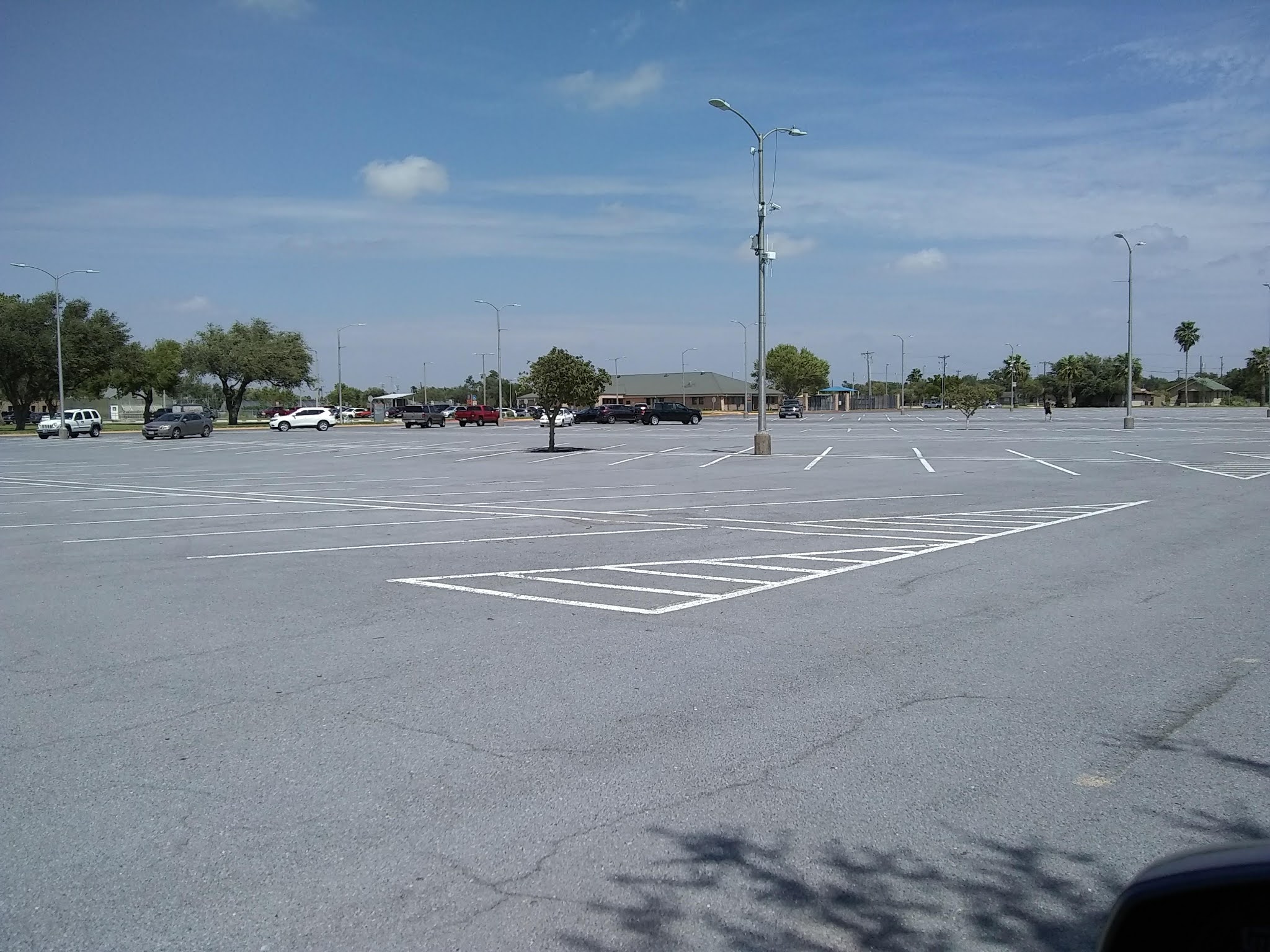
UTRGV parking lot with few cars

That parking lot was as empty as I see in the week after spring semester ends. Almost as empty as the week between Christmas and New Year.

I was incredibly relieved.

Somehow, our faculty and students have made this semster a de factor online semester for the campus. I don’t know how it happend, because there was no coordination, but I’m glad it did.

17 August 2020

Notes from a pandemic: An important academic hoax

Stinging the Predators 15.0

Over the weekend, I added two new hoax papers to my Stinging the Predators anthology. Having spent a few years curating this thing (it’s one of those little side projects that never seems to end), I have often thought while putting in a new entry, “Another sting paper to show there are bad journals? That’s been done. Do more than your predecessors.”

One of the new entries is interesting because it does more than other stings, and vindicates a lot of previous stings in the process.

The story is laid out in some detail by Michaƫl, a.k.a. MimiRyudo, on his blog. (If your French is not up to snuff, Google Translate may help.) Here is a very short synopsis.

Certain French politicians and physicians promoted the suggestion that there was a drug that could treat COVID-19. The evidence kept rolling in that this suggestion was not a very good one. But several of the drug enthusiasts wrote a paper about the matter and published it in the Asian Journal of Medicine and Health.

Let me pause here before I continue the narrative. This is the first reason this hoax is interesting, because it is a reaction to exactly the sort of scenario that previous hoaxers have said they were trying to warn us about: someone using a low quality journal to push out dubious information that could have serious public health risks. Global pandemic, politicians writing journal articles, journalists jumping on it and publicizing it, because hey, one of the authors is a nationally recognized person.

(I had always considered this scenario unlikely. But then, 2020 is unlikely in many ways. )

The authors of this paper actually compared the review process at Asian Journal of Medicine and Health to The Lancet. For anyone remotely familiar with medical research, this is a jaw drop claim of false equivalence.

A group of people on Twitter decide to prove that Asian Journal of Medicine and Health is not like The Lancet and that the former will take literally anything. So they write a paper that is as absurd and ridiculous as they can be at every possible turn.

Their absurd paper is, of course, published.

This is the second reason this hoax is interesting. It’s not a generic “some journals take anything” hoax. It’s a hoax with a very clear target: the Asian Journal of Medicine and Health – which published a paper being used to fuel a potentially dangerous drug narrative during a public health crisis – can’t be trusted.

That specificity is what, I think, makes this hoax valuable in a way previous hoaxes of poor journals were not. It’s not a hand-waving hypothetical warning. It’s a specific response of actions that could pose real risk to real people. It undercuts the original paper in a way that mere criticism would not.

External links

Le meilleur article de tous les temps (loosely, "The best paper of all time")

Stinging the Predators

25 July 2020

Notes from a pandemic: Holy Hanna, it’s bad

Weather Network landing page with "Breaking news: CONDITIONS DETERIORATING"

I’ve never felt a headline so strongly. It is the current landing page on The Weather Channel, yet somehow, it feels like it’s just an apt description of... [flails hands around pointing randomly]  everything.

“Conditions deteriorating.”

You said it, Weather Channel. You said it.

So we not only have a major outbreak locally in the global COVID-19 pandemic, and fascism and white supremacy on the rise, we now have a hurricane – Hanna – heading our way on top of that.

That’s just fuckin’ ducky.

So where are we on the COVID-19 situation? Well, it’s been so bad locally, here in the lower Rio Grande Valley, that it has on the national news repeatedly, and sometimes breaking out to international news.

For me, it’s the traffic that tells the story.

Back in late March, early April, when I went out to the university to do animal care or pick up groceries, the roads were almost empty. People were staying at home because of the COVID-19 pandemic.

Now, despite more cases and more deaths than ever, and the region being in national and international news, the amount of traffic on the road is around what it was before mid-March. People are not staying home.

The small piece of good news is that I haven’t seen any signs of people not wearing masks or being pissy about it. When I go out (which isn’t a lot), I see everyone masked. The problem people who can’t seem to wear a mask properly (it needs to cover your nose) or pull them down to talk to other people or some other reason.

The other comment I have is that in watching a lot of news coverage, it sometimes drifts towards a “blame the victim” feel. Lots of articles have commented on the Valley having lots of Hispanic / Latinx / Mexican people, and several articles have sort of pointed towards the “culture” as being one of the major drivers for the COVID-19 cases here.

I think there is much more to be said about the long, historic lack of resources in the area at the state level. Although I’ve been pleased that that has turned around in the time I’ve been here – notably the creation of my own university, UTRGV – that hasn’t been completely fixed.

And there is a long-standing health care issue here. Back in 2009, Atul Gawande wrote about the crazy high healthcare costs in McAllen. Back then, Gawande wrote:

She wasn’t the only person to mention Renaissance. It is the newest hospital in the area. It is physician-owned. And it has a reputation (which it disclaims) for aggressively recruiting high-volume physicians to become investors and send patients there. Physicians who do so receive not only their fee for whatever service they provide but also a percentage of the hospital’s profits from the tests, surgery, or other care patients are given. (In 2007, its profits totalled thirty-four million dollars.)

While some things did change in the years since (follow-ups: 2009, 2015, 2019), Renaissance (a.k.a. DHR) is still a physician owned hospital, and this same hospital has been the subject of much scrutiny, as I noted earlier this week.

I also think there is a lot to be said about state leadership. This hasn’t been ignored, but if I had to rank the reasons for an outbreak in the Valley, I reckon decisions made by Governor Greg Abbott contributed way more than family get-togethers. But the coverage I’ve been seeing about the Valley seems to give the two equal weight.

21 July 2020

Facebook is a superspreader of COVID-19 misinformation

Sources of misinformation have been a lot on my mind. And a new study shows one that I’ve not written enough about: Facebook.

Sure, I’ve written about recommendation algorithms being a problem, but I was thinking more about YouTube, which is a bigger platform than Facebook.

But an analysis of data here shows just how shocking Facebook is at squelching crazy COVID-19 rumours.

Graph showing origin of COVID-19 misinformation, with Facebook way out in front
Facebook spreads more wrong stories than all the others combined.

Update, 27 July 2020: Amy Maxmen points out anti-mask groups are also doing well on Facebook.

Related posts

External links

20 July 2020

Notes from a pandemic: Local hospital blasted for poor conditions

On Twitter, Nurse @shesinscrubs has started tweeting reports from local hospital, DHR.

It’s bad. Like, extremely bad. Like, horrible. I’ve compiled her first, main thread below (courtesy Spooler). It doesn’t capture everything in her thread, but it gets a lot.

My university has had a lot of ties with DHR. Here’s an internal medicine residency at DHR. Here’s a general surgery residency at DHR. Family medicine residency. Obstetrics and gynecology.

I would argue that these arrangements should be reviewed soon in light of these revelations.

• • • • •

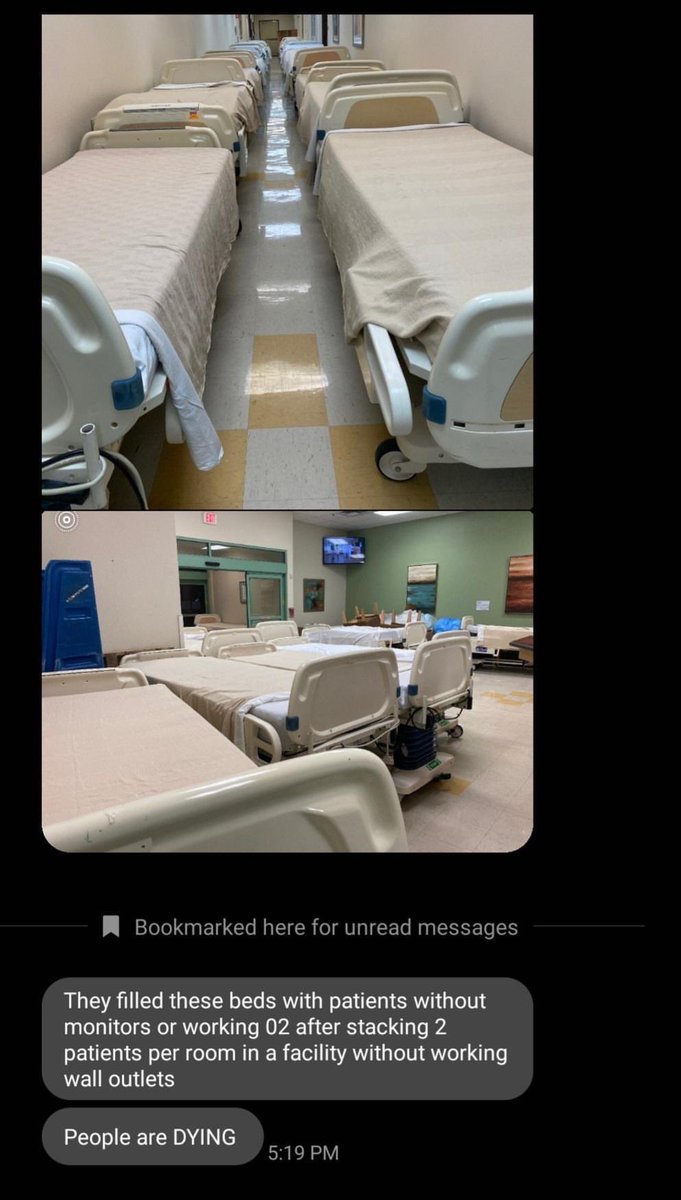
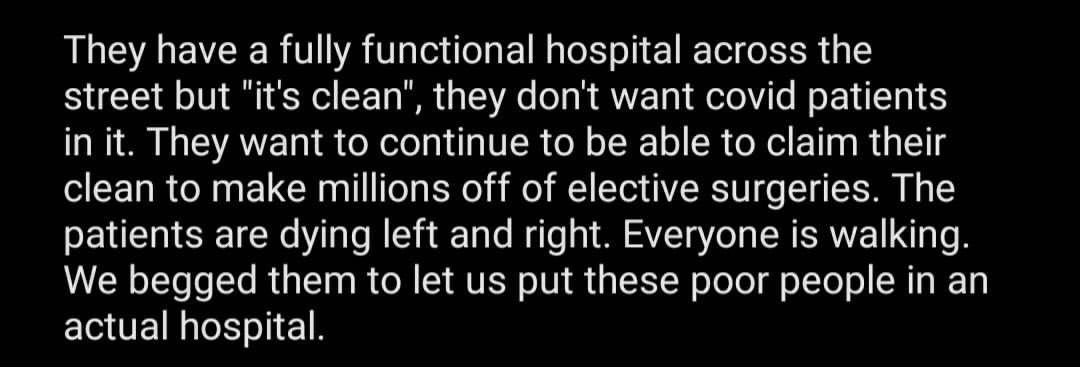
This thread will be about the abhorrent conditions at the covid "hospital" DHR put up in McAllenTexas. Staff have walked out of this facility because of the conditions in which there are literally ants crawling over critically ill patients. Hiding PPE from staff. DHR is putting covid patients in this inadequate facility because they want the fully functioning hospital across the street to remain “clean.”

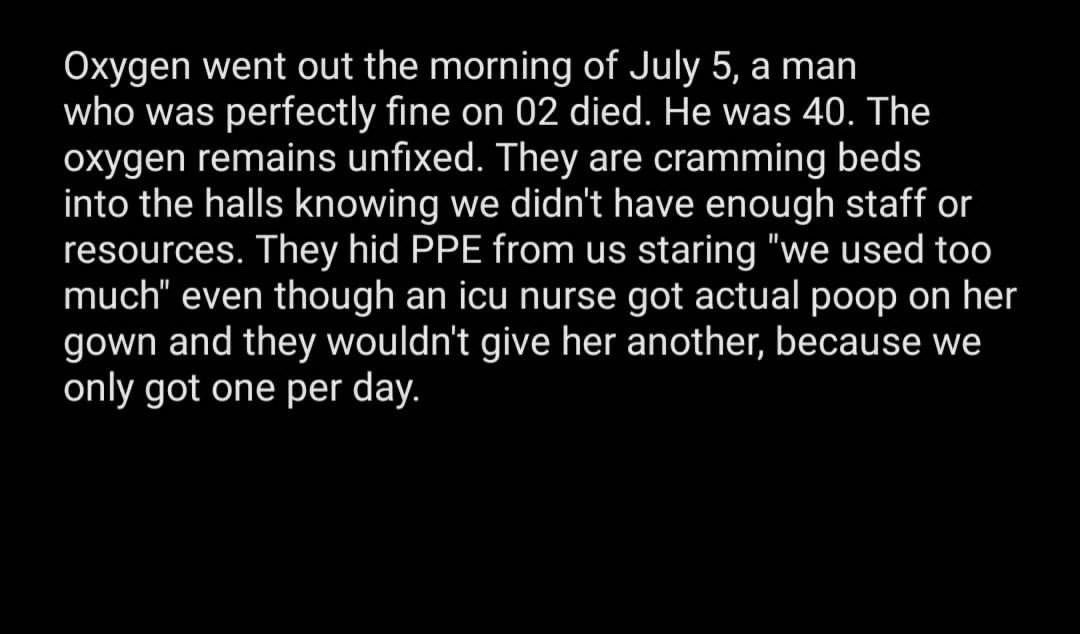
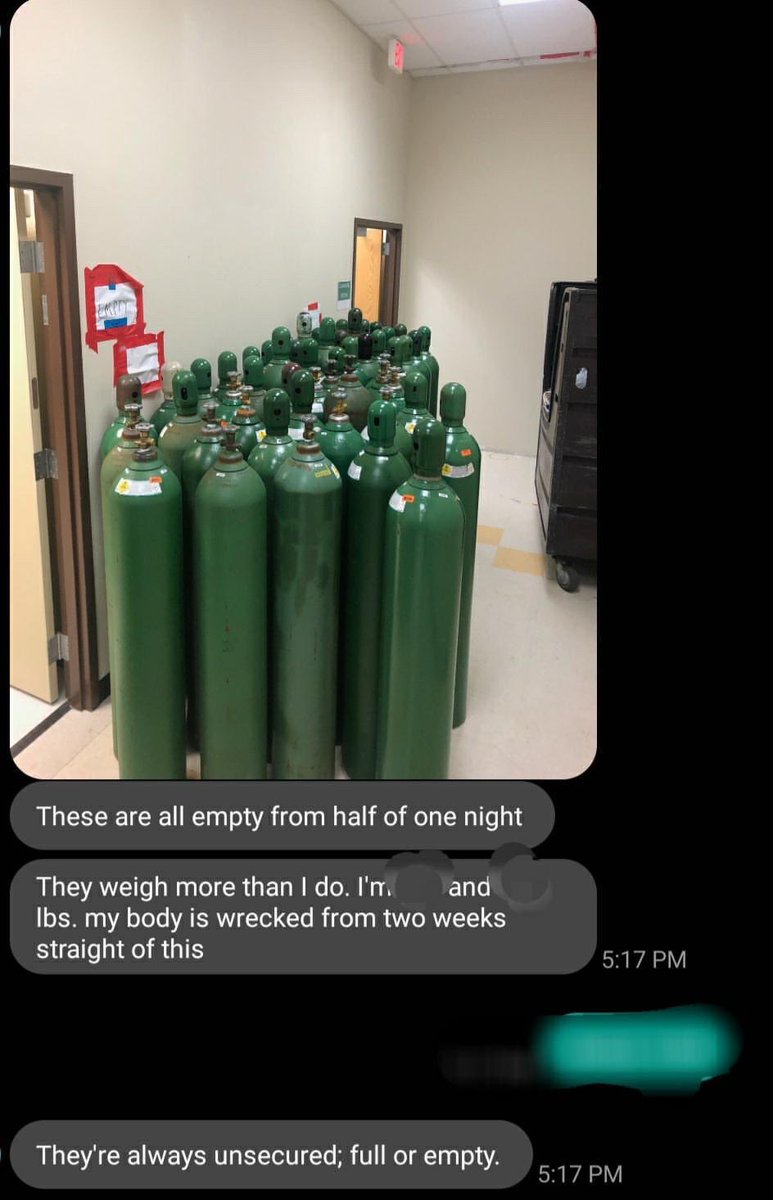
TW: Patients in abhorrent conditions. Patients placed in cramped rooms without adequate ventilation or air conditioning and full of medical equipment. Oxygen in the facility stopped working on July 5th, staff has been forced to using portable tanks for patients.

For reference these tanka last 45 minutes when run at 100% FiO2 and they only had 3 people to change them out for 90 patients.

Trigger Warning⚠️ Blood/Medical Equipment/Critically ill patient.

The black dots on the patients back and on the bed are live ants crawling all over them. This is unacceptable.

This is absolutely horrific.

Doctor’s Hospital Renaissance converted a hospice facility into a covid unit. The thread above exposes the abhorrent conditions that was not covered in this article. (texastribune.org/2020/07/02/tex…) The nurses and respiratory therapists are being threatened into silence. The hospice facility was converted into a COVID unit so that DHR would stay “clean”

I do not work at this facility. I am assisting in blowing the whistle on the conditions of this facility. Those who work at this facility have been threatened into silence. To clarify this is who “Krucial” is, a staffing agency that has been staffing surge cities.

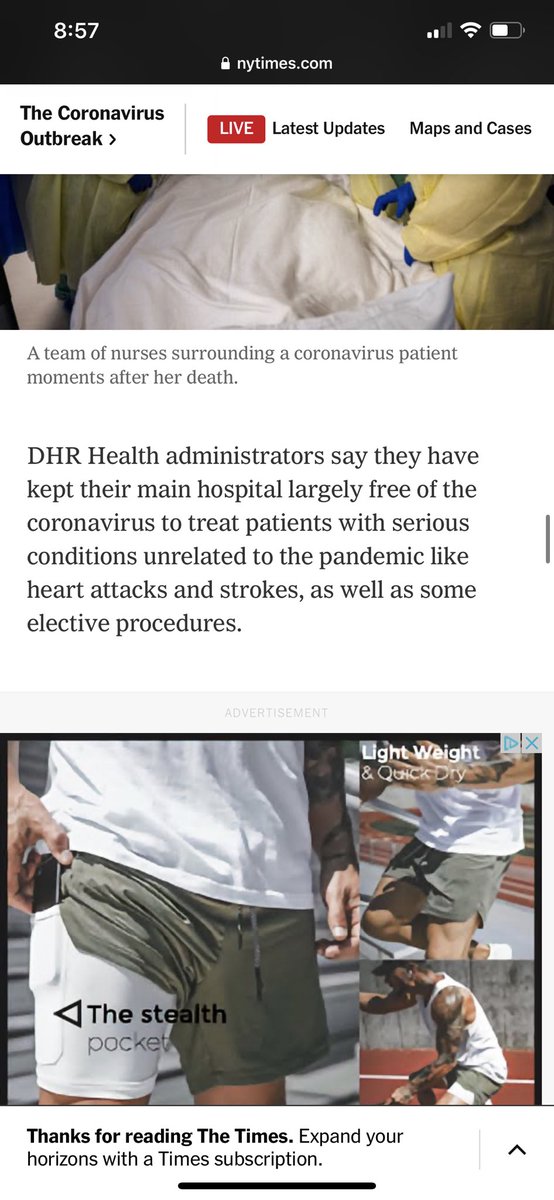
”Race-Based disparities in health outcomes are not abstract” Texas is failing their Latinx community covered DHR in an article today and here they talk about what my contact told me, the main hospital has been “kept largely free of the coronavirus to treat patients unrelated to the pandemic....as well as some elected procedures”

From a Nurse at DHR in McAllen, Texas.

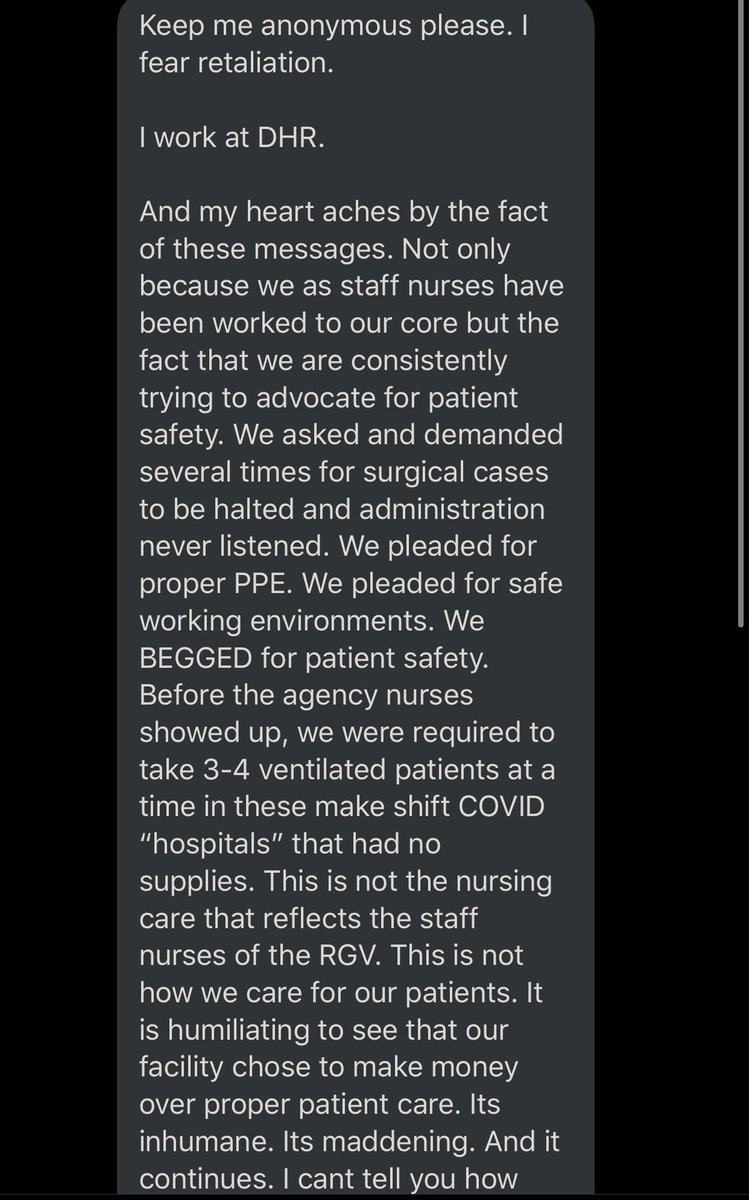
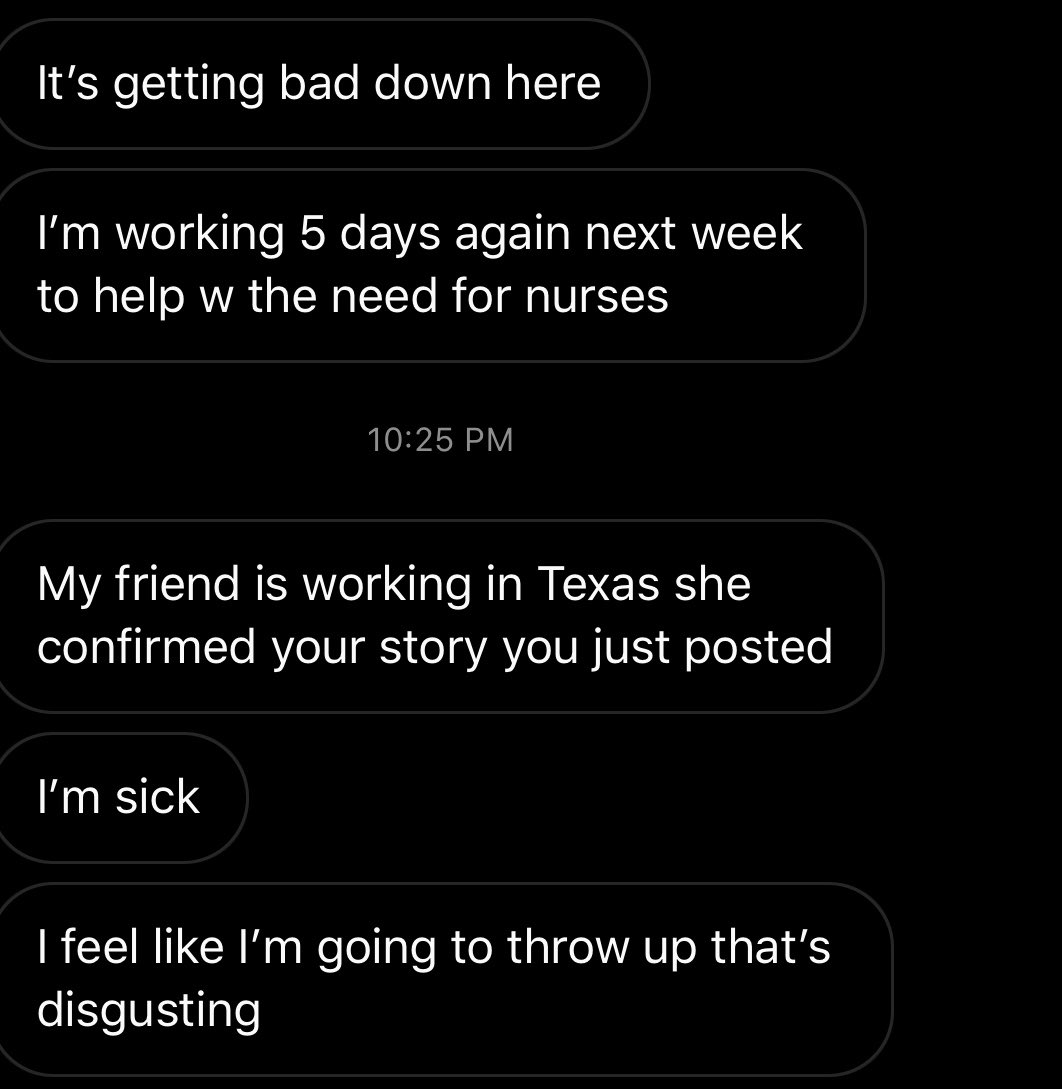
More nurses confirming this story.

Covid is not profitable. Cutting corners in order to allow for continued elective procedures is profitable.

A newly hired nurse who was basically fired for testing positive for covid because she couldn’t use her PTO as sick leave.

07 July 2020

Notes from a pandemic: You go into lockdown with the data you have, not the data you want

The Better Posters book is still in press. I am getting periodic updates from the publisher, which is exciting.

I am waiting on reviews for one project.

I am writing another big project, and I have many thousands of words down for it already.

So these are good. But I have no idea when I will be able to collect data again, and it’s kind of getting to me sometimes.

I was preparing for a journal club presentation about snapping shrimp. Which are awesome beasts. They make sound louder than a gunshot, louder than a rocket launch, with their claws. The journal club talk isn’t even about claws, but I wanted to mention how they worked because it’s tangentially relevant to the main part of the talk.

I came across this paper about the evolution of the snap. It’s comparative, got behaviour, 3-D modelling of the claws, biomechanics, a lot of the kind of stuff I was doing more back in grad school. It’s amazing work.

And I feel sad. I want to do stuff like it. I want to do good, original science.

06 July 2020

The long reach of old media: Fox News and COVID-19

I can’t stop thinking about this Washington Post article from last week.

Three serious research efforts have put numerical weight — yes, data-driven evidence — behind what many suspected all along: Americans who relied on Fox News, or similar right-wing sources, were duped as the coronavirus began its deadly spread.
Dangerously duped. ...
Those who relied on Fox or, say, radio personality Rush Limbaugh, came to believe that vitamin C was a possible remedy, that the Chinese government created the virus in a lab, and that government health agencies were exaggerating the dangers in the hopes of damaging Trump politically, a survey showed.

This has just been rolling around in my gut for days. People keep asking, “How did wearing a mask become political?” This is how.

While I still think recommendation algorithms are a huge problem for science communication, this article is a reminder of two things.

The first reminder is that while new media are influencing the information spread in ways that nobody can predict, established, pre-Internet media still exerts a huge influence on how people think about issues and problems.

In times of crisis, you need consistent and pervasive messages about what people need to to do to protect themselves and others. This is why the US Center for Disease Control keeps getting shit for: because they were slow to recommend masks. But I don’t think that is even slightly comparable to the Fox News situation. If the CDC messaging created a chink if the armor, Fox News messaging stripped off the armor and went dancing naked and blindfolded through a minefield.

The second reminder is that Fox News has a lot to answer for. The damage it has done to the United States is almost incalculable. And I am not just talking about the COVID-19 pandemic.

External links


Related posts

31 May 2020

Saddest day ever

I can’t get over this graph.

Friday, 29 May 2020 was the saddest day ever on Twitter. Click to enlarge. No seriously, click to enlarge. You really have to see it enlarged to feel what is going on in this data.


This is an amazing visualization of data. It is so rich. It shows a big picture (hm, why might there have been a downward trend in happiness since 2016?), but the details are so rich, both the highs and the lows.It reminds me a little of Charles Minard’s visualization of Napolean’s Russian campaign, which Edward Tufte has made famous.

And when you see what the lows were reactions to, in the labels of the data, it pushes home just how bad things have to be to create the saddest day ever on Twitter. And not just “saddest” by a little, but by a lot.

In a sense, this graph is helpful because it shows, “It’s not just you.” And it shows that anyone who does not acknowledge the pain that people are in now is not reading the room. People are hurting, badly.

I’m scared to see the data from Saturday and Sunday and the week to come.

Update, 2 June 2020: Friday’s record has already been broken. The last day of May, 2020, is now the saddest day ever on Twitter.


Spotted on the Hedonomter Twitter account. Data here.

22 May 2020

Notes from a pandemic: Coming back out

Depiction of virus that causes COVID-19, SARS-CoV-2
Back in March, a lot of people got very stressed going into social isolation, lockdown, stay at home, quarantine, whatever you want to call it.

Me? I was good. It’s being the prospect of coming out of isolation that is stressing me out. It’s not because I’ll have to be around people again. It’s that I am not at all convinced it’s being done safely.

As I mentioned, the University of Texas system has already decided all its campuses will have face-to-face instruction for fall.

Earlier this week, my institution had a video chat with the person in charge of “reopening” the university, and I learned that food services, the gym, and the libraries were going to open back up at the start of June.

I asked, “Given the increase in cases that other countries and states have seen after "reopening", as a medical professional, are you comfortable with reopening the campus? Is this a medically advisable course of action?”

I didn’t get an answer to that.

I did get an answer to “If it was not possible for people to be on campus safely through March-May, why is it possible now? What has changed from a public health perspective?” The answer was basically, “We know more now.” Personally, I’d be happier if that answer was, “We have a vaccine now,” but of course, we don’t, and won’t have anytime soon.

I personally will be teaching online in fall, so I am not so much worried for my own health as the safety of my colleagues and students.

My worries got even worse when I saw news last night about the University of Texas’s flagship campus at Austin. Despite having an almost empty campus, they’ve had eleven of their janitorial staff test positive for COVID-19.

(University spokesperson J.B.) Bird said that UT officials did not know exactly how the virus spread among its custodial staff members, but said they had been practicing social distancing and wearing masks.

I just don’t see anything that convinces me that universities – including mine – can realistically expect to keep people safe.

External links

Q&A with Dr. John Krouse, Dean of the UTRGV School of Medicine (Recorded from Facebook livestream)

Virus outbreak hits nearly empty University of Texas campus: What will happen this fall?

20 May 2020

Some people will literally die rather than change their minds


I have been thinking a lot about the craziness of “re-opening” and how some people refuse to take any precautions. Just a day or two ago, I was imagining asking these people, “What would it take to get you to change your mind, short of you getting hooked up to a ventilator because of COVID-19?”

Then today I saw this. Physician Ryan Morino tweeted (lightly edited):

I’ve been called a lot of names and accused of a lot of things by emergency patients but it’s surreal to have a patient accuse me of falsifying their COVID result – because they don’t believe the virus is real – as I’m actively trying to keep them from dying from multi-organ failure from COVID.

My “short of you getting COVID-19” qualifier turned out to be an unreasonable assumption. I thought that the personal first-hand experience of getting so sick that you are hospitalized would be something would force people to reconsider their views. How wrong I was.

(Aside: Hospitalization is bad, but this description of being on a ventilator proved to me that I had not idea how bad things could while trying to keep you alive from COVID-19.) 

From my experiences trying to talk about evolutionary biology, I know lots of people are intransigent. They not going to change their minds in front of you. People have values and beliefs and community ties that matter to them more than evidence. For a long time, I’d been okay with that.

But these sorts of reactions to the COVID-19 pandemic have shaken me. I’ve never felt so depressed and pessimistic about the prospects for science communication. This is the fight of our lives, and we’re losing.

Another piece that hit me hard was this article by Adrienne LaFrance about conspiracy beliefs, and how one in particular has gained so much traction over the space of three years. For someone like me who had never heard of this much before, the conspiracy stories (I refuse to call them “theories”) are unbelievable. They are inconsistent, and they have consistently failed to say anything meaningful. Edited excerpt:

I asked for examples of predictions that had come true. They could not provide specifics and instead encouraged me to do the research myself. When I asked them how they explained the events (that had been) predicted that never happened(,) they said that deception is part of (the) plan.

It brought to mind this from Jessica Price (emphasis added):

I guess it’s time to repeat the main thing I learned from reading a fuckton of Holocaust memoirs again: propaganda does not need to be persuasive, only pervasive. Its secondary purpose is to convince. Its primary purpose is to exhaust.

LaFrance arrives at a point that I had independently been thinking about before I read her article. People often talk about the “politicization” of events in the US now, such as the COVID-19 pandemic.

This moment in American history is better understood as being driven by a new religious movement rather than existing political movements.

I don’t mean “religion” in the usual sense of the major Abrahamic faiths (Christianity, Judaism, Islam) – although those are often intertwined with the new zeitgeist.

Like LaFrance, I mean that people are describing and responding to events in ways that you normally see in religious communities rather than political parties. Such as the unshakable beliefs in things unseen (“COVID-19 isn’t real,” says the one about to die from organ failure from it), belief in prophecies, communities springing up around practices not held by everyone.

And certainly, some political leaders act more like old school gods than traditional politician. They demand tribute, sacrifice, and threaten those who oppose them. A thunderbolt or two aimed at demigods who aren’t “respectful” or grateful enough. They sure aren’t above lying (you know, turning into a swan to get laid).

And they sure as hell don’t care about puny mortals. “So a few humans die. So what?”

It’s a radically different vision than one I have for politics, which is more about negotiation and compromise and trying to make most people’s live better. But probably my view was skewed from living most of my life in a relatively peaceful few decades, and mistaking that as normal.

From my point of view as a scientist who wants to do science communication, I think that treating opposition to COVID19 information as being based in religious opposition (in a secular, non-tradition sense) rather than political opposition changes the dynamic and changes the approach that you take.

It makes it clear that the task ahead of us is far, far harder than we ever could have expected.

Ultimately, I have to believe that at some point, reality will sink in. I hope that many people who aren’t wearing masks today, for instance, will one day look back at their actions and think, “Maybe I should have worn that mask.”

I hoped that we might have gotten to that point by now.

Additional: Just after I posted this, Andrew Thaler wrote:

The mistake we're making is thinking we have a science communication problem when what we have is a terror management problem.

Not sure I agree, but I think we both agree that “science communication” is not what the moment calls for. Science communication is a default mode. We need a crisis mode, and we don’t have one.

More additional: Emily G also has a thread that makes a similar point:

Here’s the thing no one wants to hear: you fight propaganda with propaganda. Unless SciComm can fundamentally scale to address the propaganda machine in sum and substance – and it can’t – then it’s doomed to ineffectiveness.

Even more additional: And just to show that some elements of this problem are widespread and not just an American thing, a new report shows a lot of Canadians have false beliefs about some aspect of COVID-19.

More than a quarter think the virus was made in a Chinese lab.

Almost a quarter thought there were drugs that could treat the disease, notably hydroxychloroquine.

More than one in ten think the virus is a cover-up for 5G wireless.

And just to top it off, there’s a lot of overconfidence to go with the misinformation.

Sarah Everts, a Carleton journalism professor and co-researcher in the study, said she was “floored by the overconfidence Canadians have in their own ability to distinguish conspiracy theories and misinformation.”

For example, 58 per cent of respondents who believe the 5G conspiracy theory also said they could “easily distinguish” between COVID-19 facts and misinformation.

External links

The prophecies of Q

The hard truth about ventilators

Nearly half of Canadians can’t tell coronavirus fact from conspiracy theory: survey

04 May 2020

Notes from a pandemic: Not good

I was doing fine until this weekend.

Then I realized that I screwed up in my online classes. I made a mistake when I changed courses to accommodate for extended spring break back in March, put it in the syllabus then, but nobody caught it (including me) until Saturday. Like, right before it mattered.

The mistake shouldn’t be too bad for two courses (except for me own grading load), but is... not what I would have done in the third. Students are grumpy with me, rightfully so, and I’m not happy with myself, either, so that fits.

Then Texas has decided to start to “re-open” and I saw images like this at my field site on the beaches of South Padre Island:

Visitors return to beach, local businesses re-open

We are going to watch so many people get sick or die. And the reporting of this story bothers the hell out of me because there is no talking to anyone in public health, no epidemiologist, nobody to assess what the consequences of packed beaches and open restaurants is going to be.

And what is just killing me inside is that I am worried that a large chunk of Americans have decided not to care. That they are going to take the same approach to COVID-19 that they have with guns for all these years: they are just going to get used to it. Get used to constant deaths running along the chyrons of news channels, shrug and say, “That’s just the price of freedom.”

Of all things, what caught the moment for me was this review of a Godzilla movie box set.


In 2019, the world is on fire. We should know better. We move on because this is what we do: We get used to the flames, the poison, the death and destruction. We constantly erect new normals, and once those are surpassed, we craft newer normals, and pretend those have always been. When we see signs of that which we cannot escape, we change the channel because it isn’t our cup of tea. We shrug at the monsters, huge and black and opposing silhouettes on the horizon. We get used to the apocalypse because we can get used to anything.

It’s just a virus we’re getting used to instead of kaiju.

External links

Visitors return to South Padre Island, local businesses reopen

Criterion's Gorgeous Godzilla Box Set Is a Testament to Our Ability to Get Used to Anything

02 May 2020

Notes from a pandemic: Football is not more important than life


I am still mad and disappointed I was by the University of Texas system’s decision to open campuses for fall, no matter what. More Texas universities have decided to open up, and I’m not just mad, I’m disgusted.

On Thursday, Texas A&M University System Chancellor John Sharp told all 11 university presidents in the system that they will reopen their campuses next school year and be ready to play sports, a university system official confirmed to The Texas Tribune. Texas Tech University has also announced that it plans to resume on-campus classes in the fall, and university President Lawrence Schovanec told the Tribune that Tech is planning to play sports, too.

I know people miss their past times. I know people love their sports. But football? Football absolutely, positively, should. not. be. the. lede here. I hate it. Football is not what a university is for. A game for the masses is not worth reopening campuses and putting hundreds of thousands of people across the state at risk.

A long time ago, I seem to remember someone comparing being at a university to owning a pet wolf. Everything is fine as long long as you keep feeding the wolf. But you should never, ever forget that the wolf will turn on you the instant there’s a problem. I feel a lot like that pet owner these days.

External links


01 May 2020

Notes from a pandemic: Back to work orders

The Daily Texan is reporting that all University of Texas campuses will be opening this fall. My initial reaction has not changed.

OH SHIT NO.

I cannot see any scenario in which UT System campuses being open for fall will not mean a lot of people are going to get sick and some are going to die.

If anything, I’ve gotten even angrier with this plan. Because the Daily Texan article makes it pretty clear that what is driving the decision is not the best interests of the students or the faculty, but money.

Milliken said the UT System has encountered economic hardship as campuses shut down.

The article goes on to describe refunds to students who can’t live in housing, the loss of income from elective surgeries in health institutions, and the drop in funding coming from oil sales (which support the state’s Permanent University Fund).

I’m upset that money seems to be a higher priority than health.

I’m upset that the decision is to try to push everything back to the old model instead of taking steps to create something new, like offering much more remote instructions.

I’m upset that the decision is being taken months before the start of fall, when Texas is deciding it wants to let restaurants and movie theaters and such open again, and we have no idea of how that is going to pan out. The possibility of things getting worse before Fall semester begins is very real.

The one good piece of news is that I was already scheduled to do a semester of courses online. So I personally will not have to go to campus very often.

I wish my students and colleagues had that option.

Update: My skepticism about Texas’s handling of the pandemic and “getting back to normal” feels justified.

The Texas Department of State Health Services reported fifty new deaths from COVID-19 in the state, the largest single day increase during the pandemic. For only the second time since tracking began, it also reported more than one thousand new confirmed cases.

We do not have COVID-19 under control. Not even close. So why is Texas allowing businesses to reopen, exactly?

External links

UT System plans for fall reopening of all institutions

23 April 2020

Notes from a pandemic: Two degrees of separation

Earlier, I wrote:

It’s an epidemic when people you don’t know get sick. It’s a pandemic when people you know get sick.

The pandemic has now struck only two degrees of separation from me. The person who some might call my academic “grandparent,” Don Kennedy, died from COVID-19.

Don Kennedy riding a bike while carrying a briefcase

Don Kennedy supervised Dorothy Paul’s doctoral work, and Dorothy went on to supervise me. I wrote about my one interaction with him here. I really hope I can find that letter.

His Stanford obituary paints a picture of someone who did well with the time he had. I was a little disappointed that his research was given short shrift, but his papers are in journals. I loved the details like him having students run with him. How me met the Queen Elizabeth. I particularly love the picture above of him riding bicycle while holding a briefcase. It has a lack of pretense that I like.

Related posts

Heritage
Heritage expanded
Classic graphics #2: Crayfish tailflips

External links

Donald Kennedy, Stanford’s eighth president, dead at 88

05 April 2020

Notes from a pandemic: Not a time to jump into science communication

I’m seeing a few people bemoaning the lack of science outreach from professional scientists during this COVIC-19 pandemic. Efra Rivera-Serrano wrote:

Still amazes me that some principal investigators (PIs) and leaders can write whole pages on their grants proposing “outreach activities” but haven’t moved a finger to educate the public when it is mostly needed.

Jen Heemstra chimed in:

Science faculty, part of our job is teaching science. What better time than now to share our science knowledge with everyone? Even better, support students and postdocs who want to learn and participate in #SciComm!

I love me some science communication, but I worry. Something we have seen repeatedly during this pandemic is that very smart people, but who are not experts or have any practical experience, in epidemiology, public health, or modelling, think they have something worthwhile to contribute. And they make some model or prediction or say something else that is badly flawed.

As a personal example, I was in a meeting Friday where one of my colleagues opined that COVID-19 probably wouldn’t too bad in South Texas because of our geographic isolation. That wasn’t a crazy thing to say, but it was said, perhaps, from a limited point of view. An article the next day indicated that was not a good prediction. Culture matters.

(Local health authorities) have begun to notice something else particular to South Texas: strong family ties are exacerbating the virus’ spread.

“We have large households and these large households, they like to visit with other members of their family,” (Dr. Emily Prot, regional medical director of the Texas Department of State Health Services’ Region 11) said.

That needs to stop, she explained.

“We need to really avoid that and stay within one single household. So, no visiting tias, tios. No visiting the mother-in-law. That has to stop. We’re seeing too much spread right now within those family groups,” Prot said.

Prot hammered home the point, adding, “Those interactions are leading to more spread and we’re seeing that at a regional level.”

The Valley as a whole is at higher risk for seeing patients needing acute critical care, or who experience serious complications from the virus, Prot said.

“Well, we have more rates of diabetes in our region, and most of them (deaths caused by COVID-19) are due to older age, but we also had in Laredo, one of the deaths was in his 40s,” she said.

We need people with relevant expertise to provide that information. But I am deeply worried about people deciding, “I need to do science communication!” when do not have the relevant expertise, are unpracticed or untrained in communication (or both).

I would like all scientists, especially science communication novices, if their planned science communication in the time of COVID-19 passes the Craig Ferguson test for science communication.

Does this need to be said?  Does this need to be said by me?  Does this need to be said by me now?

The three things you must always ask yourself before you say anything:
Does this need to be said?
Does this need to be said by me?
Does this need to be said by me now?
Three fuckin’ marriages it took me to learn that.

(From Does This Need to Be Said? Epix, 2011)

Or, as I put it when I was curating the @IAmSciComm account, “When it's not your area of expertise, shut the hell up.”

External links

DSHS: Majority of RGV cases are young people

30 March 2020

Notes from a pandemic: Scholarship stoppages

Among academics, there is a particular anxiety about being stuck at home. It’s a touchy subject. Productivity and overwork is always a sore spot in academia.

A lot of people are saying, “Academics’ cult-like worship of productivity is insane. It’s unreasonable to expect to be productive in a global crisis.”

And some people are pushing back, saying, “I need routine and work helps take my mind off that we are in the middle of a global crisis. Leave me alone.”

Whatever people’s personal feelings about continuing to do academic work, a lot of people are asking, “What is my university’s expectations about research?”

A couple of administrators and some scientists have basically said, “Keep getting data so we can keep papers and grants coming.” There’s a real worry about how this compromises social distancing and the safety of researcher. And it’s probably stressful for a lot of people to be told, “Keep working like nothing has changed.”

Most institutions have said that the fact that this has been a “pandemic year” will be taken into consideration at annual review time.

Some institutions have said they are going to “stop the clock” for tenure, which relieves some people but scares others. A year delay in review means a year delay in promotion and the raise usually associated with tenure.

Graph of faculty salaries in Texas. Professors $119,080, associate professors $89,782, assistant professors $81,250.

Looking at data from Texas, the average salary increase between assistant and associate professor is over $8,500. Because that baseline is often used for various kinds of salary adjustments, the hit to someone lifetime earnings is much more than $8,500 for that one year.

I bring all this up because I encountered an unexpected obstacle to continuing with my academic scholarship. I have a project where I have all the data. I am starting to write up a manuscript about it. so I need to read the prior work. I find a book that looks highly relevant to the topic, and my library has it on the shelves. Excellent.

That’s when I discover the library isn’t lending out its books.

And even though the library is nominally open, the stacks are closed, so I can’t even go in and read the volume in the library itself.

That’s a little obstacle I should have expected to writing up articles, but didn’t.

There are going to be tons of obstacles, large and small, even for someone like me, who is not particularly affected by social distancing measures and working from home.

27 March 2020

Notes from a pandemic: Inching closer

Illustration of SARS-CoC-2 virusFifteen days, huh? Longer than I thought.

It was fifteen days ago that because of the COVID-19 pandemic, my university announced it was extending spring break and moving all instruction online for the remainder of the semester and until further notice after that.

At the time, there were no confirmed cases in our area. But based on what I knew and based on conversation, I thought, “There are people infected here.”

And predictably enough, people testing positive started to pop up in the lower Rio Grande Valley. But today things went to a new level when one of our Brownsville students and a faculty member tested positive for COVID-19.

Friday, March 27, 2020 :: Office of the President

Dear Campus Community:

UTRGV learned today that one of our students and one of our faculty have each tested positive for COVID-19 (coronavirus). Our student tested positive after traveling out of state and our faculty member after returning from international travel. Please join me in sending positive thoughts to these Vaqueros for a speedy recovery.

Meanwhile, a few people in the science online community are starting to say, “Hey, I’ve got COVID-19.” Folks like Clement Chow and Adam Rutherford.

It’s an epidemic when people you don’t know get sick. It’s a pandemic when people you know get sick.

External links

UTRGV COVID-19 Case Update

Notes from a pandemic: Misanthrope report

Occasionally, when someone I know asks how everyone is doing (particularly on social media like Facebook or Twitter) how they’re doing working from home / self quarantined / social distancing, my response is usually something like:

“Misanthrope reporting in. What is everyone bitching about? Social distancing is the best thing ever. I’ve never been happier in my life!”

This statement is about:

  • 50% true.
  • 40% joking for the sake of joking (also known as me being a smartass).
  • 10% false bravado.

I am pseudo-extrovert. I can dial up the energy level and sometimes even charm for a presentation, conference, or teaching, but it takes it out of me. I recharge by getting away from people. This is one more reason why, as I said before, my life has been disrupted much, much less than many other people.

Part of me is digging the fact that nobody expects me to go to meetings in person. That traffic is now relatively light all the time. I don’t have to generate as much small talk.

That false bravado, though, is real. As in, really false.

Not long ago, I stumbled across the TV series Alone, and watched season 2 - partly because it was set on the north end of Vancouver Island, Canada, which is close to where I used to live. (Victoria is on the south end of the island.)

Participants film themselves. They have no film crew. They have nothing but a “panic button” to connect with the outside world.

The show is kind of an ode to boredom, punctuated by rare moments of crisis.

Watching the show, what became obvious was that for some participants who made themselves reasonably secure physically did not mean they were okay psychologically.

One participant said something like, “If you have an unresolved issues, they are going to bubble up and consume you, because there is nothing else to distract you and beat them back down.”

I’ve felt a very tiny little bit of that in the last couple of weeks.

Now, to reiterate my point earlier: I’m all right! But even we introverted, slightly misanthropic human beings are usually social animals, and we need something to keep ourselves occupied besides our own thoughts.

I am super glad for the internet and my pocket friends. I’ve said for years, “Online conversations are real conversations.” Online friendships are real friendships. This will be something that will save a lot of people from falling into bad places in their own minds.