Showing posts with label emergencies. Show all posts

20 July 2020

Notes from a pandemic: Local hospital blasted for poor conditions

On Twitter, Nurse @shesinscrubs has started tweeting reports from local hospital, DHR.

It’s bad. Like, extremely bad. Like, horrible. I’ve compiled her first, main thread below (courtesy Spooler). It doesn’t capture everything in her thread, but it gets a lot.

My university has had a lot of ties with DHR. Here’s an internal medicine residency at DHR. Here’s a general surgery residency at DHR. Family medicine residency. Obstetrics and gynecology.

I would argue that these arrangements should be reviewed soon in light of these revelations.

• • • • •

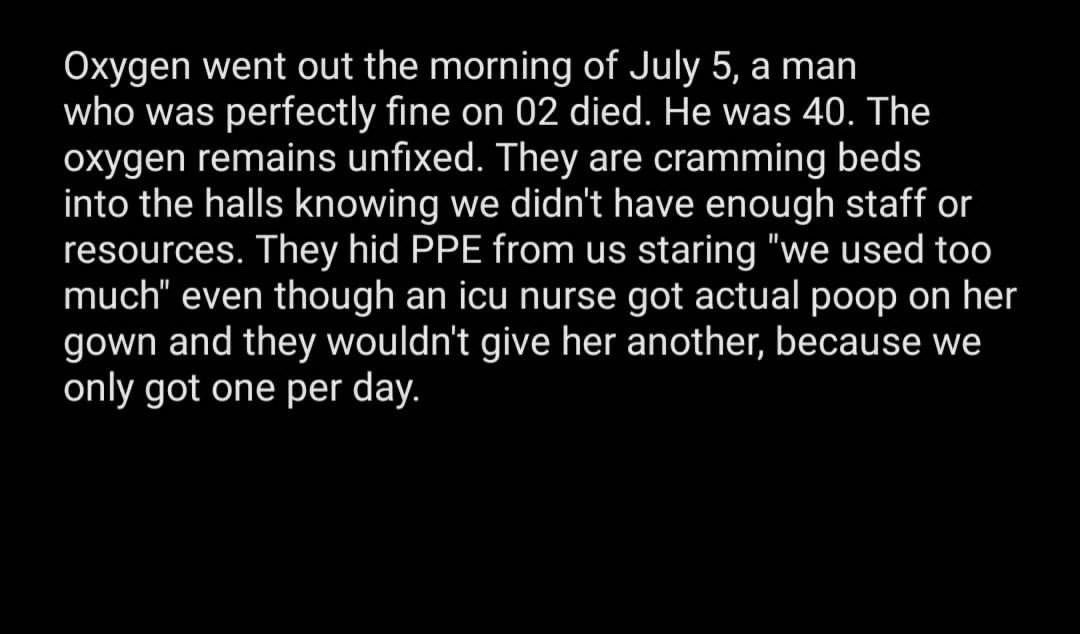
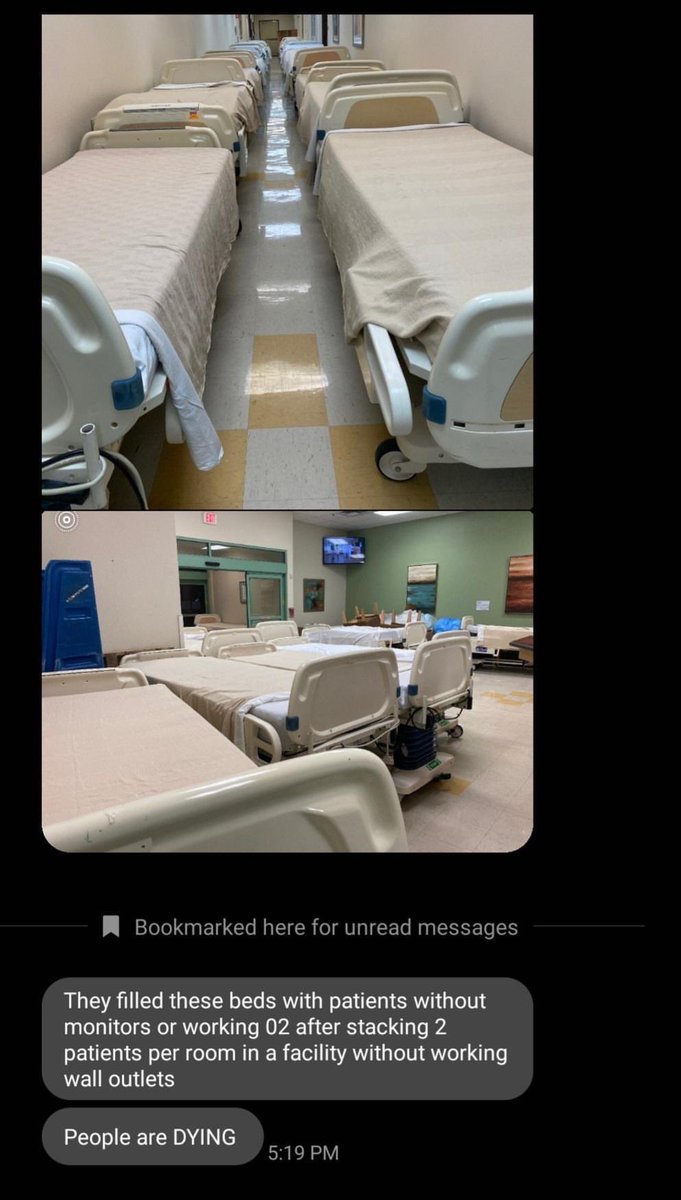
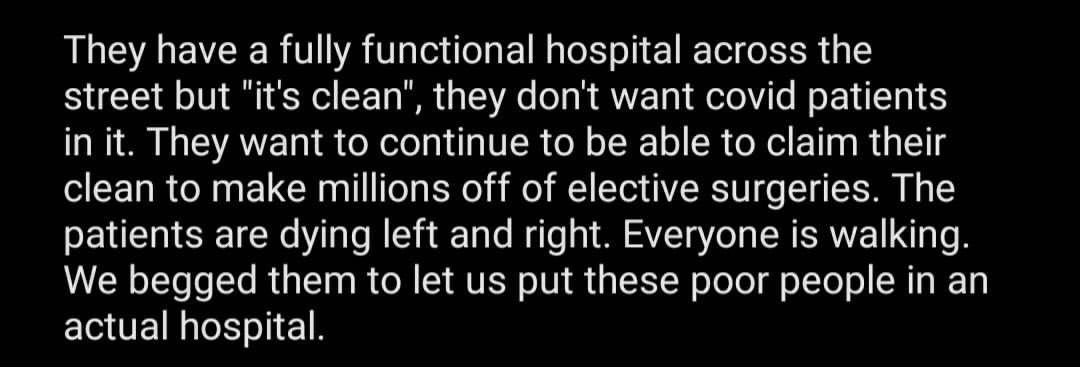
This thread will be about the abhorrent conditions at the covid "hospital" DHR put up in McAllenTexas. Staff have walked out of this facility because of the conditions in which there are literally ants crawling over critically ill patients. Hiding PPE from staff. DHR is putting covid patients in this inadequate facility because they want the fully functioning hospital across the street to remain “clean.”

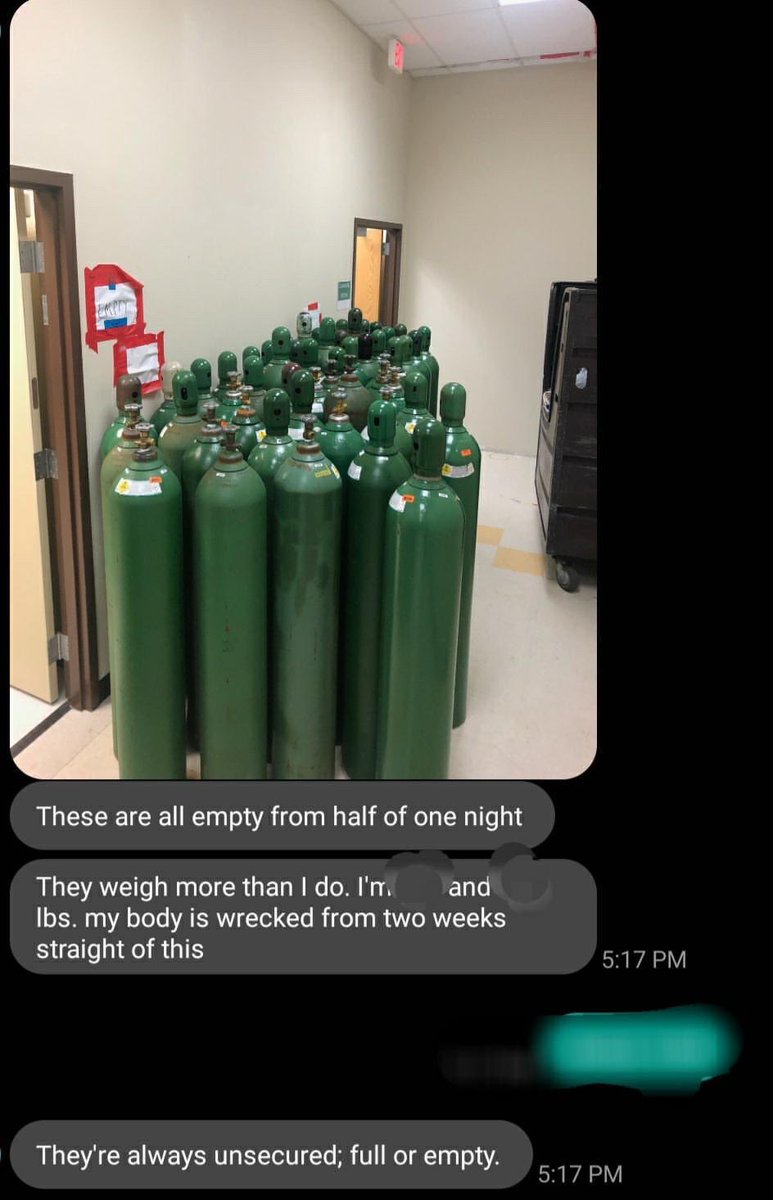
TW: Patients in abhorrent conditions. Patients placed in cramped rooms without adequate ventilation or air conditioning and full of medical equipment. Oxygen in the facility stopped working on July 5th, staff has been forced to using portable tanks for patients.

For reference these tanka last 45 minutes when run at 100% FiO2 and they only had 3 people to change them out for 90 patients.

Trigger Warning⚠️ Blood/Medical Equipment/Critically ill patient.

The black dots on the patients back and on the bed are live ants crawling all over them. This is unacceptable.

This is absolutely horrific.

Doctor’s Hospital Renaissance converted a hospice facility into a covid unit. The thread above exposes the abhorrent conditions that was not covered in this article. (texastribune.org/2020/07/02/tex…) The nurses and respiratory therapists are being threatened into silence. The hospice facility was converted into a COVID unit so that DHR would stay “clean”

I do not work at this facility. I am assisting in blowing the whistle on the conditions of this facility. Those who work at this facility have been threatened into silence. To clarify this is who “Krucial” is, a staffing agency that has been staffing surge cities.

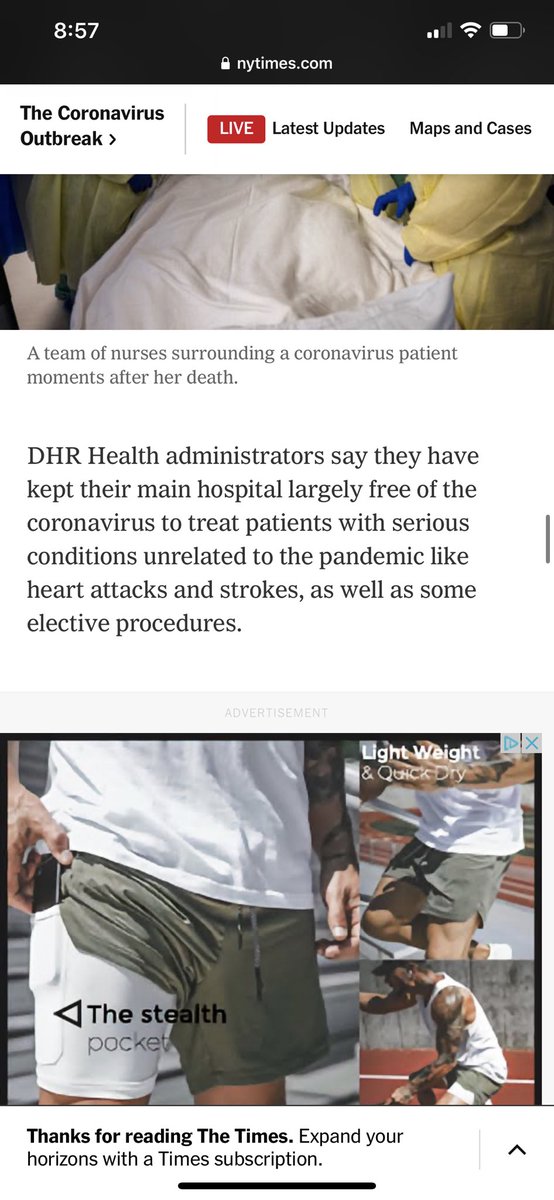
”Race-Based disparities in health outcomes are not abstract” Texas is failing their Latinx community covered DHR in an article today and here they talk about what my contact told me, the main hospital has been “kept largely free of the coronavirus to treat patients unrelated to the pandemic....as well as some elected procedures”

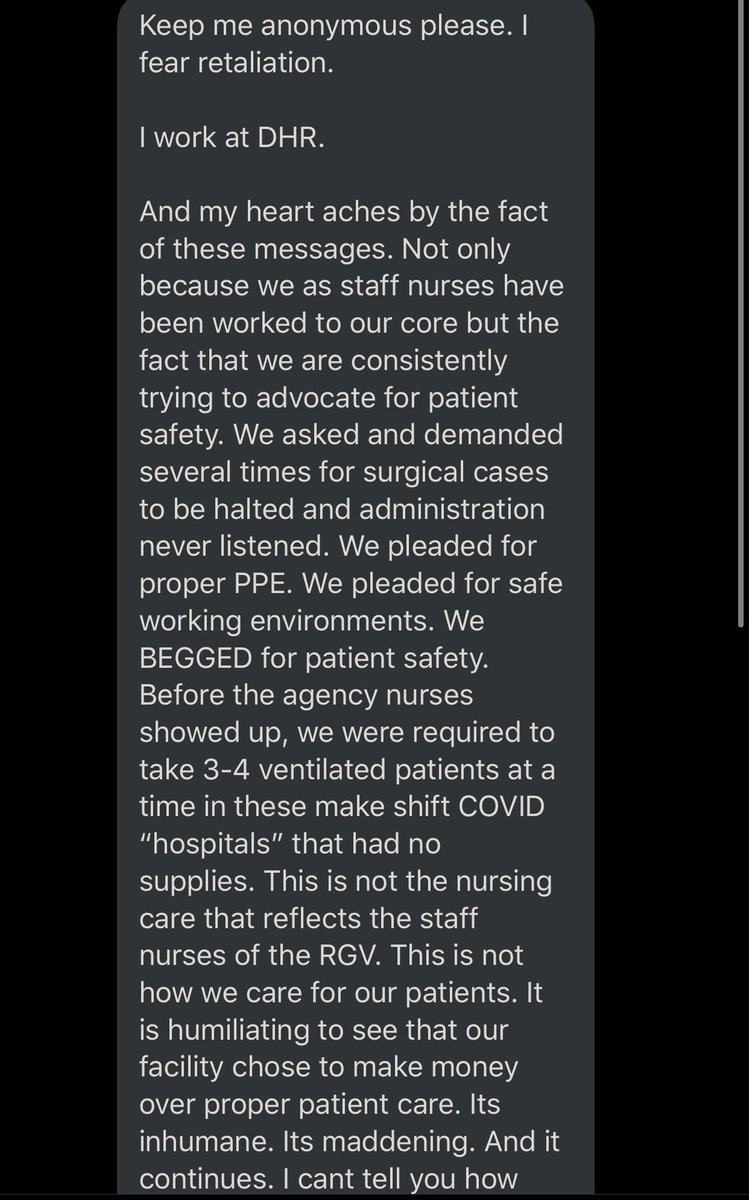
From a Nurse at DHR in McAllen, Texas.

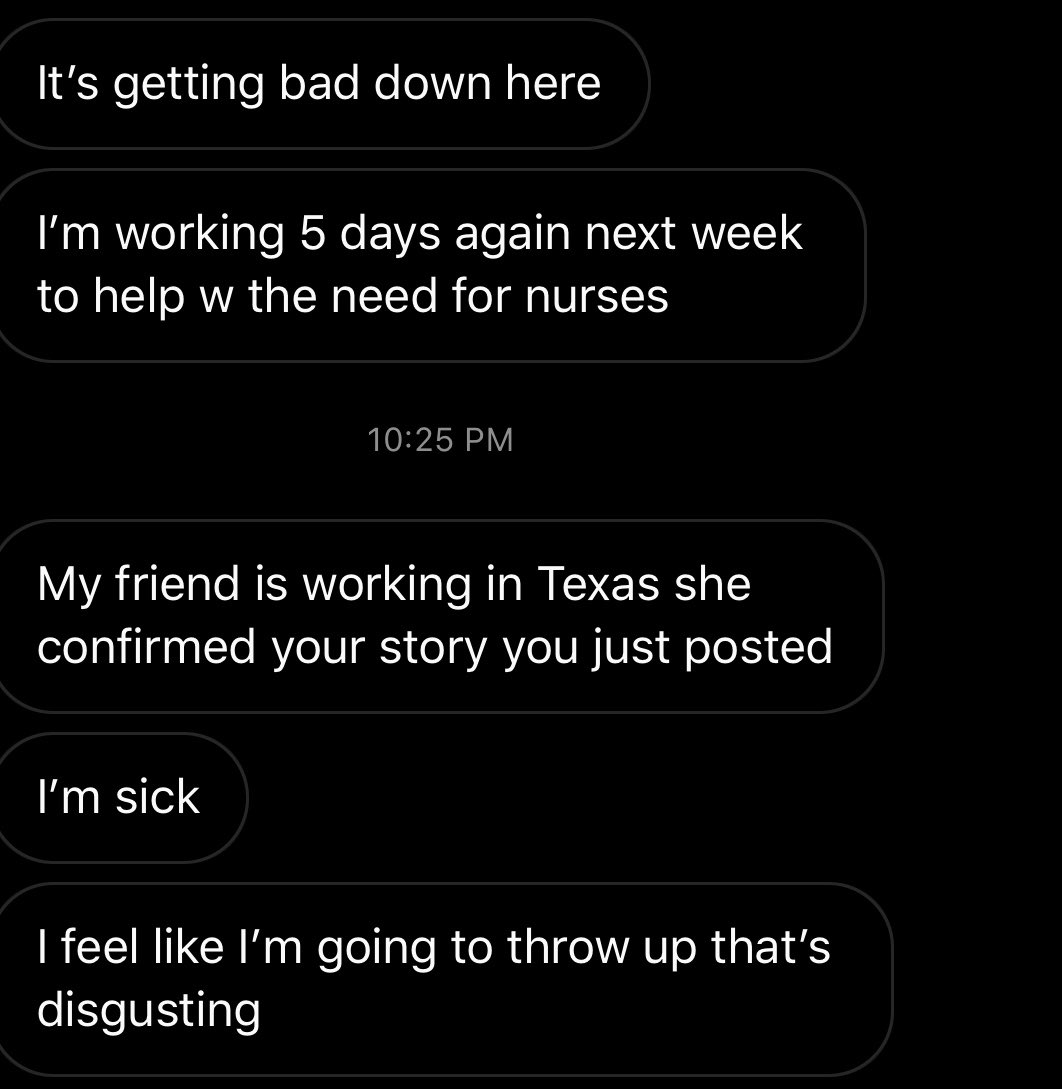
More nurses confirming this story.

Covid is not profitable. Cutting corners in order to allow for continued elective procedures is profitable.

A newly hired nurse who was basically fired for testing positive for covid because she couldn’t use her PTO as sick leave.

29 May 2020

Every empire falls

When you’re a kid and you study history, you read about all these empires of the past that rose and fell. Rome. Genghis Khan and Alexander the Great. The Holy Roman Empire, the Ottoman Empire, the British Empire. (Yes, my history was very western oriented.)

And sometimes you wonder what it must be like to be in the tail end of that, when an empire is breaking apart. “What must it be like,” you think, “to live through that?”

Well, now I know.

Living through history sucks.

Top picture from here. Bottom picture by Associated Press photographer Julio Cortez. Bruce Janu writes: “The upside-down flag has historically been used to signal ‘distress.’ And ‘distress’ may not be a word that is strong enough.”.

27 March 2020

Notes from a pandemic: Misanthrope report

Occasionally, when someone I know asks how everyone is doing (particularly on social media like Facebook or Twitter) how they’re doing working from home / self quarantined / social distancing, my response is usually something like:

“Misanthrope reporting in. What is everyone bitching about? Social distancing is the best thing ever. I’ve never been happier in my life!”

This statement is about:

  • 50% true.
  • 40% joking for the sake of joking (also known as me being a smartass).
  • 10% false bravado.

I am pseudo-extrovert. I can dial up the energy level and sometimes even charm for a presentation, conference, or teaching, but it takes it out of me. I recharge by getting away from people. This is one more reason why, as I said before, my life has been disrupted much, much less than many other people.

Part of me is digging the fact that nobody expects me to go to meetings in person. That traffic is now relatively light all the time. I don’t have to generate as much small talk.

That false bravado, though, is real. As in, really false.

Not long ago, I stumbled across the TV series Alone, and watched season 2 - partly because it was set on the north end of Vancouver Island, Canada, which is close to where I used to live. (Victoria is on the south end of the island.)

Participants film themselves. They have no film crew. They have nothing but a “panic button” to connect with the outside world.

The show is kind of an ode to boredom, punctuated by rare moments of crisis.

Watching the show, what became obvious was that for some participants who made themselves reasonably secure physically did not mean they were okay psychologically.

One participant said something like, “If you have an unresolved issues, they are going to bubble up and consume you, because there is nothing else to distract you and beat them back down.”

I’ve felt a very tiny little bit of that in the last couple of weeks.

Now, to reiterate my point earlier: I’m all right! But even we introverted, slightly misanthropic human beings are usually social animals, and we need something to keep ourselves occupied besides our own thoughts.

I am super glad for the internet and my pocket friends. I’ve said for years, “Online conversations are real conversations.” Online friendships are real friendships. This will be something that will save a lot of people from falling into bad places in their own minds.

25 March 2020

Notes from a pandemic: “Research that actually matters”

On Monday, a now deleted tweet from Andrew Timming said something along the lines of, “This crisis is a wake-up call. COVID-19 shows how much academic research is just castles in the sky. ‘Moving forward, let’s do research that actually matters to the world’.”

Andrew has deleted the tweet, so I can’t confirm the exact wording. That last part – “research that actually matters to the world” – is an exact quote. I don’t think Andrew deserves hate, which he says he received, but I do think his comment deserves commentary. Maybe even critical commentary.

I get the sentiment. I do. In times of crisis, a lot of people feel useless.

Animated cave painting of mammoth huntTimming was making a variation of an old, long-running argument about “basic verus applied” research. Now, I’ve heard a lot of retorts to this. I like, “If we only ever did applied research, all we’d have would be better mammoth traps.”

According to (probably untrue) legend, a politician once asked Michael Faraday what good electricity was.

There are two versions of the story of Faraday’s reply.

  1. “One might as well as what good is a new borne baby.”
  2. “One day, sir, you may tax it.”
(I like the second one.)

But the next day, I was listening to Maddie Sofia interviwing Ed Yong on ShortWave. It shows the COVID-19 pandemic itself shows the problem of focusing research on what “actually matters in the world.” (My emphasis.)

SOFIA: So one thing that I found really interesting in your article was the state of coronavirus research in general and how that plays into how prepared we are right now. Like, this is a big group of viruses that cause a decent bit of disease throughout the world. But one researcher you talked to said that until recently, not that many people were studying coronaviruses.

YONG: Right. So a very small group of people - maybe, you know, several dozens of researchers - have focused on coronaviruses for a few decades now. But it really has been a very, very niche field, even among virologists. When SARS classic first emerged, I think coronavirus researchers were really shocked that the things that they were studying were suddenly of public health importance.

SOFIA: Right.

YONG: And they are even more flabbergasted now.

SOFIA: And so because of that - because even after SARS, there wasn’t a huge uptake in how many people were studying this, we don’t necessarily have surveillance networks in place for coronavirus like we do for the flu.

YONG: Right. A lot of our preparedness measures in general have been focused on flu as the most likely next pandemic - and for good reason - because flu actually is the most likely next pandemic. It just so happened that this time, it was a coronavirus. And we don’t have surveillance for coronaviruses. We know, actually, surprisingly little about coronavirus biology. And all of those deficiencies have contributed to this dire situation that we’re facing when we don't know enough but we're forced to act as quickly as possible.

Arguably, the situation we now find ourselves in with the COVID-19 pandemic is not despite the view that researchers should do work “that actually matters to the world,” it’s because of it.

From a rational assessment of risk, need, whatever, I’m sure people argued in grant agencies that we should not invest much money and resources in coronavirus research. The best estimates were that coronaviruses didn’t pose much of a threat, so we should put that money into influenza or something else.

This isn’t even the first time we’ve seen this happen in the last decade.

Remember when people were freaking out about zika? (I know, it seems like something that we read about in history books instead of only four years ago, in 2016.) The CDC director tweeted this picture of every paper about the zika virus published in the world to that point.

Short stack of scientific papers

It was pretty short freakin’ stack of paper. And the headline was that scientists were caught “flat-footed.”

I’m sure that on September 10, 2001, there would have been a lot of people in the US arguing that universities should think about shuttering programs in, say, contemporary Islamic thought or Arabic language studies.

Movie poster for "Metero" (1979)If we discovered an comet, asteroid, or meteor on a collision course with Earth tomorrow (and given how 2020 is going, I feel like we should be watching the skies more), the headline would probably again be that scientists were caught flat-footed. Even though people have known this is a possibility for decades.

Hell, Hollywood knew this well enough to make a movie about it in 1979. And Sean Connery disaster from space movies are the best disaster from space movies. (Don’t @ me, Armageddon and Deep Impact viewers.)

Things are only irrelevant until they’re not. And then people complain, “Why wasn’t anyone studying this?!” Society pretty much told us not to. Society told us that we weren’t doing research that “actually matters.”

External links

Why is the coronavirus so good at spreading?
One tweet that shows how the Zika virus caught scientists flat-footed

Notes from a pandemic: Coronavirus campus


These pictures of UTRGV were taken Monday, 23 March 2020, when I went to campus to feed my crayfish. You could be forgiven for thinking they were taken the first day of spring break rather than the first day after spring break.


There were a few people on campus, but not many.

And frankly, I’ve always loved campuses when there are not many people around. I like the calm, and it was kind of beautiful.


Through a weird series of events, I am probably one of the people least affected by the COVID-19 pandemic I know.

Because I had spent the better part of the last two years mainly working on the Better Posters book:

I had been teaching online courses for the last couple of years. My teaching load was anywhere from mostly to exclusively online for the last few semesters. I had only one face-to-face class this semester, my neurobiology class. That course didn’t have a lab component. I had a good idea of how to move its course content online from my other online class experiences.

I didn’t have a lab to shut down. Because I was writing from home, I wasn’t taking students. My lab space (with my consent) got reassigned to another group of researchers from another department. I didn’t fight it because I wanted to be a team player, and I was working on the book anyway. So I thought, “No problem, I’ll get lab space once the book manuscript is done and out of the way.” Getting new lab space had taken longer than I expected, and I was getting antsy about it. But this has turned out to be a blessing in disguise, since I didn’t have to go through a process of putting everything away, worrying about trainees, and so on. I only have some crayfish to feed occasionally.

Unrelated to book writing, there’s one more thing that makes my life much less disrupted than many other people.

I don’t have kids. I feel for people who suddenly have kids at home and not at school.

Which is to say:

I’m all right!

Look after yourself and others.

It’s going to be a rough ride.

14 January 2019

How to fix a lab fail

I did my fair share of physiological experiments with neurons when I was a trainee.

The experiment was an attempt to get a handle on whether a particular pathway between sensory neurons A and interneurons B had few neurons (maybe even only a single connection; monosynaptic) or many neurons (polysynaptic).

One way you can test whether you have few connections or many is by messing with the physiological saline the neurons are sitting in. Physiological saline is a solution that mimics the inside of the animal they are normally found in. Different species have different mixes of salts and other chemicals that keep the neurons alive and firing. There is usually a lot of gold ol’ sodium chloride (table salt), potassium chloride (salt substitute for some people), and so on.

Normally, that physiological saline contains some calcium, because calcium causes neurons to release neurotransmitters. If you change with the amount of calcium in your saline, you make each connection between neurons more and more likely to fail. Using some ions that mimic calcium (like magnesium) make this plan even more effective.

Pathways with single connections between will often keep working with this altered saline: hen you stimulate A neurons, you still see the response in B neurons.

Pathways with many connections usually stop working with this altered saline. When you stimulate A neurons, you are unlikely to see activity in B neurons.

I was doing this experiment, and the results kept being... disappointing. I couldn’t understand the results. And the neurons seemed to keep dying faster than usual. I talked to my supervisor about these experiments. We went back and forth a bit, and at one point, my supervisor asked,

“What did you mix the solution in?”

I replied, “I mixed it in...”

Freeze frame. Record scratch.

It was at that precise, exact instant – after that exact word but before I said the next – that I simultaneously recognized and solved the problem that had been vexing me in the lab. If I was a cartoon, a lightbulb would have clicked on above my head. If I was in a modern movie, I would have had a high speed montage run in front of my eyes showing the key moments I went wrong.

All of this happened in pause that lasted about a second.

But I couldn’t stop myself from finishing the sentence, even though I knew that I was about to reveal myself as having made a dumb, amateur, “I should damn well have known better” mistake.

“...distilled water.”

My supervisor laughed. Not loudly. A chuckle, I think would be the appropriate description. I think the laugh was not only because he knew the solution as soon as I said it, but because he saw the look on my face that revealed I’d experienced “Aha!” and “D’oh!” moments simultaneously.

I’ d put the calcium substitutes in pure water. Not saline with all the other salts that were needed. No wonder the neurons kept dying.

I fixed the saline and went back to trying the experiment. The neurons were much happier, although it turned out the results of the experiment were so muddy and hard to interpret them that we never published that data in a paper. (It appeared on a couple of conference posters.)

And the moral of the story is: Whenever you have a problem in the lab, make sure to tell someone else. Because sometimes, you might just solve your own problem.

P.S.—I told this story on video as part of the SICB lab fail contest in 2018. I did not win. I wonder if the video is kicking around someplace...

P.P.S.—I didn’t know it until years later, but I was using a technique “Rubber duck problem solving.

P.P.P.S.—In the original account, the duck was stuffed (as in, a hunting trophy, not plush fur), not rubber.

P.P.P.P.S.—When I was deep into CCGs like Legend of the Five Rings, I talked a game company staffer who answered the phone. Her name was Mindy. Mindy would get players calling in with rules questions all the time. If you know CCGs at all, you know there are many complex rules questions that arise, because there were a lot of possible interactions between cards. Mindy said she would often get people really wanting to ask detailed questions about the Ninja Shapeshifter or something. But because Mindy was customer service and events, not game design, she didn’t have all the cards memorized. She’d ask the person on the phone to read the card out loud to her.

She said she lost track of the number of times the person would start reading the card to her, pause, and then say, “Oh.”

They answered their own question just by reading the card out loud.

Say stuff out loud, people. I’m telling you. It works.

11 September 2018

BugFest blues

Anticipation.

BugFest ad with crayfish


I had been anticipating the chance to speak at the North Carolina Natural Sciences Museum for a good long while. I’d been asked to speak at BugFest, one of their biggest events, which draws tens of thousands of people to the museum. I’d been wanting a chance to go since I heard so much positive about the museum when Science Online was held in the area. When I went to Science Online, I missed the chance to go because my flight didn’t arrive on time.

Anticipation.

Forecasted path for Hurricane Florence over North Carolina


This Sunday, I started to get a sinking feeling as I watched weather forecasts and my Twitter timeline. It’s hurricane season. Models were starting to predict Hurricane Florence was heading straight for North Carolina.Now it looks like Florence is all but going to the doorstep of the Natural Sciences Museum and knock on the door when BugFest was supposed to happen.

I emailed the organizers, got word that a decision would be made at the start of the week, and today I got word that the event was postponed.

“Whew!” from me. I did not want to get on a plane and fly towards a major hurricane.

I’ll come and talk science and crayfish after things have calmed down.

Hurricane Florence seen from space

I hope everyone in North Carolina – those I know and those I don’t – can stay safe through Florence. It looks like it’s going to be very bad.

(But it was a little fun to come up with this cancellation tagline.)

It takes a hurrican to stop a crayfish. Bugfest 2018 postponed due to Florence.

25 August 2017

Big bad Harvey

I’m probably going to be mostly unaffected by Hurricane Harvey. The University of Texas Rio Grande Valley campuses are closed today and tomorrow. Currently, the forecast is for a few inches of rain and possible power outages.

But the rest of Texas isn’t going to fare so well.

Harvey’s going to be very, very bad.

It’s hard to believe that on Monday, nature was treating millions to probably her most beautiful sight – a total solar eclipse. And here we are on Friday, same week, with millions of people dreading one of her most deadly events.

I hope my friends and colleagues elsewhere in Texas and Louisiana stay safe.

Update, 27 August 2017: Houston this morning. Pic from here.


This is after one day, and there’s more days to come yet.

This tweet shows water flooding into a news building after it rose a foot in 15 minutes. Terrifying.

External links

Hell and high water (From 2016, on why Houston did not get more prepared for a hurricane like Harvey after Ike in 2008)
Hurricane Harvey aims for the Texas fracking boom’s favorite port

27 June 2017

Being scared: academics getting death threats for having an opinion

Kate Clancy is someone who I admire. She is someone who says stuff the needed saying. Like pointing out the high incidence of sexual harassment in field work.

For the second time today, I am compiling a Twitter thread about something important. Lightly edited.

My local paper, the News-Gazette, ran an editorial yesterday. That editorial, written by their staff, was half about me. I am the “ideologue” who got a James Watson talk cancelled. The thing is, date hadn’t been set yet, and Watson has a history of being implored to give science-focused talks then just saying racist shit. Perhaps I was the only one who publicly denounced the Woese Institute for Genomic Biology talk. But I wasn’t the only one who spoke against it.

Here’s what happened next: Julie Wurth of the News-Gazette called and asked to interview me about my tweets, and I said yes. So the News-Gazette was the first, and for a while only, story about the Watson cancellation. After that, the story got picked up by conservative websites and blogs. This is when I started getting hate mail. It turns out the smartest thing most conservative trolls can zing at me is that I’m a “fucking cunt.”

Unfortunately days went by and the story didn’t go away. For this reason, I eventually started getting more serious hate mail, threats. I involved campus police. One officer has been sympathetic. But the most I got was a form to fill out for a domestic violence safety plan.

So far, neither the University of Illinois nor Institute for Genomic Biology have corrected the record on my being the sole person against the Watson talk. Nor have they done anything to defend my academic freedom, nor support my personal safety. I’m 36 weeks pregnant by the way.

Today, the day after that editorial, I found a sticky note on the front door of my home asking me to check my email.

I want to say, very clearly, that I hold News-Gazette, the University of Illinois, and the Woese Institute for Genomic Biology responsible for this loss of my personal safety.

In response to another thread about science blogging and activism, Kate wrote:

Honestly, with the experience I’ve recently had and how the conservative trolls are getting worse, I’d advocate against speaking up.

This is how a lot of people lose. Kate loses, for obvious reasons. Academics lose, because they see someone who was a strong voice saying that it’s a mistake to be outspoken. News organizations and universities lose, because people lose trust in those institutions.

Intimidation is how fascism wins.

Update: Kate has asked for the following:

For those of you offering to help: first steps are to write News-Gazette and Institute for Genomic Biology for their lack of control/protection. Contact info for News-Gazette: http://www.news-gazette.com/contact. For head of Institute for Genomic Biology: generobi@illinois.edu.

28 March 2017

Pay your interns

Matt Shipman pointed to a crowdfunding campaign for a student who wants to do an internship at NASA.

That’s horrible.

Internships should be work that give entry level experience. But the key word is “work.” If you don’t pay interns, you’re just exploiting them. And that’s wrong.

Spotting this on top of a university getting ready to destroy millions of museum specimens, and a new professor being criticized publicly for caring too much about teaching and outreach, make me feel like this about science culture, particularly academic science:


The University of Loisiana at Monroe is run by vandals

This is shocking.

From the University of Louisiana at Monroe Museum of Natural History’s Facebook page:


Dear Friends,

It is my sad duty to report to you that the ULM administration has decided to divest the research collections in the Museum of Natural History. This includes the 6 million fish specimens in the Neil Douglas fish collection and the nearly 500,000 plant specimens in the R. Dale Thomas plant collection. They find no value in the collections and no value of the collections to the university. The College was given 48 hours to suggest an alternate location for the collections so that Brown Stadium can be renovated for the track team. With only about 20 hours left, we have found no magic solution yet. To add insult to injury on what was a very hard day, we were told that if the collections are not relocated to other institutions, the collections will be destroyed at the end of July.

While we weep that our own institution would turn its back on 50+ years of hard work and dedication, we will not abandon the collections to the dumpsters. They did not have the courage to inform us face-to-face, but we have the courage to persevere through these dark times.

Oh, in other sad news, we were informed that there will not be any expansion of the public displays in Hanna Hall.

I understand that sometimes universities need to change what they do. And I’ll say that it’s not reasonable that universities support athletics and student athletes. But come on. Giving 48 hours notice over the fate of millions of specimens is ludicrous.

This is the exact opposite of what universities are supposed to do. Universities are supposed to be institutions that preserve knowledge for future generations, not chuck it in dumpsters.

Shame on you, ULM. Shame on you. You’re acting like vandals, not scholars.

I think the only hope for this collection is that enough people draw attention to its plight on social media that the university administration will change its course.

Hat tip to Terry McGlynn.

Update, 29 March 2017: The original Facebook post is gone. Now there’s this one:

Press Release: ULM to donate two collections from Museum of Natural History

By mid-July the fish and plant collections of the University of Louisiana Monroe Museum of Natural History will hopefully have a new home, according to Dr. Eric Pani, Vice President for Academic Affairs.

Several factors led to the decision to donate the collections, which have been stored in Brown Stadium since the museum was moved to Hanna Hall last year. Many of the specimens are preserved in flammable liquid and must be kept in a facility with a fire sprinkler system.

“Unfortunately, the fiscal situation facing the university over the years requires us to make choices like this. We can no longer afford to store the collections and provide all of the public services we have in the past,” Pani said.

Last week Pani told leaders of the College of Arts, Education and Sciences, which manages the museum, of the decision. He met with them again this week. He said the collections, except for some of the teaching specimens, will be donated and relocated by mid-July. The CAES people asked for 48 hours to determine if space on campus could be found and the entire collection retained.

Tuesday posts on social media could have been interpreted that the collection would be destroyed in a few hours.

Pani addressed other statements on social media, including that there would be no expansion of the museum. He clarified that expansion will be postponed for about two years while another project is underway.

The collections in Hanna Hall are open for public viewing; the specimens in Brown Stadium are for research.

Pani said renovations and improvements to the track at Brown Stadium are slated to begin in the summer. The work will raise the track to sanctioned status, allowing meets to be held there and other schools to host track and field competitions. Thus, it will provide an economic development boost for the region.

“It would be an honor for the university to donate the collection to an organization with the space to preserve and display it, and we fully expect to find such a facility as soon as possible,” Pani said.

I’m still kind of gobsmacked that a provost would argue that a stadium should take precedence over a museum because money. A museum represents a university’s primary mission. Sports does not.

This press release is nowhere to be found on the university’s news center.

More additional: Gizmodo features the story and has more comments from the VP for academic affairs, Eric Pani.

Because state appropriations have been cut more than 50% since 2008, we have struggled to provide public services. The collections have not been used for research by our students and faculty much in the last few years but are being used in class. Research use has largely been done by others from loans we have made to them.

Given that, I asked that Biology pare the collection down to something that would fit into a space typical of a classroom and would meet their teaching needs. The rest of the collection needed to be moved.

I asked that they begin to seek other institutions willing to accept our donation and transport it to their new home. As I further explained to them, this work needed to be done by mid-July because of the construction timeline involved in the renovation of the space. The 48-hr period mentioned in the Facebook post was based on their request to locate other space on our campus where the whole collection could be moved. Given what I know about campus space, I doubt they will find anything, so it would be better for them to spend the time looking for someone to accept the donation. However, I am willing to listen if they can find oncamous space. I just don’t want the search dragging on.

Christopher Dick shares an email from Pani. It’s basically the same as the Gizmodo statement.

As the Gizmodo article notes:

You can’t spell Pani without pain.

Still more additional: Andy Farke lays out the problems of trying to find a home for abandoned museum collections.

Without $$$, it's asking the impossible. It costs a lot to transfer even a well curated collection from one place to the next, even under the best of circumstances. ... Space, cabinets, databasing, archival materials, staff time, etc. It adds up fast! This is also the reason why museums are often very picky about what we take as donations or accessions.

External links

ULM Museum of Natural History Facebook post

30 January 2017

I am an immigrant


I moved from Canada to the United States in August of 2001 to take a job at what was at the time The University of Texas Pan American.

I have many advantages. I’m from a nation that the United States considers “friendly,” I am white, I am a man, I am a native English speaker, I am a skilled professional in a respected occupation.

And after the events of the last few days (the so called “Muslim ban”), I don’t want to go out of the United States for fear I might not be allowed back in. Or that something bad might happen. I’m nervous about driving to San Antonio, because there’s a Border Patrol checkpoint on the highway I have to drive through.

The executive order isn’t directed at me in any way, but I have eyes. I saw how quickly the ground truth changed. I saw the heavy handed implementation. Even if the “Muslim ban” is ultimately overturned, I saw the needless turmoil it caused. Damn right I’m nervous. I’m fine today, but will I be tomorrow? Next week? The week after that?

I can only imagine the fear and stress that other immigrants must feel, particularly those who don’t have my laundry list of advantages.

I would like to believe the university and the United States have benefited from my presence. In general, the United States has benefited from immigrants, and especially in science. The Manhattan and Apollo projects probably wouldn’t have even started without immigrants. Michio Kaku has certainly argued that the United States has been the preeminent leader in science for decades because of immigrants.

I thank those American citizens who have stood up against the terrible “Muslim ban” executive order and voiced their support for immigrants. And I support my fellow immigrants.

P.S.—I’d rather be writing about science.

Related posts

American science without Americans?

Picture from here.

02 October 2016

Physics fraud

Well, this is an interesting reveal on the eve of UTRGV’s big flagship science and technology event, HESTEC. The physics department in the legacy institution, UT Brownsville, committed fraud with about $2 million worth of federal research money.

Not a good look, considering that the agencies they ripped off, like NASA, the National Science Foundation, and the Department of Defense, have traditionally been big partners in HESTEC. Indeed, NASA is an official supporter of this year’s event.

And this is not a low-profile case, either. It’s part of the team that was involved in the discovery of gravitational waves. And that’s one of the biggest findings in physics in decades.

The Monitor reports:

An audit from the UT System Office of Internal Audits found at least six federal research grants were overcharged for a total of $1,957,547.27 for the partial or full payment of salaries of faculty who were mainly teaching and not conducting research, a critical violation of grant conditions that could have potential impact on future grant considerations.

“Salaries were charged up to 100 percent of the federal grants even though their workload reflected a full teaching load in Physics,” the audit states.

These funds came from research grants awarded to the Center for Gravitation Wave Astronomy by National Aeronautic Space Administration (NASA), the National Science Foundation-- two institutions that helped fund the center in 2003-- and the Department of Defense.

UTB notified the UT-System of at least three faculty members who were identified as being paid up to 100 percent of their salaries from research funds for multiple years, which was not part of the grant agreement.

“Center for Gravitation Wave Astronomy knowingly overcharged multiple research grants,” states the notification sent by UTB to the UT System Office of General Counsel. The department, referred to by audits as CGWA, was part of a recent national announcement in which gravitational waves had been detected, which is considered a huge scientific advancement in the field of physics.

The investigation revealed CGWA overcharged on six federal research grants from 2009 to 2015 to partially or fully pay the salaries of more than eight faculty members and some students. The investigation also concluded that the head of this department, CGWA Director Mario Diaz, was aware of the overcharges.

Of course, our institution’s president won’t promise that he will do anything about this:

When asked whether Diaz would keep his job, Bailey said he could not comment on personnel matters, but UT officials are still conducting an investigation and will send UTRGV officials the findings. Only then will any appropriate actions be taken.

After the creation of UTRGV, many administrative roles changed and some officials even retired, Bailey said. His main goal was to move forward and fully implement procedures that prevent these things from happening, especially now that the university is seeking more research funding.

“It was not under UTRGV’s watch,” Bailey said. “It’s important to us that we make sure that we have all of the processes in place so that it doesn’t happen again.”

My take is that Bailey seems the sort who subscribes to the “Do nothing and hope the problem goes away” school of university administration, and that he will be more concerned with preserving the institution’s image than whether or not anyone is made to pay for this blatant misuse of money. I expect he will try to wait this out and hope it blows over.

Oh wait, there’s more.

There’s another $3 million that the legacy institution has to pay back.

“We concluded that UTB’s benefits expenses for UTB and (Texas Southmost College) were incorrectly calculated and reported,” the audit states. “As a result, it was determined that the APS 011 reports needed to be recalculated for each institution separately.”

That second half is bad, although it isn’t as relevant to me personally as the first half. Faculty in my college, at my institution screwed up managing federal research money. I’ve gotten money from NSF before, but I think it just got a lot tougher. If I were at one of those agencies, I would be ready to blackball the institution.

And that money was probably going to be used for faculty pay increases. So because someone else misused money, I might be kissing my chance for a raise anytime soon goodbye.

External links

UTRGV forced to repay $5 million in funding on behalf of UTB

26 August 2015

Low points

Professionally, I have had a good summer. I’ve had two papers and three book chapters land, and got a little attention on the national media stage. And next week, I’m being promoted to full professor.

I was watching this talk by Bradley Voytek, who reminded me that it’s important for us not just to talk about successes, but our failures, too. I shouldn’t pretend that it’s all been easy.


The idea of talking about failure is something I’m familiar with. I’ve done it a little bit on the blog from time to time. And a large part of many stories behind the papers is, “Why did this take so long?” But I think it’s worth revisiting this to give perspective to what’s be coming down the pipe recently.

I’m not sure what I’d consider my lowest point, professionally. There are a few candidates.

My first few years of grad school were not good ones. I had a psychology degree, had switched into a biology department, and I didn’t have a lot of background knowledge that others grad students would have. Some things were easy: I was well prepared to think about experimental design and statistics (better than some biologists, I’d wager), and a philosophy of science class was a breeze. But leveling work in undergraduate physiology? Cellular physiology? I was way out of my depth there. I got a conditional pass on my qualifying oral examination.

As a teaching assistant, I was moved out of one section of an introductory biology lab to one later in the week because of student complaints about how I was handling the class. This meant I had to replace another instructor, who had been quite popular with the students. And they never let me forget that.

In one post-doc, I didn’t connect at all well with one of the other people in the lab. It was never mean or angry from my point of view, just distant. At one point, my supervisor said to us, “You guys should be talking to each other, not to me. You have very similar projects.” I was never able to do that, and we continued to run along parallel lines, rarely intersecting. That was a missed opportunity.

I had a rough road to tenure, too. The department recommended giving me one more year. After that extended year, I came within a hair’s width of not making tenure. A last minute REU grant changed one committee vote from one recommending against me to a one vote majority recommending tenure.

Even after tenure, there have been projects that got rejected, rejected, and rejected some more before getting published. The low point was one review that said, “I don't believe it,” without specifying any flaw in methodology, analysis, or reasoning that would leave the reviewer not to believe it.

These things happen. And I know they will happen again. That’s how it goes. I may not have ever had a “rock bottom” moment professionally, but there are always low points.

And I think it’s important to pull those out when, to an outsider, you might look like you’re having some measure of professional success. Because it’s easy for those moments of success to look unattainable to others, particularly incoming students. And it’s also important for me myself to not forget the screw-ups, so that I might improve.

Related posts

You do not know the end of your story
Now part of the problem
Abandonment issues

External links

Building a shadow CV
My shadow CV

01 June 2015

Breaking brand: Science magazine’s latest self-inflicted crisis

Today in, “Did nobody think this was a bad idea?”, Science Careers ran this question and this answer (edited to cut to the chase):

Q: Whenever we meet in his office, I catch him trying to look down my shirt. Not that this matters, but he’s married. What should I do?

A: I suggest you put up with it, with good humor if you can.


I wonder if Science’s editor, Marcia McNutt (the journal’s first woman editor, incidentally), would endorse this “shut up and smile” advice.

And you know what else bugs me? The way the question is phrased. “Not that it matters.” If it didn’t matter, you wouldn’t be writing the question. If if didn’t matter, there wouldn’t be laws and rules and regulations about appropriate workplace behaviour. It seems like the questioner has already internalized the “shut up and smile” advice, to think nothing of this creepy behaviour. (Just pointed out to me that the “Not that it matters” probably refers to marital status rather than behaviour.)

I would like to point out that this seems to be part of a larger trend at Science magazine, which seems to be at “imminent meltdown.”

Let’s not forget that not that long ago, Science magazine ran a cover of trans women that removed their faces, focusing all attention on the sexual aspect of the image. If I remember right, the Science Careers editor did not react that situation gracefully, either. The tweet has been deleted, but was something along the lines of being bored by the outrage.

This comes on top of last week’s huge l’affair LaCour, in which a widely covered article co-authored by one Michael LaCour was retracted following revelations of data fabrication, lack of institutional approval to carry out the experiments, and lies on the LaCour’s CV.

So we have repeated screw-ups on the social front and on the science front (I have just picked out the most recent one). There’s also the launch of Science Advances, their pricey open access Zune journal run by someone who does not think open access is a good idea.

I feel like I’m watching this brand disintegrate.

Update, 11:02 am: Oh, the article is down (. Signs of impending retraction? I hope so. Meanwhile, here’s an archival version.

Update, 11:08 am: I hope Chris Chambers is wrong:

How long until @ScienceCareers issues a face-saving, mealy-mouthed “apology” to “those who were offended”. Someone is typing it as we speak.

Update, 11:11 am: Jon Tennant notes:

Alice Huang, the respondent, was president of the AAAS from 2010-11. Bet she helped inspire great values.

Update, 1:15 pm: And, as predicted, here’s the apology. It does leave me wondering what “proper editorial review” would have been, though. I’m having a hard time believing that anything on that website just zips up without review.

Update, 1:58 pm. Danielle Lee notes that this isn’t the first time Huang has dealt with sexual issues in the lab. In a previous article, Huang notes that a student who wants to pursue a relationship with someone senior to them can jeopardize her career. As Danielle puts it:

When grad student wants to flirt with advisor, Alice says no. But when Advisor hits on grad student, she says smile about it.
Update, 2:35 pm: Mark Baxter has my favourite bit of snark so far:
The editorial meeting at Science Careers.


Update, 4:36 pm: Ask Dr. Isis:

So what does the letter writer do about it? That’s the catch-22. The relative positions of power of those involved make this a difficult situation for the leer-ee relative to the leer-er. Dealing with harassment in the workplace is always an exercise in cost reward and no one can weigh those except the person in the situation. I have certainly put up with more than I was proud of in the interest of feeding my family.

There’s more, and it’s clear headed and nuanced.

Update, 5:12 pm: And Brenden Hunt points out another old column from Alice Huang that says the way people react to your appearance is your problem:

Remove the nose ring and hide your other decorations under a long-sleeved black turtleneck and jeans.

Additional, 2 June 2015: In a move that does not surprise, Huang thinks there was nothing wrong with her advice:

What I try to do is give advice from experience, and to give the advice that would serve the writer well into the long-term future. I’m taking their best interests to heart rather than being in one camp or another camp or trying to push my own political agendas.

Meanwhile, more good commentary is appearing. I particularly like Janet Stemwedel’s column and  Wandering Scientist, who offers another much more practical and nuanced set of suggestions than Huang.

Additional, 3 June 2015: Quartz magazine, which published one piece critical of Huang’s advice (Horrible advice on sexual harassment from an accomplished female scientist), publishes a second piece critical of Huang’s advice. Too bad the second piece has the clickbaity reaction title, “Self-righteous internet goons are calling one of America’s top female scientists sexist.”

The article agrees with the criticism (“Arguably, her advice was misguided”), but feels compelled to kvetch about “tone.”

Update, 5 June 2015: I’m pleasantly surprised that Science Careers collected a lot of reactions to Huang’s article. That a very positive thing to do, and I hope it is a bellwether that the Science Careers site will be more honestly engaged with critiques.

27 August 2014

Goodbye, Maria

My colleague Maria Pereyra died today.

I was on the search committee that helped hire her, and I was happy to have her in the department. She was usually in a good mood, with a smile on here face.

This was a bit of a shock. She had seemed healthy, no obvious health problems. But now she is gone. It's very sad.

16 October 2013

Today in “What the hell is wrong with people?”: Me

Science blogger Danielle Lee was on the receiving end of bad behaviour. On the other hand, science blogger Bora Zivcovic engaged in bad behaviour. Priya Shetty ask the science blogosphere to explain the difference in reaction, saying of the latter:

But what about his fellow science writers who are normally a highly articulate and outspoken bunch? What explains either the deafening silence or the bizarre closing of ranks?

Insults are simple. Insults documented in pixels might even enter the realm of clear cut, or straightforward. In this case, I thought I could do something positive. I re-posted Dr. Lee’s (now restored) post about getting an insulting question.

Harassment is complicated. Harassment with only personal accounts, even when both participants agree in broad strokes about what happened, even more so. It’s hard to know what to make of the situation, what should be done, and what is appropriate restitution. In this case, I don’t know if there is something positive that I can do – yet.

Layer on top of that the tribal issues – who’s in, who’s out, who’s being attacked and who is doing the attacking – and you part of the explanation Shetty is asking about.

Update: Knowing what to make of the situation is getting less complicated.

More additional: Actions have consequences (part 1, I expect). Bora Zivcovic has quit the Science Online board.

Update, 18 October 2013: Yet another hard to read but important account of Bora Zivcovic’s bad behaviour has appeared. As is so often the case, just one tug starts to unravel more. And I still don’t know what I can say or do that would genuinely be positive.

More updates, 18 October 2013: Actions have consequences (part 2). Bora Zivcovic has resigned from Scientific American. This was the only possible outcome, I think. Where do we go from here? I don’t know.

Related posts

Today in “What the hell is wrong with people?”: Danielle Lee’s story

External links

Another Sexual Harassment Case in Science: The Deafening Silence That Surrounds It Condones It
This happened
The insidious power of not-quite-harassment
Two stories: One man got away with it — will the other, too?
Confronting Sexism in Science Communications – Link round-up, added 21 October 2013

12 October 2013

Today in “What the hell is wrong with people?”: Danielle Lee’s story

Danielle Lee is someone the blogosphere, and science, and science writing, needs a lot more of: smart, passionate, articulate. Can never have too much of that.

She doesn’t deserve the treatment she got in the story she described below.

She also doesn’t deserve this post being taken down by Scientific American, on which blog network this was originally posted. I am grateful to Dr. Isis for archiving it, and giving us a chance to spread this story far and wide.

Because the treatment that she got deserves to be called out and condemned. I almost hope I get asked to blog by this site so I can say in no uncertain terms, “No. I haven’t forgotten how you treated Danielle Lee.”

Update, 14 October 2013: I posted this before I realized how much of an Internet shitstorm was raging about this. Since then...

The person who asked Dr. Lee the insulting question was fired by Biology-Online. Both Biology-Online and Scientific American have issued apologies (varying in their explanations, and which are not satisfactory to many readers).

Despite Scientific American’s editor-in-chief apologizing, Dr. Lee’s post still cannot be found at  her Scientific American blog, The Urban Scientist.

Have I mentioned I’m not a big fan of words without deeds?

More update, 14 October  2013: And within less than an hour of writing the text above, Dr. Lee’s post is back up, with an explanation of why it vanished. Do I consider this particular matter settled? I’m not sure. Regardless, the issues raised by it are a long way from being resolved.


Wachemshe hao hao kwangu mtapoa

I got this wrap cloth from Tanzania. It’s a khanga. It was the first khanga I purchased while I was in Africa for my nearly 3 month stay for field research last year. Everyone giggled when they saw me wear it and then gave a nod to suggest, “Well, okay”. I later learned that it translates to “Give trouble to others, but not me”. I laughed, thinking how appropriate it was. I was never a trouble-starter as a kid and I’m no fan of drama, but I always took this 21st century ghetto proverb most seriously:

Don’t start none. Won’t be none.

For those not familiar with inner city anthropology – it is simply a variation of the Golden Rule. Be nice and respectful to me and I will do the same. Everyone doesn’t live by the Golden Rule it seems. (Click to embiggen.)


The Blog editor of Biology-Online dot org asked me if I would like to blog for them. I asked the conditions. He explained. I said no. He then called me out of my name.

My initial reaction was not civil, I can assure you. I’m far from rah-rah, but the inner South Memphis in me was spoiling for a fight after this unprovoked insult. I felt like Hollywood Cole, pulling my A-line T-shirt off over my head, walking wide leg from corner to corner yelling, “Aww hell nawl!” In my gut I felt so passionately: “Ofek, don’t let me catch you on these streets, homie!”

This is my official response:


It wasn’t just that he called me a whore – he juxtaposed it against my professional being: Are you urban scientist or an urban whore? Completely dismissing me as a scientist, a science communicator (whom he sought for my particular expertise), and someone who could offer something meaningful to his brand.What? Now, I’m so immoral and wrong to inquire about compensation? Plus, it was obvious me that I was supposed to be honored by the request..


After all, Dr. Important Person does it for free so what’s my problem? Listen, I ain’t him and he ain’t me. Folks have reasons – finances, time, energy, aligned missions, whatever – for doing or not doing things. Seriously, all anger aside…this rationalization of working for free and you’ll get exposure is wrong-headed. This is work. I am a professional. Professionals get paid. End of story. Even if I decide to do it pro bono (because I support your mission or I know you, whatevs) – it is still worth something. I’m simply choosing to waive that fee. But the fact is I told ol’ boy No; and he got all up in his feelings. So, go sit on a soft internet cushion, Ofek, ‘cause you are obviously all butt-hurt over my rejection. And take heed of the advice on my khanga.


You don’t want none of this

Thanks to everyone who helped me focus my righteous anger on these less-celebrated equines. I appreciate your support, words of encouragement, and offers to ride down on his *$$.

12 December 2012

When British and Canadians are angrier than Americans

This was the scene in England in 2010:


This was at the Science is Vital rally, organized to protest planned budget cuts in the U.K.

This was the scene in Ottawa, Canada in July of this year:


This was at the Death of Evidence rally, organized to protest several changes, including budget cuts, in Canada.

Today, faced with the looming threat of sequestration (the so called “fiscal cliff”), which could cut basic research budgets something like 8%, this is the scene in Washington:


I am surprised that American scientists do not seem to want to demonstrate publicly that they are worried about how much funding cuts could hurt them. Instead, I just see the same low level drone of emails in my inbox from scientific societies asking scientists to contact congress and support research funding. But I’ve seen those emails for years, and there doesn’t seem to be any greater urgency this time. Maybe the leadership of those societies is convinced that sequestration won’t happen, just like the capping of the debt ceiling didn’t happen a while back.

What would it take to get scientists waving placards in the Mall in Washington, DC? I’ve speculated this might just be due to geography (the UK is smaller), but there is a high enough concentration of science on the eastern seaboard to make a decent showing.

And I know it’s not because Americans are more restrained than the Canadians or the British.

Science is Vital picture from here, Death of Evidence picture from here.

03 September 2012

Save Siccar Point


This is Siccar Point. This is where we first learned that the Earth is ancient. Not just old, not just thousands of years, but so old that it seemed almost to have been around forever. It is arguably the birthplace of modern geology. The concept of an ancient Earth was important to Darwin’s thinking about evolution, too.

Now, there is a proposal that could damage this incredibly important location by digging a trench across is and filling them with concrete. Learn more here, including ways you can lodge objections.

Here’s the email I sent:

I'm an biologist and educator. I tell my students about the importance of Siccar Point in the development of science, and how geologists used Siccar Point to demonstrate the great age of the earth. That Siccar Point taught us something so fundamental about the history of the planet makes it a scientific landmark. As such, it should be preserved as best as possible.

Consequently, I object to the plan put forward by Drysdales Limited, because I am concerned about the potential damage done to this historic geological formation.

I think Siccar Point should be something like a World Heritage Site.

Photo by arvidbr on Flickr; used under a Creative Commons license.