Showing posts with label new species. Show all posts

12 December 2017

Tuesday Crustie: The river of woe

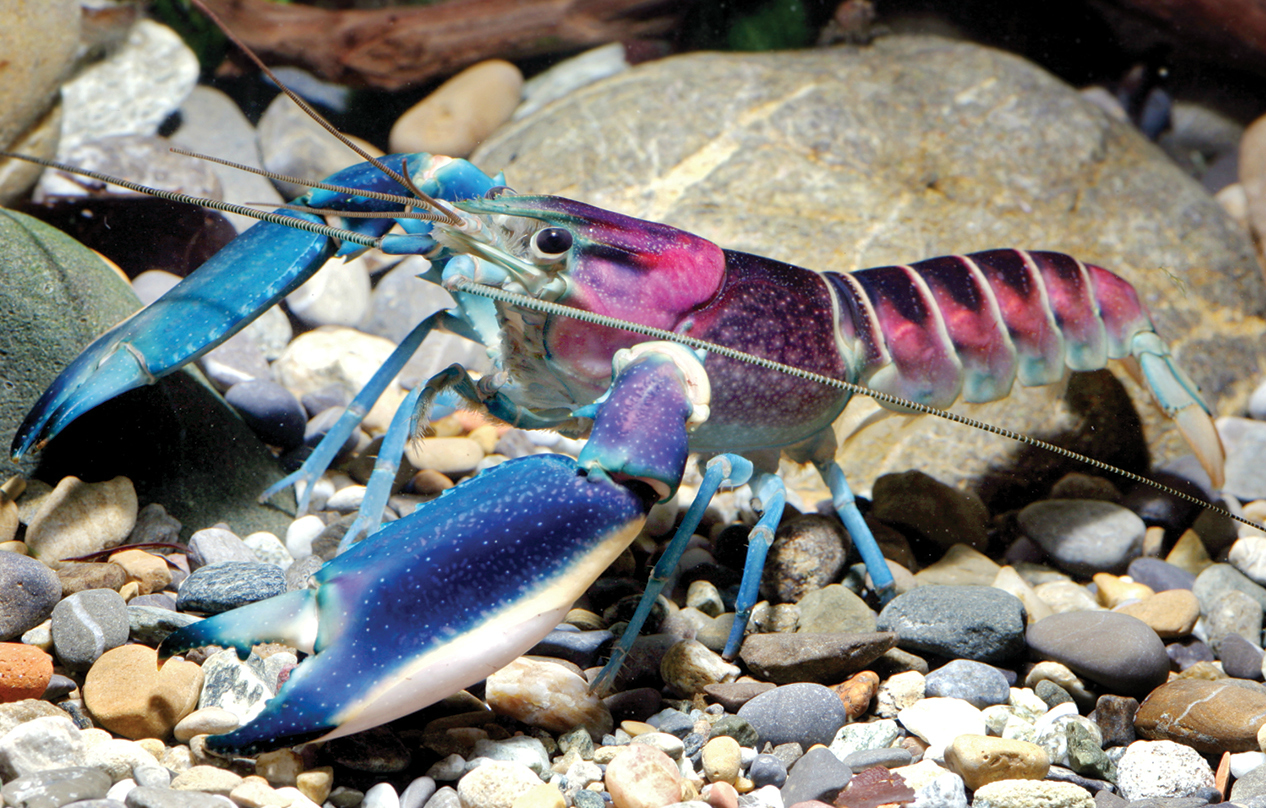
Surface dwellers, meet Cherax acherontis. Cherax acherontis, meet surface dwerllers.


There are plenty of burrowing crayfish in Australia, but this crayfish from the island of New Guinea is the first cave dweller, not just in the region, but south of the equator. That's quite remarkable, considering that the Pacific is a hotspot of crayfish biodiversity, and there are southern hemisphere crayfish in Madagascar and South America.

The name is from Acheron, one of the rivers the ran through the underworld of Greek mythology.

References

Patoka J, Bláha M, Kouba A. 2017. Cherax acherontis (Decapoda: Parastacidae), the first cave crayfish from the Southern Hemisphere (Papua Province, Indonesia). Zootaxa 4363(1): 137-144. https://doi.org/10.11646/zootaxa.4363.1.7

01 June 2017

New snail species is hard to find, in more ways than one

Last year, I tweeted:

One of today's highlights: helping a colleague photograph the holotype of an undescribed species!

I’m pleased that this species description is now out. The species in question was a little snail, now named Praticolella salina! The discovery is highlighted on the university’s home page! But the university’s article doesn’t tell you where to find the paper. Putting the name into Google Scholar didn’t help either. I finally found it because someone posted a shot of the article on Instagram:


Once I knew the journal, I went looking for its home page. I found it is still a print-only affair, with PDFs of the journal lagging three years behind the publication date.

Just remember that the next time anyone says of scientific publishing, “Everything is all online now.” No. No it is not.

External links

UTRGV professor and student researchers discover, name new species of South Texas snail
The Nautilus (journal)

09 May 2017

Tuesday Crustie: Say a prayer

Australian crayfish are often like the country itself. Big, brash, and often highly charismatic. This newly discovered crayfish is a fine example of that.


Meet Euastacus vesper.As the Australians say, “She’s a beauty.”


Sadly, the authors expect this species is already criticially endangered. Like many crayfish species, it has a tiny distribution. But in slightly more cheerful news,the authors note they are working on describing even more new species in this genus.

Reference

McCormack RB, Ahyong ST. 2017. Euastacus vesper sp. nov., a new giant spiny crayfish (Crustacea, Decapoda, Parastacidae) from the Great Dividing Range, New South Wales, Australia. Zootaxa 4244(4): 556–567. https://doi.org/10.11646/zootaxa.4244.4.6

External links

Euastacus vesper, a new Euastacus for NSW
Eustacus vesper – a NEW Euastacus for NSW


18 April 2017

Tuesday Crustie: The Pink Floyd shrimp

Last week saw the announcement of a shrimp that kills with sound and was named after Pink Floyd.


That is Synalpheus pinkfloydi. This newspaper article says the reason it was named for the band is because of a legend that the band once played so loud that it killed fish in a nearby lake. Plus, one of the authors is a rock and roll fans, previously naming a shrimp after Mick Jagger.

The article missed a damn good bit of the paper, though:

Distribution: Presently only known from the type locality on the Pacific side of Panama; likely more widespread in the tropical eastern Pacific, but unlikely to occur on the Dark Side of the Moon due to lack of suitable habitat.

Hat tips to GrrlScientist, Miss Mola Mola, and Mark Carnall.

Reference

Anker A, Hultgren KM, De Grave S. 2017. Synalpheus pinkfloydi sp. nov., a new pistol shrimp from the tropical eastern Pacific (Decapoda: Alpheidae). Zootaxa 4251(1): 102–110. http://www.mapress.com/j/zt/article/view/zootaxa.4254.1.7/10782

19 January 2016

Tuesday Crustie: Scully, is that you?

I haven’t yet been able to figure out whether this Anderson...


Inspired this one:


Or maybe I’m just too excited by The X-Files returning.

This is Cambarus andersoni, a new crayfish species described last month. As you can see, it’s a pretty hefty crustie. I’m still kind of amazed that new crayfish species are being found in well-trodden places like the southeastern United States. This one is found in south Tennessee and north Alabama.

Reference

Jones DR, Eversole AG. 2015 Two new crayfishes of the genus Cambarus (Decapoda: Cambaridae) from Northern Alabama and South Central Tennessee, U.S.A. Zootaxa 4058(2): 151–174. http://dx.doi.org/10.11646/zootaxa.4058.2.1


Gillian Anderson picture from here.

03 November 2015

Tusday Crustie: Cutie

Great new crustacean species keep appearing! And this is a new genus, too!


Meet Aletheiana tenella, a new species from Indonesia. Lovely little guy!

Reference

Ng PKL, Lukhaup C. 2015. Aletheiana tenella, a new genus and new species of freshwater hymenosomatid crab (Crustacea: Decapoda: Brachyura) from Central Sulawesi, Indonesia. Zootaxa 4039(1): 118-128. http://dx.doi.org/10.11646/zootaxa.4039.1.4

20 October 2015

Tuesday Crustie: Climbing purple tree crab leader

Ooh, this new land crab is a beauty...


Not only does Arachnothelphusa merarapensis have a pretty shade of purple going for it, it has some darned interesting habits, too:


All three individuals collected by the authors were all found in trees, often quite high off the ground. Three is obviously not a huge number, but the team looked for any burrows on the ground, and didn’t see them, suggesting this species is a climber by nature.


Because this seems to be a tree dweller, it could easily be affected by logging. The good news is that this animal was found at Merarap Hot Spring Resort (which gives it its name), so its habitat seems safe right now. But that the team could only find three individuals suggests it might be a rare species.

Additional: Loved Rachel Feltman’s comment about this species:

If a crab lives in a tree, then it’s basically just a pinchy spider.

Reference

Grinang J, Min PY, Ng PKL. 2015. A new species of tree-hole dwelling freshwater crab of the genus Arachnothelphusa Ng, 1991 (Crustacea: Decapoda: Brachyura: Gecarcinucidae) from northern Sarawak, Malaysia, Borneo. Raffles Bulletin of Zoology 63: 454-460. http://zoobank.org/urn:lsid:zoobank.org:pub:4CC4DC84-8F6E-4524-9D3F-BAA3C2DAF588

06 October 2015

Tuesday Crustie: All hail the king!

When something makes normally conservative scientists put “remarkable” in the title of a paper, and name a species “king,” you stop and you open the paper.


This lovely hermit crab is Patagurus rex. This was a new genus, named after a legend in the world of crustaceans, Pat McLaughlin.

The species name is not given because it is particularly regal (sadly), but for “the extraordinary albeit superficial resemblance of this new species to some king crabs.”

This picture shows this hermit carrying not the curved snail shell you usually associate with hermit crabs, but a clam shell.

My only regret is that I didn’t stumble upon this lovely little hermit crab description when it was published a couple of years ago.

Reference

Aanker A, Paulay G. 2013. A remarkable new crab-like hermit crab (Decapoda: Paguridae) from French Polynesia, with comments on carcinization in the Anomura. Zootaxa 3722(2): 283-300. http://dx.doi.org/10.11646/zootaxa.3722.2.9

15 September 2015

Tuesday Crustie: Volcanic

The hot new place to discover a new species seems to be pet stores.

Meet the fourth new crayfish species found in the pet trade this year.


For those keeping score, we’ve had Cherax pulcher, Cherax gherardiae, Cherax snowden described this year. To that list, we can now add Cherax subterigneus.

As far as I can tell, the species name breaks down as “subter” (as in subterranean, underneath) and “igneus” (similar to igneous rocks, “hot” rocks formed from volcanic activity). The authors say the name refers “to the Latin form for fiery orange color and bottom side(.)”

This is almost getting a bit goofy, how many crayfish species collectors pulled in and were selling before scientists got to them. I am seriously starting to wonder how many more times I am going to have to update this slide this year:


Reference

Patoka J, Bláha M, Kouba A. Cherax (Cherax) subterigneus, a new crayfish (Decapoda: Parastacidae) from West Papua, Indonesia. Journal of Crustacean Biology: in press. http://dx.doi.org/10.1163/1937240X-00002377

25 August 2015

Tuesday Crustie: Justice, and freedom

It wasn’t that long ago I posted this on Twitter:


And it’s already out of date! Yesterday, a new paper came out with another new crayfish that had appeared in the pet trade before it was formally recognized in a new paper.


I know I’ve posted quite a few crayfish species in this feature, but it’s impossible to resist such a beauty! Like most of the other species being described from the pet trade, this one is from the island of New Guinea in the Pacific.

The common name is the “orange tip crayfish,” but this didn’t factor into the scientific name.

Naming a species after a well-known person is hardly new, and it often raises eyebrows when the name is for someone who is reasonably well known. “Celebrity species names” sometimes gets some criticism due to its perception that it’s a bit of a publication relations attention getter, and not done with due deference and respect and blah blah blah.

It’s Cherax snowden, so named after Edward Snowden. This name may raise a few more eyebrows than usual, as Snowden is not universally loved, shall we say. The paper says this about the choice of the choice of name:

The new species is named after the American freedom fighter Edward Joseph Snowden. He is honored due to of his extraordinary achievements in defense of justice, and freedom.

I updated my little infographic:


Reference

Lukhaup C, Panteleit J, Schrimpf A. 2015. Cherax snowden, a new species of crayfish (Crustacea, Decapoda, Parastacidae) from the Kepala Burung (Vogelkop) Peninsula in Irian Jaya (West Papua), Indonesia. ZooKeys 518: 1-14. http://dx.doi.org/10.3897/zookeys.518.6127

External links

There’s a new crayfish species and it’s named after Edward Snowden 
New Species of Crayfish Named After Edward Snowden 
Researchers name new crayfish species after Edward Snowden
Feedback: The political games in species names

30 June 2015

Tuesday Crustie: Yeti another one

It’s kind of cool to think that when I started this blog, nobody had heard of yeti crabs. We got the first in 2006, the second in 2011, and now we’ve got a third! Meet Kiwa tyleri!


What’s cool about this creature is that it is a polar creature. Like the first two yeti crab species, this one also lives near hot spots, hydrothermal vents.

Related posts

Off the “to do” list
Tuesday Crustie: Dance

Reference

Thatje S, Marsh L, Roterman CN, Mavrogordato MN, Linse K. 2015 Adaptations to hydrothermal vent life in Kiwa tyleri, a new species of yeti crab from the East Scotia Ridge, Antarctica. PLOS ONE 10(6): e0127621. http://dx.doi.org/10.1371/journal.pone.0127621

23 June 2015

Tuesday Crustie: Blue legs

This week, another brand new crayfish species to be given a name!


It’s Cherax gherardii. Im pleased that it’s second, specific name is given in tribute to the late crayfish biologist, Francesca Gherardi. I had to good fortune to meet Francesca at one of her last conferences, the Society for Integrative and Comparative Biology in 2013.

It was sometimes called the “rainbow crayfish” and “blue moon crayfish” in the pet trade – although these names are also used to designate other species in the same genus. The authors recommend “blue-legged crayfish” as a common name.

This is at least the sixth crayfish species in twelve years that was found and sold widely in the pet trade before being introduced to the scientific literature.

To give you an idea of how little we know about it, you can’t find its native habitat (the Ajamaru River and adjoining lakes) on Google Maps. Luckily, there’s a map in the paper, and boy, its range is small.

Update, 15 September 2015: A new paper by the same team has announced a correction to the name: this species is now Cherax gherardiae.

Reference

Patoka J, Bláha M, Kouba A. 2015. Cherax (Astaconephrops) gherardii, a new crayfish (Decapoda: Parastacidae) from West Papua, Indonesia. Zootaxa 3964(5): 526-536. http://dx.doi.org/10.11646/zootaxa.3964.5.2

External links

Remembering Francesca Gherardi

09 June 2015

Tuesday Crustie: Belated present

Thanks to a manuscript I’m working on, I have crayfish on the brain! I went looking for some new crayfish species, and found a few I hadn’t seen before. I’m a few months behind on this one...


Cambarus callainus, yet another new crayfish species coming from the world hotspot for crayfish, the southeastern United States.

In my defense as to why I didn’t spot this handsome new species earlier, the paper describing it was published on Christmas eve...

Reference

Thoma RF, Loughman ZJ, Fetzner JWJ. 2014. Cambarus (Puncticambarus) callainus, a new species of crayfish (Decapoda: Cambaridae) from the Big Sandy River basin in Kentucky, Virginia, and West Virginia, USA. Zootaxa 3900(4): 541-554. http://dx.doi.org/10.11646/zootaxa.3900.4.5

05 May 2015

Tuesday Crustie: Beautiful


Meet Cherax pulcher. Its last name, “pulcher,” literally translates to “beautiful.”

Unfortunately, the beauty of this species may be its downfall. They are already for sale, and collected in large numbers, in the pet trade. And since the species is new to science, we know almost nothing about its basic biology.

Astacologist Chris Lukhaup mentioned on his Facebook page that he’s spent over a decade working on the description of this gorgeous new species. They aren’t all this pretty; there are a couple of different morphs, and no doubt Chris’s considerable photographic talents are at play in this picture, too.

Update, 13 May 2015: This crayfish is featured in this New Scientist article. Warning: contains me.

Update, 15 May 2015: It’s so nice to see crayfish in the news, and attention being drawn to the potential dangers of exploiting an almost unknown species for the pet trade. This article in the Washington Post says the species looks like a Lisa Frank creation... wait, did they steal Jason Goldman’s joke?

Reference

Lukhaup C. 2015. Cherax (Astaconephrops) pulcher, a new species of freshwater crayfish (Crustacea, Decapoda, Parastacidae) from the Kepala Burung (Vogelkop) Peninsula, Irian Jaya (West Papua), Indonesia. ZooKeys 502: 1-10. http://dx.doi.org/10.3897/zookeys.502.9800


31 March 2015

Tuesday Crustie: Made in Taiwan


Even though I’m nominally an expert in crustaceans, I’m embarrassed by how little I know about them. If I was walking down a beach and saw this little guy, I would recognize it as Emerita – which I should, since they were one of the species in my doctoral thesis! – but I would be completely oblivious to this being a new species.

I might, and I stress might, clue into to the colour. The blue patch at the front around the eyes is something that is different than in other mole crabs, but it’s still quite subtle.

Of course, I’m unlikely to spot this walking down a beach, since its name, Emerita taiwanensis, indicates where it’s from: Taiwan. They’ve been found only at two locations, and only once from one of those two.

Reference

Hsueh P-W. 2015. A new species of Emerita (Decapoda, Anomura, Hippidae) from Taiwan, with a key to species of the genus. Crustaceana 88(3): 247-258. http://dx.doi.org/10.1163/15685403-00003413


10 December 2014

Species described at UTPA

As an organismal biologist, I like to imagine discovering a new species. In the course of researching a little departmental matter, I realized that our department can lay claim to introducing three new species to the world of science: a fish, a flower, and an insect.

Garrett GP, Edwards RJ, Buth DG. 2003. New species of Gambusia (Cyprinodontiformes: Poeciliidae) from Del Rio, Texas. Copeia 2003: 783-788. http://www.asihcopeiaonline.org/doi/abs/10.1643/IA03-090.1

McDonald JA. 2008. Merremia cielensis (Convolvulaceae: Merremieae): a new species and narrow endemic from tropical Northeast Mexico. Systematic Botany 33: 552-555. http://dx.doi.org/10.1600/036364408785679833

Terry MD, Whiting MF. 2012. Zorotypus novobritannicus n. sp., the first species of the order Zoraptera (Zorotypidae) from the Australasian Ecozone. Zootaxa 3260: 53-61. http://www.mapress.com/zootaxa/2012/f/z03260p061f.pdf

Plus, some of our faculty members described a new snail species, although that was work she did before they joined our department.

Perez KE. 2011. A new species of Praticolella (Gastropoda: Polygyridae) from northeastern Mexico and revision of several species of this genus. The Nautilus 125:113-126. http://www.northamericanlandsnails.com/publications/The_Nautilus_125_113-126.pdf

DeYoe HR, Stockwell DA, Bidigare RR, Latasa M, Johnson P, Hargraves P, Suttle CA. 1997. Description and characterization of the algal species Aureoumbra lagunensis gen. et sp. nov. and referral of Aureoumbra and Aureococcus to the Pelagophyceae. Journal of Phycology 33: 1042-1048.

Picture from here.

15 April 2014

Tuesday Crustie: Hello, world!


World, meet Gramastacus lacus. Gramastacus lacus, world.

This is an interesting new burrowing crayfish species. For one, it’s only the second in its genus. Second, it has an unusual way of walking on land. (I started my scientific career doing locomotion, so this fascinates me.)

There is a unique forward movement via a series of rhythmic plunges. The crayfish raises the cephalothorax and both claws up with its legs and then moves forward overbalancing and plunges down and forward then repeats the movement. This up and forward movement is unusual, but the crayfish easily moves up, forward and down without “missing a beat”.

I would love to see a video of this!I emailed the author, Robert McCormack, and he doesn’t have any yet. He tells me he’s put recording it, and putting it up on YouTube, onto his research agenda.

Not surprisingly, the headlines are focusing on things that don’t seem so notable. They are not really that small. The technical paper calls them “robust and strong” compared to the other species in their genus. The description on NBC news referring the “cannibal” nature of the crayfish is weird, given that pretty much every crayfish will make a meal out of another if the opportunity arises.

Hat tip to David Shiffman.

Reference

McCormack R. 2014. The eastern swamp crayfish Gramastacus lacus sp. n. (Decapoda, Parastacidae) a new species of freshwater crayfish from coastal New South Wales, Australia. ZooKeys 398:53-67. http://dx.doi.org/10.3897/zookeys.398.7544

External links


28 March 2013

A short tale about a very short tail

As I’ve mentioned before, scientists are so conservative that when you see an adjective like “extraordinary” in the title, you should at least open up the paper if you can and have a peek.

I came across a paper titled, “An extraordinary tail – integrative review of the agamid genus Xenagama” in Google Reader *. I was a bit curious (and miffed) because I had no idea from the title what kind of organism this paper would be about. All kinds of animals have tails.

I love me spikes and spines and armor on critters, so I flipped out a bit when I learned this belonged to the Xenagama:


That is indeed an cool looking lizard (Xenagama taylori) with a cool looking tail. The genus Xenagama originally contained two species that was defined by this short, club-like, spiky tail. But there’s a problem when you use a single extraordinary feature to classify animals: you might overlook all the other features that tie it to other relatives.

A new paper Wagner and colleagues uses a lot of different tricks to tease apart the evolutionary relationships of the lizards in this genus: morphology, genetics, climate, and so on.

By looking at all the morphology, and not just the tails, they found that a long-tailed lizard previously put in another genus (Acanthocercus zonurus; below) sorts out with Xenagama and not Acanthocercus. Genetic analysis on this species also put it in with the rest of the Xenagama group, although it’s an early offshoot from the tree of these related lizards.


The authors also discovered a new species in the genus, that, like Acanthocercus zonurus, has a reasonably long tail; sort of intermediate between the short known species and the misidentified one. This new species is dubbed Xenagama wilmsi.


It turns out that the short tail of most of the lizards in this genus was something that was obscuring some of the relationships. There were similar problems with data on breeding colours. Some of the males in this group show different colours, which was used in creating their classifications, but the males don’t show those breeding colours all year round.

All of which doesn’t answer the obvious question: why do some of these lizards have these short tails? The tails do seem to have an adaptive function. The two species with long tails seem to be tree dwellers, while the two short-tailed species are rock-dwelling burrowers. Xenagama taylori will use its short spiked tail to close its burrow, which you can see in action below:

Xenagama taylori

How this tail has been molded through development and genetic to get so short would be a great doctorate for someone. While native to northern Africa, some of these lizards seem to be fairly available in the pet trade. Don’t know how easily these lizards would be to breed in captivity, though.

Update, 29 March 2013: When readers think of better titles than me: Malcolm Campbell dubbed this article, “Get shorty.” Brilliant!

* You know, that allegedly useless service that absolutely nobody needs because all of the people on Twitter and social media are so good at finding stuff that I want to read, yet who somehow let me down on discovering this.

Reference

Wagner P, Mazuch T, Bauer AM. 2013. An extraordinary tail - integrative review of the agamid genus Xenagama. Journal of Zoological Systematics and Evolutionary Research: in press. DOI:

Top photo from here; Acanthocercus zonurus from here.

19 February 2013

Tuesday Crustie: Two first names

Her name is Laurie Teresa:


Or, if you insist on Latin, Lauriea teresae. This lovely little squat lobster is one of several new species found in the Pacific and Indian Oceans that was just published last month.

Reference

Macpherson E, Robainas-Barcia A. 2013. A new genus and some new species of the genus Lauriea Baba, 1971 (Crustacea, Decapoda, Galatheidae) from the Pacific and Indian Oceans, using molecular and morphological characters. Zootaxa 3599(2): 2. http://dx.doi.org/10.11646/zootaxa.3599.2.2

19 August 2012

Unsolved mysteries

I have a guest post over the blog for Things We Don’t Know. The post is about what this...


...tells us about one of the biggest questions in biology: how many species are there?

Read the guest post here.