
28 April 2006
Protecting marine life in a way
I've written before in this journal about the question of whether lobsters experience pain, and the silly things that get said in support of one position or the other. I'm not entirely sure of what to make of this story, however. See here.

25 April 2006
Senator Zen
I just found out this morning I got elected to my institution's faculty senate. I think I'm pleased, but am too busy right now to know if I am or not.
14 April 2006
F2F
I am a big believer in using online resources to enhance my teaching. I want to emphasize that word, "enhance." Not "do." My general biology classes are about one-third online, and about two thirds traditional lecture. Given that I recently put up my Brain Awareness Week presentation, you might look at that and think I'm getting ready to digitize all my lectures into Flash presentations, and could go totally online with my class.
And I'm greatful to Kathy Sierra for articulating so clearly why I'm not going that route, here.
Of course, a more immediate reason I never started to push to completely online teaching was that when I went partially online, I surveyed my students. I got very strong agreement with a statement like, "Seeing a professor face to face on a regular basis is important to me." So on some level, people seem to realize that interaction with an actual person in the same room is important.
It's also why we still go to conferences and give actual presentations in addition to just writing refereed journal articles. Storytelling is deeply, deeply ingrained in the human psyche.
And I'm greatful to Kathy Sierra for articulating so clearly why I'm not going that route, here.
Of course, a more immediate reason I never started to push to completely online teaching was that when I went partially online, I surveyed my students. I got very strong agreement with a statement like, "Seeing a professor face to face on a regular basis is important to me." So on some level, people seem to realize that interaction with an actual person in the same room is important.
It's also why we still go to conferences and give actual presentations in addition to just writing refereed journal articles. Storytelling is deeply, deeply ingrained in the human psyche.
13 April 2006
A beautiful white elephant?
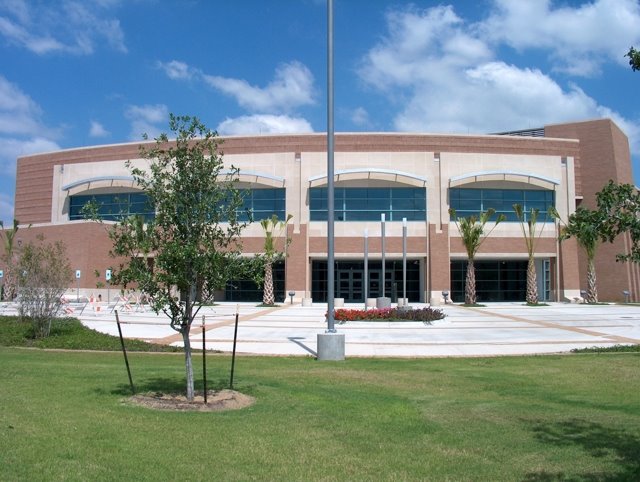 I've written from time to time about the RAHC (pronounced "rack," like the instrument of torture). Construction is pretty much done now (top). I've been inside, and it is indeed a very beautiful facility.
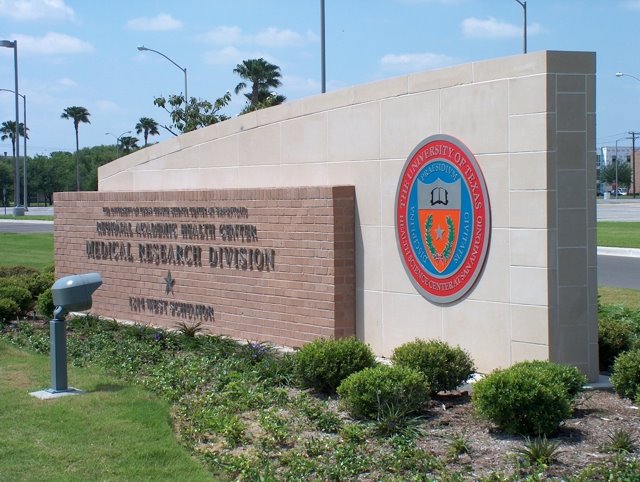 As as you can see, they have a very nice sign (middle).
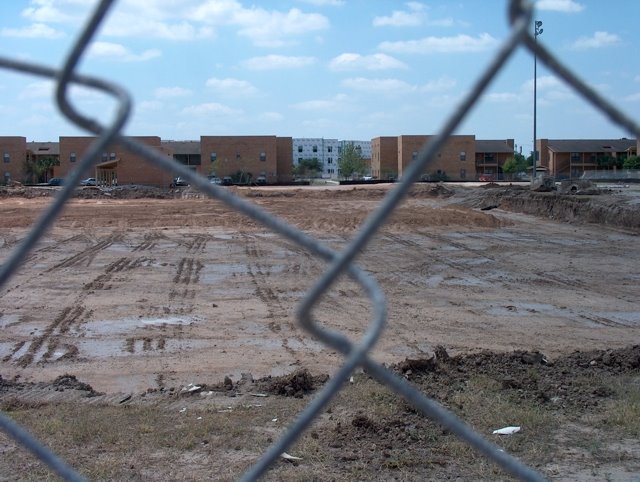 It's just such a pity they're having problems finding people willing to work in it.
Joni Mitchell once famously said that they would pave paradise and put up a parking lot. UTPA is now trying to prove that once you put up a parking lot, you then rip that up and put in a new athletic center with tennis courts and swimming pools. That's the hole in the ground seen in the third picture. If you look in the back, you can see the white buildings. Those are new student residences being constructed. So the construction and growth of my university continues unabated. In fact, though I don't have a picture of it, there's construction going on in my building as well. New office and lab space is being finished out now, and in theory, a new wing should be in the works very soon.
09 April 2006
Weird week
As you can see, I decided to spruce up the joint a little in a fit of mild boredom.
Not been a great week in a lot of ways. The online learning system for the entire university went down Thursday afternoon and is still not back up. Was kept busy by another job candidate visit and a guest seminar speaker. Next week: two more job candidates. Week after that: job candidate and seminar speaker. And the seminar speaker is mine invite, Jim Belanger from Louisiana State University.
Meanwhile, saw a lot of stuff that was depressing. Like the kafuffle here in Texas about Eric Pianka (documented over at Panda's Thumb). A couple of members of my department are prominent members of the Texas Academy of Science. I'm a member myself, but wasn't at this year's meeting, where Pianka was honored for his research, and where he gave the talk that precipitated the current tempest. So this story is closer to home than I'd like.
Also was somewhat worried to learn 60% of America's fresh vegetables come from one valley in California. And was extremely depressed to learn that about 30-40% of Americans don't know where food comes from. (These last two from this week's Science Show; specifically here.) When about a third of people are so divorced from anything biological that they don't know that meat requires killing an animal, is it any wonder why we can't convince people of more subtle biological theories like evolution? Or why people don't understand the ecological principles like carrying capacity that Eric Pianka talks about?
And the Dees have lost two in a row. Dang.
The announcement of the discovery of the ancient Devonian fish Tiktaalik in Nunavut was quite nice, however. I was listening to a radio interview with one of the authors on Quirks and Quarks, and was rather surprised when they said that their fossils ranged from over 1 meter to almost 3 meters! I knew they were impressive in some of the details of their limbs and neck, but I didn't quite appreciate how... you know... big they were. That said, I was a little irritated (again) when watching the CNN news ticker at the gym about the story. It read something like this fish was a link "leading to land animals with four legs and a backbone." Which implies that fish don't have backbones, which they do.
Not been a great week in a lot of ways. The online learning system for the entire university went down Thursday afternoon and is still not back up. Was kept busy by another job candidate visit and a guest seminar speaker. Next week: two more job candidates. Week after that: job candidate and seminar speaker. And the seminar speaker is mine invite, Jim Belanger from Louisiana State University.
Meanwhile, saw a lot of stuff that was depressing. Like the kafuffle here in Texas about Eric Pianka (documented over at Panda's Thumb). A couple of members of my department are prominent members of the Texas Academy of Science. I'm a member myself, but wasn't at this year's meeting, where Pianka was honored for his research, and where he gave the talk that precipitated the current tempest. So this story is closer to home than I'd like.
Also was somewhat worried to learn 60% of America's fresh vegetables come from one valley in California. And was extremely depressed to learn that about 30-40% of Americans don't know where food comes from. (These last two from this week's Science Show; specifically here.) When about a third of people are so divorced from anything biological that they don't know that meat requires killing an animal, is it any wonder why we can't convince people of more subtle biological theories like evolution? Or why people don't understand the ecological principles like carrying capacity that Eric Pianka talks about?
And the Dees have lost two in a row. Dang.
The announcement of the discovery of the ancient Devonian fish Tiktaalik in Nunavut was quite nice, however. I was listening to a radio interview with one of the authors on Quirks and Quarks, and was rather surprised when they said that their fossils ranged from over 1 meter to almost 3 meters! I knew they were impressive in some of the details of their limbs and neck, but I didn't quite appreciate how... you know... big they were. That said, I was a little irritated (again) when watching the CNN news ticker at the gym about the story. It read something like this fish was a link "leading to land animals with four legs and a backbone." Which implies that fish don't have backbones, which they do.
05 April 2006
Brain Awareness Week lecture
I've created an online version of my talk, "Brain Scans and the Magic Lasso," originally given for Brain Awareness Week last month. It's big -- nearly 50 megabytes, and an hour long -- so don't be trying to look at this with a slow connection. You can find it here (Flash format).
I hope that this is huge, full-blown multi-media science presentation will make up for my being quiet the last week or so. Been very busy with job candidates, among other things.
I hope that this is huge, full-blown multi-media science presentation will make up for my being quiet the last week or so. Been very busy with job candidates, among other things.
23 March 2006
Co-rejection
A grant on which I was a co-PI gt rejected this week. Another to add to the pile. But I received notice of a request for applications in April that I might try for, so it's time to line up another kick at the can.
19 March 2006
The Zen of Presentations, Part 6: Failure is an option
The day after Crash won the best picture Oscar, Sounds Like Canada replayed an old interview with writer / director Paul Haggis. (I was aware of his work without being aware of it: he was a lead creative force on Due South.) He said something very, very, very interesting. Paraphrasing, he said, "I'm not interested in a project unless there's a real chance that I might fail."
He said he quit making television because failure wasn't a very real prospect for him any more.
Another little anecdote on ths topic of failure come from Jules Feiffer. He had a cartoon where basically, people come and take stuff away from a person, who doesn't object to this. Because, when they've found you out you're a fake, why bother objecting? He apparently said that a lot of people related to that cartoon, because they never had a significant failure in their work or life. Feiffer had many failures -- Broadway plays closing first night or some such. You move on.
I think many people are governed by fear when they have to give presentations. Performance anxiety, butterflies in the stomach, frog in the throat, or just good old fashioned stage fright. Hence, they fall back on the same back habits that they see everyone else doing. Putting up title slides. Using coloured backgrounds. Sticking in tables with teeny tiny text that nobody can read.
If you aren't risking failure, are you pushing hard enough?
As Neil Gaiman wrote, "Sometimes when you fall, you fly."
He said he quit making television because failure wasn't a very real prospect for him any more.
Another little anecdote on ths topic of failure come from Jules Feiffer. He had a cartoon where basically, people come and take stuff away from a person, who doesn't object to this. Because, when they've found you out you're a fake, why bother objecting? He apparently said that a lot of people related to that cartoon, because they never had a significant failure in their work or life. Feiffer had many failures -- Broadway plays closing first night or some such. You move on.
I think many people are governed by fear when they have to give presentations. Performance anxiety, butterflies in the stomach, frog in the throat, or just good old fashioned stage fright. Hence, they fall back on the same back habits that they see everyone else doing. Putting up title slides. Using coloured backgrounds. Sticking in tables with teeny tiny text that nobody can read.
If you aren't risking failure, are you pushing hard enough?
As Neil Gaiman wrote, "Sometimes when you fall, you fly."
The Zen of Presentations, Part 5: Legalized insanity

And at this point, you may be thinking, “Eh?”
“Come on, you're a scientist, you have to give technical talks on biology. Williams is... you know... funny.” And I freely admit, at first glance, the two don’t meet anywhere near as often as they should. There's several lessons I take from watching Williams.
Nobody ever complains that a talk was “too funny.” Humor is one of the most powerful tools any speaker has. Most humor involves drawing unexpected connections, anyone who laughs has to be thinking and attending and engaged. It can be a great way to check that people are following the words coming out of your mouth. For instance, when I teach protein structure, I often use a little chain of paper clips to represent a protein. Sometimes, while I'm manipulating it at the front of class, it falls apart, and I immediately say, “Whoops! Hydrolysis – did you see the water?” Now, most people reading this will probably go, “I don't get it.” Which is perfectly understandable, you don't have the context to make the connection. But in the context of the lecture, where I've explained what hydrolysis is, it can be funny. Maybe not hysterical, but funny enough that I get laughs with it. If people laugh at jokes related to the content of the talk, I know people are understanding the technical material.
A lot of people warn against trying to be funny in a technical talk, and I don't know why. People say, “Oh, the joke might bomb, and it can be awkward.” If you’ve ever watched every comedian, not everything that comes out is funny. They move on.
One caveat on using humour during a presentation. Don’t just tell a joke just to make a joke. Tell a joke to make a point. The humour should relate to the material. As always, this is particularly true when your talk is tightly timed. That’s probably the main difference between humour in a presentation versus humour in improvisational comedy: you are slightly more confined. That said, many theatre sport games revolve around restricting what you can say or do, and the joy is to find how far you can go within those barriers.
Robin Williams also demonstrates that enthusiasm is contagious. Whenever you’re presenting, you have to find passion, energy, that personal connection to the material.
Another lesson I get from watching Williams is the power of improvisation. An important part of a talk is not just putting information out to your audience, but picking up on cues from your surroundings, and running with it. As Harlan Ellison once said in an interview, “The overriding message of all art… is ‘Pay attention.’” And presentations are an art, so pay attention!
This will sound contradictory, but I think spontaneity is a skill. It can be learned. You can plan for, practice, and rehearse spontaneity.
One of the things I did as a high school student and as an undergraduate was a little bit of acting, which was very valuable to me when I got into graduate school and started giving presentations. I knew how to project my voice, for instance. Another thing that I’m sure most actors will be familiar with is that the first thing that happens is that you have to learn your lines. As you become more familiar with your lines, though, an interesting thing happens. You start to play with them, because you reach the point where you know them so well. You can veer off, try something a little different, and not lose the plot because you have rehearsed. One reason so many talks are so stilted and canned is not that people rehearse too much – talks are stilted because people don’t rehearse enough. They are rigidly following lines, like an actor beginning to learn a new play. The slightest problem throws them off course.
One easy way to “plan for spontaneity” is to have certain lines that work in several different situations. For instance, I can always get a laugh by saying about some process, particularly one that seems a little boring or obscure, “It’s a great party trick... if you're ever at a party with no chicks or booze.” (Stolen without shame from Drew Carey, who used it all the time on Whose Line Is It Anyway?) Talk’s lagging a little? Throw in the party trick line. But it’s brilliant, because it’s so multi-purpose that you can use it without deliberately planning to use it.
Another example of how you can plan to be spontaneous is to make sure your talk is shorter than the allotted time. That way, you can take an extra 30 seconds to say that cogent example that just popped into your head. If your time is 15 minutes, and your talk is always 15 minutes, you cannot deviate without going over time. Leave yourself the breathing room to allow for those fruitful deviations.
So yes, I strongly believed spontaneity is a skill that can be, if not learned, facilitated or not hindered. I believe humour is a skill that can be learned. I think I'm much funnier now than I used to be, and I think that's largely because of having to teach. As you become better prepared, the more able you are to make stuff up as you go.
For instance, a couple of days ago I gave my Brain Awareness Week talk (which went very well, thank you for asking). At the start, I introduced what Brain Awareness Week was, and, on the spot, I said something like, “This runs all this week, so if you're not aware of your brain by the end of tonight, you still have Friday, Saturday, and Sunday to become aware of it.” Didn’t plan it, but it successfully got a laugh. And I was able to keep on track because I knew where I was in the talk and what I had to say next. If I didn't put in enough thought beforehand, I might have lost the plot: “Now, what was I saying?”
But preparation alone doesn’t get you to that level of performance that Robin Williams achieves, which he calls “legalized insanity.” You have to trust your creative impulses and not censor. The good news is that if you do that in a presentation, you are allowed a very large amount of leeway in behaviour that you don’t get while walking around in Wal-Mart (say). (Hence, the “legalized insanity.”) Now that I lecture a lot, one of the things I’ve realized is that it’s difficult to go too far. Forget about trying to present an “appropriate” facade. I do try to avoid being mean-spirited, but otherwise, I feel very comfortable saying whatever comes to mind.
Another talk that I find extremely, extremely inspiring is director Robert Rodriguez's commentary to Spy Kids 2: Island of Lost Dreams. Trust me, whatever you think of the movie, that DVD is worth renting just to listed to the commentary track. On it, Rodriguez talks a lot about his creative process. One of the lessons he said he learned was that his creativity never let him down. He faced problems like needing a song when no composer was available. Rather than saying, “I don’t know how to do that,” he just tackled it and trusted that he could come up with a solution.
And when all of those things start clicking, that's the best. Some people call it flow, some people call it their game face, some people call it being in the zone. And it doesn't seem to matter what the situation is -- the way you get to that is through lots of initial preparation, which gives you the freedom to pay attention and adjust to new situations.
It makes giving a talk. So. Much. Fun.
I've really come to enjoy my lectures, because I can go a little crazy. I can tell jokes. I know I will have a chance to engage in just a little of that “legalized insanity.”
15 March 2006
Front page, baby!
My free lecture for Brain Awareness Week is on the front page of the UTPA website this morning. You can jump directly to it here.
11 March 2006
Talks, fun; heat, not fun
I spent a good chunk of today working on a public lecture for this Thursday, whcih I'm giving as part of Brain Awareness Week. Because it's for a general public talk, I can try some things that I'd get shot if I were to try in a lecture or at a conference. I'm going to try to give a Lessig style presentation. It'll be fun to try.
Speaking of Brain Awareness Week, I'll also be having some fun on Friday. We're going to screen "the best brain movie ever made": Fiend Without a Face.
It was 36°C out today. Yuck. We are rapidly approaching the "really no fun to be outside" part of the year.
Speaking of Brain Awareness Week, I'll also be having some fun on Friday. We're going to screen "the best brain movie ever made": Fiend Without a Face.
It was 36°C out today. Yuck. We are rapidly approaching the "really no fun to be outside" part of the year.
09 March 2006
Off the “to do” list
I finally managed to check off a couple of prominent items on my “to do” list. First, a manuscript I was hoping would go out around New Year’s is sitting patiently in the outbound mailbox waiting to be picked up on its way to a scientific journal. If I can get this out by the end of this year, that would make 2006 among my most productive publishing years ever. Second, I sat down with my colleague Anita this morning and we roughed out what we want to do for our new graduate course, Evolutionary Theory, which we’re going to teach this summer. It’ll be an interesting experience. Not fifteen weeks. Twenty-four days. Twenty-four days of intense teaching action.
Meanwhile, I was actually amazed to see a crustacean making the world news! Kiwa hirsuta is a newly described deep sea decapod – if I understand right, it’s a hydrothermal vent species. It’s blind and furry. It appears to be a squat lobster, which is not a well-known group to most people. But it just goes to show how engaging one good picture of a cool animal really is.
Meanwhile, I was actually amazed to see a crustacean making the world news! Kiwa hirsuta is a newly described deep sea decapod – if I understand right, it’s a hydrothermal vent species. It’s blind and furry. It appears to be a squat lobster, which is not a well-known group to most people. But it just goes to show how engaging one good picture of a cool animal really is.
07 March 2006
Quotable...?
Some weeks back I was interviewed for not one, but two article in our local campus newspaper, The Pan American. You can find those articles online here (PDF format). Check out pages 4 and 7.
04 March 2006
Third time is not the charm
Rejected by the NSF again. This is the third time we've submitted a proposal to the Research Experience for Undergraduates Sites program. It seems like every time we make revisions, the reviews come back no better or maybe even worse.
Other lousy news: Our department was vandalized over the weekend. Only one room so far, the downstairs student lounge, but yeesh.
Ah well. Time to work on a manuscript instead of a proposal. We have a pause in lectures, anyway, that gives me a little time to do such. We have arrived at that peculiarly American phenomenon known as "spring break."
Some things I've been looking at. I just discovered the Creating Passionate Users blog and love it. I particularly like the recent posts on How to be an expert and how Dignity is deadly. Also Guy Kawasaki's blog, which I was led to by his excellent talk on innovation. Although it is geared at businesses, I think there's a lot for academics to take away from it. For instance, Guy talks about the idiocy and generic nature of mission statements. Most universities have mission statements. Heck, I was asked to write one for our graduate program. But I think he's on the mark with his alternative, which is to make a three to four word mantra instead of a mission statement. My mantra as the grad coordinator in my department is, "Springboard students' careers."
Other lousy news: Our department was vandalized over the weekend. Only one room so far, the downstairs student lounge, but yeesh.
Ah well. Time to work on a manuscript instead of a proposal. We have a pause in lectures, anyway, that gives me a little time to do such. We have arrived at that peculiarly American phenomenon known as "spring break."
Some things I've been looking at. I just discovered the Creating Passionate Users blog and love it. I particularly like the recent posts on How to be an expert and how Dignity is deadly. Also Guy Kawasaki's blog, which I was led to by his excellent talk on innovation. Although it is geared at businesses, I think there's a lot for academics to take away from it. For instance, Guy talks about the idiocy and generic nature of mission statements. Most universities have mission statements. Heck, I was asked to write one for our graduate program. But I think he's on the mark with his alternative, which is to make a three to four word mantra instead of a mission statement. My mantra as the grad coordinator in my department is, "Springboard students' careers."
28 February 2006
Reaching your audience
There are a few things that authors live for. One is finding out that someone you actually don't know personally has read something of yours. And today, I got a very nice email from a researcher in Australia who read my recent article on shovel nosed lobsters in the Journal of Crustacean Biology. He had done his doctorate on a related species, so he was one of the few people who would actually care about the topic! It made me smile.
Meanwhile, my new manuscript is getting pretty close to ready for submission. Hopefully no later than next week. I will have no excuses after next week, because it's our break. No classes to get in the way!
Meanwhile, my new manuscript is getting pretty close to ready for submission. Hopefully no later than next week. I will have no excuses after next week, because it's our break. No classes to get in the way!
27 February 2006
The Zen of Presentations, Part 4: Titles slides are a crutch
I first became aware of this particular presentation tic at grad seminars at UVic. The symposium moderator would get up, thank the previous speaker, then introduce the next speaker and tell the audience the title of the talk. The speaker would walk to the podium and put up their first slide which, more often than not, showed the title of the talk -- the one that the moderator had just read. Not content with that, the speaker would then to look at their slide and, very earnestly and deliberately, proceed to read the title out loud.
So we get that blasted title three times over.
It drove me bonkers then, and drives me bonkers now. I really only need to know a title once. Unfortunately, title slides are emblamatic of a presentation style that is not beaten out of presenters anywhere near often enough: that is, reading directly from slides verbatim.
There are several reasons to avoid having a title slide. First, it burns up time. Particularly in science, I often have to present talks where I summararize complex information that took months or years to gather and analyze, and I have to do it in 15 minutes. Including time for questions. I have to focus on what I need to say as directly and memorably and efficiently as possible.
Second, it can be a little distancing for the audience. You get up, and barely before the audience can look at your face, the lights are going down and people don't know whether to look at the slide, or look at you. Give yourself at least a few second to get up, let people see who you are. Maybe smile, if that's appropriate (not recommended if you're giving a talk about, say, deaths in sub-Saharan Africa from AIDS).
I think people like having a title slide, because it gives them a safe and easy way to start off a talk. Instead of worrying about "What will I say?", you just have to read the title, thereby putting off the problem of whether you really have anything of substance to say by... oh... a good ten to fifteen seconds or so.
A title slide is a useful crutch to deal with that initial moment of the talk. Some people need a simple way to overcome that initial hesitation -- and that's fine. I am in no way bashing crutches here; they're useful things. But the goal should always be to get rid of the crutch, rather than relying on it.
If you want to leave a title in, there are some alternatives to the title slide. Let the moderator read your title. Or, if you feel you must have a title slide, don't read it out directly -- just talk about your subject. Alternately, if you want to tell people the title because there is no moderator, just tell them -- but don't make a text slide of it. I am convinced, though, that the best solution is to forget about introducing a title and just tell people your story in most cases. And leave the lights up for a few seconds so that your audience can see your face.
So we get that blasted title three times over.
It drove me bonkers then, and drives me bonkers now. I really only need to know a title once. Unfortunately, title slides are emblamatic of a presentation style that is not beaten out of presenters anywhere near often enough: that is, reading directly from slides verbatim.
There are several reasons to avoid having a title slide. First, it burns up time. Particularly in science, I often have to present talks where I summararize complex information that took months or years to gather and analyze, and I have to do it in 15 minutes. Including time for questions. I have to focus on what I need to say as directly and memorably and efficiently as possible.
Second, it can be a little distancing for the audience. You get up, and barely before the audience can look at your face, the lights are going down and people don't know whether to look at the slide, or look at you. Give yourself at least a few second to get up, let people see who you are. Maybe smile, if that's appropriate (not recommended if you're giving a talk about, say, deaths in sub-Saharan Africa from AIDS).
I think people like having a title slide, because it gives them a safe and easy way to start off a talk. Instead of worrying about "What will I say?", you just have to read the title, thereby putting off the problem of whether you really have anything of substance to say by... oh... a good ten to fifteen seconds or so.
A title slide is a useful crutch to deal with that initial moment of the talk. Some people need a simple way to overcome that initial hesitation -- and that's fine. I am in no way bashing crutches here; they're useful things. But the goal should always be to get rid of the crutch, rather than relying on it.
If you want to leave a title in, there are some alternatives to the title slide. Let the moderator read your title. Or, if you feel you must have a title slide, don't read it out directly -- just talk about your subject. Alternately, if you want to tell people the title because there is no moderator, just tell them -- but don't make a text slide of it. I am convinced, though, that the best solution is to forget about introducing a title and just tell people your story in most cases. And leave the lights up for a few seconds so that your audience can see your face.
E.Q.
| You Are 54% Evil |
 Fear not though - you are on your way to world domination. |
26 February 2006
Unexpected linkages
Amazon.com sagely suggests that because I'd like the upcoming Harry Potter and the Goblet of Fire DVD, that I would probably also like a power razor with a storage case. Marvellous.
Was a bit of an odd week. Finally had some long-overdue time to work on a manuscript that has been almost ready to ship out for some months. It's getting even closer now, and another big push to get this manuscript out the door was that the editor of my upcoming paper emailed me to tell me that it should be out around May. Nothing in the publication pipeline is bad.
My editor for that article also emailed to say that the page charges was three months overdue. And why are they three months overdue? Could it possibly be because my institution is apparently nigh incapable of handling money? Nah, couldn't be.
Also had a birthday in there. Rather low key affair. Good, but not as extravagantly celebratory as I had thought.
19 February 2006
More rejection, please
I just got word on one of my last grant applications, this one to the SOMAS program, and it was rejected. I suck.
It has been unusually chilly the last few days, and it's quite cold in my office, so I think I'm just going to go home and work there.
18 February 2006
Professor in disguise
I went to an early morning meeting on Thursday to meet a couple of people who came to our campus to evaluate our Honor's program. It was an interesting meeting. Sometimes, it's nice to hear people from outside remind you that you're not crazy for thinking that the way certain things are set up are not functional...
Anyway, the funny part was that I came in and sat down and one of them asked if I was a student.
Heh.
Subscribe to:
Posts (Atom)