Back in March, I gave a public talk for Brain Awareness Week, "Brain Scans and the Magic Lasso." (An archived version is here).
In it, I talked about how I saw the use of fMRI as imminent in legal situations. And I was right, as I learned listening to the Nature podcast this week (transcript here). Companies called No Lie MRI and Cephos are going to sell commercial lie detection systems based on fMRI. And I pretty much called that in my talk. Legal challenges will happen, I predict.

24 June 2006

23 June 2006
Thought from an administrator
Quote from yesterday's provost candidate that I quite liked:
"A vision without a plan is fantasy. A plan without a vision is drudgery."
Even though I'm unsure if he's my favourite candidate, hey, at least I got a good quote from going to the ope forum...
"A vision without a plan is fantasy. A plan without a vision is drudgery."
Even though I'm unsure if he's my favourite candidate, hey, at least I got a good quote from going to the ope forum...
22 June 2006
The time monsters
This week is one of those weeks. Forgot about finding time to blog or work on the book manuscript, finding time to go to the washroom is a major accomplishment. This week consists of: Get up, get ready for class, class, run to tail end of faculty senate meeting with provost candidate, lunch, get quiz ready for class, for to open forum with provost candidate, work with intern Amanda, few minutes to try to tie up loose ends, home for dinner, exercise, sleep.
And that's the day. Repeat five times. Use weekend to catch up.
I'm horribly behind on some classwork and a few other things, largely because the provost interviews are chewing up a big chunk of the day. But it's really important to see those interview situations, because this is the #2 job on the campus. It's one of the ones that can have a huge impact on the overall health of the place. Not to mention my own career.
And that's the day. Repeat five times. Use weekend to catch up.
I'm horribly behind on some classwork and a few other things, largely because the provost interviews are chewing up a big chunk of the day. But it's really important to see those interview situations, because this is the #2 job on the campus. It's one of the ones that can have a huge impact on the overall health of the place. Not to mention my own career.
18 June 2006
Flashback
 Hey, I was almost hot (scientifically) in July through September 2004. Go way down to #22. Never noticed that before.
Oh, yeah...
As a Canadian, I am contractually obligated to say:
Go Oilers.
Now back to paperwork. I mean it this time.
Go Oilers.
Now back to paperwork. I mean it this time.
Bookwork
 I think there's something to be said for this obsessive tracking of a project in a public forum. It was able to get me off my bum and get a few hundred words in on my book manuscript, after a week or so of thinking about other things (class, interns, etc.). I've heard B.F. Skinner used a similar technique when writing. He would keep track of what he was doing, and would only allow himself to take speaking engagements when he was above his target number.
Anyway, back to the many other tasks that need doing. Many, many other tasks...
17 June 2006
Taxonomic romance
 In our graduate evolution class yesterday, my colleague Anita revealed that there is a group of beetles named after her.
I was instantly jealous.
By way of a few quick reminders, the traditional method of classifying organisms is to have seven levels: Kingdom, phylum, class, order, family, genus, species. The names have to be in Latin or Greek, although "latinizing" names or words from other languages is allowed. Ths person who describes a group gets to name it. Names are often descriptive of the organism's look or living space. For instance, take the case of the sand crab Blepharipoda occidentalis (pictured), which I studied for my doctoral work. Blepharipoda, the genus name, means "eyelash feet," which refers to the fringes of hairs (setae) that line the beautifully curving leg tips (dactyls) that they use for digging into sand. They live on the west coast of North America, and their specific name, occidentalis, reflects this, as it means "western."
Taxonomists are free, however, to name species and genera and so forth whatever they want. Locally, when my colleague Bob Edwards described a new species of fish, he named it Gambusia clarkhubbsi after a Texas ichthyologist, Clark Hubbs.
But you don't need to be a scientist to get a species named after you (though it probably helps). Returning to sand crabs for a second, Chris Boyko works on the taxonomy of sand crabs like Blepharipoda. He's also a fellow comics enthusiast (loves Chester Gould), and a man who made my writing life hell by splitting one sand crab family into two, making it much harder to describe some work I did. Be that as it may. He named one sand crab after The Simpsons creator Matt Groening: Albunea groeningi. He named another after Peanuts character Lucy (infamous for her "crabby" disposition): Lepidopa luciae.
Anita got a genus of beetle named after her because, well, she happened to be dating a beetle taxonomist at the time.
I'm so jealous.
I have genus envy.
(Yeah, that's right, I wrote this whole long blog entry just to make that one lousy pun.)
16 June 2006
Ah.
Friday afternoon has been nice to me today. No talk to think about that's less than 24 hours away. Nobody bothering me, for the most part. Just a chance to stop and think for a few minutes and get my head organized. I realized several NSF grant deadlines were coming up, so I started work on at least one of those. I may take a crack at more than one, who knows. Still many things that need doing and not enough of them done (must email grad students and prospective grad students...), but I didn't feel as rushed-pushed as I felt much of the week earlier.
15 June 2006
In turn...
 In another one of those still-not-quite-sure-how-this happened events of the summer, I spent this afternoon meeting with various people about a summer internship program with high school students. I'll have a student, Amanda, working with me for six weeks starting next Monday. Not quite sure what I'll have her do yet. Will have to spend some time sorting out project ideas next week.
Speaking of the grad class, it's going very well, all things considered. My colleague Anita thought today went well -- which was good, considering it was on a very subtle topic (units of selection).
12 June 2006
Today's loss of productivity
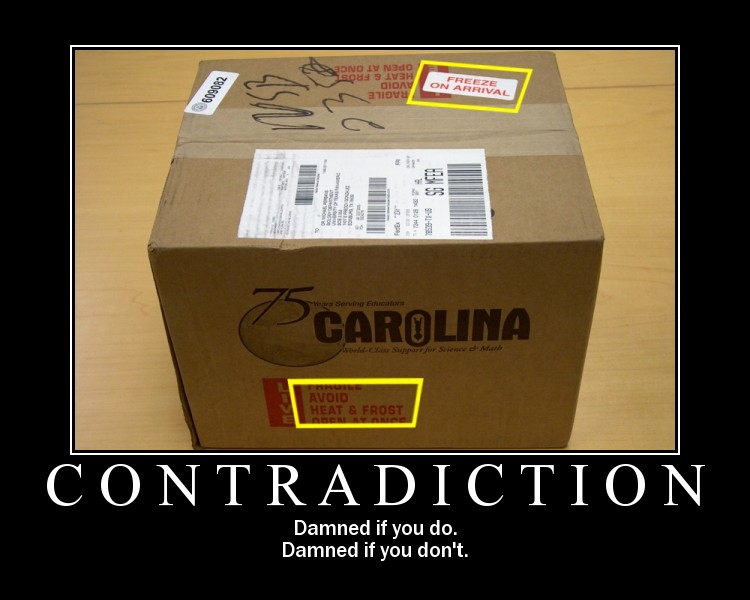 Click image to enlarge if you can't read the text. I took the picture of the box that I actually received from Carolina Biological Supply, but created the fake poster style with the instantly addictive Motivator.
10 June 2006
Ahead of the game?
 One week of summer class down. The class (Evolutionary Theory) is going as well as can be expected for the first time. The thing I'm enjoying about it the most is that, as I expected, my colleague Anita and I have very different strengths and interests. She can put together lectures on stuff that I couldn't. At least, not without way more preparation, difficulty, and stress on my part.
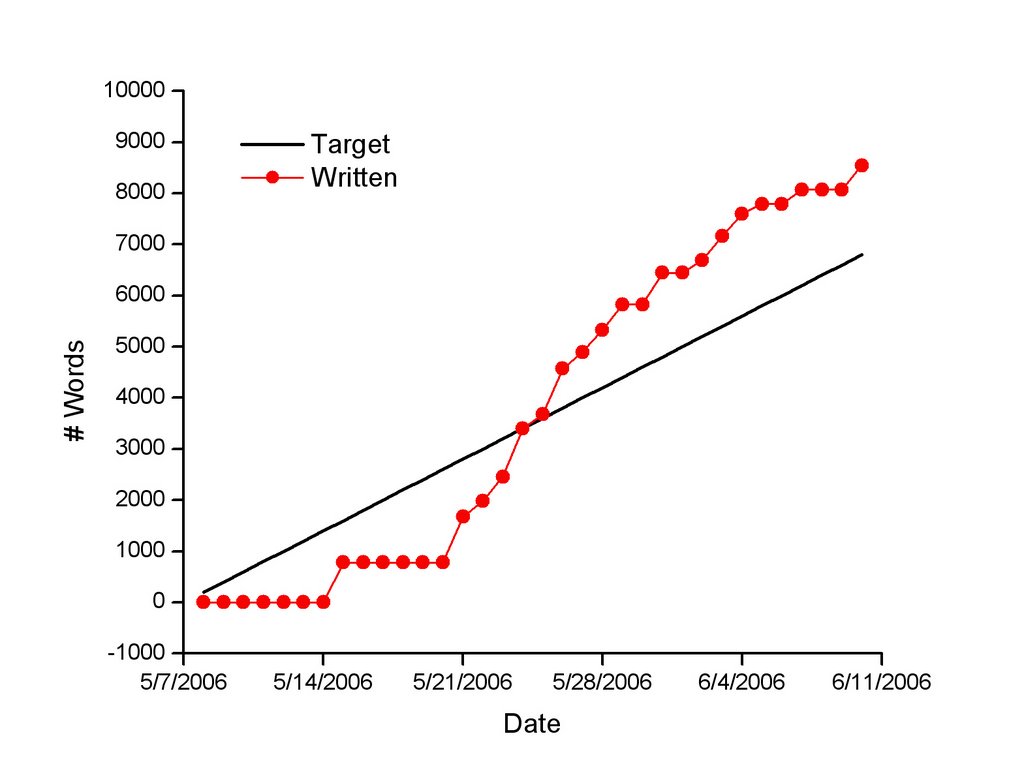
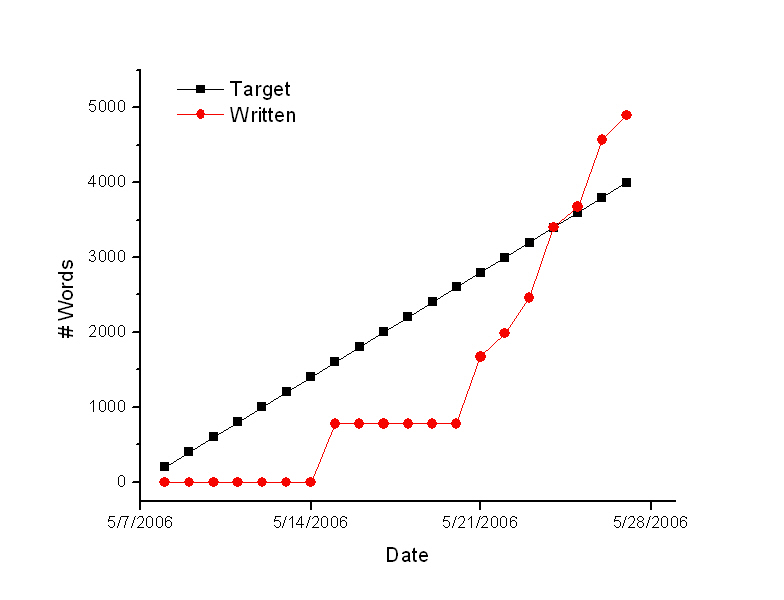
As far as the book manuscript goes, I have no idea how I'm managing to keep the word count above the 200 words a day target (graph). But I am, though the curve is clearly starting to flatten, and the writing is going to start getting harder very quickly.
04 June 2006
Heritage
 Just as people are curious about their family lineage, academics are curious about their intellectual lineages. An intellectual lineage is more complex than a family lineage in some ways, because of course while we're restricted to two parents, we are often fortunate to have many excellent teachers who contribute to our intellectual development.
Nevertheless, the usual tradition is to trace intellectual influences back through Ph.D., since that's the highest degree, and usually the one that people spend the most time on, and the one that typically establishes the closest working relationship between student and mentor.
I knew my Ph.D. supervisor, Dorothy Paul, worked with Don Kennedy. Don Kennedy is a pretty well known figure in science, because he edits the journal Science. But I couldn't find out in my digging who Don Kennedy worked with. I decided to use a rather old fashioned technique to find out: I wrote a letter.
To my surprise, considering how hectic being Science editor must be, Don Kennedy wrote me back a short but very nice letter back very promptly. To my surprise, he worked with Don Griffin, whose work is famous in biology. He demonstrated how bats found their way in the dark: by echolocating. In animal behaviour, he was also a strong advocate for the field that became known as cognitive ethology.
I have yet to work out who Don Griffin did his doctoral work with. May take a while, but I'll keep it in mind.
03 June 2006
Here we go 'round again
I spent a good chunk of the day in my lab doing work related to my current manuscript that's in revision. It's necessary but unglamorous grunt work: all I'm trying to do is to get some pictures of already known results.
One of the great joys of doing research is that you get to find out new things. But the downside is that you always have to do it more than once. Replication is critical to science. In fact, I was listening to an interview with a parapsychologist (A little searching reminds me that it was Michael Thalbourne) who talked about the "well-known fact" that results in parapsychology get weaker over time as people try to replicate them, not stronger.
And I thought, "There's your sign."
The effect gets worse the more you try to study it? That's the exact opposite of regular science, and to me speaks volumes about why parapsychology doesn't get respect. It's pathological science to say, "Oh, effects get weaker as we look for it again."
In my case, I'm trying to get a few pictures of crayfish neurons. The ones I'm interested in were well described about 30 years ago, and are well known. But, since the point of the paper I'm working on is to compare similar neurons in a species that is not a crayfish, it helps to have pictures showing that I can in fact see what everyone else has described, and that any differences are not just due to dodgy techniques on my part.
And, to make matters even less interesting, I even have some pictures of the relevant cells. They're just not very pretty. But, because I think this manuscript has a chance to actually be a bit more widely read than some of my other stuff, I figured I might as well take the time to try to get some stuff that looks nice.
Necessary, but trying to maintain enthusiasm while doing replicates is awfully hard for me. Research is much more fun when you don't know what the answer is going to be.
One of the great joys of doing research is that you get to find out new things. But the downside is that you always have to do it more than once. Replication is critical to science. In fact, I was listening to an interview with a parapsychologist (A little searching reminds me that it was Michael Thalbourne) who talked about the "well-known fact" that results in parapsychology get weaker over time as people try to replicate them, not stronger.
And I thought, "There's your sign."
The effect gets worse the more you try to study it? That's the exact opposite of regular science, and to me speaks volumes about why parapsychology doesn't get respect. It's pathological science to say, "Oh, effects get weaker as we look for it again."
In my case, I'm trying to get a few pictures of crayfish neurons. The ones I'm interested in were well described about 30 years ago, and are well known. But, since the point of the paper I'm working on is to compare similar neurons in a species that is not a crayfish, it helps to have pictures showing that I can in fact see what everyone else has described, and that any differences are not just due to dodgy techniques on my part.
And, to make matters even less interesting, I even have some pictures of the relevant cells. They're just not very pretty. But, because I think this manuscript has a chance to actually be a bit more widely read than some of my other stuff, I figured I might as well take the time to try to get some stuff that looks nice.
Necessary, but trying to maintain enthusiasm while doing replicates is awfully hard for me. Research is much more fun when you don't know what the answer is going to be.
02 June 2006
Holy cow, it's June?
 Yeah. It's June. My new graduate class, Evolutionary Theory, starts Monday. It runs every day and I'm just working on Friday's talk. Luckily, I'm co-teaching it with my colleague Anita Davelos Baines, because otherwise, I'd only be working on Wednesday's talk and I'd getting ready for complete panic on Thursday. Instead of moderately nervous for the following Monday (10 days time).
Fortunately, I've managed to get somewhat ahead in my target word count for the book manuscript. Which is good, because I think that red line is going to flatten next week.
29 May 2006
The blog as art
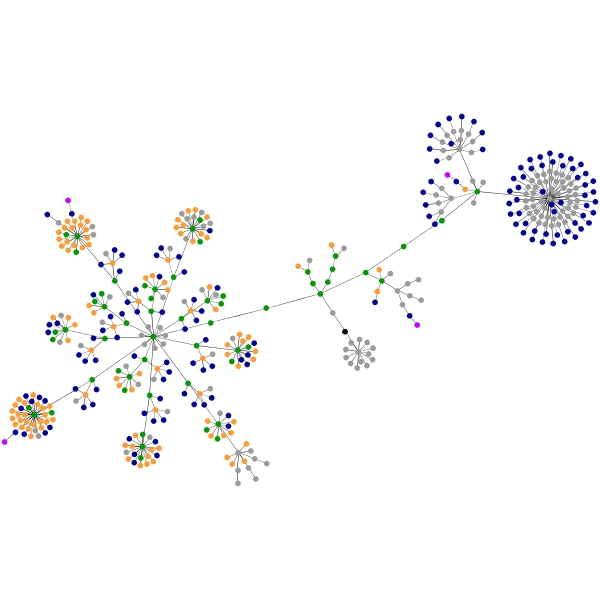


 The graphics on this page shows the way a webpage is written. The first one on the left is the page you're reading (prior to making this post, which should change the structure slightly). I suspect that many Blogger-driven blogs will look the same, due to common blogger templates and such.
To the right of that, with lots of red, is the structure of the International Society for Neuroethology webpage, which I oversee but did not write. The preponderance of red indicates a lot of tables being used to structure the page.
Interestingly, but not surprisingly, authors seem to have distinct styles. The third and fourth graphs are both pages I created -- my academic home page (left) and one of my hobby pages (right). The substantial amount of blue and orange in the bottom two graphs shows that I like links and text, respectively.
The original description of the project, and a link to make a graph of any website you want) is here. It's really quite fun to watch the program run, as the graphic "grows" out, very quickly at first, then finally settling down to a pattern. More discussion, including some very helpful interpretation, is found on this discussion thread on Edward Tufte's website.
27 May 2006
Lies that scientists tell
I wrote previously that honesty is a core value for scientists, but that doesn't mean that scientists don't engage in, shall we say, "spin."
(This post inspired by several similar ones over at Guy Kawasaki's blog.)
- "This work could have practical applications." Maybe it will and maybe it won't, but that's not why you did the research, is it, you fibber? You did it to test the dominant theories. It might be a dominant theory in the field that you want to support, it might be a little upstart theory that you think makes no sense or attacks your findings. Most scientists are scientist entirely because they love the ideas. It's the engineers' job to worry about practical applications.
- "I'm just following the data." The idea that scientists are dispassionate observers does not, in any way, jive with my experience woking with scientists. I've seen and read too many arguments from researchers studying the origin of bird flight to be convinced otherwise. (It seems, from a distance, to be one of the most polarized, divided into us and them warring intellectual camps that you'll find anywhere.) Scientists I know are very often emotionally attached to their theories. After all, as I mentioned a while ago, people like to have their beliefs confirmed. But if you understand science in a deep-in-your-bones kind of way, you know that you have to try to murder your darlings. You have try to strangle your absolute best to see if they really hold up.
- "Introduction - Materials and Methods - Results - Discussion/" This is the standard format of scientific papers. It's supposed to reflect the order of events that goes on in performing research. Ha! More like, "Methods, preliminary results, more methods, results we had to throw out because equipment broke / animals died / grad student didn't take measurements when he was supposed to / supervisor didn't take measurements that she was supposed to, more methods, statistical analysis of results so far because the poster for the upcoming conference is due next Tuesday, more methods trying to fix the criticism you got from the conference poster, results that you might actually be able to trust, start researching discussion, write introduction to make it seem that this experiment was designed to test a theory that you weren't even aware of until you started researching the discussion."
(This post inspired by several similar ones over at Guy Kawasaki's blog.)
Why a book?
 As I mentioned last time, I'm working on a book manuscript. Why am I doing that instead of, say, writing a technical review article for a journal? There's several reasons, but it boils down to public relations.
Books get attention.
Science, Nature, American Scientist, Animal Behaviour, New Scientist are all journals that I read that have book reviews every issue. Just a few off the top of my head. Some even have occasional special book issues. There are many books that even though I've never read, I've read so many reviews about them that I have a decent idea of their arguments and what they're about.
Write a book and you might get invited to talk about it on Quirks & Quarks or the Science Show. Heck, the last third of The Daily Show would not exist if it wasn't for authors plugging their books.
Likewise, relatively few people ever go in and wander around an academic library, pick up a journal with an interesting cover and skim a few abstracts. People go into bookstores and do that all the time.
Sure, the blogosphere is making an ever-increasing impact over the past few years. And there's no getting away from the importance of peer reviewed refereed journals in making or breaking scientific careers. But if the goal is to explain something about my field to those outside it -- which it is -- I think a book may be the best way to go.
It's easy to keep up with my 200 word a day target right now (see graph). This is partly because I'm still at the point where I'm fleshing out a structure and deciding what I want to talk about. It's also partly because as I'm writing, references are going in. References add quite a few words, but don't require any talent on my part except deciding which is the right one to put in and where.
There's going to be two hard parts. One is going to come when I start hitting the limits of what I know from my general background, which will mean I'll have to find a lot of old articles to learn what I don't know. The second is going to be the point where I have the structure in place and I have enough words (or, more likely, more than enough), and have to figure how to say it all in a way that a non-researcher can not only understand, but enjoy.
;;;;;
Meanwhile, I actually had research going on in my lab this week. We finally have tunicates back, so my HHMI undergraduate student Veronica is doing some experiments with them. My graduate student Sandra got the tax return cheque that she needed to fix her rattling car, so she can now drive into the lab. Both she and I are trying to replicate some results for a manuscript that we're revising for a journal. The reviews were positive, but the referees asked us to try to refine a couple of figures.
I hope Sandra has more success than me. I set up one experiment Wendesday, and needed to finish it Thursday. I had meetings almost all that day and I wasn't able to get into the lab until quite late. And the experiment has not worked at all. I didn't get a single datum, nothing that would help the manuscript revision get off.
24 May 2006
Now that I'm on track I can tell you
 Spalding Gray, in his monologue movie Monster In A Box, talked about being in Los Angeles and asking random people (the person behind the checkout counter, someone in line in the grocery store, whoever), "How's your screenplay going?"
The usual response: "How'd you know?!"
Everyone secretly working away on their story. I feel a little bit like that now.
I can't remember whether to blame this one Neil Gaiman's blog or Stephen King's writing memoir, but I think it was one of those two who wrote that if you can write 200 words a day for a year, you've got a novel at the end of one year. Somehow, that little piece of advice has ferreted itself away in my head, and I've decided to give it a try.
I'm trying to write a book. Not a novel, not a work of fiction, but a scientific book. (I don't have enough imagination for fiction.) The idea to write a book has been rolling around in my head for a while now. Originally, the idea was to do a review article for some journal, but somewhere along the road, I thought this might work as a full-blown, proper book.
At the end of the semester, I decided to try to get it off the ground. I was promptly waylaid and did nothing on it for several days. But I'm keeping track (that's the graph -- I am that geeky), and trying to keep to that goal of 200 words a day. It's taken until today to get to about where I should be.
I'm hoping that by posting about this process, it'll help to force me to continue steadily writing. 'Cause now someone might, you know, be watching. I know, weird, but I can't explain it better than that.
I'm not going to tell you what the book's about yet. It's too early. After all, I am often overly ambitious and this might just fall apart and I never finish it. But it's better better to try stuff than not try it.
Do i whiiiiiiiiiiiiiiiiiIIIIIIIne?
While browsing the always enlightening Panda's Thumb, I followed a link from there to the equally fine Aetiology and finally a weird editorial on MSNBC.
First, the subtitle says, "Evolution debate doesn't help doctors confronting difficult medical decisions." I think most people with some biological knowledge can immediately think of one case where understanding of evolution would inform a medical decision: do you prescribe antibiotics or not? If you understand evolution, you're more likely to understand why using antibiotics willy-nilly is a bad idea. Antibiotics kill bacteria -- most of them. Some, by natural variation, resist the antibiotics, maybe taking more to kill them. They survive and reproduce. Congratulations! You've created a selection pressure on bacteria that leaves us with antibiotic resistant strains in the long run.
In the first paragraph describes how he was thinking about this as his kid graduated from med school. While I'm always happy to hear about a student completing achievement, it's not at all clear why physicians and medicine is getting dragged in here so forcibly. Tara Smith already pointed out in Aetiology, scientists are not here just to teach medical students, gunfunit.
He wants scientists to talk about values. Hey! I did that a couple of months ago. And I will argue to him that the value of honesty requires that biologists continue to "whine" about intelligent design: because a lie left unchallenged gains the perception of truth.
Besides, I'd prefer to think that I whinge.
First, the subtitle says, "Evolution debate doesn't help doctors confronting difficult medical decisions." I think most people with some biological knowledge can immediately think of one case where understanding of evolution would inform a medical decision: do you prescribe antibiotics or not? If you understand evolution, you're more likely to understand why using antibiotics willy-nilly is a bad idea. Antibiotics kill bacteria -- most of them. Some, by natural variation, resist the antibiotics, maybe taking more to kill them. They survive and reproduce. Congratulations! You've created a selection pressure on bacteria that leaves us with antibiotic resistant strains in the long run.
In the first paragraph describes how he was thinking about this as his kid graduated from med school. While I'm always happy to hear about a student completing achievement, it's not at all clear why physicians and medicine is getting dragged in here so forcibly. Tara Smith already pointed out in Aetiology, scientists are not here just to teach medical students, gunfunit.
He wants scientists to talk about values. Hey! I did that a couple of months ago. And I will argue to him that the value of honesty requires that biologists continue to "whine" about intelligent design: because a lie left unchallenged gains the perception of truth.
Besides, I'd prefer to think that I whinge.
21 May 2006
Ancient enemies continue their battle
I live right across the corner from the Edinburg Baseball Stadium. The year I moved here, 2001, was the year the Edinburg Roadrunners debuted. They won the league championship that year, and again in 2004. Imagine my surprise when I walked by the front of the stadium as I routinely do, and saw a sign up proclaiming that the baseball stadium was home to the Edinburg... Coyotes.
Sheesh. Don't they know coyotes never catch roadrunners?
(With appreciation to the late, great Chuck Jones.)
Couldn't resist. Actually, the Coyotes are actually the winners this time. The poor Roadrunners are defunct, as is the league they played in. More on the Roadrunners / Coyote dispute here. And, joking aside, the Coyotes did win earlier this week.
Sheesh. Don't they know coyotes never catch roadrunners?
(With appreciation to the late, great Chuck Jones.)
Couldn't resist. Actually, the Coyotes are actually the winners this time. The poor Roadrunners are defunct, as is the league they played in. More on the Roadrunners / Coyote dispute here. And, joking aside, the Coyotes did win earlier this week.
Subscribe to:
Posts (Atom)