17 May 2023

First women’s footy game!

I became a card-carrying member of an AFLW team in season 1. I was finally pleased to see a women’s footy game in person – and a championship game, no less!

Over the weekend, Hamilton hosted the AFL Canada Cup, a tournament for North American women’s teams. I didn’t get to see the whole tournament, but I did make it for the final game between the Calgary Kookaburras (actually joint with Burnaby Eagles) and the Etobicoke Kangaroos.

Picture of Calgary Kookaburras in red playing against the Etobicoke Kangaroos in blue.

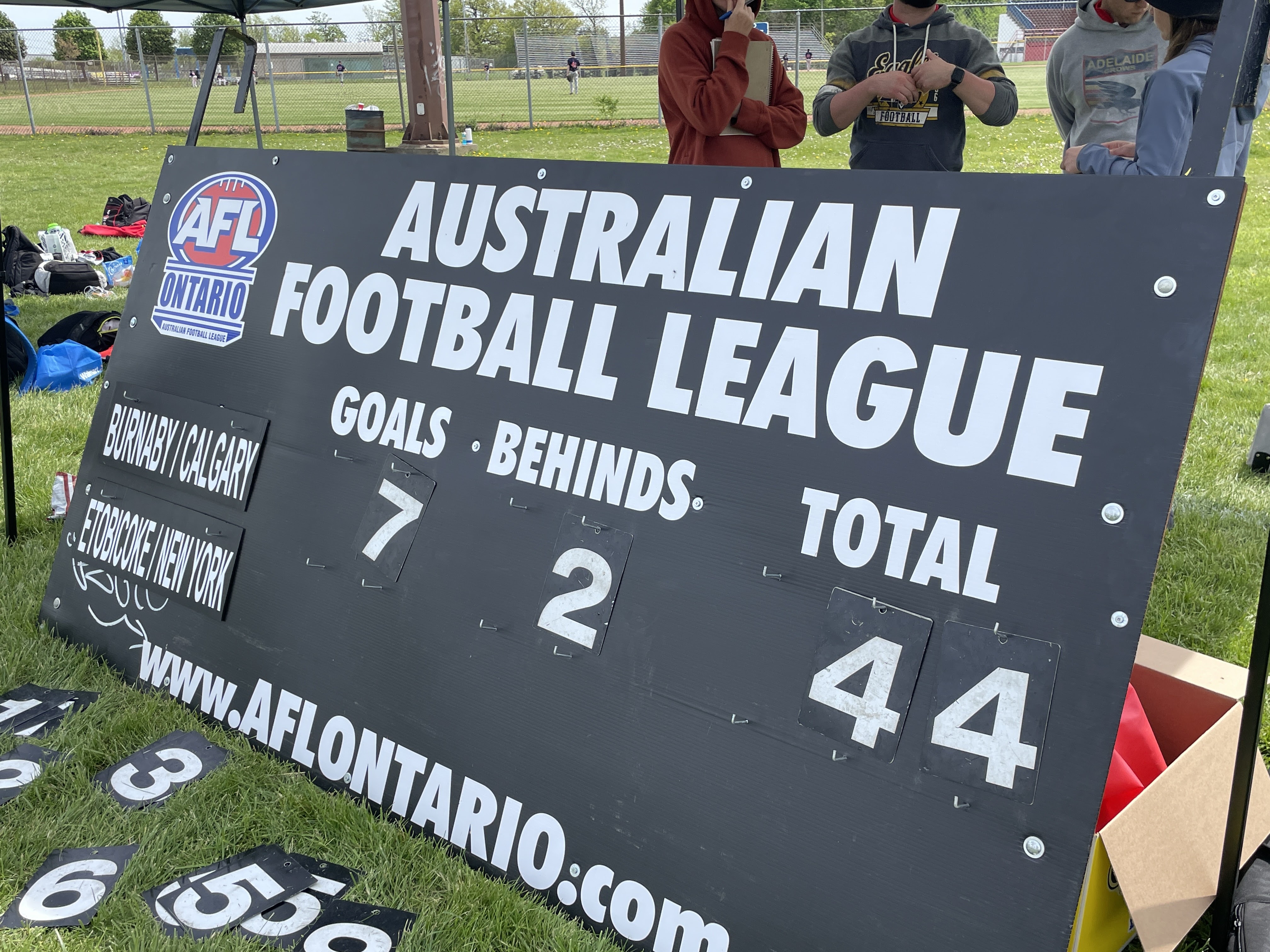
Unfortunately, things did not go well for the Kangaroos. And this wasn’t the final score, which I think was 50 to zero? Weirdly, I can’t find any definitive report of game results in the tournament.

Scoreboard showing Calgary 44, Etobicoke 0

External links

The AFL Canada Cup

Aussie-rules football Canadian-style

AFL Canada Instagram

16 May 2023

The “blog and secretaries” model of scholarly publishing

Steve Harnad has done much for open access. So I was surprised by a new article, in which he wrote:

In the old pre-digital days of S&S (“scientists and scholars” - ZF) publishing, the true costs of providing print-on-paper to would-be users required the services of another profession for the production and delivery. But (let’s cut to the quick) those days are over, forever. Online publication is not altogether cost-free, but the costs are so ridiculously low that all an S&S author needs pay for is a blog service-provider, rather like a phone or email service provider. ...

All other goods and services are now obsolete – or almost obsolete: scaled down to only the tiny, trivial cost per article of managing the peer review, by paying secretaries to run the software for soliciting and monitoring it.

This is such misleading characterization of what is required to run an online publication that I kind of can’t believe he wrote it. I think he knows better – I hope e knows better – but is oversimplifying to try to make a point.

Before I go on, I want to be clear. I am not about to argue here is not that journal prices are fair, or they could not be lower. When I commented on this article on Twitter, Björn Brembs came in and provided what the article lacked: some real values associated with costs. 

What I want to comment on is Harnad’s characterization of the infrastructure of an online publishing platform. A blog service and a secretary is pretty much all you need, according to him.

In the last decade, there have been no shortage of people providing online scholarly platforms. Many of those are trying hard to move away from legacy academic publishing and the costs associated with those traditional journals.

Very few have been able to make the “blog and secretary” model work. There are possible exceptions, judging from this description of the Journal of Machine Learning Research. Keep in mind, though, that this description is now over ten years old. I am sure there are other niches for the “blog and secretaries” model, but I don’t think this is the way forward for all scholarly communication.

Preprint servers provide open access for readers without fee to authors. They are no legacy publishers, and would seem to be prime candidates for Harnad’s proposed ultra-lightweight publishing model.

This article describes how several preprint servers were struggling to get enough money to run. Since the article appeared in 2020, a of them – INA-Rxiv, ArabiXiv – are no longer taking new submissions.

Brembs mentioned Humanities Common as a model. It has expenses of about US$750,000 and is run by three major committees. This still seems a far cry from the picture Harnad paints of using off the shelf software and a skeleton staff.

Likewise, larger preprint servers have higher costs and a bureaucracy to sustain them. The big one, arXiv has a budget of US$4.8 million.

I would love to survey of researchers on their estimates of the costs of a preprint server and how many people it takes to keep them running. Prediction: I bet a lot of them would underestimate the cost and time it takes to do so, perhaps influenced by descriptions like Harnad’s.

External links

Publishers can’t be blamed for clinging to the golden goose

Popular preprint servers face closure because of money troubles

15 May 2023

“Publisher bans & DORA” roundtable recording and notes

Publisher bans & DORA

 Today, I was the moderator for the “Publisher bans & DORA” roundtable! Everything worked as it was supposed to, and we kept the discussion to a tight hour.

Thanks to my panelists Payal Joshi, Katherine Stephan, and Jennifer Coston-Guarini for joining me and keeping the discussion lively and interesting!

A video of the roundtable is on YouTube. I edited the video, but edits may not be processed by YouTube yet. If you see "dead air" at the start of the video, jump to 7:29.

I have saved some material on Figshare. Currently, it’s just the introductory material about events that inspired the roundtable. It may expand in the coming days.

External links

Recording of “Publisher bans & DORA” on YouTube

Notes and other material from “Publisher bans & DORA”

11 May 2023

I told you the Lemon test was important

I’ve been expecting new bills in the US that re-introduce “intelligent design” into schools. Reason? The Kennedy v. Bremeton School District ruling in 2022. 

Surprisingly, a lot of people do not seem to think this is likely.

But state legislators sure noticed the court case.

You may have heard that there was a bill introduced into the Texas legislature to require schools to display the Ten Commandments of the Bible (88R SB1515). It’s passed the Senate.

The analysis of the bill includes a section on the intent of the bill. And it’s super clear: the bill is being pushed because the Kennedy ruling said the Supreme Court was abandoning the Lemon test.

This legislation only became legally feasible with the United States Supreme Court's opinion last year in Kennedy v. Bremerton School District, 142 S. Ct. 2407 (2022), which overturned the Lemon test under the Establishment Clause (found in Lemon v. Kurtzman, 403 U.S. 602 (1971)) and instead provided a test of whether a governmental display of religious content comports with America's history and tradition.

If the loss of the Lemon test was an open invitation for lawmakers to display religion in schools, why on earth would they stop with displays? Why would you not start to push for religious instructions in public schools?

09 May 2023

How article paywalls made (some) science more accessible

Everyone grumbles about paying for a single scientific article.

But you used to not be able to do that. Articles were bundled in journals, and if you wanted to read an article, you typically needed to find the entire journal issue. Your options to do that were limited.

You could subscribe to a journal in your field. Maybe. Journals superficially look like magazines, but they were rarely priced like magazines. Journals had small print runs, so the economics of printing journals were very different than printing magazines. So a year’s subscription for a journal would not run tens of dollars, but could be thousands or even tens of thousands of dollars for a year. (The Journal of Comparative Neurology was famously expensive. And continues to be, last I looked.)

If an article wasn’t in a journal you subscribed to (because nobody could subscribe to all the journals they would need), you had to hope a library subscribed to the journal if you needed a single article from that journal. But libraries didn’t subscribe to everything, either.

That left either interlibrary loans or sending postcards to authors asking for reprints. Both were time consuming. It could take weeks to get a reply, if you got one at all. It didn’t always yield results.

Yes, I know everyone wants knowledge to be free and we haven’t gone far enough and all that.

When you compare what getting a single article used to involve,being able to just spend some money to get a single article that you need on demand?

That improved people’s ability to get to the scientific literature.

Related posts

Got $30,000 to spare?

26 April 2023

Publication Star

I have been blogging about conference posters for fourteen years. Many people have told me that my blog helped them win a poster award.

Today, I finally shared a poster award!

Certificate for "ISMPP Poster Abstract Award for Publication Star"

This certificate is for an encore presentation of our poster, “Are conference presentations accessible? Insights from an online survey to improve equity.” This is a project I was invited to work on last year. It’s been shown at a couple of meetings of the International Society of Medical Publication Professionals.

The “Publication Star” award is for the poster that the judges most want to see written up in  a manuscript and published in a journal. That award category is the most academic thing ever. “You win an award! Your prize is... to get back to writing, you layabout!” 😶

You can read the poster at the conference website. This version has a seven and a half minute video by lead author Emily Messina explaining the works.

The poster is also part of our FigShare collection of material related to this project. You can compare and contrast versions 1 and 2 of the poster, presented at European meeting in January and the American meeting this month.

External links

International Society of Medical Publication Professionals

Poster awards for 19th ISMPP meeting

22 April 2023

Texas in lead to be first state to eliminate tenure

The Texas senate passed Senate Bill 18 a couple of days ago. If approved, the law would eliminate tenure in Texas public universities starting fall of 2024.

This is deeply disappointing. Both the bill itself and the weirdly limited reaction from higher ed. Higher ed leaders should be on every news channel, every talk show, writing op eds about why tenure is valuable. The response is nowhere near what it needs to be.

Is the loss of tenure on par with states that are allowing kids to work in factories again? No. But it’s part of the same small minded and regressive mentality.

Anyway, you can check the progress of the Texas bill on the Texas Legislature website.

Related posts

Tenure in US higher education is under threat, and I’m not sure it can be saved

14 April 2023

Tenure in US higher education is under threat, and I’m not sure it can be saved

Texas, where I used to work, is considering legislation that would end tenure in its universities.

Needless to say, I think this is a horrible idea. Texas already had post-tenure review (every five years). I know, I went through it.

As much as I am concerned about the legislation, I am even more concerned about the apparent lack of reaction to it. This should be the five alarm fire for American higher education, all hands on deck emergency type of reaction. And I’m not seeing that.

How did we get here? I’ve long has a suspicion that tenure was becoming increasingly vulnerable to attack because the job market for academics has been so tight for so long. When I’ve seen moves to curtail tenure, universities usual response is, “We won’t be able to attract talent, people won’t come to a place without tenure.”

Well, when the educational system has been churning out far more qualified candidates than jobs for decades, that threat rings hollow. A lot of people will take their chances at a job without tenure, because people have to eat and people want to work in the fields they trained to work in.

I hope these bills will die in committee, as many do. But I’m not feeling optimistic.

External links

A Texas trilogy of anti-DEI, tenure bills

New Texas bill would end tenure for college faculty

How Republicans’ threats to tenure and diversity might undercut their own efforts to advance Texas’ universities

Tenure was already in decline. Now some Republicans want it gone from colleges for good.


12 April 2023

I think that “intelligent design” bill died

I’d been occasionally checking the West Virginia bill tracker for the progress of the “intelligent design” bill (Senate Bill 619) that made it out of the Senate’s education committee. Every time, I saw the bill still in the House Education Committee, so I thought it was still possible that it might move forward.

But the legislative session ended last month. The bill tracker makes no note the end of the session, which is why I missed it. The bill never make it out of committee for a vote.

I think that means the bill in its present form is done?

Related posts

That “intelligent design” bill hasn’t died yet

12 March 2023

Register for “Publication bans & DORA” roundtable

The anniversary week for DORA is still some weeks away, but I just realized that people who learn about it now might want to get updates as the event gets organized.

I have created a registration form for the “Publisher bans & DORA” roundtable event. Just enter your email and you will get an update when I have panelists and links to the online discussion ready to go. 

External links

Dora Tenth Anniversary events

11 March 2023

A star chamber for predatory journals

Look, I am not one for conspiracy theories. 

But if I was a major academic publisher, and I saw a lot of business going to new, upstart publishers that had even slightly questionable editorial practices, I’m not sure I would back a way from a little aggressive corporate public relations. I might set up a website that claimed to be providing a service by listing dodgy journals and publishers, and then – Bam! 💥 – I label a bunch of stuff coming from the competition as “predatory.”

Meanwhile, today I learned about a website called Predatory Reports in Scientific Publishing. I noticed today because they recently stuck a bunch of MDPI journals on their blacklist.

Their Twitter account has been around for a little over a year. It’s interesting that I never heard of them before they target MDPI, which fits the narrative of people who are already grumpy (legitimately so) with MDPI.

Looking around their website, I clicked the “About” page, I thought this was an overly honest image:

Empty conference room

An empty conference room.

The written description is no more informative. This group is “association of scientists and researchers.” No names, emails, how many people are involved, nothing.

Now, there may be a reason for this. The debates about anonymity in science are long, but usually come down to, “There are some cases where it’s appropriate.”

For instance, the creator of the original blacklist of predatory journals, Jeffrey Beall, tended to have people threaten to sue him with alarming regularity. You may recall he took down his list and never explained why.

But a far more important question is how this “association” decides what journals to include on their list. There is zero description of criteria or process here.

Compare this to another organization that tries to identify predatory publishers, Cabell’s. Their list is a commercial product, but their “About predatory reports” page at least promises that the full report includes, “A complete record of when, what and why a journal is put in Predatory Reports.”

I looked at one of their blog posts about SCRIP to try to glean how they are assessing publishers. They quote Beall’s work, they quote Cabell’s report, and have a list of references at the end. It looks like just a haphazard compilation of other people’s writings.

This is a step up from how I thought the list might be generated (just by using vibes), but there doesn’t seem to be anything new here. I don’t see a lot of value.

Poster for the movie “The Star Chamber” (1983).

For an association that wants to “build trust in scientific research and publications,” they don’t seem to have given much thought to how a blacklist made by a completely opaque process by a group of utterly unknown people looks more like a star chamber than a trustworthy organization.

External links

Predatory journals in scientific publishing

About Predatory reports (Cabell’s)

07 March 2023

Are grad students employees or students?

Many people have noted that grad students are in a weird dual state. Sometimes that are treated as employees. Sometimes they are treated as students. Which they get treated as often seems to depend on which is advantageous to the university at that particular moment.

Over the last couple of years, a combination of events has meant that many professors – particularly in the US – are finding it harder to get graduate students and post docs. So the number of people broadcasting on Twitter that they are recruiting students has gone up.

And what has struck more more and more is that those tweets look like job ads.

They’re not, “Come join our master’s program in my department,” they’re “I have a master’s position to study desert fishes using ecological modelling and environmental DNA” or what have you. 

Opportunities for graduate students are consistently described as “positions,” not programs.

I would have expected this for postdoc positions. I think postdocs have always been more or less this way, because there6s no degree associated with being a postdoc. But I wouldn’t have expected this as much for a doctoral programs, and lately I’m seeing a lot of tweets that are advertising for master’s students like this.

This is probably an inevitable outcome of graduate students being supported by professors’ research grants.

So I think we have to really stop thinking of graduate degrees as degree programs, because we aren’t treating them that was. They are entry level contract positions for scientists, in which you are partly compensated with a credential rather than money.

06 March 2023

I miss the fail whale

At least when Twitter tanked when it was a new service, you got an amusing, cute marine mammal to look at.

Black screen reading "Your current API plan does not include access to this endpoint, please see https://developer.twitter.com/en/docs/twitter-api for more information"

Now you just get a cryptic error message.

Several sites are reporting that every link on Twitter is doing this.

External links

Every link on Twitter is broken right now

Twitter Displaying Error Messages for Web Links Posted in Tweets 

Twitter’s busted again

05 March 2023

My social media style

 Okay,I blame Doc Becca for linking to abbrevia.me. It generates descriptions of how people use Twitter.

Doctorzen’s tweets cover a wide range of topics, including science, education, politics, and social issues. They often share articles and express their opinions on current events. They also engage with other users and respond to their comments and questions. Doctorzen’s writing style is straightforward and concise, with occasional humor and sarcasm. They use hashtags and retweets to amplify important messages and promote causes they support. Overall, Doctorzen appears to be an active and engaged Twitter user who uses the platform to share information and connect with others.

Ooh, concise! I worked hard for that one!

External links

abbrevia.me

02 March 2023

That “intelligent design” bill hasn’t died yet

Well, hell.

The pro “intelligent design” bill in West Virginia passed the Senate Education Committee.

The bill has now gone to the House Education Committee. The bill’s progress can be tracked on the West Virginia bill tracker

This Metro News article has more background on the bill, including the slightly strange fact that the bill was prompted by an idea from a high school student.

Committee chair Amy Grady, R-Mason, is leader sponsor and told the committee that the idea was brought to her by Hayden Hodge from Hurricane High.

Hodge appeared before the committee and said a teacher gave him the idea. The teacher wanted the option to teach ID alongside evolution.

“I am not in favor of getting rid of evolution,” Hodge said. And ID is not ultimately religious. (I hope this is Hodge’s opinion, not the reporter trying to state a fact. - ZF)

“I’m not asking for religion to be taught in classrooms, period,” Hodge said.

This is, of course, untrue. “Intelligent design” is a religious argument. This has been documented many times. We have the receipts. 

Reading the comments from the committee members is depressing. A retired science teacher was arguing in favour of this bill. In favour.

I’m glad the American Civil Liberties Union spoke out against the bill.

The bill made it out of committee with only one vote against it. The report doesn’t say who it was, but my hat is off to you, anonymous West Virginia senator.

External links

Senate education committee approves 4 bills including ‘intelligent design’ measure

‘Intelligent Design’ bill threatens science education in West Virginia

16 February 2023

A zombie idea rises again: New attempt to get “intelligent design” into classes

Policy analyst Bryan Kelley is reporting on a bill in West Virginia – Senate Bill 619 – that would legalize the teaching of intelligent design.

There is zero ambiguity in the text of this short bill.

(A)llowing teachers in public schools that include any one or more of grades kindergarten through 12 to teach intelligent design as a theory of how the universe and/or humanity came to exist.

Last year, I predicted that we would see a renewed push to get religious ideas into public schools in the United States. The legal landscape has completely changed for teaching religious ideas in public schools after the US Supreme Court said, “We don’t use the Lemon test any more.”

Honestly, I’m only surprised it took this long.

At this point, the bill has been referred to committee. And many state bills die in committee, never get voted on, never become law. But here’s the thing. There is a pattern of political parties acting in many states more or less simultaneously to push bills towards legislation. I would not be surprised to see a whole bunch of similar bills in state governments before the end of the year.

Hat tip to Tara Smith.

P.S.—Hey, support the National Center for Science Education!

Related posts

Prediction: American creationists will try again to get evolution out of schools 

Supreme Court of the US (SCOTUS) decision clears way for new science education battles

External links

Senate Bill 619, West Virginia

13 February 2023

Context matters as much as data

In the novel Passion Play, author Sean Stewart has a rant about Sherlock Holmes. 

It’s one of Doyle’s famous scenes where Holmes says, without prompting, what Watson was thinking about the war he was in. I think it might have been this, the opening to “The Dancing Men”:

 “So, Watson,” said he, suddenly, “you do not propose to invest in South African securities?”
I gave a start of astonishment. Accustomed as I was to Holmes’s curious faculties, this sudden intrusion into my most intimate thoughts was utterly inexplicable.
“How on earth do you know that?” I asked.

 Holmes goes on to explain how he arrived at the conclusion. But while Holmes is famous for his “deduction,” what Holmes did was not deduction.

“Very likely not; but I can quickly show you a close connection. Here are the missing links of the very simple chain: 1. You had chalk between your left finger and thumb when you returned from the club last night. 2. You put chalk there when you play billiards, to steady the cue. 3. You never play billiards except with Thurston. 4. You told me, four weeks ago, that Thurston had an option on some South African property which would expire in a month, and which he desired you to share with him. 5. Your check book is locked in my drawer, and you have not asked for the key. 6. You do not propose to invest your money in this manner.”
“How absurdly simple!” I cried.

You couldn’t have come to the same conclusion as Holmes if you didn’t have the same detailed knowledge that Holmes had about Watson. You had to know practically everything about Watson. You had to know the context for all of these little details that Holmes observed.

It’s been reported that human brain size is shrinking. I think I’ve even said this in a Quora answer or two.

The Guardian mentions this claim (as well as the “sea squirt eats its own brain” myth) in a new article about language using artificial intelligence like ChatGPT.

Alain Gorely tracked the origin of this claim back to one particular paper. He found reasons to be skeptical of the “brains have shrunk in the last few thousand years.

Suzanna Herculano-Houzel looked at this sleuthing and wrote:

ALWAYS look at the data. Always. The data are one thing; the interpretation of the data quite another. Robust findings are the ones that already appear with basic statistics, not that require the complex analyses.

The funny thing is... the data are not at issue here. That is, the values that are used in the analysis are not in any way wrong or under dispute. It’s not, “Someone moved a decimal place, and that screws up the average.” 

What Gorely does is put the data in context. In particular, he asks, “How were the data collected? How consistent was the collection methods? Are the numbers in line with other numbers?”

“Show me the data” isn’t a definitive mic drop. And when people “look at the data,” they are usually doing something much more complicated.

08 February 2023

Killing Twitter

Today may be the day that signals the end of Twitter for me.

I initially had a good day on Twitter. I live-tweeted a great presentation. I was pretty pleased with that.

But late afternoon, I tried to follow-up and got a message saying:

You are over the daily limit for sending Tweets.

Then Tweetdeck wouldn’t let me log in. I’d been worried about Tweetdeck for a while, given that Twitter was killing its open API so there couldn’t be third-party Twitter apps. But Twitter owns Tweedeck, so I thought it might be safe. But apparently not.

This seems to be another restriction to force more people to subscribe to Twitter Blue. I just can’t see myself doing it. Yes, Twitter has provided great value to me, but. I just can’t stomach the thought of sending money to a billionaire who is poisoning the town well so he can sell more bottled water. 

Update: News services are saying that a change to number of tweets was not announced, so could be a bug. But it sure doesn’t feel like one. It feels like a preview.

30 January 2023

DORA at ten: Publisher ban roundtable

On a bit of a whim, I proposed an event for the 10th anniversary events around the Declaration of Research Assessment (DORA).

And they said yes?

And now I have to do this. Mark your calendars and if you’re interested in being part of the roundtable, email me!

Publisher bans and DORA

Publisher bans and DORA

Publishers like MDPI, Frontiers, and Hindawi have experienced enormous growth in the number of submissions from researchers, which would suggest they they are meeting needs of the research community and providing good value to researchers. But multiple institutions have told scientists that research in journals from these publishers will no longer “count” for assessment. Such policies suggest that these are “predatory” publishers that do not perform the basic functions of academic journals. The publishers dispute this, as do many authors whose work appears in their journals. Many authors believe that choosing where to publishing their findings is part of their academic freedom. Blacklisting publishers with hundreds of journals may be too blunt an instrument for research assessment and inconsistent with DORA. Are there cases where such bans are valid and useful to the community?

This event will be held as an online round-table discussion followed by a moderated Q & A session.

Update, 12 March 2023: I have created a registration form for the publisher bans and blacklists event so that you can be notified of updates.

I’ve been ripped off! OMICS journal messes up my work

Matt Hodgkinson drew my attention of that fact that one of my articles on authorship has been ripped off and turned into mush by someone in OMICS. (Lightly edited)

Allied Business Academies, a.k.a. Allied Academies, are another publisher to avoid. Quelle surprise, as they’re a brand of the notorious publisher OMICS.

Compare: Zen Faulkes’s 2018 article, “Resolving authorship disputes by mediation and arbitration” with Laura Sandra’s 2021 article, “Alternative Dispute Resolution in Academic Publishing”, in Journal of Organizational Culture Communications and Conflict.

Ms. Sandra, of course, does not exist.

I am always glad when someone finds my work worthy enough to re-use, but I have to say: This is not what I had in mind.

It is weird to see my work in this garbled form. I can recognize some of the elements of my paper, but it’s like they’ve been put through a blender, no doubt to avoid setting off plagiarism detectors. My original paper was 7 typeset pages with 95 references. “Sandra’s” version is a page and a half with three references. 

I have not included a link to the OMICS article because they don’t need the clicks. Go read my paper instead. I think it has something useful to say.

Reference

Faulkes Z. 2018. Resolving authorship disputes by mediation and arbitration. Research Integrity and Peer Review 3(1): 12. https://doi.org/10.1186/s41073-018-0057-z

External links

Matt Hodgkinson on LinkedIn