24 June 2006

Beautiful Evidence reviewed

Baeutiful Evidence coverEdward Tufte's three previous books -- The Visual Display of Quantitative Information, Envisioning Information, and Visual Explantions -- were good purchases. They're the sort of book that I go back to again and again, sometimes just browsing through just to get a little inspiration.

Consequently, I looked forward to receiving Tufte's fourth major book on information design, Beautiful Evidence. There was something different about reading this book compared to the others, though. Tufte has posted several sections on his discussion board well in advance to get feedback on the ideas. I was one of the many "Kindly Contributors," as Tufte calls them, on those chapters, particularly one on phylogenetic trees. Further, one chapter had already been printed as a little booklet on PowerPoint. It so successful that it went to two editions.

Furthermore, a cursory glance reveals many examples that Tufte has already talked about at some length in his earlier three books. There's the works of Galileo. There is a whole chapter about Minard's chart of Napolean's march towards Moscow, which Tufte pretty much single-handedly made famous in The Visual Display of Quantitative Information, in which he said it might be the best statistical graph ever. High praise from a demanding taskmaster!

Given that a good chunk of the book was already familiar to me, was there anything new to be learned? Absolutely.

The first chapter concerns annotating pictures, which Tufte calls "mapped images." Right away, two of the books themes emerge. First, the importance of integration of different types of data. Here, pictures are the focus with the words providing supplemental information. Second, a concern is raised about dubious evidence, with the work of Ernst Mössel. Mössel tried to create a universal description of art, but ended up with a system that was so all encompassing that it could not be shown to be wrong.

The second chapter continues on the theme of integrating information in Tufte's concept of sparklines. Sparklines are little mini graphs that are meant to be fully incorporated into text. To my disappointment, the HTML that would be required to stick a sparkline in the blog falls into the "more trouble than it's worth" category. But a few people are experimenting with these, and there are a few sparkline plug-ins for word processors that can be found on the web. I've used one of these in my own writing, though; shown here is something from one of my annual review documents.
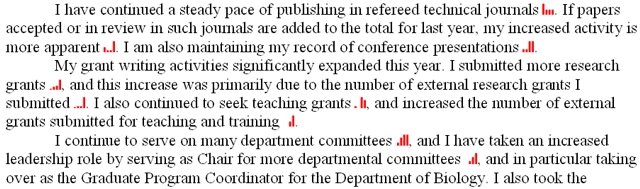

It will be interesting to see if any high end technical journal will consider using these routinely.

The next chapter concerns using lines to link together. Tufte argues that most lines are underutilized, and could contain much more information and be much more useful than they usually are.

The fourth chapter is, to my mind, the heart of the book: "Words, numbers, images -- together." That statement is simple, but the many excellent examples make this a deep exploration of the idea. A chapter section on Galileo's work is wonderful. Every scientist knows Galileo's contributions, but seeing them through Tufte's words and pictures gave me a much deeper appreciation of the impact Galileo had. Tufte credits Galileo with a "forever idea," which, in a word, might be "empiricism." More to the theme of the book, however, Tufte uses Galileo's work to show how his arguments were enhanced by an integration of word and image. Again, this is an idea that Tufte has talked about before, that good displays put many comparisons in "eyespan," but the point is pushed farther in this book than before.

Similarly, the fifth chapter on Minard's chart is worth Tufte's revisit, as he uses it to exemplify powerful general principles we can learn about how to make "intense" displays that generate credible, powerful evidence. One simple example lesson from this chapter: sign your work. Credibility is enhanced by accountability.

Bad evidence, which had been introduced in the beginning, returns in force in the next two chapters, the second of which contains Tufte's already famous indictment of PowerPoint. Making a graph, Tufte argues, is an ethical act. Again, this is not a new idea for Tufte, since he introduced the "lie factor" in his first book. What is new is his argument that consuming such information is also an ethical act. Too often, we are lazy and don't hold liars accountable. These are powerful and important messages in an age of spin and truthiness. As I've said before, a lie left unchallenged gains the perception of truth.

The book's last chapter, on pedastals for sculptures, is the weakest and could have been omitted. It is disconnected from the rest of the book. The book, after all, is supposed to be about evidence. Nobody that I know of has ever claimed that scultural pedastals were ever intended or perceived to be evidence. Instead, the chapter showcases one of Tufte's other interests, outdoor abstract scultures. Still, Tufte's passion and thoughtfulness still shines, so much so that this deviant chapter is almost forgivable. Almost.

Similarly, I am puzzled by the choice of dust cover, which shows a series of pictures of one of Tufte's dogs leaping into a lake. Beautiful they may be, but are they evidence? If so, of what?

And I'll put out just one more thing that annoyed me in the text. In a few points, Tufte suggests that we ask ourselves, "What would Richard Feynman think?" I find this just as annoying as, "What would Jesus do?" I have no way of knowing how bright (Feynman) and profound (Jesus) people will respond to new and novel situations. Isn't this one of the reasons we find these people to be bright or profound? It's more useful to invoke their principles than trying to use imprecise empathy to figure out what to do. Particularly when I ask, "What have I done?" and see that I've approached the same problems in several different ways, often with equal success. In other words, when I see a bad graph, I think it's more useful to think of one of the many simple but deep ideas presented in Beautiful Evidence ("Show comparisons, contrasts, differences") instead of asking, "How would Tufte redesign this graph?" I could only really answer the latter question if I have buckets of money to try to hire Tufte as a consultant.

Finally, I am left wondering about cases where the evidence may be highly credible -- but is not beautiful. While working on this review, I was reading a scientific paper for my evolution class (Pellmyr, Olle & Leebens-Mack, James. 1999. Forty million years of mutualism: Evidence for Eocene origin of the yucca-yucca moth association. Proceedings of the National Academy of Sciences of the United States of America 96: 9178–9183; click here for abstract). The evidence is highly credible and believable, but I daresay that it is not beautiful. The argumentation is precise, but deadening. Tufte talks about ways that flawed evidence may be concealed (second hand repackaging: e.g., textbooks presenting summaries of technical papers that very few have read). But papers like this raise another way that flawed evidence might hide that Tufte does not discuss: "If it's incomprehensible, it must be brilliant." * People have become accustomed to research using techniques that are so new, few people understand them. Unintelligibility itself becomes an indication of credibility. That's bad. I think there's more to be said here, but perhaps that will be Tufte's book five, since the introduction promises he has more to say on the subject.

This book is, of course, going to be widely read and highly praised. But I don't think it will it be read enough. It is frustrating to read something like this advocating ethical scholarship and standards for evidence when there are new books that flat out lie about science (yeah, I'm looking at you, Ann Coulter). And when you can lie about science -- that part of human endeavor that Galileo transformed with his forever idea that it was all about evidence -- you can lie about anything.

To do your bit to kill truthiness, you could do much worse than following the principles in Beautiful Evidence.

* I call "If it's incomprehensible, it must be brilliant" the 2001 principle, because I think it explains why so many people sing praises to the movie 2001: A Space Odyssey. Many virtues it has, I admit, but the thing does not make sense.

I knew it

Back in March, I gave a public talk for Brain Awareness Week, "Brain Scans and the Magic Lasso." (An archived version is here).
In it, I talked about how I saw the use of fMRI as imminent in legal situations. And I was right, as I learned listening to the Nature podcast this week (transcript here). Companies called No Lie MRI and Cephos are going to sell commercial lie detection systems based on fMRI. And I pretty much called that in my talk. Legal challenges will happen, I predict.

23 June 2006

Thought from an administrator

Quote from yesterday's provost candidate that I quite liked:

"A vision without a plan is fantasy. A plan without a vision is drudgery."

Even though I'm unsure if he's my favourite candidate, hey, at least I got a good quote from going to the ope forum...

22 June 2006

The time monsters

This week is one of those weeks. Forgot about finding time to blog or work on the book manuscript, finding time to go to the washroom is a major accomplishment. This week consists of: Get up, get ready for class, class, run to tail end of faculty senate meeting with provost candidate, lunch, get quiz ready for class, for to open forum with provost candidate, work with intern Amanda, few minutes to try to tie up loose ends, home for dinner, exercise, sleep.

And that's the day. Repeat five times. Use weekend to catch up.

I'm horribly behind on some classwork and a few other things, largely because the provost interviews are chewing up a big chunk of the day. But it's really important to see those interview situations, because this is the #2 job on the campus. It's one of the ones that can have a huge impact on the overall health of the place. Not to mention my own career.

18 June 2006

Flashback

Athropod Structure and Development Top 25Hey, I was almost hot (scientifically) in July through September 2004. Go way down to #22. Never noticed that before.

Oh, yeah...

As a Canadian, I am contractually obligated to say:

Go Oilers.

Now back to paperwork. I mean it this time.

Bookwork

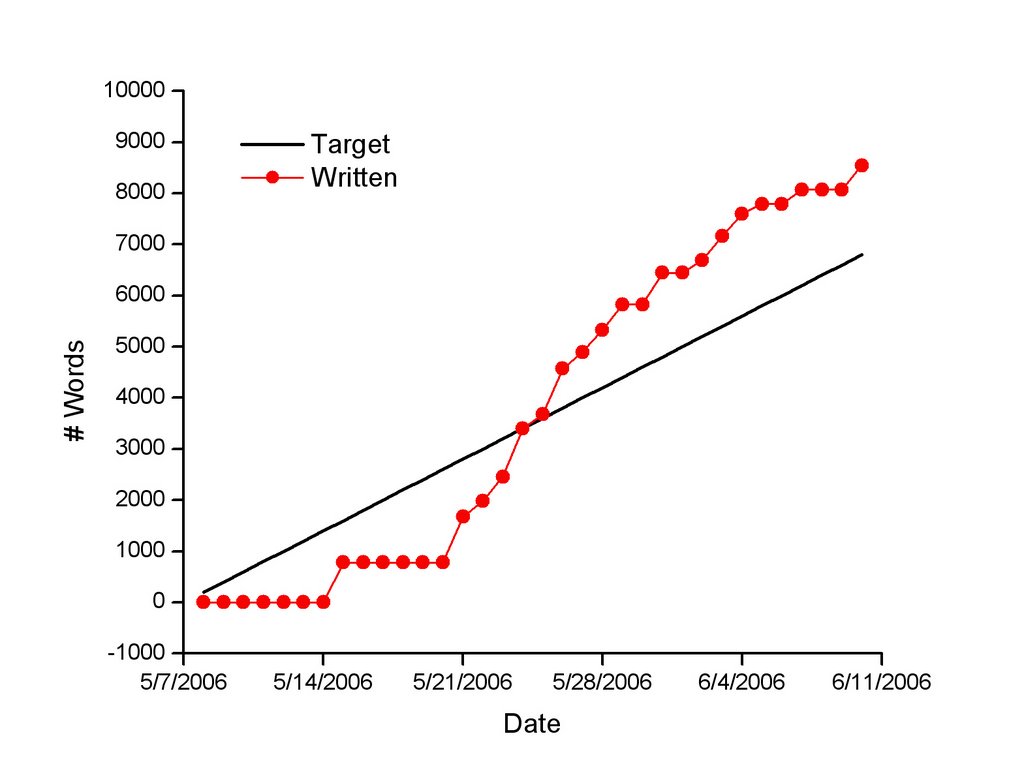
Manuscript word count for 18 June 2006I think there's something to be said for this obsessive tracking of a project in a public forum. It was able to get me off my bum and get a few hundred words in on my book manuscript, after a week or so of thinking about other things (class, interns, etc.). I've heard B.F. Skinner used a similar technique when writing. He would keep track of what he was doing, and would only allow himself to take speaking engagements when he was above his target number.

Anyway, back to the many other tasks that need doing. Many, many other tasks...

17 June 2006

Taxonomic romance

Blepharipoda occidentalisIn our graduate evolution class yesterday, my colleague Anita revealed that there is a group of beetles named after her.

I was instantly jealous.

By way of a few quick reminders, the traditional method of classifying organisms is to have seven levels: Kingdom, phylum, class, order, family, genus, species. The names have to be in Latin or Greek, although "latinizing" names or words from other languages is allowed. Ths person who describes a group gets to name it. Names are often descriptive of the organism's look or living space. For instance, take the case of the sand crab Blepharipoda occidentalis (pictured), which I studied for my doctoral work. Blepharipoda, the genus name, means "eyelash feet," which refers to the fringes of hairs (setae) that line the beautifully curving leg tips (dactyls) that they use for digging into sand. They live on the west coast of North America, and their specific name, occidentalis, reflects this, as it means "western."

Taxonomists are free, however, to name species and genera and so forth whatever they want. Locally, when my colleague Bob Edwards described a new species of fish, he named it Gambusia clarkhubbsi after a Texas ichthyologist, Clark Hubbs.

But you don't need to be a scientist to get a species named after you (though it probably helps). Returning to sand crabs for a second, Chris Boyko works on the taxonomy of sand crabs like Blepharipoda. He's also a fellow comics enthusiast (loves Chester Gould), and a man who made my writing life hell by splitting one sand crab family into two, making it much harder to describe some work I did. Be that as it may. He named one sand crab after The Simpsons creator Matt Groening: Albunea groeningi. He named another after Peanuts character Lucy (infamous for her "crabby" disposition): Lepidopa luciae.

Anita got a genus of beetle named after her because, well, she happened to be dating a beetle taxonomist at the time.

I'm so jealous.

I have genus envy.

(Yeah, that's right, I wrote this whole long blog entry just to make that one lousy pun.)

16 June 2006

Ah.

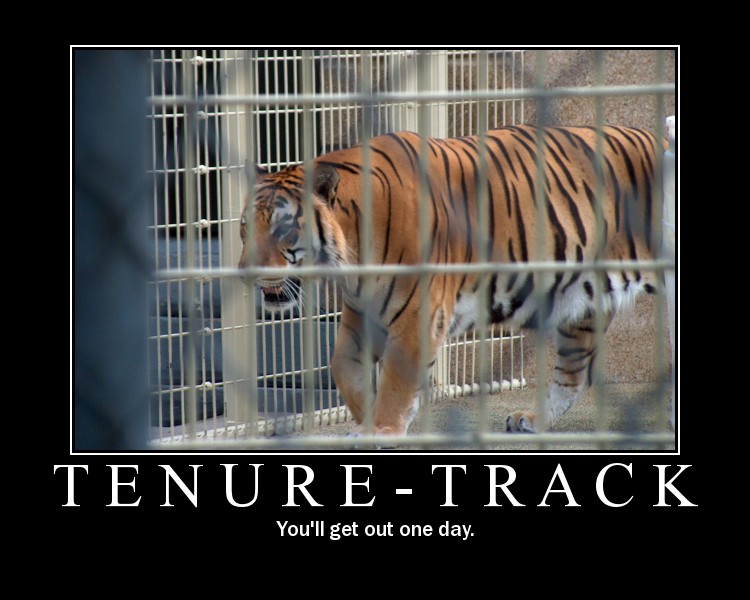
Motivator: Tenure-track
Friday afternoon has been nice to me today. No talk to think about that's less than 24 hours away. Nobody bothering me, for the most part. Just a chance to stop and think for a few minutes and get my head organized. I realized several NSF grant deadlines were coming up, so I started work on at least one of those. I may take a crack at more than one, who knows. Still many things that need doing and not enough of them done (must email grad students and prospective grad students...), but I didn't feel as rushed-pushed as I felt much of the week earlier.

15 June 2006

In turn...

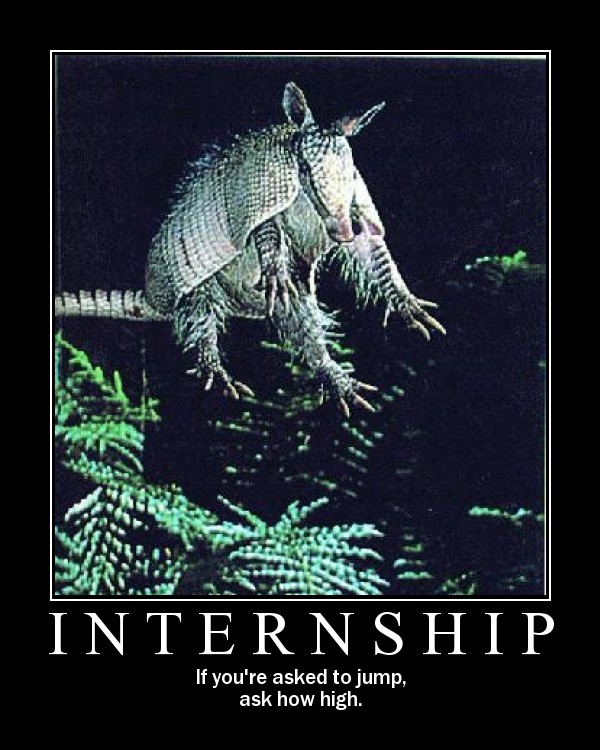
Internship motivatorIn another one of those still-not-quite-sure-how-this happened events of the summer, I spent this afternoon meeting with various people about a summer internship program with high school students. I'll have a student, Amanda, working with me for six weeks starting next Monday. Not quite sure what I'll have her do yet. Will have to spend some time sorting out project ideas next week.

Speaking of the grad class, it's going very well, all things considered. My colleague Anita thought today went well -- which was good, considering it was on a very subtle topic (units of selection).

12 June 2006

Today's loss of productivity

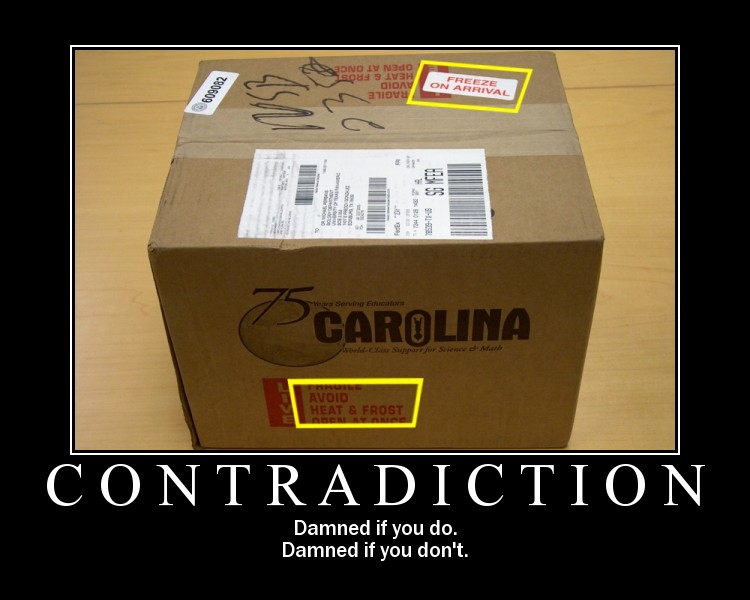
Contradiction motivation posterClick image to enlarge if you can't read the text. I took the picture of the box that I actually received from Carolina Biological Supply, but created the fake poster style with the instantly addictive Motivator.

10 June 2006

Ahead of the game?

Manuscript count 10 June 2006One week of summer class down. The class (Evolutionary Theory) is going as well as can be expected for the first time. The thing I'm enjoying about it the most is that, as I expected, my colleague Anita and I have very different strengths and interests. She can put together lectures on stuff that I couldn't. At least, not without way more preparation, difficulty, and stress on my part.

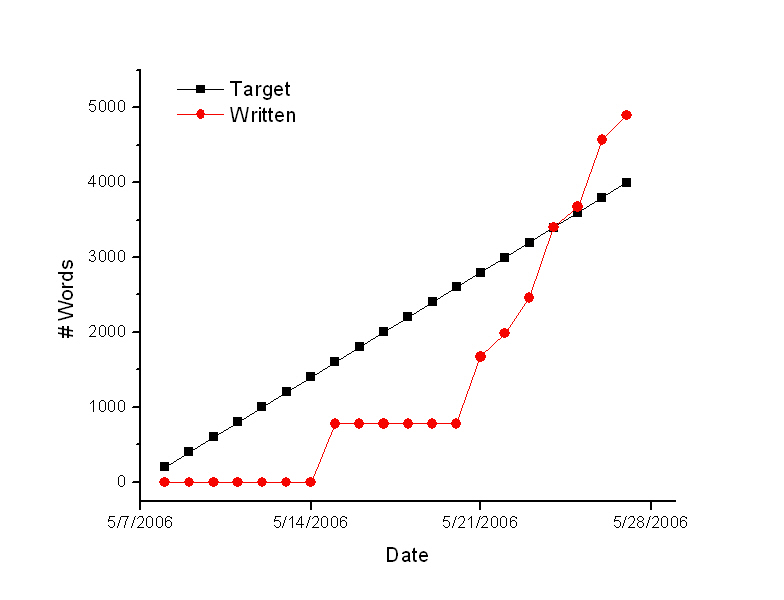
As far as the book manuscript goes, I have no idea how I'm managing to keep the word count above the 200 words a day target (graph). But I am, though the curve is clearly starting to flatten, and the writing is going to start getting harder very quickly.

04 June 2006

Heritage

Just as people are curious about their family lineage, academics are curious about their intellectual lineages. An intellectual lineage is more complex than a family lineage in some ways, because of course while we're restricted to two parents, we are often fortunate to have many excellent teachers who contribute to our intellectual development.

Nevertheless, the usual tradition is to trace intellectual influences back through Ph.D., since that's the highest degree, and usually the one that people spend the most time on, and the one that typically establishes the closest working relationship between student and mentor.

I knew my Ph.D. supervisor, Dorothy Paul, worked with Don Kennedy. Don Kennedy is a pretty well known figure in science, because he edits the journal Science. But I couldn't find out in my digging who Don Kennedy worked with. I decided to use a rather old fashioned technique to find out: I wrote a letter.

To my surprise, considering how hectic being Science editor must be, Don Kennedy wrote me back a short but very nice letter back very promptly. To my surprise, he worked with Don Griffin, whose work is famous in biology. He demonstrated how bats found their way in the dark: by echolocating. In animal behaviour, he was also a strong advocate for the field that became known as cognitive ethology.

I have yet to work out who Don Griffin did his doctoral work with. May take a while, but I'll keep it in mind.

03 June 2006

Here we go 'round again

I spent a good chunk of the day in my lab doing work related to my current manuscript that's in revision. It's necessary but unglamorous grunt work: all I'm trying to do is to get some pictures of already known results.

One of the great joys of doing research is that you get to find out new things. But the downside is that you always have to do it more than once. Replication is critical to science. In fact, I was listening to an interview with a parapsychologist (A little searching reminds me that it was Michael Thalbourne) who talked about the "well-known fact" that results in parapsychology get weaker over time as people try to replicate them, not stronger.

And I thought, "There's your sign."

The effect gets worse the more you try to study it? That's the exact opposite of regular science, and to me speaks volumes about why parapsychology doesn't get respect. It's pathological science to say, "Oh, effects get weaker as we look for it again."

In my case, I'm trying to get a few pictures of crayfish neurons. The ones I'm interested in were well described about 30 years ago, and are well known. But, since the point of the paper I'm working on is to compare similar neurons in a species that is not a crayfish, it helps to have pictures showing that I can in fact see what everyone else has described, and that any differences are not just due to dodgy techniques on my part.

And, to make matters even less interesting, I even have some pictures of the relevant cells. They're just not very pretty. But, because I think this manuscript has a chance to actually be a bit more widely read than some of my other stuff, I figured I might as well take the time to try to get some stuff that looks nice.

Necessary, but trying to maintain enthusiasm while doing replicates is awfully hard for me. Research is much more fun when you don't know what the answer is going to be.

02 June 2006

Holy cow, it's June?

Yeah. It's June. My new graduate class, Evolutionary Theory, starts Monday. It runs every day and I'm just working on Friday's talk. Luckily, I'm co-teaching it with my colleague Anita Davelos Baines, because otherwise, I'd only be working on Wednesday's talk and I'd getting ready for complete panic on Thursday. Instead of moderately nervous for the following Monday (10 days time).

Fortunately, I've managed to get somewhat ahead in my target word count for the book manuscript. Which is good, because I think that red line is going to flatten next week.

29 May 2006

The blog as art

NeuroDojo structure graph
Neuroethology.org structure graph
Zen's UTPA webpage graph
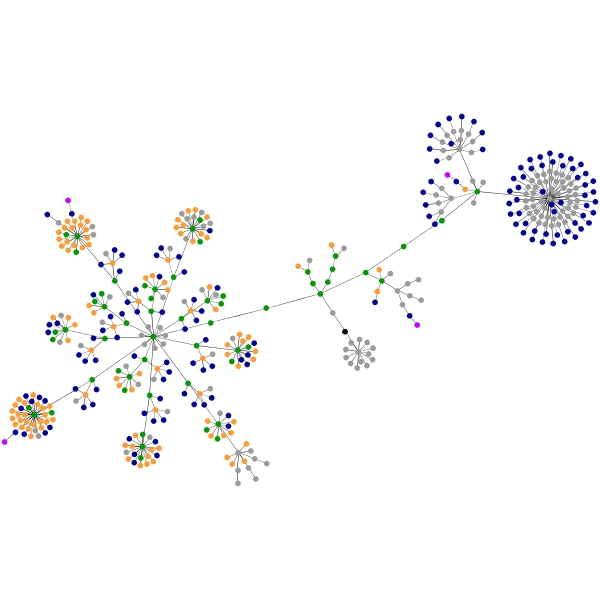
Zen's hobby page graphThe graphics on this page shows the way a webpage is written. The first one on the left is the page you're reading (prior to making this post, which should change the structure slightly). I suspect that many Blogger-driven blogs will look the same, due to common blogger templates and such.

To the right of that, with lots of red, is the structure of the International Society for Neuroethology webpage, which I oversee but did not write. The preponderance of red indicates a lot of tables being used to structure the page.

Interestingly, but not surprisingly, authors seem to have distinct styles. The third and fourth graphs are both pages I created -- my academic home page (left) and one of my hobby pages (right). The substantial amount of blue and orange in the bottom two graphs shows that I like links and text, respectively.

The original description of the project, and a link to make a graph of any website you want) is here. It's really quite fun to watch the program run, as the graphic "grows" out, very quickly at first, then finally settling down to a pattern. More discussion, including some very helpful interpretation, is found on this discussion thread on Edward Tufte's website.

27 May 2006

Lies that scientists tell

I wrote previously that honesty is a core value for scientists, but that doesn't mean that scientists don't engage in, shall we say, "spin."

  • "This work could have practical applications." Maybe it will and maybe it won't, but that's not why you did the research, is it, you fibber? You did it to test the dominant theories. It might be a dominant theory in the field that you want to support, it might be a little upstart theory that you think makes no sense or attacks your findings. Most scientists are scientist entirely because they love the ideas. It's the engineers' job to worry about practical applications.

  • "I'm just following the data." The idea that scientists are dispassionate observers does not, in any way, jive with my experience woking with scientists. I've seen and read too many arguments from researchers studying the origin of bird flight to be convinced otherwise. (It seems, from a distance, to be one of the most polarized, divided into us and them warring intellectual camps that you'll find anywhere.) Scientists I know are very often emotionally attached to their theories. After all, as I mentioned a while ago, people like to have their beliefs confirmed. But if you understand science in a deep-in-your-bones kind of way, you know that you have to try to murder your darlings. You have try to strangle your absolute best to see if they really hold up.

  • "Introduction - Materials and Methods - Results - Discussion/"
  • This is the standard format of scientific papers. It's supposed to reflect the order of events that goes on in performing research. Ha! More like, "Methods, preliminary results, more methods, results we had to throw out because equipment broke / animals died / grad student didn't take measurements when he was supposed to / supervisor didn't take measurements that she was supposed to, more methods, statistical analysis of results so far because the poster for the upcoming conference is due next Tuesday, more methods trying to fix the criticism you got from the conference poster, results that you might actually be able to trust, start researching discussion, write introduction to make it seem that this experiment was designed to test a theory that you weren't even aware of until you started researching the discussion."


(This post inspired by several similar ones over at Guy Kawasaki's blog.)

Why a book?

As I mentioned last time, I'm working on a book manuscript. Why am I doing that instead of, say, writing a technical review article for a journal? There's several reasons, but it boils down to public relations.

Books get attention.

Science, Nature, American Scientist, Animal Behaviour, New Scientist are all journals that I read that have book reviews every issue. Just a few off the top of my head. Some even have occasional special book issues. There are many books that even though I've never read, I've read so many reviews about them that I have a decent idea of their arguments and what they're about.

Write a book and you might get invited to talk about it on Quirks & Quarks or the Science Show. Heck, the last third of The Daily Show would not exist if it wasn't for authors plugging their books.

Likewise, relatively few people ever go in and wander around an academic library, pick up a journal with an interesting cover and skim a few abstracts. People go into bookstores and do that all the time.

Sure, the blogosphere is making an ever-increasing impact over the past few years. And there's no getting away from the importance of peer reviewed refereed journals in making or breaking scientific careers. But if the goal is to explain something about my field to those outside it -- which it is -- I think a book may be the best way to go.

It's easy to keep up with my 200 word a day target right now (see graph). This is partly because I'm still at the point where I'm fleshing out a structure and deciding what I want to talk about. It's also partly because as I'm writing, references are going in. References add quite a few words, but don't require any talent on my part except deciding which is the right one to put in and where.

There's going to be two hard parts. One is going to come when I start hitting the limits of what I know from my general background, which will mean I'll have to find a lot of old articles to learn what I don't know. The second is going to be the point where I have the structure in place and I have enough words (or, more likely, more than enough), and have to figure how to say it all in a way that a non-researcher can not only understand, but enjoy.

;;;;;

Meanwhile, I actually had research going on in my lab this week. We finally have tunicates back, so my HHMI undergraduate student Veronica is doing some experiments with them. My graduate student Sandra got the tax return cheque that she needed to fix her rattling car, so she can now drive into the lab. Both she and I are trying to replicate some results for a manuscript that we're revising for a journal. The reviews were positive, but the referees asked us to try to refine a couple of figures.

I hope Sandra has more success than me. I set up one experiment Wendesday, and needed to finish it Thursday. I had meetings almost all that day and I wasn't able to get into the lab until quite late. And the experiment has not worked at all. I didn't get a single datum, nothing that would help the manuscript revision get off.

24 May 2006

Now that I'm on track I can tell you

Spalding Gray, in his monologue movie Monster In A Box, talked about being in Los Angeles and asking random people (the person behind the checkout counter, someone in line in the grocery store, whoever), "How's your screenplay going?"

The usual response: "How'd you know?!"

Everyone secretly working away on their story. I feel a little bit like that now.

I can't remember whether to blame this one Neil Gaiman's blog or Stephen King's writing memoir, but I think it was one of those two who wrote that if you can write 200 words a day for a year, you've got a novel at the end of one year. Somehow, that little piece of advice has ferreted itself away in my head, and I've decided to give it a try.

I'm trying to write a book. Not a novel, not a work of fiction, but a scientific book. (I don't have enough imagination for fiction.) The idea to write a book has been rolling around in my head for a while now. Originally, the idea was to do a review article for some journal, but somewhere along the road, I thought this might work as a full-blown, proper book.

At the end of the semester, I decided to try to get it off the ground. I was promptly waylaid and did nothing on it for several days. But I'm keeping track (that's the graph -- I am that geeky), and trying to keep to that goal of 200 words a day. It's taken until today to get to about where I should be.

I'm hoping that by posting about this process, it'll help to force me to continue steadily writing. 'Cause now someone might, you know, be watching. I know, weird, but I can't explain it better than that.

I'm not going to tell you what the book's about yet. It's too early. After all, I am often overly ambitious and this might just fall apart and I never finish it. But it's better better to try stuff than not try it.

Do i whiiiiiiiiiiiiiiiiiIIIIIIIne?

While browsing the always enlightening Panda's Thumb, I followed a link from there to the equally fine Aetiology and finally a weird editorial on MSNBC.

First, the subtitle says, "Evolution debate doesn't help doctors confronting difficult medical decisions." I think most people with some biological knowledge can immediately think of one case where understanding of evolution would inform a medical decision: do you prescribe antibiotics or not? If you understand evolution, you're more likely to understand why using antibiotics willy-nilly is a bad idea. Antibiotics kill bacteria -- most of them. Some, by natural variation, resist the antibiotics, maybe taking more to kill them. They survive and reproduce. Congratulations! You've created a selection pressure on bacteria that leaves us with antibiotic resistant strains in the long run.

In the first paragraph describes how he was thinking about this as his kid graduated from med school. While I'm always happy to hear about a student completing achievement, it's not at all clear why physicians and medicine is getting dragged in here so forcibly. Tara Smith already pointed out in Aetiology, scientists are not here just to teach medical students, gunfunit.

He wants scientists to talk about values. Hey! I did that a couple of months ago. And I will argue to him that the value of honesty requires that biologists continue to "whine" about intelligent design: because a lie left unchallenged gains the perception of truth.

Besides, I'd prefer to think that I whinge.

21 May 2006

Ancient enemies continue their battle

I live right across the corner from the Edinburg Baseball Stadium. The year I moved here, 2001, was the year the Edinburg Roadrunners debuted. They won the league championship that year, and again in 2004. Imagine my surprise when I walked by the front of the stadium as I routinely do, and saw a sign up proclaiming that the baseball stadium was home to the Edinburg... Coyotes.

Sheesh. Don't they know coyotes never catch roadrunners?

(With appreciation to the late, great Chuck Jones.)

Couldn't resist. Actually, the Coyotes are actually the winners this time. The poor Roadrunners are defunct, as is the league they played in. More on the Roadrunners / Coyote dispute here. And, joking aside, the Coyotes did win earlier this week.

Thinking scientifically

We are living in an age where people routinely ignore facts and ideas that are inconvenient or uncomfortable to them. It's easy to do: people like to have their beliefs confirmed, not challenged. (If I had stayed in my original field of psychology, I think I would be studying the psychology of belief.) But of course, the natural world doesn't care what we believe. Hence, the need for scientific thinking. Here, I wanted to put together a few short points geared towards helping someone think a little more like a scientist.

What is the evidence? This is a crucial first question to ask about any claim. We all have a tendency to trust, and to take things presented to us at face value. That's why it pays to stop, give your head a shake, and say, "Waitaminute. This is all very interesting, but does it have anything to back it up?"

Extraordinary claims require extraordinary evidence. This is an extension of the first point, but it's important enough to merit its own paragraph. As I mentioned above, we like to confirm our beliefs, so there's a real temptation to "clutch at straws." You compile all the evidence in favour of a belief, and ignore all the problems and contradictions the evidence presents. For instance, there's lots of evidence that the Loch Ness Monster exists. Now, hear me out! The problem is that the quality of the evidence is weak compared to the claim. Eyewitness reports are notoriously unreliable; most pictures of the monster are ambiguous. (That's for the pictures that have not been revealed as outright hoaxes.) Saying, "There is a large undescribed animal present in a Scottish loch" is a big claim. To convince me of something that big, you're going to need something equally big to prove it.

If you didn't manipulate anything, it's not an experiment. In an experiment, someone deliberately manipulates something. In the simplest form, you set up two groups, and you make it so one one group gets a treatment, another doesn't. Experiments are important for science because they can establish causal relationships. But research does not necessarily mean an experiment was done. A "study" does not mean an experiment was done. That's not to say it's bad science or weak evidence -- not at all. But there's a limit to what you can conclude, because...

Correlation does not imply causation. Just because two things go together does not mean one caused the other. Now, it's a strong hint that one might cause the other, but that's about as far as you can take it without an experiment. You see correlation and causation confused all the time. Watch any political show. "Since we introduced tax cuts, unemployment went down." The implication is clear: tax cuts caused the change in employment rates. They may have done, but it's very difficult to prove that causal link.

19 May 2006

A goal

That I can be as good a looking Canadian scientist as David Suzuki.

A trip to the island, but no beach time

Went to South Padre Island today, and this time, I wasn't there digging up the beach. Instead, I was there for a networking lunch at a little conference my buddy Mike (King Midas) Persans was hosting on plant membranes. While I had nothing to do with plant membranes, they had one of the program directors from the NSF there. I welcome a chance to hear the sounds directly from any goose that might one day lay a golden egg.

If nothing else, I did confirm that an impression I had was not just a hallucination on my part. The NSF has plenty of programs for undergraduate research, and doctoral research, but ignores Master's students. Since I coordinate a Master's program... well, you can see where my (self-)interest in such things lies.

18 May 2006

Aw, maaaaaaaaaaaaaaaaan...

Had my wallet stolen tonight out of my gym locker. Locker door was forced open. Major hassle. Enough said.

Additional, 27 May 2006: I phoned all my credit card and bank card phone numbers the evening of the theft, Thursday night. Discover Card had a new card in my hands by Saturday morning. Chase Master Card and my Bank of America bank card didn't hit my mailbox until Wendesday. Just in case you're wondering about replacement services.

16 May 2006

Best research article title of the month

"Twenty-eight retinas but only twelve eyes: An anatomical analysis of the larval visual system of the diving beetle Thermonectus marmoratus (Coleoptera: Dytiscidae)" by Karunyakanth Mandapaka, Randy C. Morgan, and Elke K. Buschbeck in this month's Journal of Comparative Neurology.

13 May 2006

New technical work online

My latest research article, another on a digging crustacean, can be found here. Or at least, you can find the abstract there. And if you've got $25 burning a hole in your pocket, you get the option of buying a reprint of the whole article. Digital object identifier 10.1163/156854006776952874 -- accept no substitutes!

I'm slowly starting to get my head back up to look around and see what's going on since the semester officially ended yesterday. I should have many more updates over the next few days.

12 May 2006

Hail King Midas!

Congratulations to my buddy Mike on his USDA grant renewal.

28 April 2006

Protecting marine life in a way

I've written before in this journal about the question of whether lobsters experience pain, and the silly things that get said in support of one position or the other. I'm not entirely sure of what to make of this story, however. See here.

25 April 2006

Senator Zen

I just found out this morning I got elected to my institution's faculty senate. I think I'm pleased, but am too busy right now to know if I am or not.

14 April 2006

F2F

I am a big believer in using online resources to enhance my teaching. I want to emphasize that word, "enhance." Not "do." My general biology classes are about one-third online, and about two thirds traditional lecture. Given that I recently put up my Brain Awareness Week presentation, you might look at that and think I'm getting ready to digitize all my lectures into Flash presentations, and could go totally online with my class.

And I'm greatful to Kathy Sierra for articulating so clearly why I'm not going that route, here.

Of course, a more immediate reason I never started to push to completely online teaching was that when I went partially online, I surveyed my students. I got very strong agreement with a statement like, "Seeing a professor face to face on a regular basis is important to me." So on some level, people seem to realize that interaction with an actual person in the same room is important.

It's also why we still go to conferences and give actual presentations in addition to just writing refereed journal articles. Storytelling is deeply, deeply ingrained in the human psyche.

13 April 2006

A beautiful white elephant?

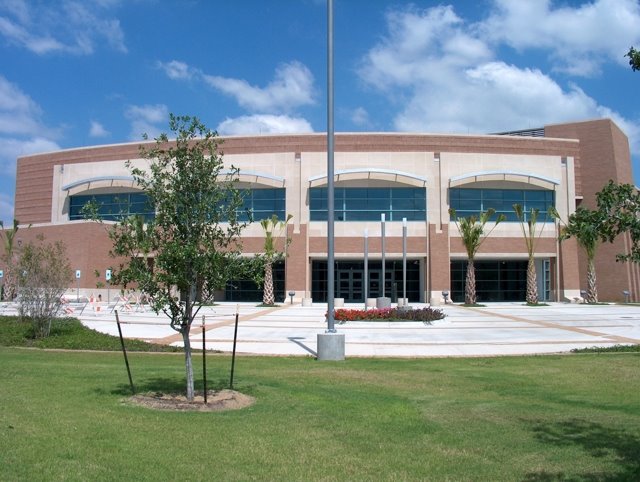
I've written from time to time about the RAHC (pronounced "rack," like the instrument of torture). Construction is pretty much done now (top). I've been inside, and it is indeed a very beautiful facility.

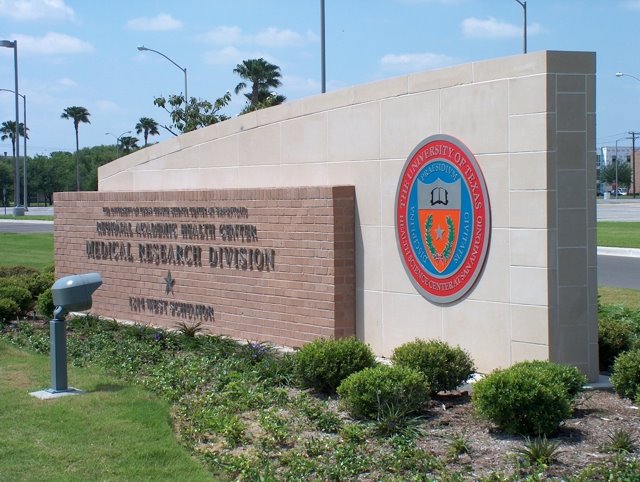
As as you can see, they have a very nice sign (middle).

It's just such a pity they're having problems finding people willing to work in it.

Joni Mitchell once famously said that they would pave paradise and put up a parking lot. UTPA is now trying to prove that once you put up a parking lot, you then rip that up and put in a new athletic center with tennis courts and swimming pools. That's the hole in the ground seen in the third picture. If you look in the back, you can see the white buildings. Those are new student residences being constructed. So the construction and growth of my university continues unabated. In fact, though I don't have a picture of it, there's construction going on in my building as well. New office and lab space is being finished out now, and in theory, a new wing should be in the works very soon.

09 April 2006

Weird week

As you can see, I decided to spruce up the joint a little in a fit of mild boredom.

Not been a great week in a lot of ways. The online learning system for the entire university went down Thursday afternoon and is still not back up. Was kept busy by another job candidate visit and a guest seminar speaker. Next week: two more job candidates. Week after that: job candidate and seminar speaker. And the seminar speaker is mine invite, Jim Belanger from Louisiana State University.

Meanwhile, saw a lot of stuff that was depressing. Like the kafuffle here in Texas about Eric Pianka (documented over at Panda's Thumb). A couple of members of my department are prominent members of the Texas Academy of Science. I'm a member myself, but wasn't at this year's meeting, where Pianka was honored for his research, and where he gave the talk that precipitated the current tempest. So this story is closer to home than I'd like.

Also was somewhat worried to learn 60% of America's fresh vegetables come from one valley in California. And was extremely depressed to learn that about 30-40% of Americans don't know where food comes from. (These last two from this week's Science Show; specifically here.) When about a third of people are so divorced from anything biological that they don't know that meat requires killing an animal, is it any wonder why we can't convince people of more subtle biological theories like evolution? Or why people don't understand the ecological principles like carrying capacity that Eric Pianka talks about?

And the Dees have lost two in a row. Dang.

The announcement of the discovery of the ancient Devonian fish Tiktaalik in Nunavut was quite nice, however. I was listening to a radio interview with one of the authors on Quirks and Quarks, and was rather surprised when they said that their fossils ranged from over 1 meter to almost 3 meters! I knew they were impressive in some of the details of their limbs and neck, but I didn't quite appreciate how... you know... big they were. That said, I was a little irritated (again) when watching the CNN news ticker at the gym about the story. It read something like this fish was a link "leading to land animals with four legs and a backbone." Which implies that fish don't have backbones, which they do.

05 April 2006

Brain Awareness Week lecture

I've created an online version of my talk, "Brain Scans and the Magic Lasso," originally given for Brain Awareness Week last month. It's big -- nearly 50 megabytes, and an hour long -- so don't be trying to look at this with a slow connection. You can find it here (Flash format).

I hope that this is huge, full-blown multi-media science presentation will make up for my being quiet the last week or so. Been very busy with job candidates, among other things.

23 March 2006

Co-rejection

A grant on which I was a co-PI gt rejected this week. Another to add to the pile. But I received notice of a request for applications in April that I might try for, so it's time to line up another kick at the can.

19 March 2006

The Zen of Presentations, Part 6: Failure is an option

The day after Crash won the best picture Oscar, Sounds Like Canada replayed an old interview with writer / director Paul Haggis. (I was aware of his work without being aware of it: he was a lead creative force on Due South.) He said something very, very, very interesting. Paraphrasing, he said, "I'm not interested in a project unless there's a real chance that I might fail."

He said he quit making television because failure wasn't a very real prospect for him any more.

Another little anecdote on ths topic of failure come from Jules Feiffer. He had a cartoon where basically, people come and take stuff away from a person, who doesn't object to this. Because, when they've found you out you're a fake, why bother objecting? He apparently said that a lot of people related to that cartoon, because they never had a significant failure in their work or life. Feiffer had many failures -- Broadway plays closing first night or some such. You move on.

I think many people are governed by fear when they have to give presentations. Performance anxiety, butterflies in the stomach, frog in the throat, or just good old fashioned stage fright. Hence, they fall back on the same back habits that they see everyone else doing. Putting up title slides. Using coloured backgrounds. Sticking in tables with teeny tiny text that nobody can read.

If you aren't risking failure, are you pushing hard enough?

As Neil Gaiman wrote, "Sometimes when you fall, you fly."

The Zen of Presentations, Part 5: Legalized insanity

In the “cosmic coincidence” category today, the cable station Bravo is showing the Inside the Actor's Studio episode with Robin Williams. Unfortunately, it’s the short version – only an hour. There's a longer, 90 minute version, and I would pay good money to see an uncut version of the whole evening, which ran over five hours, according to host James Lipton. I watch it whenever it’s on, because it inspires my presentations and lectures.


And at this point, you may be thinking, “Eh?”

“Come on, you're a scientist, you have to give technical talks on biology. Williams is... you know... funny.” And I freely admit, at first glance, the two don’t meet anywhere near as often as they should. There's several lessons I take from watching Williams.

Nobody ever complains that a talk was “too funny.” Humor is one of the most powerful tools any speaker has. Most humor involves drawing unexpected connections, anyone who laughs has to be thinking and attending and engaged. It can be a great way to check that people are following the words coming out of your mouth. For instance, when I teach protein structure, I often use a little chain of paper clips to represent a protein. Sometimes, while I'm manipulating it at the front of class, it falls apart, and I immediately say, “Whoops! Hydrolysis – did you see the water?” Now, most people reading this will probably go, “I don't get it.” Which is perfectly understandable, you don't have the context to make the connection. But in the context of the lecture, where I've explained what hydrolysis is, it can be funny. Maybe not hysterical, but funny enough that I get laughs with it. If people laugh at jokes related to the content of the talk, I know people are understanding the technical material.

A lot of people warn against trying to be funny in a technical talk, and I don't know why. People say, “Oh, the joke might bomb, and it can be awkward.” If you’ve ever watched every comedian, not everything that comes out is funny. They move on.

One caveat on using humour during a presentation. Don’t just tell a joke just to make a joke. Tell a joke to make a point. The humour should relate to the material. As always, this is particularly true when your talk is tightly timed. That’s probably the main difference between humour in a presentation versus humour in improvisational comedy: you are slightly more confined. That said, many theatre sport games revolve around restricting what you can say or do, and the joy is to find how far you can go within those barriers.

Robin Williams also demonstrates that enthusiasm is contagious. Whenever you’re presenting, you have to find passion, energy, that personal connection to the material.

Another lesson I get from watching Williams is the power of improvisation. An important part of a talk is not just putting information out to your audience, but picking up on cues from your surroundings, and running with it. As Harlan Ellison once said in an interview, “The overriding message of all art… is ‘Pay attention.’” And presentations are an art, so pay attention!

This will sound contradictory, but I think spontaneity is a skill. It can be learned. You can plan for, practice, and rehearse spontaneity.

One of the things I did as a high school student and as an undergraduate was a little bit of acting, which was very valuable to me when I got into graduate school and started giving presentations. I knew how to project my voice, for instance. Another thing that I’m sure most actors will be familiar with is that the first thing that happens is that you have to learn your lines. As you become more familiar with your lines, though, an interesting thing happens. You start to play with them, because you reach the point where you know them so well. You can veer off, try something a little different, and not lose the plot because you have rehearsed. One reason so many talks are so stilted and canned is not that people rehearse too much – talks are stilted because people don’t rehearse enough. They are rigidly following lines, like an actor beginning to learn a new play. The slightest problem throws them off course.

One easy way to “plan for spontaneity” is to have certain lines that work in several different situations. For instance, I can always get a laugh by saying about some process, particularly one that seems a little boring or obscure, “It’s a great party trick... if you're ever at a party with no chicks or booze.” (Stolen without shame from Drew Carey, who used it all the time on Whose Line Is It Anyway?) Talk’s lagging a little? Throw in the party trick line. But it’s brilliant, because it’s so multi-purpose that you can use it without deliberately planning to use it.

Another example of how you can plan to be spontaneous is to make sure your talk is shorter than the allotted time. That way, you can take an extra 30 seconds to say that cogent example that just popped into your head. If your time is 15 minutes, and your talk is always 15 minutes, you cannot deviate without going over time. Leave yourself the breathing room to allow for those fruitful deviations.

So yes, I strongly believed spontaneity is a skill that can be, if not learned, facilitated or not hindered. I believe humour is a skill that can be learned. I think I'm much funnier now than I used to be, and I think that's largely because of having to teach. As you become better prepared, the more able you are to make stuff up as you go.

For instance, a couple of days ago I gave my Brain Awareness Week talk (which went very well, thank you for asking). At the start, I introduced what Brain Awareness Week was, and, on the spot, I said something like, “This runs all this week, so if you're not aware of your brain by the end of tonight, you still have Friday, Saturday, and Sunday to become aware of it.” Didn’t plan it, but it successfully got a laugh. And I was able to keep on track because I knew where I was in the talk and what I had to say next. If I didn't put in enough thought beforehand, I might have lost the plot: “Now, what was I saying?”

But preparation alone doesn’t get you to that level of performance that Robin Williams achieves, which he calls “legalized insanity.” You have to trust your creative impulses and not censor. The good news is that if you do that in a presentation, you are allowed a very large amount of leeway in behaviour that you don’t get while walking around in Wal-Mart (say). (Hence, the “legalized insanity.”) Now that I lecture a lot, one of the things I’ve realized is that it’s difficult to go too far. Forget about trying to present an “appropriate” facade. I do try to avoid being mean-spirited, but otherwise, I feel very comfortable saying whatever comes to mind.

Another talk that I find extremely, extremely inspiring is director Robert Rodriguez's commentary to Spy Kids 2: Island of Lost Dreams. Trust me, whatever you think of the movie, that DVD is worth renting just to listed to the commentary track. On it, Rodriguez talks a lot about his creative process. One of the lessons he said he learned was that his creativity never let him down. He faced problems like needing a song when no composer was available. Rather than saying, “I don’t know how to do that,” he just tackled it and trusted that he could come up with a solution.

And when all of those things start clicking, that's the best. Some people call it flow, some people call it their game face, some people call it being in the zone. And it doesn't seem to matter what the situation is -- the way you get to that is through lots of initial preparation, which gives you the freedom to pay attention and adjust to new situations.

It makes giving a talk. So. Much. Fun.

I've really come to enjoy my lectures, because I can go a little crazy. I can tell jokes. I know I will have a chance to engage in just a little of that “legalized insanity.”

15 March 2006

11 March 2006

Talks, fun; heat, not fun

I spent a good chunk of today working on a public lecture for this Thursday, whcih I'm giving as part of Brain Awareness Week. Because it's for a general public talk, I can try some things that I'd get shot if I were to try in a lecture or at a conference. I'm going to try to give a Lessig style presentation. It'll be fun to try.

Speaking of Brain Awareness Week, I'll also be having some fun on Friday. We're going to screen "the best brain movie ever made": Fiend Without a Face.

It was 36°C out today. Yuck. We are rapidly approaching the "really no fun to be outside" part of the year.

09 March 2006

Off the “to do” list

I finally managed to check off a couple of prominent items on my “to do” list. First, a manuscript I was hoping would go out around New Year’s is sitting patiently in the outbound mailbox waiting to be picked up on its way to a scientific journal. If I can get this out by the end of this year, that would make 2006 among my most productive publishing years ever. Second, I sat down with my colleague Anita this morning and we roughed out what we want to do for our new graduate course, Evolutionary Theory, which we’re going to teach this summer. It’ll be an interesting experience. Not fifteen weeks. Twenty-four days. Twenty-four days of intense teaching action.

Meanwhile, I was actually amazed to see a crustacean making the world news! Kiwa hirsuta is a newly described deep sea decapod – if I understand right, it’s a hydrothermal vent species. It’s blind and furry. It appears to be a squat lobster, which is not a well-known group to most people. But it just goes to show how engaging one good picture of a cool animal really is.

07 March 2006

Quotable...?

Some weeks back I was interviewed for not one, but two article in our local campus newspaper, The Pan American. You can find those articles online here (PDF format). Check out pages 4 and 7.

04 March 2006

Third time is not the charm

Rejected by the NSF again. This is the third time we've submitted a proposal to the Research Experience for Undergraduates Sites program. It seems like every time we make revisions, the reviews come back no better or maybe even worse.

Other lousy news: Our department was vandalized over the weekend. Only one room so far, the downstairs student lounge, but yeesh.

Ah well. Time to work on a manuscript instead of a proposal. We have a pause in lectures, anyway, that gives me a little time to do such. We have arrived at that peculiarly American phenomenon known as "spring break."

Some things I've been looking at. I just discovered the Creating Passionate Users blog and love it. I particularly like the recent posts on How to be an expert and how Dignity is deadly. Also Guy Kawasaki's blog, which I was led to by his excellent talk on innovation. Although it is geared at businesses, I think there's a lot for academics to take away from it. For instance, Guy talks about the idiocy and generic nature of mission statements. Most universities have mission statements. Heck, I was asked to write one for our graduate program. But I think he's on the mark with his alternative, which is to make a three to four word mantra instead of a mission statement. My mantra as the grad coordinator in my department is, "Springboard students' careers."

28 February 2006

Reaching your audience

There are a few things that authors live for. One is finding out that someone you actually don't know personally has read something of yours. And today, I got a very nice email from a researcher in Australia who read my recent article on shovel nosed lobsters in the Journal of Crustacean Biology. He had done his doctorate on a related species, so he was one of the few people who would actually care about the topic! It made me smile.

Meanwhile, my new manuscript is getting pretty close to ready for submission. Hopefully no later than next week. I will have no excuses after next week, because it's our break. No classes to get in the way!

27 February 2006

The Zen of Presentations, Part 4: Titles slides are a crutch

I first became aware of this particular presentation tic at grad seminars at UVic. The symposium moderator would get up, thank the previous speaker, then introduce the next speaker and tell the audience the title of the talk. The speaker would walk to the podium and put up their first slide which, more often than not, showed the title of the talk -- the one that the moderator had just read. Not content with that, the speaker would then to look at their slide and, very earnestly and deliberately, proceed to read the title out loud.

So we get that blasted title three times over.

It drove me bonkers then, and drives me bonkers now. I really only need to know a title once. Unfortunately, title slides are emblamatic of a presentation style that is not beaten out of presenters anywhere near often enough: that is, reading directly from slides verbatim.

There are several reasons to avoid having a title slide. First, it burns up time. Particularly in science, I often have to present talks where I summararize complex information that took months or years to gather and analyze, and I have to do it in 15 minutes. Including time for questions. I have to focus on what I need to say as directly and memorably and efficiently as possible.

Second, it can be a little distancing for the audience. You get up, and barely before the audience can look at your face, the lights are going down and people don't know whether to look at the slide, or look at you. Give yourself at least a few second to get up, let people see who you are. Maybe smile, if that's appropriate (not recommended if you're giving a talk about, say, deaths in sub-Saharan Africa from AIDS).

I think people like having a title slide, because it gives them a safe and easy way to start off a talk. Instead of worrying about "What will I say?", you just have to read the title, thereby putting off the problem of whether you really have anything of substance to say by... oh... a good ten to fifteen seconds or so.

A title slide is a useful crutch to deal with that initial moment of the talk. Some people need a simple way to overcome that initial hesitation -- and that's fine. I am in no way bashing crutches here; they're useful things. But the goal should always be to get rid of the crutch, rather than relying on it.

If you want to leave a title in, there are some alternatives to the title slide. Let the moderator read your title. Or, if you feel you must have a title slide, don't read it out directly -- just talk about your subject. Alternately, if you want to tell people the title because there is no moderator, just tell them -- but don't make a text slide of it. I am convinced, though, that the best solution is to forget about introducing a title and just tell people your story in most cases. And leave the lights up for a few seconds so that your audience can see your face.

E.Q.

You Are 54% Evil
You are evil, but you haven't yet mastered the dark side.
Fear not though - you are on your way to world domination.

26 February 2006

Unexpected linkages

Amazon.com sagely suggests that because I'd like the upcoming Harry Potter and the Goblet of Fire DVD, that I would probably also like a power razor with a storage case. Marvellous.


Was a bit of an odd week. Finally had some long-overdue time to work on a manuscript that has been almost ready to ship out for some months. It's getting even closer now, and another big push to get this manuscript out the door was that the editor of my upcoming paper emailed me to tell me that it should be out around May. Nothing in the publication pipeline is bad.


My editor for that article also emailed to say that the page charges was three months overdue. And why are they three months overdue? Could it possibly be because my institution is apparently nigh incapable of handling money? Nah, couldn't be.


Also had a birthday in there. Rather low key affair. Good, but not as extravagantly celebratory as I had thought.

19 February 2006

More rejection, please

I just got word on one of my last grant applications, this one to the SOMAS program, and it was rejected. I suck.


It has been unusually chilly the last few days, and it's quite cold in my office, so I think I'm just going to go home and work there.

18 February 2006

Professor in disguise

I went to an early morning meeting on Thursday to meet a couple of people who came to our campus to evaluate our Honor's program. It was an interesting meeting. Sometimes, it's nice to hear people from outside remind you that you're not crazy for thinking that the way certain things are set up are not functional...


Anyway, the funny part was that I came in and sat down and one of them asked if I was a student.


Heh.

11 February 2006

The Zen of Presentations, Part 3: Can you do it on the radio?

Late last year, science lost a real treasure: Ted Bullock died at the age of 90. He was a neurobiologist of the first water. I somewhat selfishly took it upon myself to write a short obituary for the International Society for Neuroethology, for which Ted was the founding president. I was fortunate enough to meet Ted several times. In some ways, the first meeting was the most memorable. He came to the University of Victoria to give the last seminar of the academic year, at the invitation of Dorothy Paul, my Ph.D. supervisor. There were many remarkable things about his visit. For instance, when I had just driven him to campus from the airport, he walked into Dorothy's neurobiology class just as some undergraduate students got some microelectrodes into slug brains and were recordings neurons' action potentials. After giving Dorothy a brief hug, Ted immediately doffed his coat, and grabbed a chair to sit and work with the students and talk about the recordings they were getting.

When Dorothy asked if he had any slides so that she might load up a slide carousel, Ted said he didn't have any. He said that the clearer the story was in his head, the fewer slides he needed. No slides was his definition of "nirvana."

The seminar he gave was extraordinary. I think it's still the only academic seminar I've seen where the speaker got up, talked for about 50 minutes or so, without a single slide, a single overhead, without writing a single word on a blackboard. Yet it was absolutely clear, and you never lost sight of the story he was telling. As Dorothy would later put it, "Even the plant physiologists were enthralled." (She wasn't implying that plant physiologists are a hard to please lot, but Ted was talking about neurobiology, which is rather off the beaten path for plant researchers.)

I saw Ted give talks at other meetings. A couple of other times, including the last time I saw him, at Western Nerve Net a couple of years ago, he presented it without slides, but those were much shorter talks.

I think anyone giving a talk should be ready to give a talk using the "Bullock method": be able to do the whole thing without slides.

Having said that, I have a confession to make: I've never had the guts to do an academic talk without some sort of slides. In fact, I put a lot of thought and effort into my slides. For my SICB talk in Janaury, I had started working on my PowerPoint files in mid-November. But I would like to think that I could have given the talk on the radio, if I had to, and it would hopefully be understandable. I always aspire to have the story so clear in my head that I could go right to zero slides.

There's another reason to aspire to be able to give a talk without visual aids. There are two types of speakers: those who have had slide or visual aide disasters and those who haven't had one yet. Not only does preparing give a talk on the radio force you to really think about what you're saying, it gives you valuable insurance.

While I was at the SICB meeting, there were several student paper competitions. I was in the audience for one, in which the speaker was going along reasonably well. He tried to show a video -- and froze the computer instead. Completely. During a juried presentation competition. He ultimately finished the talk, but the long pause while he tried to get the computer going was agonizing. You pretty have to think that cost him any chance he had in the competition.

My other favourite disaster story was at a Western Nerve Net meeting, where the first speaker for the regular presentations was an undergraduate giving her first talk. She was already nervous. And the slide carousel got upended, and put all her slides in a jumble.

Heck, my own seminar for my own job talk was almost derailed for lack of a cable to connect my computer to a projection system. Though because I am gutless, I was steadily filling a carousel with 35 mm film slides rather than "going Bullock" at the last second.

08 February 2006

Science on TV

Some time ago, I mused about a television science reality show about grad students. A writer in the journal Nature expresses doubts. And the always witty Jorge Cham also weighed in on the idea over at Ph.D. Comics.

06 February 2006

Latest work

My latest masterpiece -- er, research paper, "Digging mechanisms and substrate preferences of shovel nosed lobsters, Ibacus peronii (Decapoda: Scyllaridae)", has now been published online, and is available in Journal of Crustacean Biology. You can read the abstract here or here. If you're a subscriber to the journal, the first link will let you go whole hog and get the PDF of the paper, too. Please do. Spread among friends and enemies alike. Everyone loves lobster research papers, don't they?


The one thing I will always wonder about this paper is whether I could have got this published with the title I wanted to give it. I thought long and hard about calling it, "Do shovel nosed lobsters shovel with their noses?" I chickened out, and used for my talk on this subject at the SICB meeting last month instead.

05 February 2006

Invertebrates and psychology

My first degree was in psychology, so when I began working with crustaceans, I was somewhat surprised to learn that Sigmund Freud worked on crayfish nervous systems early in his career, before producing the theories on the unconscious for which he would become famous. And the crayfish work was not trivial, either.


When I mentioned this to Jennifer Mather, my undergraduate supervisor, she immediately informed me that Jean Piaget, who work kick-started the field of developmental psychology, did many experiments with snails, particularly Lymnaea stagnalis, which is still widely used in neurobiology research. She like to get a rise out of her psychology colleagues by saying that they'd lost a damn fine malacologist when Piaget started studying psychology.


Today I learned, from the ABC Radio National show Ockham's Razor, that a third highly influential psychologist also worked with invertebrates: Alfred Binet. Binet's doctoral dissertation was titled, A contribution to the study of the subintestinal nervous system of insects. But if Binet's name sounds familiar, it's probably because you heard it as the second half of the name of the Stanford-Binet test. "Stanford" was a late addition to the test. Binet, with co-author Theodore Simon, developed it first, and published it as "New Methods for the diagnosis of the intellectual level of subnormals" in 1905. It was effectively the first IQ test. This was perhaps as influential as any invention (idea? concept?) in psychology. Despite horrendous misuse of IQ tests, I'm among those who count it as an important scientific advance.


So three of the most influential psychologists of all time started their careers studying inveterate behaviour and nervous systems. Coincidence? Probably. But a sweet and interesting one nevertheless.

04 February 2006

Core values

Strange convergence of events got me thinking. The MSI conference that I've been writing about has had a lot of high powered American politicians, who, as particularly American politicians seem wont to do, go on about "American values," "core values," "the values that make America great." Considering that we've had a keynote from the secretary of the army, a big lunch sponsored by the Department of Defense, such rhetoric gets pretty thick pretty quick.


Now, as it happens, yesterday in our regular journal club meeting, we were talking about the stem cell and cloning debacle in Korea with Woo-Suk Hwang. It was an interesting conversation -- a chance to talk about ethics rather than data, exactly.


These two things together got me thinking about what the core value of a scientist are. I thought of these three. Of course, there are other virtues that are probably widespread among scientists. But those three came particularly quickly and easily to my mind.


Reason. Honesty. Equality.


Reason could be "Rationality" if you wanted all three to rhyme. Science holds as a fundamental assumption that the universe is lawful and understandable. Reason, rationality, logic are the tools we have for going about understanding things.


Honesty. You don't fake data. You admit when you are wrong. This one is probably leapt lose to the top of my list because of the discussions we've been having about scientific fraud and misconduct and such.


Equality is there because I believe science is fundamentally an enterprise conducted by peers. Anyone can have a good idea and test it and subject it to scientific scrutiny. By this I don't mean that there is nobody who can justifiably gain respect as an authority on a subject, or a particularly distinguished scholar, but that is a respect gained among peers.


From time to time, people have suggested that scientists should have an equivalent to the Hippocratic oath that doctors take. While I don't believe that the Hippocratic oath in particular deters much morally suspect behaviour in doctors, and I'm not sure that such an institution as a researcher's oath could be created now, it is interesting to consider what it might contain.

Link of the moment

As I've been talking and thinking about presentations lately, I must send you to this entry over at my namesake PresentationZen. It made me laugh.

03 February 2006

The things I'll do for half a merit point and the promise of a cookie<

The MSIRP conference continued today. I wasn't planning on taking part in it too much, because today was a teaching day (three lectures in four hours). So I went in early enough to have breakfast, talked to a very nice woman in the semi-conductor(?) industry, then went off to teach my lectures.


Then something strange happened. In my one hour break between classes, Mohammed, my department chair, walked into my office and asked if I could phone over to one of the MSIRP organizers. They were looking for judges of student posters. I blinked a couple of times, and more or less said, "Okay." I had no idea what was going on, because I would have thought I would have heard about it in advance. The person on the other end of the phone didn't quite know what was going on, either. But she said they needed judges, and wanted a judges from a fairly wide range of disciplines.


I said I might do it if they gave me a cookie.


I went back off to my last lecture of the day, they off to yet more really great food for the MSIRP lunch (this one sponsored by the Department of Defense), then back to where I unexpectedly found myself judging five student posters instead of going to sessions. One of the organizers apologized, said they were out of cookies, and offered me a muffin. I took the muffin, and said, "But I won't try to conceal my disappointment." Being a judge for a conference is worth something like a third or a half of a merit point at the end of the year. Although they do cap the number of points you can claim, and I'm way, way over, so I suppose I really did it for the broken promise of a cookie and for fun. It was good talking to the students.


After that, back to the biology journal club for a very interesting session on some of the ethical issues raised in the recent Korean stem cell research scandal. Then back yet again to the MSI conference for -- you guessed it -- more really excellent food(*) at a local museum. This time, I had dinner with a fellow from Washington state, a NASA official, and a woman in the Research office of the university (Eastern Washington University) that our Provost is taking over on 1 April. I joke to someone else that I was warning her, but in actual fact I was good and said nothing. Since our Provost was somewhere in the room and all.


I got to see yet another high ranking U.S. government official giving a talk. She said her name is on the money now, so she's treasurer -- though I haven't pulled out a new bill and looked for her name. She was the most effective speaker I've seen so far this conference. No slides and a near letter perfect delivery.


She also mentioned that new US$10 bills are coming out 2 March. I like the new $20s much more than the old, so I'm hoping the new $10s will also be an improvement.


So one more half day of this MSI stuff and then... um... I'm not sure what.


(*) Wendy, our VP for Research, stopped me in the morning and asked if I'd gained anything from the conference so far. I told her, "Weight."

02 February 2006

The perfect strawberry

This has been an odd week. Tuesday I was finally able to go out and collect animals, which I'd been meaning to do for a while. Excellent conditions: warm, low tide, little swell -- I could have picked up huge numbers of shrimp.


Wednesday was a bit of a panicky day. My students had their first weekly online quiz, which always tends to result in a few people who freak out a little, because they've never taken a test this way before. While they were doing that and I was dealing with lots of little first time questions, my student Sandra walked into my office and I said, "Hey, remember that Woods Hole course we were talking about? We'd better start thinking about that, because the deadline's sometime in February." Surf over to the website to find the deadline is... February 1st. Today. Yipes!


You can imagine how I spend the afternoon.


Luckily, we were able to pull it together, since we had worked to put together an NSF application for Sandra late last year. It's out, so fingers crossed. There's another application in two weeks. At least this time we have a couple of days to think about it.


Today I was in and out of the MSIRP conference. I'm not convinced I've advanced my research or created any new opportunities at all yet. And I am again perplexed that experienced, powerful people don't give better talks. But the food has been good. Tonight I had conference dinner held at an old mansion once owned by a wealthy citrus farmer; the secretary of the army was speaking. And while there was lots to like about the food, I happened upon a perfect strawberry on one of the plates. You bit into it and knew this was what strawberries were supposed to be like. Sublime.

27 January 2006

The Zen of Presentation, Part 2: It's all about you

If ever there was a presentation where the visual would completely dominate the presentation, it was a talk I saw at least ten years ago at the University of Victoria by one of the people who was closely involved in the cleaning of Michelangelo's frescos on the Sistine Chapel. The slides (and this was still before PowerPoint had killed slide carousels; these were real 35 mm film slides) were, of course, glorious. When the first one went up, showing one of the frescos before and after cleaning, the whole audience let out an audible gasp.

The speaker paused and said, "You are a good audience."

I remember him. I remember his dry sense of humour, his Italian accent, his self-deprecation. At one point, he showed a video of the cleaning where he was seated, watching someone else work, and joked when he gestured in the video about the hard work he had to do supervising. (He had lifted his hand, pointed, and set it back down.) I remember an answer he gave to a questions from an audience member about how remove plaster that had been added to censor nudes; he said they would not even try it, because that would not be true to the spirit of Michelangelo's work.

I wish I could remember his name, but that's not really the point. I remember him and what he had to say.

Extraordinary talks are almost never extraordinary because of the slides. They're memorable because of the personality of the speaker and the story he or she has to tell.

It's not just me saying this. About this time last year, I was teaching a seminar class. I asked the students to name someone that they thought was a good speaker, and tell me why they admired that particular person. It was very interesting. Their responses fell into a few broad categories. Enthusiasm. Humour. Expertise. Sincerity.

"Great visual aids" or "great slides" never came up. Not once.

The point came up again when I was at the SICB meeting earlier this month. One of the most popular talks was by Steve Vogel, who studies biomechanics, and is well-known for his intoxicatingly clear writing on books like Life's Devices. I had never seen him speak before, though I was always impressed by his prose. I was not surprised that there was standing room only for his talk, which was in one of the bigger rooms. He was talking about ballistic trajectories, and how biological organisms don't really follow classic physics of things being shot. And it was an excellent talk, delivered with a great sense of fun.

In discussing talks with some of the people I met, I mentioned my theory that the visual aids are really secondary. Dmitri (a Russian grad student now in Canada) commented on Vogel's talk, "If you just looked at the slides, you'd think it was a pretty ordinary talk." And he was right; none of them really stood out. It was his personality and clarity that shone through when he talked.

I'll explore a variation on this theme in part three of this erratic series.

26 January 2006

Is the eleventh time the charm?

I just had my eleventh proposal to the National Science Foundation submitted. I've had nine rejections so far, but maybe this will be the lucky one. Though I doubt it, as I was so strapped for time that I just never quite got around to phoning the program director, which everyone tells me is key to getting a proposal funded.


Yet I persist anyway.


Also whipped together an internal proposal for equipment money. Also spent a good chunk of today trying to fix a mess concerning graduate student pay and experimenting with a new voice recorder for podcasting and getting tomorrow's lecture up and running... and so it goes.


The fun never stops.

21 January 2006

The Zen of Presentations, Part 1: You’re showing, not editing

A blog I’ve really been enjoying late – and the title has nothing to do with my enjoyment – is Presentation Zen. I’ve already found much of use, and such thoughtful writing is always a delight. In my business, I think a lot about presentations. I have to lecture somewhere between three to nine times a week, and I have to admit, being able to give a talk at a conference or at a seminar or someplace is one of the things that sometimes keeps me going.

The funny thing is, I’ve often said to students, “Giving a good talk is not one of life’s great mysteries.” There are certain traps that can be easily avoided, so I am always puzzled by why so many talks I’ve seen suck. Yet while I do believe giving a talk isn’t a mystery, mastery of presentation skills is much trickier.

One of the things you have to do as an academic is to figure out what you do not suck at. I’m reasonably certain I do not suck at giving talks. My recent experience at the SICB meeting is the sort of thing that makes me believe presenting is something I’m reasonably good at. I had quite a few conversations about presentations with fellow attendees at that meeting. I thought I would use this journal as a way to start putting some of these down as a resource. So thoughts on presentations will be a semi-regular feature for a while.

On to this entry’s tip. A real simple one (because I’m up late and should probably go to bed or something).

1. Take advantage of *.pps

Much has been written about the ubiquity of PowerPoint, and how badly people use it. Edward Tufte, for instance, published a little pamphlet on just that matter that’s already sold through once. Since PowerPoint isn’t going away, I do wish that people would take a little more time to learn how to use it.

When you save a PowerPoint file, there are actually several options. 99% of people that I’ve seen save the file with the default extension, *.ppt. But if you scroll down a few, you find a very useful option: PowerPoint Show (*.pps). You can open this file in PowerPoint and edit it just like a *.ppt file. But if you double click the file or shortcut directly, something wonderful happens.

The slide show starts.

That’s it. Simple. But I wish more people would take advantage of it.

If you double click on a *.ppt file, it opens PowerPoint, in some configuration of editing panes. You can typically see a whole bunch of slides on the sorter tray, menus, and more – which I as an audience member don't care about. Sometimes, as a presenter, I don't want someone to have the slightest clue about what my upcoming slides are until they see them – but opening up a *.ppt file often blows a surprise out of the water.

Then after you’ve opened up PowerPoint to start your *.ppt show, you then have to start the thing. Then I, as an audience member, have to wait through the boring process of watching someone trying to hit a little tiny icon in the lower left hand corner of the screen, or run around trying to find a menu option. (Very few people know you can just hit F5 to start.) It always seems like the operator is fumbling to get the thing started.

Finally, because you don’t have to fiddle around trying to start the show within PowerPoint, you’re saving a few precious seconds. That doesn’t sound like much, but in a conference situation where there are many speakers and time limits are enforced, those few seconds of efficiency should not be underestimated.

Credit where it’s due: I have to thank my colleague Bob Edwards for drawing my attention to this little trick.

19 January 2006

Reflexes

I have felt very reactive this week, particularly the last couple of days. It seems like there's someone walking into my office wanting to talk to me. And while I don't mind talking to people, lots of things are just not getting done! This graduate program thing in particular is taking up far more time than anticipated.


Well, I guess that's what weekends are for: to catch up...

16 January 2006

Frantic?

Not yet. But I am spending a lot more time than I expected trying to get everything updated for General Biology, and introductory course I've done many times before. This time, though, we have a new textbook, and I'm working hard to try to pull a lot of available resources from the publisher into my class website, for instance. And that isn't easy.


There's a grant deadline due next week, too.


Going home now. I think. (I was planning to leave an hour ago...)

12 January 2006

Lab photo from SICB 2006

Zen's lab at SICB 2006I was very pleased to finally be able to take students with me to a meeting. This picture shows our SICB poster, Sandra (first author on the poster) on the left, and my HHMI undergraduate student Veronica on the right. I was very pleased that for once, the instructions gave the exact right size of the poster boards! Our massive poster fit like a hand in a glove in its space, as you can see. I haven't always been so lucky, and have had poster edges dangling off poster boards before. (Yes, I'm looking at you, Third International Tunicate Conference organizers!)

Besides boasting about our poster and my students, posting this picture gives me a good excuse to test Blogger's picture loading, which seems to work fairly well. Click on the picture to enlarge.

Who's the joke on?

Our current provost, Rodolfo Arevalo, starts his new job at Eastern Washington University on April 1st. Hmmmmm...

10 January 2006

Ah, Rudy, we hardly knew ya...

A guy goes away for a few days, and suddenly everything is topsy turvey.


Our provost, Rudolfo Arevalo, is leaving to become the 25th president of Eastern Washington University. I wish him a speedy transition to his new institution. While Arevalo has done some very positive things for our institution, he's done it in an amazingly heavy-handed manner that he alienated a lot of people.


New president a couple of years ago, now a new provost. With Arevalo's departure, only a few of the "old guard" at our campus is still around. We'll see if the revolution continues.

Home again, home again, jiggedy jig

I spent the last week in Orlando at the Society for Integrative and Comparative Biology conference. I gave a talk which went very well. First, almost everyone I talked to remembered my talk title -- "Do shovel-nosed lobsters shovel with their noses?" -- so I can take some pride in finding a title with a high stickiness factor. My presentation also was very well received, with one person calling it "inspiring," (or perhaps inspirational, I can't exactly remember) and another person saying, "I hope you teach," and saying she thought my passion "went through the room" and infected others. I have to say that after spending almost two months thinking about that presentation, and then boom, having it all over in 15 minutes, you milk those compliments for as long as you possibly can.


Also, my grad student Sandra gave a poster which was also well received. We did quite a bit of useful networking, including with an associate editor of the journal to which we plan to submit the paper, who gave us some very good and helpful advice. It will be a while before we find out if she managed to make her way into the finals of The Crustacean Society's best student poster competition.


I have been back in town now for a little over 12 hours after about a week with only one brief internet session, and am playing the inevitable game of catch-up. More on the conference later!

02 January 2006

Was 2005 real?

It's seems a bit of a shame that a couple of the biggest science stories of the year were about fake science. The year closed out with accusations of massive scientific fraud in Korean stem cell research (see articles here). Another big science-related story was the continuing fight over intelligent design. I make no bones that I am excited about the results of a recent court case (extensively covered at The Panda's Thumb) which says (among other things) in no uncertain terms, "Intelligent design ain't science."


Although it's easy to be cynical about the widespread peddling of -- I was about to type "disinformation," but I think I'll be blunt and call them "lies" -- that these stories represent, there is good news to both of them. Systems in place to check these thing worked. Investigation uncovers possible fraud. A trial recognizes when people are trying to push religious belief under the disguise of science.


Looking at the evidence seems to work -- although there are certainly times I wished it worked a bit faster.