26 October 2015

Dubious journals from major scientific publishers: Homeopathy

Consumer Reports recently looked into homeopathic remedies. It was pretty timid repudiation, but did contain this critical line:

That makes no scientific sense, our experts say.

In this regard, Consumer Reports seems to be ahead of the giant science publisher Elsevier. Elsevier publishes an entire journal titled Homeopathy.


I was reminded of Homeopathy when Jane Hu commented that Elsevier’s journal Medical Hypotheses is “The X-Files division of Elsevier.”

Medical Hypotheses was intended to be a journal that would let people put out ideas that would be hard to publish in more conservative journals. This mostly meant ditching peer review, and a lot of crazy stuff got into its pages. I have never heard anyone praise a paper from Medical Hypotheses as demonstrably advancing a field. But I am at least sympathetic to the idea that maybe some speculative ideas need a home.

But if Medical Hypotheses is Elsevier’s X-Files, Homeopathy is its Area 51.

I hate to be blunt, and expect someone call me names, but... Homeopathy is crazy. Homeopathy is pseudoscience. It has no theoretical mechanism for action. It has failed test after test after test. It does not work.

Not only is this journal published by Elsevier, it is indexed in the Thomson Reuters Web of Knowledge and has an Impact Factor.


The Web of Knowledge is vetted, and claims:

Our rigorous selection process for Web of Science guarantees that the best, most relevant journals contribute to all of our data and evaluation solutions.

When a closely inspected scientific database can’t weed out the most obvious junk science, you have to wonder how serious they are about identifying “best, more relevant journals”.

Perhaps the most disturbing this is that it gets cited by other journals. They are mostly “alternative medicine” types of journals, but certainly not all.


As I have written before, I do not consider for profit scientific publishing an inherently evil idea. Burying traditional publishers is not a goal for me.

But whenever anyone talks about the importance of gatekeepers and reputation and the value of traditional publishers... ask if a major scientific publisher should have a journal like Homeopathy on its roster. Any publisher that claims to value scientific rigor should not only be embarrassed by a journal like this, they should shut it down.

Scientific publishers should be judged not only on their highest quality products, but by what crap they keep around and can’t be bothered to get rid of.

Additional, 27 October 2015: This journal is, of course, yesterday’s news. Librarian Jeffrey Beall (he of the dodgy publishers list) tweeted about this journal earlier this year. It elicited this disappointing response from Elsevier representative Tom Reller:

So for every topic that someone thinks is pseudoscience on wikipedia, STM pubs aren’t allowed to publish studies on it? What?

Sure, cast doubt on Wikipedia rather than addressing the question. Say it’s just “someone” on Wikipedia, as though it’s the work of a lone troublemaker instead of a page with (as of this count) 2,299 different users. Ignore that the Wikipedia article has 297 references, many of which go to peer reviewed journal articles. Ignore that homeopathy does not have credibility in the scientific community.

If I had time, I would love to create list of all the articles in Elsevier journals that have titles like, “Homeopathy cannot even be used to replace placebo”. Or maybe this article in the Elsevier journal The Lancet, which concludes in the abstract, “This finding is compatible with the notion that the clinical effects of homeopathy are placebo effects.”

I’m not arguing that academic publishers should outlaw papers on a topic. The point is that having a journal dedicated to bunk looks bad, and provides an easy outlet for bunk.

Indeed, Homeopathy may be one of the best arguments for keeping research articles bundled in journals: it provides a quick signpost that reads, “You can ignore this.”

Hat tip to Björn Brembs for pointing out this journal to me. Further hat tip to Richard Poynder for pointing me to Reller’s response.

Additional, 13 June 2018: The journal Homeopathy is also indexed in PubMed.


This story notes that the journal had been delisted from Web of Science journal rankings in 2016. Since then, however, Web of Science has changed ownership, and the journal is still indexed in the service.
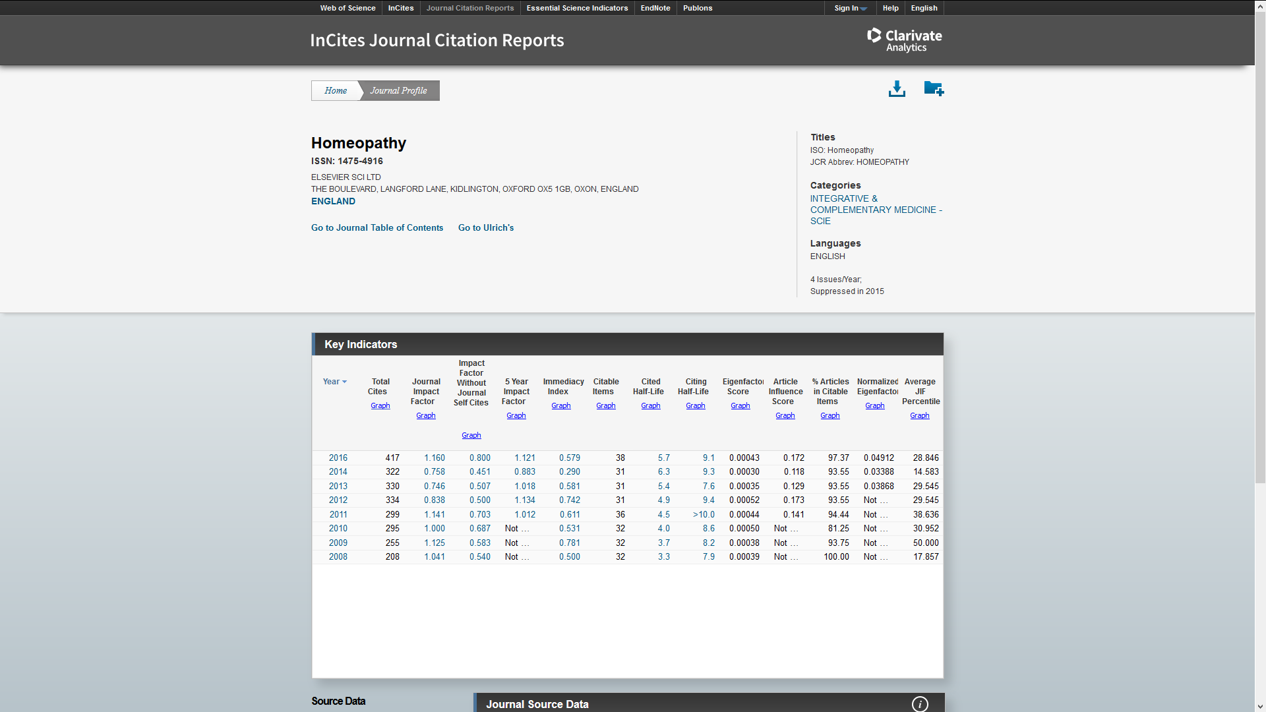

There is a tiny side note saying, “Suppressed in 2015,” with no explanation of what that means. It looks like it got back on the list the next year.

Update, 7 August 2019: The journal Homeopathy is no longer published by Elsevier! But if you think that means it is out of business, think again. It’s changed hands and is now published by Thieme. Thieme is a long established academic publisher (over 125 years), so I’m just as shocked to see them pick up this journal as I was surprised when I saw it in Elsevier’s stable.

20 October 2015

Kiloauthor still gaining traction

Apparently this appears in the November issue of Wired:


I’m seriously wondering how far this word will go now. Oxford English Dictionary, are you listening?

Hat tip to Eric Topol.

Related posts

When does authorship stop meaning anything useful?
Living the Matthew effect with kiloauthors

Tuesday Crustie: Climbing purple tree crab leader

Ooh, this new land crab is a beauty...


Not only does Arachnothelphusa merarapensis have a pretty shade of purple going for it, it has some darned interesting habits, too:


All three individuals collected by the authors were all found in trees, often quite high off the ground. Three is obviously not a huge number, but the team looked for any burrows on the ground, and didn’t see them, suggesting this species is a climber by nature.


Because this seems to be a tree dweller, it could easily be affected by logging. The good news is that this animal was found at Merarap Hot Spring Resort (which gives it its name), so its habitat seems safe right now. But that the team could only find three individuals suggests it might be a rare species.

Additional: Loved Rachel Feltman’s comment about this species:

If a crab lives in a tree, then it’s basically just a pinchy spider.

Reference

Grinang J, Min PY, Ng PKL. 2015. A new species of tree-hole dwelling freshwater crab of the genus Arachnothelphusa Ng, 1991 (Crustacea: Decapoda: Brachyura: Gecarcinucidae) from northern Sarawak, Malaysia, Borneo. Raffles Bulletin of Zoology 63: 454-460. http://zoobank.org/urn:lsid:zoobank.org:pub:4CC4DC84-8F6E-4524-9D3F-BAA3C2DAF588

19 October 2015

Getting too old for this

“We at the Society for Neuroscience would like to take this moment to remind you...


“That you are old. I mean, seriously old. I mean, you think that wizard in Lord of the Rings is old...


“But he hasn’t been a member of the Society for a quarter century now, has he? No he has not.”

18 October 2015

#SfN15 bingo

By popular demand!

(Okay, one person asked. And there went a half hour of productivity...)


Update, 19 October 2015: Enough material came in for a second bingo card!


Update, 20 October 2015: I can’t stop myself!


Related posts

Neuroethology bingo
SfN 2013 bingo

16 October 2015

15 October 2015

Mitochondrial misconceptions

A Google image search for mitochondria reveals this:


All the images show mitochondria a the shape of a short bean, more or less.

Now check out this fluorescent stain of mitochondria:


Instead of a bunch of short little football shapes, we see long, stringy networks of mitochondria within cells.

I’m embarrassed by how many times I’ve shown the artistic representations of the mitochondria in my classes. They’ve been mostly provided by textbook suppliers, but they are far from alone in getting it wrong, as the Google search shows. My colleague down the hall, Robert Gilkerson, works on mitochondria, tells me that researchers have known that mitochondria form these long, connected networks since the 1990s.

Weirdly, Wikipedia shows no less that four of the wrong “bean-like” pictures, then goes on to say:

Although commonly depicted as bean-like structures they form a highly dynamic network in the majority of cells where they constantly undergo fission and fusion.

Why do we keep perpetuating the wrong image? The artist’s renditions are very helpful in showing the double membrane structure of mitochondria, which is very relevant to function. But that could be shown in a more realistic representation of the structure, instead of copying from other textbooks.

I say “copy” deliberately, because there is clear evidence that undergrad biology textbook creators do copy from existing texts, sometimes for generations (Gould, 1991).

References

Gould SJ. 1991. The Case of the Creeping Fox Terrier Clone. Bully for Brontosaurus: Reflections in Natural History. W.W. Norton & Co.: New York. 


External links

Enhanced Yellow Fluorescent Protein (EYFP) Mitochondria Localization

06 October 2015

Tuesday Crustie: All hail the king!

When something makes normally conservative scientists put “remarkable” in the title of a paper, and name a species “king,” you stop and you open the paper.


This lovely hermit crab is Patagurus rex. This was a new genus, named after a legend in the world of crustaceans, Pat McLaughlin.

The species name is not given because it is particularly regal (sadly), but for “the extraordinary albeit superficial resemblance of this new species to some king crabs.”

This picture shows this hermit carrying not the curved snail shell you usually associate with hermit crabs, but a clam shell.

My only regret is that I didn’t stumble upon this lovely little hermit crab description when it was published a couple of years ago.

Reference

Aanker A, Paulay G. 2013. A remarkable new crab-like hermit crab (Decapoda: Paguridae) from French Polynesia, with comments on carcinization in the Anomura. Zootaxa 3722(2): 283-300. http://dx.doi.org/10.11646/zootaxa.3722.2.9

01 October 2015

Badges for scientific paper contributors


A news article in Nature examines the latest bid to reform scientific authorship: badges.

I completely agree that the problem the badges are trying to address is one that needs addressing: clarifying author contributions. The article describes efforts to come up with a standardized list of tasks that people might perform in a scientific study. I’ve done similar exercises in my biological writing classes. Usually, we end up with about five categories, something like this:

  • Concept 
  • Experimental design
  • Data collection
  • Statistical analyses
  • Writing

The taxonomy the badges are working from is more elaborate, with 14 categories, although the article mentions another group that recorded over 500 reasons (!) someone might be an author on a paper.

The Nature article links out to four papers with badges, each badge signifying an author’s contribution. The badges are standardized, appearing with the same design in both journals.

In neither journal do the badges appear in the PDF of the papers. To me, this immediately limits the usefulness of badges. I save papers as PDFs, and I consider that to be the most “official” version of the paper. If the goal is to clarify authorship, it needs to as integral a part of the paper as author affiliations or contact information.

Turning these contribution categories into badges seems like needless gamification. The article notes that software firms have used badges. This is probably why I have only heard our online learning center talk about badges. That’s been about it.

I’m hesitant about adopting trendy things from software companies. I think too often, you run the risk of investing a lot of time and effort into something nobody uses, and is quickly abandoned a few years later. For example, see this article about how universities bought into Second Life, and where that effort stands now:

I decided to travel through several of the campuses, to see what’s happening in Second Life college-world in 2015.

First, I didn’t see a single other user during my tour. They are all truly abandoned.

Second, the college islands are bizarre. They mostly are laid out in a way to evoke stereotypes of how college campuses should look, but mixed in is a streak of absurd choices, like classrooms in tree houses and pirate ships. These decisions might have seemed whimsical at the time, but with the dated graphics, they just look weird.

The work on standardizing the contributions seems very valuable to me. It moves us closer to to the movie credit model, which I think scientific authorship will ultimate evolve towards, particularly with kiloauthored papers. But I am trying to imagine having “writing,” “acting” and “special effect” badges go by at the end of movie. It wouldn’t deepen my understanding of who did what.

I do not understand how contribution badges add value that you don’t get by simply writing out the contributions in words.

Related posts

Letter in Science!
How common is “co-first” authorship?
When does authorship stop meaning anything useful?
Everybody gets to be corresponding author! 

References

Chawla DS. 2015. Digital badges aim to clear up politics of authorship. Nature 526: 145–146. http://dx.doi.org/10.1038/526145a

Photo by hyperdashery badges on Flickr; used under a Creative Commons license.

Comments for second half of September 2015

DrugMonkey asks how much it costs to generate a publication in something like Science or Nature or Cell. This was probably prompted by Steve Ramirez’s estimate that it took $3 million to generate one of his papers.

30 September 2015

Journals, tired of complaining about blogs, complain about PubPeer

Well, it had been a while since a journal complained about how the Internet is ruining science.

Fortunately, Michael Blatt,  Plant Physiology stepped up to the plate with an editorial re-hashing tired arguments about post-publication peer review.

How tired are they? The editorial pretty much checks off every box of arguments against post-publication peer review that I listed in my article on the subject over a year ago. It’s so familiar, Blatt could have used mine article as a template for his. “Hm. Have I complained about anonymity yet? I have. Oooh, but I haven’t said anything about the tone.”

The only wrinkle is that this time, it’s directed at PubPeer rather than blogs. Blatt goes so far as to say:

Until then, I urge scientists publishing in Plant Physiology and other reputable scientific journals not to respond to comments or allegations on PubPeer(.)

Weirdly, a very similar sentiment was expressed about the blog Retraction Watch just days before:

Mr. (Ariel) Fernández never filed the lawsuit he threatened against Retraction Watch in 2013. But he has not retracted his disdain for the blog.

“I thought about suing RW,” he told The Chronicle in an email this month, “then I quickly realized that nobody with scientific credentials takes RW seriously.”

It’s a slightly sad and desperate ploy. “Don’t look at them!”

I would do a deeper analysis of this editorial, but Paul Brookes and DrugMonkey have already done it. Go read.

Related posts

Back room science


External links

Punching down; In defense of PubPeer
Throwing punches about PubPeer

References

Blatt MR. 2015. Vigilante science. Plant Physiology 169(2): 907-909. http:/​/​dx.​doi.​org/​10.​1104/​pp.​15.​01443

Faulkes Z. 2014. The vacuum shouts back: post-publication peer-review on social media. Neuron 82(2): 258-260. http://dx.doi.org/10.1016/j.neuron.2014.03.032

28 September 2015

“Ideas you shall have...”

The other day, someone said to me (roughly), “You made your research career by scratching it out with your fingernails.”

Which reminded me of this classic Sandman comic (#17):

All the pictures in my head. I had to get them down, but I didn’t have any paper, or ink. So I used the wall.

And my fingertips.

Sounds about right.

25 September 2015

Meteor

I saw a meteor last night!

I was lucky. I was outside for just a few minutes, and turned around at just the right time.

Now, I’ve seen meteors before. Shooting stars, like the Perseid meteor shower. But this was a big ol’ bright fireball.

At first, I thought it was a firework or something man-made. It was bright, and moving slower than I’d seen shooting stars move. It had a long trail that changed colour as it fell, although it was mostly green.

And it looked like it was headed straight for the ground. I seriously wondered if it might have landed and made an impact.

Idiot that I am, I didn’t look at my watch to get the exact time. It was too fast for video. It lasted just a few seconds.

Of course, I did what anyone would do today when they want to catch up with real-time information: I hopped on Twitter. Sure enough, there were tweets about seeing a meteor at about the same time I did. Most people didn’t have where they lived, but the timing and description matched what I saw, so I was pretty sure this was real.

I tweeted if anyone knew where I could report this, since the trajectory led me to think it might, just might, have landed. Bad Astronomer and one-time UTPA presenter Phil Plait came through and told me about the American Meteor Society’s reporting website. It’s a very cool process; very easy to give a lot of information. If you ever see a meteor, report it! For science!

The phrase “once in a lifetime” gets overused a lot, but this probably was a true once in a lifetime event.

Additional: Here’s the report page of the American Meteor Society of last night’s fireball. Quite surprised by spread out the observers were!


Do you take science to where the people are, even if they’re at a vile cesspool?

I saw this question from a Reddit “Ask me anything” (known as AMA for short) science session on Twitter:


The gist of the question is, “female Neanderthal... do you bang or do you pass?”

Eww.


The answer is pretty funny, but the question comes close to encapsulating why I, personally, am less and less inclined to try to do an AMA on Reddit.

Lots has been written about Reddit’s culture of sexism (here’s one, two, three, four for starters). And yes, there is good stuff on Reddit. I have an account and post there from time to time. Some women report having never experienced sexism on Reddit. I get that.

Nevertheless, there are enough examples of problems that I ask myself: “Is this a forum I feel comfortable appearing in?”

Increasingly,  my answer to Reddit is no. Because from a distance, I’m kind of getting the impression the place is mostly a cesspool.

But I say this realizing that... there are a lot of people on Reddit. If you only go to where there are like-minded people, you can consign yourself to irrelevance.

For my fellow scientists, have you done outreach on places that are opposite to your views? Would you? Why or why not? Would you do a spot on Fox News in the U.S.? (Or, if you happen to be a politically conservative scientist, MSNBC?

Additional, 10 August 2016: The Science and Everything Science sub Reddits won’t let you post research from a journal article unless the journal has an Impact Factor of 1.5 or more. Another reason to avoid the place.

External links

Why Reddit is sexist
Sexist, racist – the web hounding of Ellen Pao shows the trolls are winning
Why Reddit Tends Towards Sexism In 1 Chart
Reddit’s woman problem

24 September 2015

Everybody gets to be corresponding author!

Spotted in the comments section of DrugMonkey’s blog:

(C)an someone explain to me how a paper in this week’s Science is able to have 4 freaking corresponding authors?

It’s worse than that. In this week’s Science, there is one paper with two corresponding authors, one with three, and one with four corresponding authors, as mentioned above.

And that paper with four corresponding authors? It only has four authors! As Oprah might put it:


On top of that, the paper with four corresponding authors also has a note that two of the authors “contributed equally.”

DrugMonkey’s reply is on the ball:

It is because the Corresponding Author marker has now become a tick mark of academic contribution and credit instead of a mere convenience for getting in touch with the research team. So much like we’ve seen metastasis of “co-equal” first (and now last) authors, we’re seeing expansion of corresponding author credits.

We now have at least three “indicators” of relative contributions to a paper:

  1. First author: this is usually assumed to be the person who did most of the “boots on the ground” work, a grad student or post-doc.
  2. Last author: This is usually assumed to be the boss, the principle investigator, the person who came up with the idea and got the grant.
  3. Corresponding author: Um... to me, I would take this as a signal that this person is the boss. That is, it’s the exact same assumption I make for “last author.”

If I saw a paper with different last author and corresponding author, I’d be confused. Add in multiple corresponding authors and multiple “co-last” authors and equal contribution notes, and I have no idea who’s to credit (or, if it’s bad, who’s to blame).

This is not an idle exercise for me. My new university is in the middle of trying to develop new promotion and tenure guidelines. I’m on a departmental tenure and promotion committee. Figuring out how people interpret authorship (particularly upper administration) has real implications for people’s careers. A couple of years ago, one administrator was complaining that our tenure-track faculty didn’t have enough first authored papers, apparently not realizing that in biology, the norm is that they would be last author on papers.

This is yet another indication of the phenomenon I’ve been talking about for a while. The concept of “authorship” for scientific papers isn’t the right model for assigning credit in large collaborative research projects.

Additional, 25 September 2015: Scott Edmunds on Twitter notes that “corresponsing author” has monetary value:

Chinese authors get paid (and also pay) to be corresponding, first and last author

He gave links out to China's Publication Bazaar and The outflow of academic papers from China: why is it happening and can it be stemmed?.

Related posts

When does authorship stop meaning anything useful?
Letter in Science

Overly honest recruitment ad

I spotted this recruiting ad for an undergraduate research position yesterday:


“You’re Only Limited by Your Imagination!

“and funding”

I’m not sure that this level of candor is attractive, helpful, or necessary for undergraduates.

Quote of the day: Career long shots

Applies to scientific careers as well. Emphasis added:

When first starting out, did making a career of fiction writing seem possible?

Sure, it was an awfully long shot, but also I was in my 20s, and that’s the time to take your long shots — when you don’t have a mortgage, don’t have kids, don’t have anybody else who’s depending on you. Yes, of course it was a long shot, but so is being a professional athlete, being a professional actor, being a professional musician. But the world would be devoid of arts and culture (and science - ZF) if everybody said, “Ah, it’s not easy, I’d better give up now.” - Robert J Sawyer

External links

Writers on Writing: Robert J. Sawyer
Hat tip to Robert J. Sawyer on his Facebook page. 

23 September 2015

Ancient legacies promoting ancient legacies


In all the excitement about the discovery of the new fossils of Homo naledi, many of my friends in the science community have remarked on this discovery being published in the journal eLife, a new open access journal, rather than Science or Nature.

“Look, this shows that you don’t have to publish short articles in those closed access journals to get lots of attention!”

What I haven’t heard many people point out is that the discovery of Homo naledi had the advantage of being publicized by a well-oiled, well established, recognized print brand: National Geographic.

The style of coverage for Homo naledi was almost exactly what you would see for Science or Nature: simultaneous press releases, probably embargoes, cover of a magazine,and so on. The only difference is that National Geographic isn’t a peer reviewed journal, but I’m not sure that difference is one that a lot of the non-scientist crowd (maybe even including many in journalism) would recognize. I would wager that for many, National Geographic is viewed as having the same authority as Science or Nature.

Don’t get me wrong: it’s great that this kind scientific research is in an open access journal with an unlimited page count. See this post by team member John Hawks which shows how this publication compares to the scientific arguments over other fossils: short papers, long waits for descriptions, etc. And the scans of the fossils that people can print on 3-D printers are something pretty new to scientific publication. All of that is important for the science, but I’m asking more about the outreach.

If this same amount of attention had been garnered by the eLife articles alone – or, to head into complete fantasy, a bioRxiv or PeerJ pre-print (say) – then it will be safer to say the landscape for scientific publicity, news, and outreach has changed significantly. Right now, it’s just showing how much muscle the established media brands still have.

External links

New species of human relative discovered in South African cave
Is Homo naledi just a primitive version of Homo erectus?
Cover image from here.

22 September 2015

Inspirational

I don’t think it matters what age they are: some people wonder if they can contribute. Young people wonder if they’ll get their shot. Mid-career people wonder if they’re making an impact. Older people wonder if they’ve still got it.

Some people do their best work early. Einstein’s “miracle year” was when he was about 26. As Tom Lehrer once said of another musician:

It is a sobering thought, for example, that when Mozart was my age, he had been dead for two years.

Then you have slow burners like Charles Darwin, who published the On the Origin of Species when he was 50.

I think you look for those examples of people who have success at different ages to convince yourself that there’s still a shot for you to stay creative and productive and vital.

So I was amazed and pleased to learn that last night, the Polaris music prize for independent Canadian music was won by a 74 year old. It was Buffy Sainte-Marie, whose music career started before I was even born.

Holy crap.

Frankly, I was never familiar with her music from when I was younger. I was never a fan. But I defy anyone to listen to “Power in the Blood” and tell me that they’d have guessed that song came from a septuagenarian. It’s got as much punch, nerve, and energy as songs by artists a third her age. It freakin’ rocks.

Huge congratulations to Buffy!

Update, 7 March 2025: The Polaris Prize has been rescinded from Buffy Sainte-Marie after she returned her Order of Canada and descibed herself as American. This is the latest in a long series of moves that arose from investigations into her claimed but falsified First Nations heritage.

Tuesday Crustie: Speedster

This animal has a superpower:


Speed.

Undinula vulgaris has one of the fastest reaction times in the the animal kingdom: 1.5-3 milliseconds. Most animals can barely get a message from one neuron to another in that amount time, never mind detect a stimulus, process it, send a signal to muscles, and make them contract.

How do they do it? Part of the answer is that they have myelinated neurons, which is unusual for an invertebrate (Lenz et al. 2000, Wetherby et al. 2000).

Reference

Lenz PH, Hartline DK. 1999. Reaction times and force production during escape behavior of a calanoid copepod, Undinula vulgaris. Marine Biology 133(2): 249-258. http://dx.doi.org/10.1007/s002270050464

Lenz PH, Hartline DK, Davis AD. 2000. The need for speed. I. Fast reactions and myelinated axons in copepods. Journal of Comparative Physiology A 186: 337-345. http://dx.doi.org/10.1007/s003590050434

Weatherby TM, Davis AD, Hartline DK, Lenz PH. 2000. The need for speed. II. Myelin in calanoid copepods. Journal of Comparative Physiology A 186: 347-357. http://dx.doi.org/10.1007/s003590050435

External links

What animal has the fastest reaction time?

Photo from here.

21 September 2015

Prophetic paragraphs


Bradley Voytek wanted to read the last paragraphs of people’s doctoral dissertations. I dug up mine. It was in a section titled, “What next?”

Fourth, the brachyuran superfamily Raninoidea de Haan, 1841 are true crabs that, like hippoid sand crabs, are specialised for digging in sand and mud. Their gross morphology is reminiscent of albuneids: unlike the thorax of most brachyurans, the thorax of ranid crabs is not rostro-caudally compressed, and their legs have very flat, paddle-shaped dactyls. Comparing the convergent digging behaviours in the ranid crabs with the hippoid sand crabs could be illuminating in understanding the biomechanics of digging.

It’s, um, not a ringing last paragraph. No eternal verities or a big “What does it all mean?!” conclusion.

But what is cool is that of the four things I listed in my “What next?” conclusion, this was the only one I got to do. I did get to study those ranid crabs! And publish a paper about it!

Faulkes Z. 2006. The locomotor toolbox of spanner crabs, Ranina ranina (brachyura, Raninidae). Crustaceana 79(2): 143-155. http://dx.doi.org/10.1163/156854006776952874

That makes up a tiny little bit for not even coming close to doing any of the other three things I listed as possible avenues since then. That makes it a nice last paragraph.

Photo by Tom Demeyer on Flickr; used under a Creative Commons license.

18 September 2015

Incoming: Science Blogging

After being listed as “in press” on my home page for some months now, Yale University Press has moved a step closer to publication of Science Blogging: The Essential Guide.

It now has a publication date (22 March 2016), an ISBN (9780300197556 – accept no substitutes), and a price (an affordable “buy one for yourself and one for a gift” price of $24.00).

Along the way, the book has gotten a slight title makeover from The Complete Guide to Science Blogging to Science Blogging: The Essential Guide. The change is probably a good one, as it puts the book’s subject matter right up front.

The cover is not up yet, but I’ll be sure to preview it when it’s available!

External links

Science Blogging on Yale University Press
Science Blogging page of Facebook

16 September 2015

The book chapter you’ll never get to read


A while ago, I wrote about the importance of talking about failures. I thought I’d share this failure, because the release of the newest series of Doctor Who this weekend makes it kind of timely.

I submitted this proposal for a planned academic book titled Doctor Who & History. Even though I keep swearing off writing book chapters, I submitted it because I thought this might feel more like fun than work.

They wanted fifteen chapters, and got 50 proposals. This was one of them. It wasn’t selected. I have to commend the editors, who gave me one of the nicer rejection letters I’ve gotten.

The history of science in Doctor Who


The character of The Doctor is a scientist. Doctor Who was originally created with the goal of teaching history and science, but the show rarely mixed the two in its plotlines. This chapter will examine how the scientific history is treated in, and reflected by, Doctor Who. When set in the past, the show usually features social and cultural leaders than scientific ones. For example, Queen Victoria and Charles Dickens have both appeared in Doctor Who, but Charles Darwin, their contemporary, has not. The real history of science has rarely warranted more than The Doctor dropping the name of a famous scientist into a conversation. The show’s portrayal of its fictional scientists (other than The Doctor) is often suspicious and critical, with several stories centering on ambitious scientists overreaching, with disastrous consequences. But in their search for new plot material, writers often looked to emerging scientific ideas and worked them into their scripts. The most famous example of this was the creation of the Cybermen, which was inspired by research on organ replacement. Sometimes, the show’s scientific and technological elements would be familiar to any contemporary viewer. The many 1960s stories that incorporated crewed spaceflight would be completely familiar to people living in the middle of the space race. Less often, but more interestingly, Doctor Who sometimes used scientific ideas before they were well incorporated into popular culture. The supercomputer WOTAN threatened the world by joining a network of computers long before most people had even seen a pocket calculator let alone a computer, or that computers would eventually be connected by the Internet. “Earthshock” featured the dinosaurs being wiped out by a crashing spaceship just two years after the suggestion that an extraterrestrial impact first appeared in scientific journals. Since the show’s revival, living scientists, like physicist Brian Cox, have appeared with The Doctor. Therefore, Doctor Who provides insights into the history of science over the last half century and how those scientific discoveries percolate into popular awareness.

Update, 21 July 2017: The book is out now!

Related posts

Low points

External links

Doctor Who and history 
Publisher’s site 

Comments for first half of September 2015

Dynamic Ecology looks at the current scientific publishing field.

15 September 2015

Texas A&M expected to announce local campus

With the formation of UTRGV this month, it is a little surprising to see that Texas A&M seems poised to announce plans for another university in the Lower Rio Grande Valley.

I wonder if this region has the population (and maybe the infrastructure) to support two major universities.

I was planning on abandoning the “new Texas university” label for posts, but I guess I can keep it going for a while yet.

Update: Confirmed!

External links

Texas A&M University plans to open McAllen campus
Texas A&M to open campus in McAllen

Tuesday Crustie: Volcanic

The hot new place to discover a new species seems to be pet stores.

Meet the fourth new crayfish species found in the pet trade this year.


For those keeping score, we’ve had Cherax pulcher, Cherax gherardiae, Cherax snowden described this year. To that list, we can now add Cherax subterigneus.

As far as I can tell, the species name breaks down as “subter” (as in subterranean, underneath) and “igneus” (similar to igneous rocks, “hot” rocks formed from volcanic activity). The authors say the name refers “to the Latin form for fiery orange color and bottom side(.)”

This is almost getting a bit goofy, how many crayfish species collectors pulled in and were selling before scientists got to them. I am seriously starting to wonder how many more times I am going to have to update this slide this year:


Reference

Patoka J, Bláha M, Kouba A. Cherax (Cherax) subterigneus, a new crayfish (Decapoda: Parastacidae) from West Papua, Indonesia. Journal of Crustacean Biology: in press. http://dx.doi.org/10.1163/1937240X-00002377

14 September 2015

The role of caprice in academic careers


Most faculty members get just two promotions in their entire life: from assistant to associate professor, and associate to full professor. Our promotion guidelines (which are pretty standard) say you have to have six years of experience to move up a level. So, you need twelve years to become a full professor.

As I’ve mentioned recently, I had a slow start at my current position. This resulted in me spending a year longer at the assistant professor level than normal. Things picked up for me substantially as an associate professor. I was confident that I had exceeded what was needed to qualify for promotion to full professor.

When I hit my twelve years in my job (two years ago), I asked if I could apply for promotion.

I was told not to try. The way our promotion guidelines were worded, you needed six years experience at each level, not a cumulative number (twelve total). Following the letter of the guidelines, I would have been going up for promotion a year early.

Administrators at the time had told faculty repeatedly that they did not like to people to go up for promotions early. You needed an exceptional reason to get early promotion, though that was never specified what that was. Maybe a Nobel prize or something.

I was okay with that. I generally agree with the idea that early promotion should be exceptional and not routine. I waited until last fall, put in my folder, was reviewed, and had no problem getting promoted.

Then I found out that one of my colleagues applied for early promotion, also from associate to full professor, and got it.

I’m very happy for my colleague, who went for the brass ring and got it. It seems, though, that the main reason this person got an early promotion after I was told not even to try was due to the administrative changes that occurred leading up to the formation of UTRGV. A lot of administrators changed jobs, and we were left with a bunch of interim administrators.

That happenstance difference in administration set my promotion, and the associated $10,000 raise* back a year. I could have done something with that money.

The loss of money isn’t the thing that bugs me, though. It’s the blind, stinking, clueless luck part of the process that bugs me. One year, one adminstrator says, “No.” The next, someone else says, “Sure.”

Universities have a (deserved) reputation for being inflexible, rule bound bureaucracies. But there is still a lot of room for your career to be affected by unpredictable decisions made by a small number of people.

* My salary is public record, so no point in being coy about it.

Photo by Pascal on Flickr; used under a Creative Commons license.

13 September 2015

The move of L5R

On Friday, the game I think of as “my game”, Legend of the Five Rings, was sold by Alderac Entertainment Group to Fantasy Flight Games.

This made for a suprisingly emotional weekend.

Reading about the sale made me flush. I could feel my body temperature rise just from the surprise.

Then, as the weekend wore on, Facebook saw fit to put a lot of posts in my newsfeed that people had written about their memories of the game and what it meant to them. These were wonderful to read.

I thought about writing one of my own, but I couldn’t. There was too much, and the feelings were too deep.

I am just so glad the game is continuing. I can’t wait to play again. Maybe I should start planning a trip to GenCon 2017...

Related posts

Happy anniversary, L5R!

External links

A new emperor rises

11 September 2015

UTRGV makes the news

It’s almost the end of week two of the fall semester, and I’m behind. So this will be quick.


First, we have a syllabus from one of my colleagues on this campus who asked students not say say, “God bless you.” This news story says this went viral, but weirdly, I didn’t see it in my social media.

Professors already have this image of being anti-religious atheists (see the urban legends of atheist professors getting comeuppance here and here):

Likewise, "the atheist professor" is a figure common to a number of urban legends and anecdotes of the faithful: he gets flung into the mix where there's a need for someone to play the role of Science Vanquished in Science-versus-Religion tales. But he is not inserted merely to serve as an icon of learning to be humbled in tales that aim to teach that faith is of greater value than provable knowledge; he is also woven into these sorts of stories for his lack of belief. Just as the villain in oldtime melodramas had to have a waxed moustache, a black cape, and an evil laugh, so too must the bullying professor of such stories be an atheist: it would not be enough for him to be merely an insufferable, over-educated git arrogantly attempting to stretch the minds of his students by having them question something deeply believed. No, he must instead be someone who rejects the existence of God, an assignment of role that re-positions what might otherwise have been a bloodless debate about philosophy as an epic battle between two champions of faith and denial and sets up the action to unfold as one putting the boots to the other.

This incident feed right into that stereotype and doesn’t help professors’ image. I’ll place a bet that this ends up on national television on the Fox News network. If it hasn’t already.

The most charitable thing I can say about this was that it was a remarkably tone deaf thing to put on a syllabus. I just don’t understand why anyone would put this in. Maybe the idea was to keep the sound level down after someone sneezed.

But the syllabus has been changed already, and it looks like everyone acted quickly and appropriately.

Second, a few former professors are suing UTRGV because they weren’t hired back. I’ll be interested to see the outcome, since this was exactly the sort of worries that some faculty had in the planning stages.

Third, the crazy first week of UTRGV got covered in this story.

Fourth, Fridays are a fricking ghost town around here. Remember I showed this picture of parking on opening day?


Compare that to this picture from about the same time and about the same place today, this Friday:


I hate our current class schedule, which slots the vast majority of classes into twice a week 75 minute blocks. (One set on Monday and Wednesday, one set on Tuesday and Thursday.) Concentrating the classes on a smaller number of days had made the already bad parking situation worse.

Update, 14 September 2015: As predicted, the story is making its way through the national media. Interestingly, Inside Higher Education seemed to think UTRGV is the same as UT Austin:

They since corrected the tweet.

Update, 15 September 2015: More coverage, which generally transforms a polite request (“Please refrain...”) into something more strident (“outlaw”, “ban”, “prohbited”). This story made its way to Russia, in the Pravda website. Probably the first and last time UTRGV will be mentioned in Russian media for a long while.

The Chronicle of Higher Education says the UTRGV was created in 2013, which is... not exactly accurate. The law was passed then, but the university didn’t exist.

The Daily Caller took the time to call UTRGV an “unwieldy” acronym. Thanks for tossing in a dig there, guys.

One writer had a different take:

I can personally attest to students exclaiming loudly “(GOD) BLESS YOU!!” in class and during exams when someone sneezes, and it’s plainly obvious the intent was to be funny (actually annoying to everyone), not polite to the sneezer.

Of course, there are many other things with which students can interrupt, so I can see how this syllabus, as written, does appear (religiously) exclusionary.

External links

UTRGV professor asks students to resist saying ‘God bless you’ in class
Professor: Don’t say “God bless you”
College Syllabus: Please Refrain from Saying 'God Bless You'
Gesundheit, Not 'God Bless You'

More UTPA professors file suits against UTRGV, UT officials

08 September 2015

There’s probably someone “smarter than Einstein” in your city

Seen on Facebook today:


“12-Year-Old Girl Beats Einstein, Stephen Hawking’s score on Mensa IQ test.”

You know the expression, “Don’t get me started!”?

That got me started.

The first thing that annoyed me was that, as far as I have been able to find, neither Albert Einstein nor Stephen Hawking, ever took IQ tests.

Stephen Hawking told the New York Times:

What is your I.Q.?
I have no idea. People who boast about their I.Q. are losers.

I found some pages like this that have estimates of Einstein’s IQ. This page says flat out that he never took it. (Googling “Einstein IQ” today reveals about a zillion pages carrying this “Girl beats Einstein” story, so I may have missed this. But I doubt it.) But when you write that Neha Ramu (the 12 year old girl’s name) has an IQ “higher than Einstein,” you’re just guessing.

The second problem is that any time you take a measurement, there is measurement error (as Joel G. pointed out on Twitter). Measure your height or weight on two different days. You may not get exactly the same value (unless you use measure very coarsely; like measuring your height to the nearest foot, say). People have good days and bad. If this girl had taken a test on a different day, oops, maybe no worldwide story, she’s lower than the completely made-up and arbitrary Einstein IQ line. As Eric Mills noted, it’s hard to assess accuracy for a test when you’re a long way from the average.

This might also be a good time to point out that there are data on the stability of IQ scores over life. People can have pretty big swings over the course of their life.

If I remember correctly, IQ tests for young people are age-adjusted, so a score tells you about how a person compares to other people of the same age. It does not tell you that a kid can flat out outperform an adult.

Second, there is an underlying assumption that this girl’s score is crazy rare. So how rare is this girl’s IQ score? Well, there are different IQ tests. In most, the average is 100 points, and the standard deviation is about 15.

The reports seem to estimate Einstein and Hawking’s IQ scores at around 160: that would be 4 standard deviations about the mean. (This site puts it at 3.75 standard deviations.)

According to this site, someone with an IQ of 160 is rare: you would expect to find one such person out of 31,560 individuals. You’d need to look through 55,906 people to find someone with a score of 162.

You’d expect someone “smarter than Einstein” in pretty much any medium sized city. With seven billion people on the planet, there are probably 125,000 who are “smarter than Einstein” on a standard IQ test.

In fact, there were at least two young people in the news just last year with the “smarter than Einstein” label. One was Paulius Zabotkiene and another was Ramarni Wilfred. And the coverage is breathless. “How is that even possible?” asks one. The other advises you, “Just let that sink in for a minute.”

And all three of these young people are from the United Kingdom. This provides even further evidence that finding someone “smarter than Einstein” is hardly a once in a lifetime event with some sort of earth shattering implications. Instead, it’s a lazy journalistic trope.

But these people’s IQ scores, and how rare they are, are, of course, completely irrelevant.

Einstein’s IQ doesn’t matter. Hawking’s IQ doesn’t matter. Neha Ramu’s IQ doesn't matter. What matters is what you do with that.

We don’t value Albert Einstein or Stephen Hawking because of their IQ scores. We value them for their achievements. Many people also value their other personal characteristics, which happened to be bottled up in the same body as their smarts.

We value Einstein as a humanitarian who worried about the atomic bomb and played the violin.

We admire Stephen Hawking for being someone who remained productive and accomplished in his field despite the most astonishing physical challenges.

Young people with high IQ scores will probably (though not always) do well in life. Good for them. But they are not “the chosen ones,” for crying out loud.

Additional: Sciliz noted that there is also the possibility of sexism in these sorts of stories. You know, “Einstein beat... by a girl!”

Indeed, I’ve noticed over time that a lot of these sorts of news stories often mention sex, race, class, ethnic background, hard upbringing, and so on. The overarching point of mentioning these characteristics seems to these seems to increase the surprise factor by feeding into people’s biases. “Look how smart this person is even though...!” Again, it seems to be lazy reporting and lazy writing.

Weirdly, this story seems to have first been reported months ago. No idea why it showed up in my Facebook feed today. Ramu’s age is variously reported as 12 or 13, so presumably she’s had a birthday since the story came out.

Related posts

Genius is overrated
The genius myth

External links

12 year old girl beats Albert Einstein and Stephen Hawking’s record in MENSA IQ Is there anyone who has increased IQ substantially like 40 points?
IQ basics
IQ conversion
Giftedness in the long term, professor 

Tuesday Crustie: Preserved

I’ve often commented on how different shrimps and prawns look in the water compared to how they look out of water. I think this picture was taken out of water...


...and I think it’s a preserved specimen, not a live one. While I would much rather see a living animal, I have to say that this is an impressive image. I like it as an almost abstract curved shape more than for its biology.

The photo description says this is Nematopalaemon schmitti, which Google tells me is usually called the whitebelly prawn. A quick look at Google Scholar tells me that this is from Brazil.

Picture by bathyporeia on Flickr; used under a Creative Commons license.

05 September 2015

The long tail in action

I just learned that an answer I wrote months ago on Quora got picked up and featured on a fairly major UK news website, the Independent months ago.

You never know how far something you put online might travel. Or how hard it might be to know that it has traveled. I had no idea it was on the Independent website until a few minutes ago.

External links

Do crustaceans feel pain when we boil them?

01 September 2015

UTRGV, day two

Let’s check in with how things are going at The University of Texas Rio Grande Valley now that all the big ceremonial “We will make history” moments are over from day one. Down to business, right?

We have a student who was forced to have a class outside.

Two classes booked in the same room. This might explain why some classes were moved between day one and two.

And we have cancelled courses and changes of professor.


Academic free play unlocked


Lots of big adventure video games have a couple of different modes. There’s a story mode, where you have clearly defined objectives, whether they be called “goals,” “quests,” “missions,” or something else. Each one advances the narrative. You can have side missions or random encounters along the way. There may be a lot of different ways to accomplish a task. But essentially you are working towards some sort of conclusion.

(As an aside, if you have never worked through the story of a big adventure video game all the way through to the end... I recommend trying it at least once. The feel of accomplishment is very satisfying.)

But, to help games have replay value, lots of games also have a free play mode.


In free play, you get to play in the sandbox. You get the virtual environment, the random encounters, and you can roam around and do whatever you want. There are treasures to find, badges to collect, achievements to earn.

That’s usually the point I stop playing. Free play tends not to interest me very much. As the actors say: “What’s my motivation?”

Most of an academic career is like story mode.

  • Mission: Obtain Ph.D.
    • Objective: Find supervisor.
    • Objective: Pass qualifying exam.
    • Objective: Write dissertation.

Or...

  • Mission: Obtain tenure.
    • Current objective: Secure external funding.
    • Objective: Publish papers.

Today is my first day as a full professor. And I feel like I’ve just entered the free play mode of academia. Full professor is... the top of the heap. There isn’t any promotion for regular faculty after that point. (That is, unless you go into administration. But that’s a different story.)

This is not to say that I feel like I am about to stop. Far from it. Sometimes, there is a perception that faculty get lazy after getting tenure (hence this sea squirt joke), but I was pleased to realize that when I got tenure, I put my foot on the gas, not the brakes. I published a lot more as a tenured associate professor than an untenured assistant professor.

Being out of quests to pursue means that I’ve got to do some pretty significant psychological recalibration. It can be easy to wander around in the sandbox in free play, looking for something to do, but not accomplishing much.

Like the first day of my first promotion (to associate professor), I’m wearing a kilt today on my first day of being a full professor. Because a man in a kilt fears nothing, and that is still my reminder to be fearless. Since I am at the point where I need to set my own mission objectives, I want them to be good ones. Time to raise the difficulty setting off “easy.”

Additional, 2 September 2015: I wrote too soon. I didn’t get the memo below memo until after I posted this:


Tuesday Crustie: Craven-esque

Filmmaker Wes Craven, best known for his horror movies, passed away this week. This image seems like it could have come from one of his works:


It’s a close up of appendages from an amphipod. Leucothoidae, according to the label.

Photo by Macroscopic Solutions on Flickr; used under a Creative Commons license.

Comments for second half of August 2015

Prof-Like Substance asks for hiring committees to treat their applicants, like, you know, people who deserve to know the status of their application. Madness!

Stephen Heard at Scientist Sees Squirrel doesn’t see many big problems arising from kiloauthored papers.