07 October 2014
Tuesday Crustie: Impressions
This gorgeous impressions were left by a species of Dithyrocaris, a phylocarrid crustacean.
Photo by James St. John on Flickr; used under a Creative Commons license.
06 October 2014
Cognitive dissonance, science careers edition
On the one hand...
HESTEC is starting on my campus this week. I had honestly forgotten, which is an indication of how much the event is run from administration at the top instead of being orgazed more by faculty at the grass roots. The Twitter #HESTEC2014 hashtag is filled with “We must get more and more and more students in STEM!”
On the other hand...
Also in my Twitter feed this morning is this article from The Boston Globe: “Glut of postdoc researchers stirs quiet crisis in science.” (Incidentally, for those of us in the business, it hasn’t been that quiet.)
(U)niversities have expanded the number of PhD students they train — there were about 30,000 biomedical graduate students in 1979 and 56,800 in 2009. That has had the effect of flooding the system with trainees and drawing out the training period.
I doubt you’ll hear a single politician at HESTEC (and there’s quiet a few here) mention this issue.
External links
Glut of postdoc researchers stirs quiet crisis in science
Photo from here.
Incoming: The Complete Guide to Science Blogging
I am a big fan of “Nerdy” Christie Wilcox, Bethany “Scicurious” Brookshire, and Jason “Needs a catchy nickname” Goldman. They have all appeared on this blog in one form or another, and I on theirs.
The three of them have combined their forces, and the result is like this:
These three fantastic writers have edited The Complete Guide to Science Blogging, which will be out next year from Yale University Press.
I am not just a fan of this book, I am also a contributor. I do not, however, know much more about the book yet. I am looking forward to seeing who the other authors are, and what their chapters are about! These are slowly being revealed on the book’s Facebook page.
Next year seems to be a year for book chapters for me... although I think I am done with book chapters after the ones I’ve finished come out.
External links
The Complete Guide to Science Blogging Facebook page
The three of them have combined their forces, and the result is like this:
These three fantastic writers have edited The Complete Guide to Science Blogging, which will be out next year from Yale University Press.
I am not just a fan of this book, I am also a contributor. I do not, however, know much more about the book yet. I am looking forward to seeing who the other authors are, and what their chapters are about! These are slowly being revealed on the book’s Facebook page.
Next year seems to be a year for book chapters for me... although I think I am done with book chapters after the ones I’ve finished come out.
External links
The Complete Guide to Science Blogging Facebook page
03 October 2014
Every scientific introduction ever
“Hi, I’m [name], working in [lab] at [institution].
“I’m a [disciplinary title] in [research field] focusing on [topic]. In particular, I’m [looking at / interested in] [topic] using [species or system name] as a model.”
Then, describe your research in a way that sounds almost exactly like you memorized it from a journal abstract, starting with a bland generalization (“Beetles are a speciose group,” “Sauropod dinosaurs were the largest land animals,” “Climate change will create conservation challenges”) before drilling down to your specific question after about 1-3 minutes.
Once you start listening, it is surprising how consistent this pattern is.
“I’m a [disciplinary title] in [research field] focusing on [topic]. In particular, I’m [looking at / interested in] [topic] using [species or system name] as a model.”
Then, describe your research in a way that sounds almost exactly like you memorized it from a journal abstract, starting with a bland generalization (“Beetles are a speciose group,” “Sauropod dinosaurs were the largest land animals,” “Climate change will create conservation challenges”) before drilling down to your specific question after about 1-3 minutes.
Once you start listening, it is surprising how consistent this pattern is.
02 October 2014
What ever happened to Open Lab?
I have been thinking about the Open Lab anthology the last couple of days. The annual anthology used to be something that generated excitement in the science blogosphere. People advertised for nominations, hundreds of entries were submitted, and there was a lot of noise when the finalists were selected.
Then, Scientific American publishing took it over for the 2012 edition, and changed the name. That was supposed to be the start of a wider distribution of the anthology. But
I had to think hard to remember if there had been a 2013 release. (There was, at the end of February.)
And I haven’t heard anything about whether there is going to be one for this year. When you look at the Open Lab page at the Science Online website, the last mention is the release of the 2013 edition. Nothing about 2014.
Maybe this reflects the emergence of new social media. A lot of science conversation that once might have happened on blogs moved to Twitter and elsewhere.
Maybe it reflects the death of Google Reader and other RSS readers. I know my blog reading habits have never recovered since Google Reader shuttered.
Maybe it reflects increasingly professionalized, with an upswing in blog networks by established media brands. There’s no longer the sense that blogs have a credibility problem that needs a showcase to show it’s not just people writing in their pajamas mouthing off, or that blogs are ephemera where the good stuff needs to be archived. Maybe science blogs have just become too routine.
Update, 10 October 2014: Well, now we have an answer, of sorts. A sad one. The Science Online organization is done, no more, and the planned 2015 Science Online conference is cancelled.
The announcement is here.
Knight Science Journalism Tracker has a summary here.
Another update, also 10 October 2014: John Hawks makes some interesting points about blogging in a post-mortem of Science Online. His points relate to whether there was a continuing need for Open Lab. (Emphasis in original.)
Then, Scientific American publishing took it over for the 2012 edition, and changed the name. That was supposed to be the start of a wider distribution of the anthology. But
I had to think hard to remember if there had been a 2013 release. (There was, at the end of February.)And I haven’t heard anything about whether there is going to be one for this year. When you look at the Open Lab page at the Science Online website, the last mention is the release of the 2013 edition. Nothing about 2014.
Maybe this reflects the emergence of new social media. A lot of science conversation that once might have happened on blogs moved to Twitter and elsewhere.
Maybe it reflects the death of Google Reader and other RSS readers. I know my blog reading habits have never recovered since Google Reader shuttered.
Maybe it reflects increasingly professionalized, with an upswing in blog networks by established media brands. There’s no longer the sense that blogs have a credibility problem that needs a showcase to show it’s not just people writing in their pajamas mouthing off, or that blogs are ephemera where the good stuff needs to be archived. Maybe science blogs have just become too routine.
Update, 10 October 2014: Well, now we have an answer, of sorts. A sad one. The Science Online organization is done, no more, and the planned 2015 Science Online conference is cancelled.
The announcement is here.
Knight Science Journalism Tracker has a summary here.
Another update, also 10 October 2014: John Hawks makes some interesting points about blogging in a post-mortem of Science Online. His points relate to whether there was a continuing need for Open Lab. (Emphasis in original.)
ScienceOnline... never really evolved beyond the time when blogs were new. Blogs were quick and nimble mainly because they were small, with few layers of editorial decision-making. This gave them an unmatched power to respond to events, but has limited their reach. The leaders of online science have gone beyond the blog, exploring many other avenues of creativity.
01 October 2014
The great UTRGV mascot debate continues
“It’s like Springfield versus Shelbyville.” I was chatting over the weekend about the still undecided mascot for The University of Texas Rio Grande Valley. I’d heard that Edinburg city council had passed a resolution in support of keeping the current mascot, the bronc.
What I hadn’t known was that Edinburg’s resolution had prompted counter resolutions, by a lot of local organizations and councils, either supporting or condemning the Edinburg resolution. And the split is generally the McAllen metro area (Edinburg, McAllen, Pharr) versus the rest of the Rio Grande Valley. A Texas Monthly article noted:
Ultimately, this will come down to power and politics, as much as anything, which is presumably why the anti-Bucky crowd is concerned: UTPA is the larger and more powerful of the schools, and Edinburg is by a substantial margin the wealthier of the two communities, compared to Brownsville (Edinburg's median household income is more then 30% higher than Brownsville's).
It is surprising to me the amount of political heat that mascot names generate, but the UTRGV mascot situation is far from unique. At the national level, we have the Washington Redskins being pressured to change their name. And a few years ago, the change of another university mascot, from a plantation owner to bear, got national attention.
Dan Solomon has been covering the mascot debate at Texas Monthly. He arrives as similar conclusions to my own about the shortlist. Having reflected on the short list some more, I am coming around to like “Tortoises.” A tortoise reflects tenacity, resilience, and maybe even wisdom. The Texas tortoise has character:
If the University of California Santa Cruz can have a banana slug as a popular mascot, why not a tortoise?
Update: Same day I posted this, I get an email about another survey on the UTRGV mascot. Interestingly, some of the options were not on the previous shortlist of ten. I see “Green Jays” and “Vaqueros” as choices (which I’d heard before), “Storm” (what? – another seemingly random surprise option) in addition to “Phoenix.”
Update, 6 October 2014: Brownsville has gotten in on the action, joining the “Anything but Bucky” campaign. The Texas Monthly wryly observes:
(T)he resolution highlights how sensitive everyone can be when it comes to debating pagan-like animal worship.
Update, 28 October 2014: The Texas Monthly considers the biggest sporting debate in Texas right now to be, “Are you for or against Bucky?” The article raises the specter of this being a bellwether for constant infighting over the direction of UTRGV.
Related posts
In search of an identity for UTRGV, or: why Bucky must go
Bland mascots
External links
UT-RGV Has Narrowed Its Search For a New Mascot Down to the Final Ten Contenders
The Debate Over What The Mascot For The New UT-RGV Campus Is Getting Heated, Y'all (Quotes this blog)
And then there were 4
Brownsville city leaders request ‘new identity” for UT-RGV
Get Bucky
Tortoise pic by Sara Viernum on Flickr; used under a Creative Commons license.
Comments for second half of September 2014
For Dorothy Bishop, two peer reviewed papers a year means you’re “totally disconnected from mainstream science.”
Science of the South examines which area has historic campus buildings statisically.
30 September 2014
Riff raff and proud of it
Steven McKnight, president of the American Society for Biochemistry and Microbiology, has given us one of the best “I can’t believe he said that” editorials since Scott Kern.First, the average scientist today is not of the quality of our predecessors; it’s a bit analogous to the so-called “greatest generation” of men and women of the United States who fought off fascism in World War II compared with their baby boomer children. Biomedical research is a huge enterprise now; it attracts riff-raff who never would have survived as scientists in the 1960s and 1970s. There is no doubt that highly capable scientists currently participate in the grant-review process. Likewise, unfortunately, study sections are undoubtedly contaminated by riff-raff.
I’m just astonished by the sheer arrogance on display here. This goes beyond normal grumpy old man mumblings about how things are not as good as they used to be. To call younger colleagues “riff-raff” and impugn the quality of their work is... well, politely, not collegial. It’s punching down. It’s insulting.
Maybe the good news for McKnight is that there is no way of knowing if the average researcher from fifty years ago compares to today’s. The landscape has changed irrevocably, and there is no way to objectively measure the quality of researchers decades apart.
So I can I contend, with as much evidence as McKnight, that many of the scientists of forty to fifty years ago could not survive in today’s environment, with more information to learn and keep on top of, greater competition, increased accountability, and greater administrative burden.
Additional, 8 October 2014: McKnight is reached for comment by Nature:
McKnight said that he was “saddened” by suggestions that he has any gripe with young researchers or with diversity. He meant to criticize review committees as a whole, not just young scientists, he added. “A level of mediocrity has crept into the grant-review system,” he said. He recalled that earlier in his career, grant-review committees were packed with well-known scientists with established credentials. “Now when I look at the list, I’ll know zero names. Five or six of them will be people from fly-by-night biotech companies.” He said that he hasn’t done any quantitative research on this trend, “but I think I’m probably right”.
Check your apology bingo card.
Hat tip to DrugMonkey.
External links
The curse of committees and clubs
The new ASBMB President has words for the science riff-raff
Struggles of the Scientific Riff-Raff
Tuesday Crustie: En garde!
There is a horror movie trope about the scientist who is far too curious for his own good, particularly where new animals are. It usually starts with something like, “Hey, little guy, what are you?” Of course, the animal turns out to be deadly and scientist’s curiosity immediately turns to terror or death.
Of course, there are reasons these things are clichés. I learned this about myself last week.
I had been out collecting sand crabs, and was driving back through Port Isabel. I saw something in the middle of the road, and I thought it looked like a crab. I debated with myself as to whether I should turn around to find out, which I did, and found this guy:
I was able to wrangle it off the middle of the road to an abandoned business front to take some pictures. And it took great pictures. It obviously had excellent vision, and wanted to keep its claws between me and the rest of its body, so it was always turning to face the camera.
I think this is something in the genus Ocypode, but am not sure.
Of course, I had take a selfie, idiot that I am. Why idiot? Let’s just say this picture could have this caption:
“Claw lock engaging in 3... 2... 1...”
29 September 2014
“You don’t have to be clever to make a discovery”
I think the Nobel Prizes may do more harm to science than good. Over on Quora, I’ve seen more than a couple of questions asking about the IQ of Nobel prize winners, often mentioned as though winning a Nobel was some sort of objective yardstick for intelligence.
With the awards only a few weeks away, I was pleased to hear this refreshing, level headed take on the prizes from a winner of the award, Tim Hunt:
Related posts
Will you still love me if I don’t win the Nobel prize?
Are prizes good for science?
External links
Nobel Prize for discoveries, not cleverness says laureate Tim Hunt
With the awards only a few weeks away, I was pleased to hear this refreshing, level headed take on the prizes from a winner of the award, Tim Hunt:
Robyn Williams: (T)he other startling thing you said is that you are not clever personally, and I find that amazing. How can you win a Nobel Prize if you’re not clever?
Tim Hunt: Because winning a Nobel Prize isn’t about being clever at all, it's about making… at least in physiology or medicine it’s about making discoveries, and you don’t have to be clever to make a discovery I don’t think, it just comes up and punches you on the nose. Sort of one moment you didn’t know that and the next moment, coo-er! Gosh! So that’s how it works.
Related posts
Will you still love me if I don’t win the Nobel prize?
Are prizes good for science?
External links
Nobel Prize for discoveries, not cleverness says laureate Tim Hunt
26 September 2014
What you need for strong hypotheses
Given how important hypothesis testing is in science, I am continually frustrated by how much trouble students have in making good, strong hypotheses ones.
When I ask students, even our graduate students, “What’s your hypothesis?”, the answer often start with something like, “I’m studying,” “I’m looking at,” or, “My question is...” Those are not hypotheses.
Some more advanced students (particularly in proposal seminars) will say, “My hypothesis is that my control group will be different than my experimental group.” Okay, you’ve learned the concept of the null and alternate hypotheses. That’s a useful thing to understand for statistical analyses. I suppose “experiment will be different than the control” that counts as an hypothesis, but it’s such a weak one.
That’s not hypothesizing, that’s just hoping.
Strong hypotheses have two components:
First, strong hypotheses incorporate some kind of mechanism, whether implicitly or explicitly. A strong hypothesis is based on investigating causal mechanisms. Without that, you have a fishing expedition.
Second, because strong hypotheses are based on assumptions about mechanisms, they make explicit predictions. Do you think the mean of the experimental group will be higher or lower than the control group? Both are valid alternate hypotheses under the “null versus alternate” scheme, but they are not the same. It’s even better if you can predict the magnitude of the difference.
When I ask students, even our graduate students, “What’s your hypothesis?”, the answer often start with something like, “I’m studying,” “I’m looking at,” or, “My question is...” Those are not hypotheses.
Some more advanced students (particularly in proposal seminars) will say, “My hypothesis is that my control group will be different than my experimental group.” Okay, you’ve learned the concept of the null and alternate hypotheses. That’s a useful thing to understand for statistical analyses. I suppose “experiment will be different than the control” that counts as an hypothesis, but it’s such a weak one.
That’s not hypothesizing, that’s just hoping.
Strong hypotheses have two components:
First, strong hypotheses incorporate some kind of mechanism, whether implicitly or explicitly. A strong hypothesis is based on investigating causal mechanisms. Without that, you have a fishing expedition.
Second, because strong hypotheses are based on assumptions about mechanisms, they make explicit predictions. Do you think the mean of the experimental group will be higher or lower than the control group? Both are valid alternate hypotheses under the “null versus alternate” scheme, but they are not the same. It’s even better if you can predict the magnitude of the difference.
24 September 2014
Being bigger than your mistakes
A lot of academics worry about making mistakes.
Given that academics work in a reputation economy, it’s right to be concerned about mistakes that could damage your reputation. Many academics try to do this by being extremely careful and not make mistakes in the first place, but being in research pretty much ensures that you will be making mistakes. A lot of them.
A better approach is to do the legwork to establish an identity and reputation for yourself before a major mistake hits.
I think it’s pretty widely agreed that this was a mistake.
The Motola Rokr was Apple’s first effort at merging their successful iTunes product with a phone. It didn’t take off. But this mistake was not fatal, and they did a much better job with the iPhone some years later.
Apple, as a brand, was bigger than it’s mistakes.
Bill Clinton recovered from a scandal, perhaps in part because he had established a brand for himself before the scandal broke. Monica Lewinsky had no brand, and has never really recovered from it.
In science, the journals Science and Nature have both been involved in multiple embarrassing mistakes, from problem covers to to Zune journals to papers being published over peer reviews that didn’t support publication... but none of those mistakes seem to matter. They have barely made a dent in the journal, and they roll on regardless.
It’s easier for institutions to do this than individuals. But it’s not impossible for people to do this.
This is one of the reasons I’m such an advocate of building your online identity: with a website, a blog, social media. It’s a way that you can build a personal brand so that when you make a mistake (and you probably will), you can move past it.
Given that academics work in a reputation economy, it’s right to be concerned about mistakes that could damage your reputation. Many academics try to do this by being extremely careful and not make mistakes in the first place, but being in research pretty much ensures that you will be making mistakes. A lot of them.
A better approach is to do the legwork to establish an identity and reputation for yourself before a major mistake hits.
I think it’s pretty widely agreed that this was a mistake.
The Motola Rokr was Apple’s first effort at merging their successful iTunes product with a phone. It didn’t take off. But this mistake was not fatal, and they did a much better job with the iPhone some years later.
Apple, as a brand, was bigger than it’s mistakes.
Bill Clinton recovered from a scandal, perhaps in part because he had established a brand for himself before the scandal broke. Monica Lewinsky had no brand, and has never really recovered from it.
In science, the journals Science and Nature have both been involved in multiple embarrassing mistakes, from problem covers to to Zune journals to papers being published over peer reviews that didn’t support publication... but none of those mistakes seem to matter. They have barely made a dent in the journal, and they roll on regardless.
It’s easier for institutions to do this than individuals. But it’s not impossible for people to do this.
This is one of the reasons I’m such an advocate of building your online identity: with a website, a blog, social media. It’s a way that you can build a personal brand so that when you make a mistake (and you probably will), you can move past it.
17 September 2014
Selfish science
I was out on South Padre Island yesterday, making my regular collecting trip for my long term Lepidopa study. I had been worried, because we’ve had a lot of rain lately, and the forecast was for isolated thundershowers. But the day turned out to be flawless.
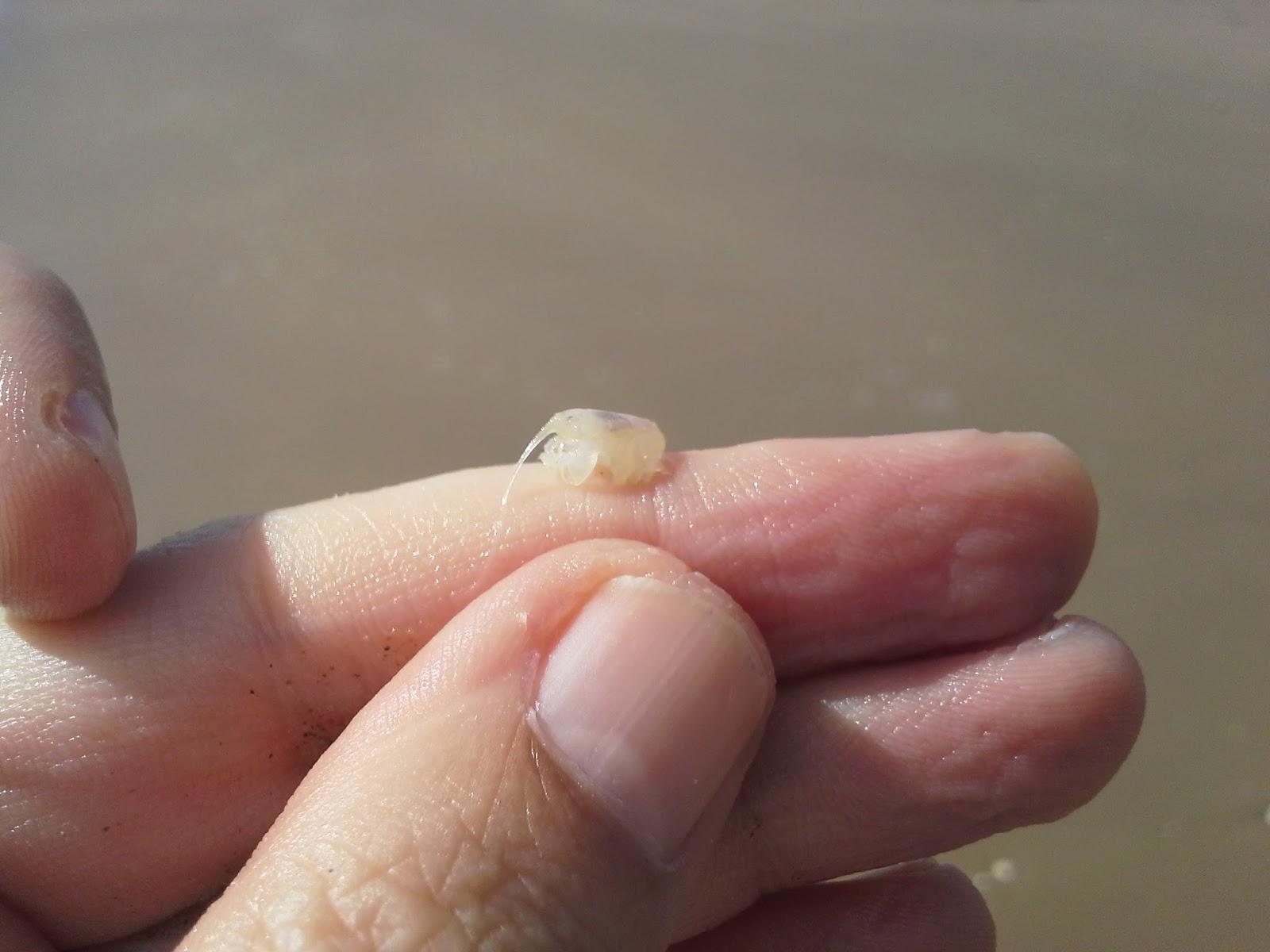
It wasn’t just the nice weather; I got some useful scientific data, too. I found the first “young of the year” for my sand crabs, arriving as if on cue:
As I was digging and taking in how pleasant it was, I wondered, “Why don’t I have grad students lining up to do this work?” I sometimes get a little down that I have had very few inquiries from students about working with me.
But then, I flipped it. If I had grad students, they would probably be out collecting data instead of me! And I thought that would be a loss for me. I would have missed the satisfaction of getting the data, and the enjoyment of a beautiful day on the beach.
This made me wonder how many other scientists have jobs that they could leave to students or technicians, but keep for themselves, because they enjoy the experience so much.
Maybe this seems selfish, but I think it’s very important that I continue collecting my own data. A lot of mid-career scientists seem to be are chained to a desk, writing manuscripts and grants.It’s too easy to get disconnected from the stuff that drew you into to science in the first place.
P.S.—Not every collecting trip is anywhere near as physically pleasant as yesterday. Extreme heat, sudden cloudbursts, beach littered with Portuguese men-o-war... somedays, the rose loses its bloom.
16 September 2014
Tuesday Crustie: Be free!
This is what victory looks like:
I know, you probably expected it to look a little less muddy.
Photographer Steve Severinghaus wrote, “A gull at Dead Horse Bay abandoned this crab for some reason.”
Photo by Steve Severinghaus on Flickr; used under a Creative Commons license.
I know, you probably expected it to look a little less muddy.
Photographer Steve Severinghaus wrote, “A gull at Dead Horse Bay abandoned this crab for some reason.”
Photo by Steve Severinghaus on Flickr; used under a Creative Commons license.
Comments for first half of September 2014
Rene Bekkers talks about only reviewing for journals that publish open access. I’ve heard that one before.
12 September 2014
Another reason why students hate instructors
Another reason why students hate instructors is because some of us comment about ways that we trick students (my emphasis):
I hate that it assumes an adversarial relationship with students. I can live with that, I suppose, because there can be conflicts between instructors and students. I don’t think it should be assumed from the start, but it happens.
But what I can’t get over that an instructor thinks it’s useful to lie to students, routinely, just to avoid a conversation with as student about grades. It’s an instructor’s job to talk to students about grades.
There are few things that piss students off more than unfairness. This sounds like a situation where students who are close to the dividing for a letter grade are more likely to get that extra point than those who are not. If they were ever to find out that an instructor gave extra points to some students but not others (which sounds like the scenario here) to shut up “complainers,” instead of one complainer, you would have a whole classroom full of them.
When students find out that one instructor is pulling fast ones like this, they take that lesson into every other learning situation. “If one instructor is willing to fake an exam total to keep me quiet, will another one give me a lower grade because she didn’t like some random thing about me?”
Ultimately, the lesson students will take from this is complaining about grades gets you extra points, that grades reflect instructor bias more than actual achievement, and that instructors are lazy and uninterested in talking to students.
Don’t do this, instructors. And don’t say that you are looking forward to doing this on social media, like some I’ve seen.
To reduce chance of students complaining:
Grade fairly each question/problem and write the score next to each question; write onto the top of the exam a sum-total score that is slightly greater (e.g., by 1-2%) than the actual sum if scores were tallied correctly for all questions. Students typically figure out that there is a discrepancy between what they deserve (based on correct sum total from all questions), and what was recorded incorrectly as the total; students then tend not complain about individual questions because they don’t want to risk discovery of the 2% grading “error” that benefits them. This works great for the professional complainers who would try to argue points no matter how fair you grade.
I hate that it assumes an adversarial relationship with students. I can live with that, I suppose, because there can be conflicts between instructors and students. I don’t think it should be assumed from the start, but it happens.
But what I can’t get over that an instructor thinks it’s useful to lie to students, routinely, just to avoid a conversation with as student about grades. It’s an instructor’s job to talk to students about grades. There are few things that piss students off more than unfairness. This sounds like a situation where students who are close to the dividing for a letter grade are more likely to get that extra point than those who are not. If they were ever to find out that an instructor gave extra points to some students but not others (which sounds like the scenario here) to shut up “complainers,” instead of one complainer, you would have a whole classroom full of them.
When students find out that one instructor is pulling fast ones like this, they take that lesson into every other learning situation. “If one instructor is willing to fake an exam total to keep me quiet, will another one give me a lower grade because she didn’t like some random thing about me?”
Ultimately, the lesson students will take from this is complaining about grades gets you extra points, that grades reflect instructor bias more than actual achievement, and that instructors are lazy and uninterested in talking to students.
Don’t do this, instructors. And don’t say that you are looking forward to doing this on social media, like some I’ve seen.
11 September 2014
Different economies of academic success
From the K-12 system to their undergraduate degree, students are taught that they are operating in a credential economy. What is valued are whether or not you get a high school diploma, a certain GPA, a bachelor’s degree.
After so long operating in a credential based system, it should be no surprise that they have trouble comprehending the idea that at higher levels, in post-graduate work, academics are operating in a reputation economy. It’s no big deal to have a doctoral degree; lots of people have them.
The skills needed to survive in these two economies are rather different. In a credential economy, you are essentially on your own. You just need to complete tasks to complete the requirements to earn the credential.
A reputation economy, in contrast, is inherently social. Your worth is determined by how you are perceived by the relevant professional community.
Consequently, when they transition to grad school, students underestimate the necessity of establishing personal connections, and relating with the community they want to join . They are overly concerned about “programs” and not concerned enough about finding mentors and cultivating professional relationships in in their field.
After so long operating in a credential based system, it should be no surprise that they have trouble comprehending the idea that at higher levels, in post-graduate work, academics are operating in a reputation economy. It’s no big deal to have a doctoral degree; lots of people have them.
The skills needed to survive in these two economies are rather different. In a credential economy, you are essentially on your own. You just need to complete tasks to complete the requirements to earn the credential.
A reputation economy, in contrast, is inherently social. Your worth is determined by how you are perceived by the relevant professional community.
Consequently, when they transition to grad school, students underestimate the necessity of establishing personal connections, and relating with the community they want to join . They are overly concerned about “programs” and not concerned enough about finding mentors and cultivating professional relationships in in their field.
10 September 2014
The solution to the research funding problem is simultaneously obvious and nigh impossible
American National Public Radio has been running a series about the state of funding for basic medical research. Today’s entry was When scientists give up.
Scientists hear these sorts of stories routinely. What bugs me about them is their faux simplicity.
Most articles stop there. The implication always seems to be, “More money will fix everything! So give us more!” I am pleased that one article goes one step further:
I’m surprised that so few articles about science funding never discuss issues like, “Should there be new taxes to support research? Should other discretionary programs be cut to support research funding? Should there be incentives to get industry back into the research game?”
Ignoring that people have vastly different ideas about how to spend federal dollars, not to mention the role of government, is not helpful in solving this problem.
External links
When Scientists Give Up
U.S. Science Suffering From Booms And Busts In Funding
Built In Better Times, University Labs Now Lack Research Funding
Scientists hear these sorts of stories routinely. What bugs me about them is their faux simplicity.
- American federal government reduces money for research.
- Scientists issue dire warnings of bad effects of cuts.
Most articles stop there. The implication always seems to be, “More money will fix everything! So give us more!” I am pleased that one article goes one step further:
Many scientists hold out hope for a simple solution: more money. But the current U.S. Congress has no appetite to spend more — even on health research that has broad, bipartisan public support.
I’m surprised that so few articles about science funding never discuss issues like, “Should there be new taxes to support research? Should other discretionary programs be cut to support research funding? Should there be incentives to get industry back into the research game?”
Ignoring that people have vastly different ideas about how to spend federal dollars, not to mention the role of government, is not helpful in solving this problem.
External links
When Scientists Give Up
U.S. Science Suffering From Booms And Busts In Funding
Built In Better Times, University Labs Now Lack Research Funding
06 September 2014
Bland mascots
The Pan American reports that a potential list of mascot names has been presented to students. And wow. The names seems to have come out of the blue. Not one was something that I heard suggested at either of the open forums about the prospects of new colours and mascots. Very few of them are at all related to the South Texas region.
I don’t like any name on that list. Every one has serious shortcomings for me. But if I had to pick from that list, I’d probably go sharks (“RGV Sharks” has some nice repeating “ar” sounds). Foxes might be my second choice, because no other campus has that name.
But I’ll still take any of those ten names over keeping the Bronc. That will just lead to strife and keep the new university from being a new university.
External links
UTRGV mascot
- Aztecs: Um... the Aztec empire at its height never came remotely close to the South Texas region (map below). I suppose that this fits with the ongoing push for UTRGV to be a university that will attract students from Central and South America. Still, it’s already used by two other universities.
- Barracudas: As far as I can tell, about the only barracuda you will find around these parts was the Barracuda Grill on South Padre Island... and it’s closed! There is no other university team with that name, but that doesn't quite make up for the disconnect between the animal and the region. (Update, 17 September 2014: One of my departmental colleagues has said we do have barracuda in our waters. We have both the great barracuda (Sphyraena barracuda; map here) and the Northern Sennet (Sphyraena borealis).
- Bears: Finally, you have something that has some local relevance. We are starting to see bears in the South Texas area again... after about 50 years or so. Not exactly something that has a strong local presence yet. And there are over 20 teams with that name already.
- Sharks: Yes, there are sharks in the Gulf of Mexico waters. Heck, some made the news a couple of days ago! But it is a bit generic; four other universities have shark mascots.
- Bull snakes: These are handsome animals, and they are common throughout Texas. It's good that we have them here, but they are not exactly distinctive to the region.
- Tortoises: The Texas tortoise is only found in South Texas in the U.S., and no other university has a tortoise as a mascot. And that is probably because... well... tortoises are great animals, but since athletics are often concerned with, say... speed... (Plug: One of my colleagues has recently co-authored a book on Texas tortoises.)
- Phoenix: This mythical creature has no connection to the region, and four teams already use the name. The name is slightly confusing because it doesn’t have an easy plural. On the plus side, it might symbolize the rebirth of The University of Texas Pan American and University of Texas Brownsville into The University of Texas Rio Grande Valley.
- Red wolves: They don’t live here (map below)! At this point, I'm starting to wonder if the branding company has looked at a map. Do they know where our campuses are?
- Foxes: To my surprise, this does not seem to be a name used by any university. There's a Red Fox and a Swamp Fox, but nothing which is just “Foxes.” The common gray fox does live here, but it lives throughout Texas, so again, not distinctive.
- Mockingbirds: The northern mockingbird is so widespread throughout Texas that it is the state bird for Texas.., and four other states. Not exactly a distinctive creature to the region. On the plus side, the name is not being used as a team name by any university.
I don’t like any name on that list. Every one has serious shortcomings for me. But if I had to pick from that list, I’d probably go sharks (“RGV Sharks” has some nice repeating “ar” sounds). Foxes might be my second choice, because no other campus has that name.
But I’ll still take any of those ten names over keeping the Bronc. That will just lead to strife and keep the new university from being a new university.
External links
UTRGV mascot
01 September 2014
Comments for second half of August 2014
Jeremy Fox tried Ignite! talks at the Ecological Society of America conference, and was unimpressed.
Jon Tennant is interviewed about open access and the open letter about Science Advances.
Brain’s Idea pronounces the “10,000 hour practice rule” for gainin expertise to be “nonsense.” But wait... is that a peer-reviewed paper you’re basing that conclusion on?
Jon Tennant is interviewed about open access and the open letter about Science Advances.
Brain’s Idea pronounces the “10,000 hour practice rule” for gainin expertise to be “nonsense.” But wait... is that a peer-reviewed paper you’re basing that conclusion on?
Subscribe to:
Posts (Atom)