12 September 2007

Another sad day

Some become so famous that one one name is needed. Elvis. Madonna.

In the field of animal behaviour and psychology, most people knew about Alex.

Poor Alex died unexpectedly last week. When I saw a new story about a "famous parrot" dying, my heart sunk, because I knew there was only one parrot that it could be.

Alex was the African grey parrot that Irene Pepperberg had worked with for 30 years in her classic studies of comparative cognition. People had always known parrots were clever, but started to show just how clever. Categorization, counting, concepts... Work with Alex really started to undo a lot of the thinking that had permeated animal behaviour since the Clever Hans affair and the radical behaviourism of American psychology in the mid-20th century. For decades, anything that remotely smelled of "thinking" was exiled from scientific study in animals, and sometimes even humans.

Irene Pepperberg's work can be seen at the Alex Foundation.

08 September 2007

Classic graphics #2: Crayfish tailflips

Blogging on Peer-Reviewed ResearchTailflips from Wine and Krasne 1972This particular picture is not famous outside of my own field. But it has been reproduced many times, and as such, I think warrants the classic designation.

Crayfish tailflipping was one of the first natural animal behaviours that neuroethology really cracked. It was one of the first cases where we could explain how the connections between the neurons explained a lot about how the behaviour of the animal worked.

One of the little oddities in the story of understanding the escape response of crayfish was that the major neurons involved were recognized back in the 1920s. These huge neurons became known as the lateral giant (LG) and medial giant (MG) neurons, but even in the flapper era, there was pretty strong evidence then these giant neurons were involved in tailflipping.

But it took over 40 years for people to explain why there were two sets of neurons involved in tailflipping. And they can be forgiven for not figuring this out quickly, because this behaviour is so blindingly fast, you can't make it out with the naked eye.

When people finally got around to using high speed film, the answer became clear. There wasn't one behaviour. There were two. There were two different kinds of tailflips, each triggered by a different set of neurons. (Actually, it turned out that there were three kinds of tailflips, but that's another story.)

What fascinates me about this particular figure (from Wine and Krasne, 1972) is that it was not the first to make this point. Priority is huge in science. Normally, the first to show anything gets priority, and hold a very strong sway on our imaginations. Ask someone who was the second person to climb Mount Everest, or the second person to fly solo across the Atlantic. Heck, I don't know.
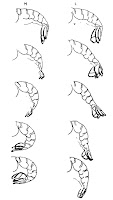
Tailflips from Larimer and colleaguesJust a few months earlier, in the same journal, another group of researchers led by Jim Larimer (which included my intellectual predecessor, Don Kennedy) published a picture that shows the same thing: that stimulating the different neurons generates different movements.

In this case, I think it's pretty clear why the later picture became the canonical representation of crayfish escape behaviour: context. You see the stick tapping animal, and you see the whole animal, moving through space, rather than an isolated part of an animal being held static. The advantages of this are huge.

The top diagram makes it forcefully clear what advantage there is to having two tailflips: both tailflips take the animal away from the source of the offending stimulus, but do so by throwing the animal in different directions. The crayfish jackknifes into the water when the LGs fire, but heads straight back when the MGs fire. You can sort of extrapolate that from what's shown in the earlier figure, but since you can't see where the stimulus would be, you don't have that immediate "Aha!" insight.

Sometimes, it isn't better to be first. It's better to be better.

References

Larimer, J. L., Eggleston, A. C., Masukawa, L. M. and Kennedy, D. (1971). The different connections and motor outputs of lateral and medial giant fibres in the crayfish. The Journal of Experimental Biology 54, 391-404.

Wine, J. J. and Krasne, F. B. (1972). The organization of escape behaviour in the crayfish. The Journal of Experimental Biology 56, 1-18.

Classic graphics#1: The Cartesian reflex

Blogging on Peer-Reviewed ResearchReflex from Trait de L'HommeOne of my side interests is in graphics. And I'm curious about what makes an image famous. Particularly scientific images. So I'm going to try exploring that from time to time, focusing on my own field of interest, neurobiology.

Over at the left is an image that I've seen reproduced many times. So often, in fact, that I'm having a hard time finding exactly the original source, to my embarrassment. It's from the work of René Descartes, 17th century French intellectual. I think it's from Treatise on Man, published around 1662 after Descartes' death.

I do not know if Descartes drew his own figures. I doubt it, because preparing woodcuts is a pretty specialized talent. And Descartes, I've heard, loved a life of luxury. I don't think he was the sort to handle woodcutting tools. Be that as it may...

What the figure is showing is Descartes' conception of how behaviour worked. It looks fairly modern. Even if you understand only a bit of modern biology, you might think, "You have a sensory stimulus, impulses travel up the spinal cord to the brain, are processed, and you get a withdrawal from the painful stimulus."

I think that's one reason why this particular diagram is famous: because it is almost eerily prescient.

And indeed, in broad strokes, that's what this is showing. Descartes was the first to develop a reflexive theory of behaviour, although I don't think he used the term "reflex." Because Descartes is so famous for his ideas on the soul, his arguments that much of behaviour -- even in humans -- is purely "push pull" sorts of automatic, reflexive responses is often overlooked.

That the picture looks quite modern in some ways actually sort of overshadows some important problems. Descartes had what I consider to be a pre-scientific concept of behaviour. The discovery of biological electricity was centuries away, so Descartes followed the ancients in thinking that behaviour was controlled through the movements of "animal spirits."

Reflex from De HomineIs the picture at top famous because of the idea that it shows? I don't think it's just that. Over to the left is another picture showing the same basic idea, again from Descartes, and I think even from the same book. Regardless, you see the same basic elements: a fire, an outstretched limb, and "animal spirit vessels" leading to the brain.

Yet this one I have not reproduced seen over and over again like the top one. I would say the top one is a classic, but the bottom one not. And here, the actual rendering of the diagram might be important in why this one isn't reproduced that often.

I find the second one is kind of disturbing. The figure has sort of babyish proportions. The torso sort of floats out of a cloak, which no obvious indications of a bottom half. Plus, the "animal spirit vessels" don't go right out to the fingers, making the idea that there's a connection between the stimulus and the person's brain harder to understand.

Or maybe the reason the top one is more famous is that editors are always looking for excuses to put in more nudes in their books.

07 September 2007

Oh, no.

I was just looking for something for another post I was writing, and boom, learned Barry Beyerstein was dead.

Geez.

I can't say I knew him well, but he was someone who did me some favours. When I was a grad student, he invited me over from UVic to SFU to give a talk to the BC Skeptics after reading an article I published in The Skeptical Inquirer. It was my first invited talk. Later, he was a special science guest at I-Con 2, a SF convention I helped organize in Victoria.

He was wonderfully friendly guy. I'm sorry I'll never get a chance to run into him again.

Additional, 20 March 2014: Here’s someone who heard Barry Beyerstein at I-Con 2, which, as I said, I was involved in organizing and inviting Barry to. He calls hearing Beyerstein speak, “a life-altering shock to me, a road to Damascus moment.”

If only it were that easy to get rid of a cold

Vitamin CI have a cold. And being a guy, I am a crybaby about it. But even a simple cold gives a chance for some thinking about science.

Someone who stuck her head into my office said, "Drink some orange juice." While I like orange juice, the advice is wrong on two counts.

As far as I can tell, the idea that orange juice does anything for a cold can be traced back to Linus Pauling. Pauling was no doubt a clever person, judging by his measure in the world's universally recognized international cleverness unit, the Nobel Prize. Pauling won the prize for chemistry in 1954 and again for peace in 1962. But winning a Nobel prize is no guarantee against going off the rails, which Pauling did on at least one point in the 1970s or so.

For some reason, Pauling became convinced that megadoses of vitamin C could prevent colds. Apparently he was quite obsessive about taking vitamin C, particularly when there was the slightest symptom of a cold.

And what's a good source of vitamin C? Orange juice, of course.

But it doesn't work. There was no evidence that Vitamin C did anything for a cold that a kleenex or off the shelf cough suppressant couldn't do.

So that's the first way the advice is wrong.

The second thing is, even if Pauling was right (which he wasn't), orange juice still wouldn't be the way to go. Pauling didn't advocate just having vitamin C in your diet, the way that you might get from orange juice. No, he advocated megadoses: amounts many, many times over the recommended daily amount. And sometimes, you got to admit monks are onto something with that whole moderation thing. Huge doses of vitamins are not without their risks; it is possible to overdose on some. High vitamin c amounts are associated with diarrhea -- perhaps not life endangering, but still.

And that's how the advice is wrong twice.

We can't even get our wrong bits right.

31 August 2007

You know you're having a tough week when...

...You get halfway through the day with your shirt on backwards.

And nobody tells you!

Time to prep a lecture. Or my tenure folder. Or research. Or administer the grad program. Or clean the seawater tank. Or...

Right. No more blogging.

29 August 2007

Most fun of the day

glue
The most fun of the day was when I had a couple of faculty from the art department in my office and a bunch of art grad students asking how they could make glue from natural sources.

I was especially pleased because I was able to find a book in my office (and I did have to hunt for it), look in the index, and find an answer. Bones, hides, hoofs, and the ever popular "fish remains." And I learned that "collagen" and "collage" are basically similar words, collagen was the major material in some kinds of early glue. Thank you, Steve Vogel, for writing Life's Devices, which is where I got the answer.

Paying dues

NCSE logoI finally joined the National Center for Science Education. I probably should have joined a long time ago. What finally pushed me to join was a couple of recent stories about individuals on the Texas Board of Education talking about how school textbooks should address "weaknesses" in evolutionary theory.

Translation: "We think evolution is wrong, but we can't say that we object on religious grounds in science classes because the courts have repeatedly ruled against teaching religion in public schools in the United States, so we'll just attack it at every opportunity."

And because I live in Texas, but, as a Canadian citizen, can't vote, this seemed one way that I might be able to contribute ensuring that my research discipline isn't weakened in Texas schools.

What's the alternative?

John Kennedy in Dallas, 1963Who killed John F. Kennedy?

Do you believe the official story that Lee Harvey Oswald acted alone?

Recently, I've been posting about distinguishing a serious scientific skeptic from someone who is a crank. (Previous posts: Lying with statistics, Skeptic or denier, Science is a democratic process).

A recent article about HIV deniers in PLoS Medicine throws some valuable light on this matter.

What you often see is that the "minority view" has no consistent position apart from saying the consensus view is wrong.

Those who claim HIV doesn't cause AIDS have a zillion alternative theories about what does. From the PLoS Medicine article: "In Africa, HIV deniers attribute AIDS to a combination of malnutrition and poor sanitation, i.e., they believe that AIDS is simply a relabeling of old diseases. In America and other wealthy countries, they claim AIDS is caused by drug use and promiscuity."

Climate change critics are probably divided on many issues. Some will say there is not significant change (not many now, though, I suspect). Some say there is significant change, but propose a whole slew of alternatives for what might be causing it, with solar radiation being only one idea.

So you say evolution is a lie? So tell me, is the Earth about 4 billion years old, or about 6,000 years old? Young Earth Creationists and Old Earth Creationists have deep disagreements on this point.

Who killed JFK? Depending on who you listen to, it was the mafia, the Cubans, the Russians, the CIA... and the list goes on.

For an alternative to a consensus view to be credible in science, the alternative itself needs to establish a consensus. Credible criticisms tend to get stronger over time, because they develop more evidence and more consistency. Because nature abhors contradiction.

Incidentally, first author on the HIV article, Tara Smith is a Panda's Thumb contributer, and writes her own thoughtful blog, Aetiology.

25 August 2007

Evidence and policy

In a previous post, I drew some parallels between scientific and democratic processes. Another thought that occurred to me is that evidence in science functions somewhat like policy in politics.

On election day, you have a chance to vote for a government with a particular set of policies. Those policies, however, are very liable to change. And people can change their minds about a policy that isn't working, or if a new policy is introduced that they disagree with.

In science, people change their minds as new evidence becomes available.

In neither case is a decision now and for ever, once and for all.

Of course, it's often much harder to show that policy is faulty than it is to show scientific evidence is faulty. To paraphrase Feynman, if your basic understanding of physics of balances and strains and stresses is bad, your building falls down.

Champions of stink

Dead things, we know, stink. Dead things that live in water stink more. Dead things that live in seawater stink more. And I think echinoderms may be the top of the list.

We have a new seawater tank, which I've been looking after. Unfortunately, had a water quality problem and a lot of animals in it died. But the sea cucumbers were really wretched things to clean. Now I can tell my student Sakshi that it's not just starfish that die horribly in an awful mess.

My hands are very itchy and dry from having been in salt water much of the day.

24 August 2007

Mysticism in the lab

If you were to look for an exemplary case of mysticism, close to the top would have to be the out of body experience. Many people have reported this, and has been used to promote ideas such as astral projection and life after death.

Not one, but two papers in this week's Science have now created this experience in lab settings. The first is here, and the second is here. And a third article commenting on the other two is here.

There one sense, some might feel that this debunks astral projection and the like. But in another very real way, it validates those reports. Various people who had out of body experiences were not (necessarily) frauds who were just making it all up, but reporting "real," albeit illusory, experiences.

17 August 2007

Science is a democratic process

I was listening to an interview was former New Scientist editor Nigel Calder yesterday, and he insisted a couple of times that, “Science is not a democratic process.”

The point he was making was that views that were once a minority position often become conventional wisdom. Which is fair enough. That’s a valid point. As Calder himself says, “I have in my time been criticised for saying that black holes might exist, the continents move, that an asteroidal comet wiped out the dinosaurs.”

Calder fails, however, to say what he thinks the scientific process actually is, if not democratic. It’s like saying I am not American, don’t dance the tango, don’t like pickles, and don’t own a dog. You know everything about me now, right?

If you want to use political analogies, what are the alternatives? Science is certainly not a monarchy or any other sort of authoritarian system. Everyone is allowed to engage in the scientific process. Science doesn’t care about who originates an idea or who promulgates it – it cares about evidence.

So who decides if evidence is credible? It’s a consensus developed by a community. And the views of that community can change over time, as more evidence becomes available, or as people have more time to think over an idea. After all, any real democracy worthy of its name reviews and has regular opportunities to change governments. (Even in Alberta.)

What other elements does science share with a democratic system? How about accountability? Scientists are typically for crediting sources, for allowing others to examine their findings, allowing others to replicate them.

Of course, it’s more complex than that. Earlier this week, reading Ryan Dancey’s blog, he mentioned the reputation economy, which is something I have to think about more. A similar idea crops up in today's entry in Seth Godin's blog. I think this has the potential to describe why some scientific ideas thrive and some do not in the sort term.

But as Arthur C. Clarke once noted, science tends to get to the bottom of things in about 50 years, if there is any bottom to be gotten to. The evidence will out. People will either admit they have been wrong, or relegate themselves to the fringe.

There’s also another sort of fallacy that Calder engages in: that because minority views have become majority views before, it will happen again, and specifically in this case – and he’s talking about human-induced climate change. Unfortunately, lots of fringe ideas have stayed fringe ideas.

Also, I think Calder might agree that regardless of climate change, there are other reasons to get away from the status quo of running our economies by burning fossil fuels.

16 August 2007

“I am thinking now”

When you're an educator, it's easy to get bogged down in details. Often petty details. And it's easy to forget the big picture.

In this TED talk, Patrick Awuah talks about how universities create the educated people that can drive nations to succeed. And how the lack of such people can cause national crises.


He calls this leadership, but I'm suspicious of that word.

13 August 2007

Cloudburst!

Lots of lightning and raucous thunder late this afternoon. Internet access at uni dropped out. The usual flood points were, as expected, flooded. I can make it almost home with only the souls of my feet getting wet... but there's a couple of ankle deep spots near the end of my trek. Alas.

Meanwhile, spent a good chunk of the afternoon – before everyone started to worry about being smitten with Thor's hammer – troubleshooting some DNA sequencing. It looks like we simply had too much DNA. Yes, for our delicate sequencer, it is possible to have too much of a good thing.

The sequencer is broken again, though, and so we won't have a chance to test our suspicions until Wednesday, probably.

12 August 2007

Revision of a figure

Yesterday, I did a quick revamp on our Neuroethology poster for HESTEC. Previously, I wrote about the design of one of the data figures for that poster. Interestingly, I found out at the meeting that I was too clever for my own good in designing the Neuroethology poster. The problem was that I used the bars coming from the boxes to represent the minimum and maximum. Several people interpreted these as error bars (standard deviation or standard error). Because overlapping error bars usually indicate that groups are not significantly different, and error bars are smaller than minimums and maximums, this led some viewers to momentarily question the results.

Consequently, I went back to a more standard bar graph in the revised HESTEC poster. It's similar to this one, except it shows transformed data rather than the raw data, and the colour is not bright red.

The size of the HESTEC poster was also smaller, so a lot of cutting text and general simplification occurred. It's probably a better poster as a result.

I also started work on my annual compilation of everything I've done in the last year. It's a dreary process, although sometimes it can be nice to see how much you've done.

10 August 2007

Getting closer...

Raw DNA data
It may not look like much. And it isn't. Nevertheless, it's my first little steps into a new area of research: DNA analysis.

The traces above show a small snippet of an attempt to sequence a bit of DNA. Ideally, there should be a nice sequence of evenly distributed peaks of about the same height. Each peak indicates a single nucleotide. Unfortunately, our sample is not ideal and there's a lot of noise in the measurement. My student Unnam and I need to do some troubleshooting and try again.

Another indication of our problems is that DNA is made of a sequence of four letters: A, T, C, and G (nucleotides, really, but the names need not concern us here, and the letter symbols are universally used). The sequencer gave us A, T, C, G... and N. "N" is a symbol for "any nucleotide," which basically means that the machine couldn't figure out what it was and spit out a "I dunno."

We were very excited to be sequencing -- finally -- yesterday, so that it was really not all that usable was disappointing. Or, as Unnam wrote, "THAT SUCKS. A lot."

Still, after my buddy Virginia was always bugging me... "Zen, you have to get into molecular biology to show the world that you're a modern biologist," I do feel the need to point out that I'm moving in that direction.

07 August 2007

Omit needless words

Lately, I've been seeing a lot of headlines that say things like, “10 places to visit before you die.”

Is there really any other time to visit those places? Does anyone think, “Oh, that's okay, I'll get to that after I die...”?

05 August 2007

A rule

Nature doesn't abhor a vacuum.

Nature abhors a contradiction.