10 November 2016

Favourite Quora answers

The search function on Quora sucks, and so I’m collecting some of my favourite answers here so I can find them again later.

Neurobiology


Crustaceans


Evolutionary biology


Academic writing


Academic publishing


Skepticism


Academic careers


Academia and higher education


Movies


Learning and memory


All quiet on the social media front

Back in July, I posted this graph:


It’s an appropriate time for an update:


Related posts

Reasons to go back to blogging

Competition

Question and answer originally posted at Quora.

Q: If a university were to be created today, how could it compete with MIT, Harvard, and other top-tier schools?

New universities can’t compete with established universities.

I’ve thought about this question a lot, because the university I now work at may be the newest university in the world. It was established September 2015, so is currently about 15 months old as I write this. It has aspirations to become an emerging research university.

One of a university’s major resources is prestige. Prestige attracts students and faculty. Prestige attracts donors. Prestige attracts attention. Prestige gets you the benefit of the doubt.

You cannot create prestige. Prestige is something others bestow upon you.

People perceive universities as prestigious because they are old and have a proven track record. Prestige has very little to do with the education of students or skills of faculty. I’ve met students and faculty from all kinds of universities, and their abilities and skills are not different enough to explain the huge differences in how their institutions are perceived.

Lists of new universities don’t have a 5 or 10 year window; a university 50 years old is still considered “new” (e.g., The 7 best US universities founded in the last 50 years or The World's Best New Universities).

There is no way a university created in the 21st century can amass the prestige of a university created in the 17th century. Age probably stops mattering when you get a century out from the establishment of the institution.

That said, you can certainly do a better or worse job of establishing a research university. You do that primarily giving faculty resources (particularly doctoral students to provide cheap labour) and keeping them as far away from undergraduate students as possible. Professors at research intensive universities might teach a class or two a year; colleagues in my university are typically teaching three courses a semester. This means research universities cannot admit lots of undergraduate students, meaning they are more selective, further feeding into the perception of prestige.

08 November 2016

Brush your teeth

(Note: I’ve been answering questions on Quora for a while, and this one has proved to have a “long tail”: it’s been slowly, but consistently, getting voted up. SO I’m putting it here for archival purposes.)

Q: For hundreds of thousands of years, humans did not brush their teeth. What happens if I stop altogether? At what point does my mouth start to take care of itself? Animals don't brush their teeth; how do they pull it off?

A: You can’t expect your mouth to “take care of itself” the way ancient humans did. Modern humans in advanced industrial societies have a different bacteria and different diet (probably more sugars and other carbohydrates) than ancient humans.

Ancient humans tended to have good dental health. Two research papers published in 2013 both suggest that human cavities started to take off about 10,000 years ago – roughly about the same times as we were moving to agriculture. They show this in part by comparing modern to ancient bacteria that live in our mouths.


Even if you could go back to the ancient diet, you are not going to be able to get the ancient bacteria to live in your mouth – they are long gone.

Just brush your teeth.

External links

For hundreds of thousands of years, humans did not brush their teeth. What happens if I stop altogether? 

31 October 2016

Resemblance, but family resemblance?


You can find the images above floating around on various Internet websites in listicles purporting to show amazing family resemblances. The painting on the left is of John Brownlow, a eighteenth century English nobleman. There are lots of images of Brownlow on the Internet, so I’m pretty confident this is him.

The photograph on the right is, according to various lists, “descendant John Brownlow (born 1953).” One page says, “these relatives were born more than 200 years apart, and they're still rocking the family resemblance!”

Just one problem.

Wikipedia says the elder Brownlow had no children from his marriages.

The Wikipedia article says Brownlow had no children from his marriages, not that he had no children. But it would be strange for the younger to have the same family name if he traced his lineage back to an illegitimate child of the elder Brownlow.

There are many ways that they two Brownlows could be related, but the pages pretty specifically say he is the “descendant,” which usually implies a strict parent to offspring lineage. That would seem to rule out the young Brownlow being a great-great-nephew of the elder. The person who inherited Brownlow’s estate, his nephew John Cust, has the same general facial shape.

The remaining possibilities are that the Wikipedia entry is wrong, or that someone just found a contemporary photo of someone entirely unrelated and made up the rest.

26 October 2016

Real time peer review

There are some discussions about double blind peer review making the rounds on science Twitter this morning, predominantly over whether double blind peer review would help matters. For instance, see this Twitter thread from Sciencegurl; this bit from Timothée Poisot; and watch this poll and replies from Terry McGlynn.

The pros and cons of open peer review, blinded peer review, and double blind peer review are welcome. But I crave a different change to peer review.

I wish peer review was a conversation, not a series of statements.

Right now, a referee writes one long review. This goes to an editor, who compiles and passes them back to the author. The author writes another long reply, point by point, and has to to to address everything in one go. Repeat for each round of review.

Why can’t the comments come from a referee in something closer to real time?

As an author, I would love it if a referee could say to me, soon after getting a paper, “I noticed this issue right away. It’s important, but easy to fix.” And then I make that fix while the referee is thinking about other aspects of the paper, and say, “Done.”

As a referee, I would love it if when I didn’t understand a point, I could ask the author, “Do I have this right?” Right now, I have no way of clarifying the author’s intent until I have gone through the entire review and sent it to an editor. Lots of comments on my review might be based on simple misunderstandings.

I do understand that one advantage to getting a review all at once is that it forces the reviewer to consider the paper in its entirety. You get cohesion and clarity that way. I’m not advocating getting rid of those overall summaries. I would just like to see more ways that authors and reviewers could communicate with each other, and to have the option for back and forth that isn’t measured in weeks or months.

Related posts

Initial reactions: can we hide the sex of authors? And should we?

03 October 2016

Incoming: Interstellate magazine


Interstellate is the brainchild of Cait. The mandate of this project? To show off bee-yoo-tee-ful neurons.

There’s a magazine coming (maybe in time for the Neuroscience meeting), and Cait posted a preview of the first volume above last night. Look closely, and you might see one that is familiar...

Update, 25 October 2016: It’s out! Download the PDF here.

External links

Interstellate Twitter
Interstellate archive
Interstellate, Volume 1

02 October 2016

Physics fraud

Well, this is an interesting reveal on the eve of UTRGV’s big flagship science and technology event, HESTEC. The physics department in the legacy institution, UT Brownsville, committed fraud with about $2 million worth of federal research money.

Not a good look, considering that the agencies they ripped off, like NASA, the National Science Foundation, and the Department of Defense, have traditionally been big partners in HESTEC. Indeed, NASA is an official supporter of this year’s event.

And this is not a low-profile case, either. It’s part of the team that was involved in the discovery of gravitational waves. And that’s one of the biggest findings in physics in decades.

The Monitor reports:

An audit from the UT System Office of Internal Audits found at least six federal research grants were overcharged for a total of $1,957,547.27 for the partial or full payment of salaries of faculty who were mainly teaching and not conducting research, a critical violation of grant conditions that could have potential impact on future grant considerations.

“Salaries were charged up to 100 percent of the federal grants even though their workload reflected a full teaching load in Physics,” the audit states.

These funds came from research grants awarded to the Center for Gravitation Wave Astronomy by National Aeronautic Space Administration (NASA), the National Science Foundation-- two institutions that helped fund the center in 2003-- and the Department of Defense.

UTB notified the UT-System of at least three faculty members who were identified as being paid up to 100 percent of their salaries from research funds for multiple years, which was not part of the grant agreement.

“Center for Gravitation Wave Astronomy knowingly overcharged multiple research grants,” states the notification sent by UTB to the UT System Office of General Counsel. The department, referred to by audits as CGWA, was part of a recent national announcement in which gravitational waves had been detected, which is considered a huge scientific advancement in the field of physics.

The investigation revealed CGWA overcharged on six federal research grants from 2009 to 2015 to partially or fully pay the salaries of more than eight faculty members and some students. The investigation also concluded that the head of this department, CGWA Director Mario Diaz, was aware of the overcharges.

Of course, our institution’s president won’t promise that he will do anything about this:

When asked whether Diaz would keep his job, Bailey said he could not comment on personnel matters, but UT officials are still conducting an investigation and will send UTRGV officials the findings. Only then will any appropriate actions be taken.

After the creation of UTRGV, many administrative roles changed and some officials even retired, Bailey said. His main goal was to move forward and fully implement procedures that prevent these things from happening, especially now that the university is seeking more research funding.

“It was not under UTRGV’s watch,” Bailey said. “It’s important to us that we make sure that we have all of the processes in place so that it doesn’t happen again.”

My take is that Bailey seems the sort who subscribes to the “Do nothing and hope the problem goes away” school of university administration, and that he will be more concerned with preserving the institution’s image than whether or not anyone is made to pay for this blatant misuse of money. I expect he will try to wait this out and hope it blows over.

Oh wait, there’s more.

There’s another $3 million that the legacy institution has to pay back.

“We concluded that UTB’s benefits expenses for UTB and (Texas Southmost College) were incorrectly calculated and reported,” the audit states. “As a result, it was determined that the APS 011 reports needed to be recalculated for each institution separately.”

That second half is bad, although it isn’t as relevant to me personally as the first half. Faculty in my college, at my institution screwed up managing federal research money. I’ve gotten money from NSF before, but I think it just got a lot tougher. If I were at one of those agencies, I would be ready to blackball the institution.

And that money was probably going to be used for faculty pay increases. So because someone else misused money, I might be kissing my chance for a raise anytime soon goodbye.

External links

UTRGV forced to repay $5 million in funding on behalf of UTB

28 September 2016

Fifteen rounds


There are fifteen rounds in a heavyweight boxing match.

There are fifteen weeks in a semester.

Today, I feel like that isn’t a coincidence.

Sometimes, a semester can feel like a boxing match. You know when it starts, know when it ends, you get a few breaks in the middle, and you just know that there are going to be a lot of punches thrown at you in between.

You hope that you can dodge out of the way of some of those punches.


But you cannot dodge them all.


You’re going to get tired, you’re going to lose your quickness, as the rounds wear on.

The difference between the two is that in teaching, you can’t win early. You have to go the full fifteen rounds. You can only win by judge’s decision, never by knockout.

You just hope that you have trained well enough make it to the last round. You just don’t want to throw in the towel...


Or be the one who goes down in an early round.


And I think there’s a risk both fighters and academics take. They can start to lose their form after too many of these encounters. It takes its toll.

I can’t recall the last time I felt so drained so early in the semester. We’ve barely been at this a month, and I’m already looking forward to the last round.

External links

Losing Your Way as a Scientist: How Not to Suck

Round card photo by leyla.a on Flickr; used under a Creative Commons license.

25 September 2016

Our med school is not going smoothly

Earlier this year, the UTRGV medical school had its dean step down for reasons unknown.

Now, one of the communities is backing out of its financial commitment to the medical school, making it the second local city to do so.

And one of the university’s prominent supporters, a Texas senator, says the medical school is, “Not okay.

“The medical school is not okay. I don’t think people really realize how much money it costs and how complicated it is to create a new medical school,” Hinojosa told the Rio Grande Guardian. “The type of equipment that it needs, the type of infrastructure support that it needs to be successful. We cannot do a top-notch job unless we get support and help from the community.”

Basically, there is wrangling about taxes to support the medical school, and there is a vote on the November ballot about it.

Yeah. The new medical school was supposed to be the jewel in the crown of the new university. It’s not looking so shiny right now.

External links

Feud over hospital district prompts Mission to pull support for UTRGV medical schoolFrancisco Fernandez leaving leadership role, will remain on school faculty
Why is McAllen reneging on funds to UTRGV School of Medicine?
Cigarroa: Healthcare Districts are ‘an important piece of the puzzle’
Hinojosa: UTRGV medical school is not okay

23 September 2016

Day of the Monkey


Sharp.

It’s a word that has both a negative and positive meaning when you say it of a person. And if I had to use one word to describe the pseudonymous blogger Drugmonkey, that’s the one.

Drugmonkey is sharp.

One friend said to me, “Drugmonkey is mean.” He is quick to unleash cutting remarks. He has called a lot of people he disagrees with “wackalooons,” and that’s when he’s feeling polite. He’s impatient and profane. I can probably make his blood boil by mentioning “pit bulls,” “professional editors with English degrees,” and “numbered references” in the same sentence. He’s got opinions, and sometimes it feels like he will never admit he was wrong or change his mind in the slightest. He can be infuriating. It’s not fun being on the receiving end when he thinks you’re wrong.

Drugmonkey is sharp.

He is smart. Nobody has written more about National Institutes of Health funding, or developing careers in biomedicine and – more importantly – nobody has written about it with more insight and intelligence. And he has consistently taken agencies to task on issues like racism and sexism, and asked why they are not doing better on long standing problems in ensuring more diversity. He wants to make sure senior scientists don’t pull the ladder up behind them. He cares about other people, not just himself, and wields his razor sharp and lightning fast writing skills to advocate for them, and for fair treatment.

That makes him one of the good ones.

He’s started a lot of conversations, and made a lot of people think. You can see evidence for it in the comments in his blog. (Justin Kiggins says he reads Drugmonkey’s blog for the comments.)

I have only been in a room with Drugmonkey once, at Madhatter’s in Washington DC, at one of Dr. Becca’s BANTER meet-ups during Society for Neuroscience. We didn’t have a chat to converse at length in person. But it doesn’t matter, because online conversations are real conversations. Thank you, Drugmonkey, for the many conversations we have had. I am not sure I have ever changed your mind, but you have changed mine. I have learned a lot from you, and I grateful for it.

And thanks to whoever came up with the idea of Drugmonkey day!

External links

Drugmonkey on Twitter
Drugmonkey blog
Another Drugonkey blog
#Drugmonkeyday
Unofficial Drugmonkey Day
An oldish dog learning new tricks #drugmonkeyday
Thank you Drugmonkey
appreciation #drugmonkeyday
Thanks Drugmonkey!
#drugmonkeyday
Did You Miss It? Big Research Investing and A Decade of DrugmonkeyBlog
Yesterday was #drugmonkeyday!

21 September 2016

A memo of understanding is not neutrality

Seen on Twitter this morning, from Moosesplaining Max:

A neutral stance on a contentious person is an implicit endorsement, stop kidding yourself.

The moose is right. It reminded me of this quote:

“We understand that there were two sides to this,” he said. “The students that [are part] of that certain student group is opposed to LNG and I hope you understand that there are those who are for it as well. We can’t get involved in either of those sides. We’re simply focused on providing the best educational opportunities for our students.”

And that would be Guy Bailey, our university president, arguing with a straight face that signing a memo of understanding with an energy company, NextDecade, is “not taking sides.” What rot. That’s not even an “implict” endorsement, that’s an explicit endorsement.


I also don’t buy the “We’re just focused on education” argument, either. Why do we have a South Texas Diabetes and Obesity Center? It’s not just to educate people about that; it’s an active effort to improve health in the region. This university does all kinds of things that are not related to education.


The president’s office got over 200 calls about the university’s memo of understanding with NextDecade, and almost all were against it.

I hate the crummy arguments. I wish that administrators would keep it a hundred: say there is a real controversy. Talk about the pros and cons of partnering with corporations. But I so wish they would stop kidding themselves.

Related posts

Is there any money you won’t take?
External links

LNG agreement concerns continue

20 September 2016

09 September 2016

Is there any money you won’t take?


Here’s a picture of UTRGV president Guy Bailey from a little over a week ago, doing what he’s doing in a lot of pictures: agreeing to take money. Okay, that may be a slight exaggeration. There wasn’t a cheque from NextDecade, the other party in this agreement. Instead, the press release says this is a:

(S)trategic partnership to foster STEM-based (science, technology, engineering and math) education programs,facilitate research and job training opportunities for UTRGV students, and promote collaboration between academia and industry(.)

This is not just yesterday’s news, it’s last week’s news. Why am I blogging about this now? Because I missed it. It wasn’t on the university’s home page. It wasn’t in the daily news email we all get. No administrator – not my chair, not my dean, nobody – mentioned it, even though, as a STEM faculty, I should be one of the people potentially affected, nay, benefiting from this partnership, because it’s for STEM education, right? It snuck past my radar, almost as though the university isn’t proud of this partnership. Hm...

The partnership is with NextDecade, a company proposing to build a liquefied natural gas (LNG) terminal in the region. Here’s how the Sierra Club describes it:

If built, the Rio Grande LNG export terminal would be the largest single source of air pollution in Cameron County, according to its expected emissions. Its construction would require filling in hundreds of acres of wetlands in an area that is critical habitat for the endangered ocelot and Aplomado falcon. There are also concerns that the view of the industrial landscape and associated pollution could threaten the Valley’s beach and nature tourism industries.

The Brownsville Herald reports (my emphasis)

UTRGV declined to address the controversial aspect of local LNG projects. In an emailed response to The Brownsville Herald’s request for comment on that aspect, university spokesman Patrick Gonzales wrote only that “UTRGV is excited about the education opportunities this NextDecade LLC partnership provides, especially in the STEM fields, for our students.”

UTRGV is going to deal with community controversy by pretending it doesn’t exist. That is not the way to build trust with your community.

Calling this partnership a boon for “STEM education” is too generous. This will be a partnership for TE education. I doubt there will be anything for science or math students or faculty. This might be for engineers.

It’s also coming at a time when many other universities are divesting from fossil fuels.

Is there any money our president won’t take?

Bailey has more or less said that he sees money as the solution to all the university’s problems. When he started, he accepted money from the food industry for diabetes and obesity research. That’s a conflict of interest. This NextDecade partnership is also rife with potential conflicts of interest. I wonder what would happen if biology faculty started doing research on those endangered species whose habitats could be affected by the LNG export terminal?
 A lot of old UTPA signs were swapped out for UTRGV ones last week when the semester started. Maybe they should have looked like this:


Related posts

Show me what you value
H.E.B.’s donation to UTRGV: the gift that keeps on conflicting

External links

NextDecade partnership with UTRGV aims to stimulate STEM-based learning and boost local economy
University of Texas Rio Grande Valley Makes Agreement with Rio Grande LNG. Students, Community Leaders Wont Have It
Students, environmentalists, criticize UTRGV education agreement with LNG firm
UTRGV and NextDecade sign MOU

07 September 2016

Administrator calls our students “products”

In a recent document, one of our adminstrators was talking about student learning outcomes (SLOs), and wrote (my emphasis):

Identifying which SLO a course addresses is not a huge task. It only ensures that students learn what they are required to learn so that we send a product out that we are proud of.

Wait. Did this administrator just call our students, “products”? Pretty sure the answer is yes.

When I first ran across this, I was surprised and disappointed. The more I’ve thought on it, the madder I’ve gotten. Our students are not “products.” They are people.

This is just horribly dehumanizing. I only hope the administrator who wrote this will feel a little shame for writing that when this is pointed out.

It’s such a revealing glimpse into the model of education that administrators long to have, which is an industrial model.


As few professors, oops, lecturers, oops, adjuncts, oops, workers, oops, online tutorial programs as needed to churn through as many products with as little variation as possible.

Many others have pointed out this is a trend in North American higher education. But I’ve worked under a lot of administrative teams here. These are attitudes that are specific to this administrative team now, that I have not seen under previous administrations.

Related post

Show me what you value

01 September 2016

In praise of lurkers

There’s practically a new emerging literary genre of academics writing pearl clutching thinkpieces decrying the sad effect of social media on academia and science.

Last week there was an opinion piece in PNAS. It was illustrated with this picture:


Then, there was this piece in Times Higher Education.

In return for feeding our desire for evidence of how we are doing in our social interactions – our narcissistic craving for others' approval – first Facebook and then a group of other social media corporations persuaded half of humankind to give up their most intimate personal details. 

Both of these pieces got soundly criticized, as they should, because they make some silly statements. For instance, the Egan piece says:

Students need to be helped to sever some of the ties that bind them to the people they already know and to discover new forms of connectedness in the shared writings of the wider world.

Jordan Gaines wrote:

This is...literally exactly why I started using social media more when I started as a grad student.

That’s my experience, too. Social media has given me a window into what other people are thinking in a way that I just haven’t had before.

A very common charge levied against social media is that is is mere “narcissism.” What these anti-social media types seem to forget is that there is another, largely invisible category of social media users: the lurkers. For every person who is active on social media (the “narcissists” posting material), there is an unknown number of people quietly reading, listening, learning.


If you condemn the posting of scientific or academia material on social media, you’re penalizing not just the producers of that material, but you’re saying that all the people who might learn from that don’t matter, and that their learning is somehow invalid and unworthy. Presumably because it’s not in a brick and mortar building.

This “cane shaking at social media” genre needs a catchy name. Like how people writing editorials about why they got out of academia became known as “Quit lit.”

External links

Science in the age of selfies 
Why academics should NOT make time for social media

Picture from here.

31 August 2016

The IOT test

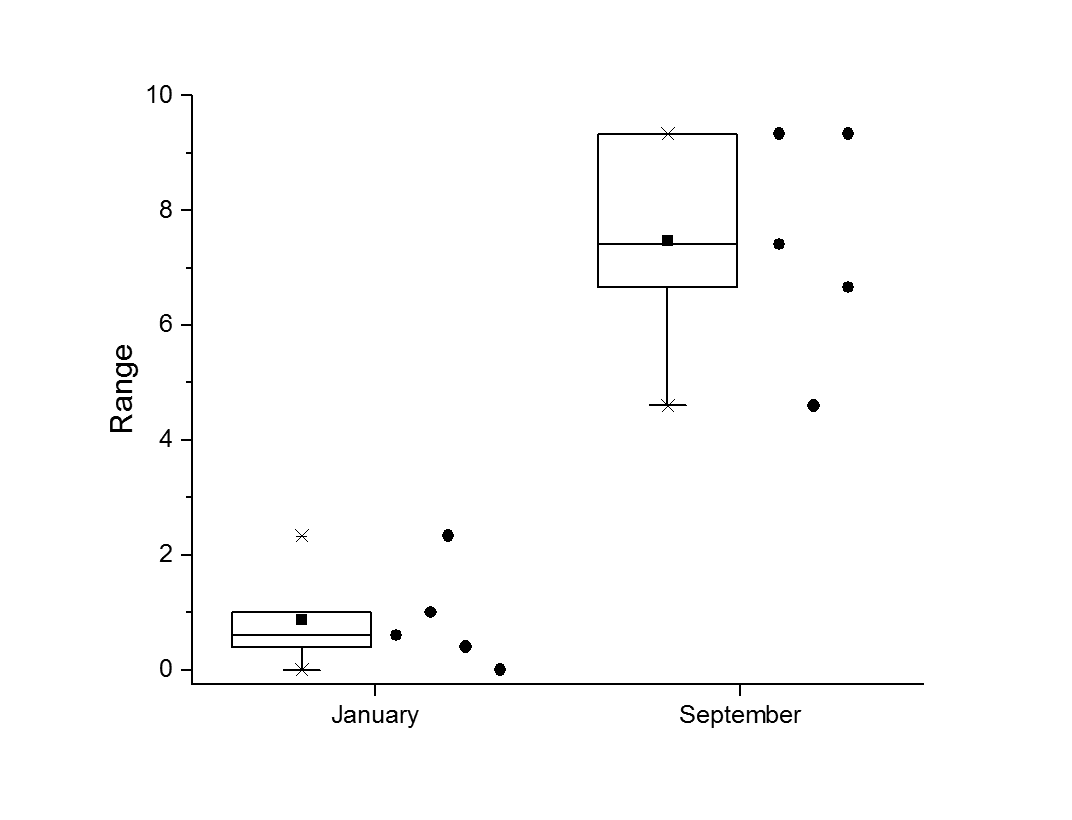
This is an excerpt of a data set from a manuscript I’ve been working on.


The box shows where half the data live, with a line dividing the boxes marking the median. The small black square in the mean, and the little crosses show highest and lowest data points.

When I submitted the manuscript, I didn’t do any statistical analysis of the data. One reviewer asked me to to a statistical analysis. It was a perfectly reasonable request that I should have anticipated. The reviewer didn’t see the same plot that I have above and didn’t know the data as well as I do.

But it got me thinking. John Vokey, one of my undergraduate professors at the University of Lethbridge,used to refer to some differences as “significant by the IOT test.” IOT was an acronym for “Inter Ocular Test.” In other words, the difference was so bloody obvious that it hit you right between the eyes.

“If the mean for one group is up here with only a little variation, and the mean for the other group is down here with this much variation, what do you need a test for? Why not just say they’re different?”

I didn’t do an analysis because I thought there was no point. In the data above, there is no overlap between the two sets at all. Do you need a statistical test to tell you that those two data sets are different?

It is easy enough to do a simple t-test on the data above.


But does adding the test and p value tell you anything more, or different, than the plot alone? Or is including the p value a statistical “fig leaf”?

Do your thoughts about analysis change when I plot the raw data next to the box plot?


Now you can see more clearly that the sample size is small. But even then, when there is no overlap in the data sets, is there any test or condition that will say those two are not statistically different?