19 June 2013

Believing in imposters


A while ago, I was at a graduate program workshop that was geared towards recruiting under-represented minorities in science. One of the participants didn’t know what imposter syndrome was.

This surprised me. I’ve read a lot about this phenomenon, how it affects many people in academia, and how it is particularly hard on under-represented groups.

I explained what imposter syndrome was to the gentleman. “It’s when you think that you have lucked your way into a situation, and that you have no real talent or ability. You keep thinking that any second, people are going to find out, realize they made a terrible mistake, and take it all away from you.”

I saw a few heads nodding in recognition from a couple of other people in the room who had obviously heard of the term. Surprise turned to astonishment when this man refused to believe that doctoral students would ever suffer from imposter syndrome. He said something like, “When you’re a Ph.D. student, you have to have the confidence that you are going to make original and valuable contributions to science.”

He insisted that doctoral students must have healthy egos, kind of by definition. I think his view was that this was the only reason you would enter a doctoral program in the first place. (It was not surprising that this individual seemed to have a very healthy ego of his own. He was a very active speaker at the workshop.)

If anyone should know about imposter syndrome, I would have hoped that it would be someone in a workshop about recruiting minorities to grad school.

It was so disheartening to see him deny something that causes many people much stress. It was even more disheartening to hear such a dismissal in a forum devoted to improving recruitment and retention of students. And it was disappointing to hear it from a man, because “guys trivializing other peoples’ problems” is so clichéd.

If we are to ever improve academic careers, and get more diversity in our departments, the first step will have to be that we believe what people tell us. If someone tells you they have a problem, responding with, “You can’t actually have that problem” is not helpful.

Bonus! Me speaking at a recent graduate fair about the kind of program I help to run. I talk about 30 seconds in.


Hat tip to Scicurious for reminding me to finish this post with her own article on imposter syndrome!

External links

Imposter syndrome: beating the blue-eyed monster
Athene Donald: I still suffer from ‘Imposter Syndrome’

Photo by Erwin Verbruggen on flickr; used under a Creative Commons license.

18 June 2013

Sight sighing: This is an embarrassment

Our university is going to merge and grow with the aim of becoming an emerging research institution, and is going to establish a medical school in the process. Given that these are the state goals of our institution, that this appeared in my inbox this morning was a bit of a shock.

I am very pleased to announce that Braco has accepted our invitation to come to South Texas and share his talent of “Gazing” with the community at large and the UTPA community starting this Wednesday, June 19th, at 2 p.m. with a FREE web live streaming, we can all have access via a computer, iPad, iPhone, etc., from all over the world. ...

The weekend of June 22nd & 23rd, Braco will be at the Holiday Inn Airport McAllen, TX doing group sessions for all who want to experience firsthand from 10 a.m.-6 p.m. for the community at large. ... During the event, Spanish/English translation will be available for each session.

Then for his last day in Texas, Braco has accepted to allow FREE access to all UTPA staff, faculty and students of the web live streaming at the Student Union on Monday June 24th from 11 – 5 pm. Just bring your UTPA ID with you to get in! Come and be engaged with the gazing of Braco hourly for 5-7 minutes!

I also want to take this opportunity to extend this invitation to South Texas College (STC) and University of Texas-Brownsville (UTB) nursing & other health-related field students & faculty to join us for this event. Bring your school ID with you! Not open to the public in general!

This is an embarrassment to our university. Although most of the material concerning Braco (pronounced braht-zo) tosses around the word “healer,” a better one is “charlatan.”

Braco normally charges $8 for him to gaze on you for about five to eight minutes. He does not speak in public. And there is a distinct lack of promises:

Braco also comes with many disclaimers. He does not call himself a healer or guarantee any results. He does not consider himself a prophet or a religious leader, does not espouse a particular philosophy and does not want anyone to follow him. The impact of his gaze may be sudden or gradual, subtle or profound. If there’s any impact at all.

Another article also uses the word “healing,” and notes:

A promotional video features many followers who attest to experiencing healing miracles, and one who claims to have seen Braco shape-shift. (Disappointingly, this follower does not say what shape Braco shifted into.) ...

Less mysterious – he also says he’s got an advanced degree in economics – is the Braco line of 14-karat gold jewellery.

Karen Stollznow notes in a CSICOP article:

Braco makes many claims for someone who claims to not make any claims.

As Skepchick put it:

Best. scam. evah.

Why has Braco agreed to do this for the university? I wager that he will use this to promote his credibility: “Braco has been invited to the prestigious University of Texas system!” Because the email describes this as being sponsored by our Department of Nursing. The email concludes:

This event has been sponsored by the University of Texas-Pan American Nursing Department and Sigma Theta Tau International Honor Society of Nursing Pi Omicron Chapter 397.

Why would a Nursing department sponsor this? (Additional: In an email to me, the department chair says, “We are not providing any financial support or ‘supporting this event’ in any way other than providing an announcement. ... The nursing honor society Pi Omicron has organized this event.” That’s a very limited set of activities, and I wouldn’t normally call it “sponsorship.” ) The email again:

“At UTPA Nursing Department, we strive to prepare our graduates to meet the health care needs of a culturally diverse society. We do so by preparing our students to develop critical thinking skills in order to provide holistic (mind-body-spirit) care to people who have interwoven spiritual, biopsychosocial, and cultural characteristics. Although these unique people are viewed as being ultimately responsible to act in their own best interests, our students, as client advocates, can help people maximize their mind-body-spirit wellness. As such, it is imperative to expose our students to many myriad complementary approaches to wellness and wellness-restoration from the lay, folk, and professional health sectors.”

The word “holistic” appears a lot on the department’s description of “BSN Philosophy,” too. Poor “holism”; a perfectly good word ruined by overuse by those practising pseudoscience. The degree philosophy purports to be in favour of critical thinking, but this is very much not in evidence here.

If you found out another department in your university was promoting this, what would you do? (Additional: As noted above, the Department’s involvement is minimal. It is a student honors society organizing it, which is almost as disappointing.)

External links

Braco the gazer
Gazing balls: I’m looking at you, Braco
Braco The Gazer: A New Age Guru With Nothing To Say
Braco brings his healing gaze to Arlington
Braco Gazing Event: Long-Haired Croatian 'Healer' Will Stare At You For $8 At Crystal City Sheraton

Tuesday Crustie: National Lobster Day, 2013

This past Saturday was National Lobster Day (15 June every year), and I thank Kayle Goff for her devotion to the cause:

17 June 2013

It’s the law! Governor signs off on new Texas university

This snuck by me on Friday: Governor Perry has signed the bill that will create a new university in South Texas.

Perry highlighted the Valley university legislation as some of the most important to emerge from this year’s session.

“This session will expand opportunities for success, and help us keep our state the best place in the nation to live, work, raise a family and run a business," he said in a statement.

UT System said a ceremonial bill signing in the Valley will happen sometime in the next few weeks.

Relevant to my interests are these:

In the more immediate future, is nearly $200 million for construction at UTPA and UTB; $100 million of that earmarked for a new UTB campus, the rest for a Science Building II at UTPA.

Time ran out on securing the funds this regular session in the Legislature.

The science building, where I work, was not completed and had much empty shell space when I arrived. But it has been full for several years now, and there is a desperate need for new research and office space.

External links

Perry signs bill to merge Rio Grande Valley universities

16 June 2013

Comments for first half of June 2013

Inkfish covers a paper that asks people at various stages of education to draw neurons. Hey, did they copy from me?

I make a cameo appearance on Surprising Science, a Smithsonian Museum blog, about that idea that lobsters are immortal. I say again: lobsters are not immortal, despite what the Singularity blog claims. I have my severe doubts about the other four, too.

You gotta see this fish. Deep Sea News covers the first video of the elusive oarfish alive and in the wild. Just amazing stuff.

Undergraduates, Charles Lin has done you a favour in compiling a great list of advice on how to get involved in undergraduate research.

Terry McGlynn about going to conferences as a researcher from a not well known for research university at Small Pond Science.

14 June 2013

“Exploit your size”

Nina K. Simon is one of those writers who writes about one thing on the surface, but has lessons that apply to many areas. In her list of what she has learned in reviving a museum, a few things resonated with me:

Exploit your size. There are unique advantages to every budget level. Big organizations seem comfortable with this – they make big plays based on their scale. But many small organizations seem to spend too much time trying to emulate big organizations rather than exploiting the opportunity to be more personal, more idiosyncratic, and less bureaucratic. No one opens a small coffeeshop and thinks, “we’ll really be successful if we are just like Starbucks.” The whole point is to not be Starbucks. Instead of apologizing for the “lack of professionalism” of small institutions, we should celebrate the ways that our programming can lead to stronger engagement on an individual level. My first year at the MAH, I would often say that we are a “no money, no bullshit” operation. We may not have funding for your project, but we won’t tie it up in red tape either. You want to have an artist collective sleepover at the museum? Sure. Want to give visitors sledgehammers and invite them to help make a giant metal sculpture? Sounds great. Want to give free admission spontaneously as a gift to visitors who need it? No problem. Just as a large organization can exploit its resources, we can do the same in a different way as a small organization.

This made me think a lot about #Scifund, crowdfunding, and “small science” as I have dubbed it. It may have been Nina’s “no red tape” comments. I see many people who say “crowdfunding can’t work,” when what they really mean is, “crowdfunding can’t work for me.” They may be true, but maybe others have different goals and advantages than you do.

Unfortunately, at an institutional level, there often seems to be little interest in supporting this kind of diversity. This is why her last tip also matters:

Remember why you got into this. The reason that we do this revolutionary work is in service of a bigger mission(.) Whatever your personal focus, it’s worth thinking about whether you are working on a problem that you consider to be truly important. ... Find a problem that is truly important, and you will find a revolution worth fighting for.

Go read the rest if you are at all interested in making positive change.

External links

Memo from the Revolution: Six Things I’ve Learned from our Institutional Transformation

13 June 2013

Is this good advice?


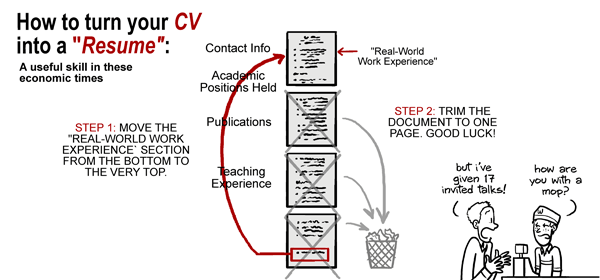
Things that a student heard at a workshop for students wanting to go into doctoral programs:

  • A 3 page CV is too long.
  • Ph.D. programs are looking for “well rounded students”, not people who are just focused on research, so not appearing “well rounded” is a weakness in a CV.
  • Don’t include relevant classes that you have taken.
  • Include clubs in your CV.
  • Include community service in your CV, and volunteer activities.
  • Don’t put so much research activities.
I think this is terrible advice. This sounds like advice from someone used to industry resumes (which usually are limited to 1-2 pages), not academic CVs. And especially not CVs from students looking to get into grad school in STEM fields. Less emphasis on research?

Thoughts?

Additional: Reactions from Twitter:

Neuroscience doesn’t need a grand theory to advance

In a new post on the planned BRAIN Initiative, the National Science Foundation characterizes neuroscience as:

Desperately seeking a theory

Not just seeking, but desperately seeking.

In other words, scientists lack a basic, overarching theory about healthy brain function that would explain how memories, thoughts and behaviors emerge from dynamic activities in the brain – any brain.

That doesn’t sound like a theory of the brain. That sounds like what is desired is a theory of consciousness. This does not surprise me; it’s the big hairy audacious goal for many neuroscientists. I have a message for my fellow neuroscientists about this.

People, chill out. You don’t need a theory to make excellent progress in understanding how any of those things work.

Let me draw a parallel. Consciousness is a network property of certain combinations of matter. Life is also a network property of certain combinations of matter. We want to explain what are the conditions necessary for those network properties to appear. So, the task of understanding consciousness for neuroscientists is very similar to the task of understanding of life for biologists.


We do not have a theory of life in biology.

By this I mean no theory predicts what configurations of matter are capable of life. Could you have a silicon based life form? A life form that exists in liquid methane instead of water? We have no idea. We have been surprised by extremophiles on Earth that live in conditions that were generally predicted not to be able to support life.

In my estimation, one of the last hopes for a unifying theory that separated life from non-live was vitalism: the idea that all living things had an “essence” that non-living ones did not. But we now know that there is no clear distinction between animate and inanimate matter, and vitalism is dead.

Of course, we may develop a theory of life, particularly if we can ever discover other independent origins of life, whether it be “shadow life” on our planet, evidence of life on other planets, or develop artificial life.

It’s not that we lack theories in biology; we do have them. Evolutionary theory and cell theory are the two main (some would argue only) theories in biology. But neither of these do the job of predicting what configurations of matter have what properties of life, and which don’t.

Similarly, neuroscience does have has theories: neuron theory, for instance. It doesn’t explain the “consciousness, but then again, its biological relative, cell theory, doesn’t explain “life,” either.

Yet this lack of a theory has not prevented an explosion in our understanding of biology. Inheritance and the development of complex multi-celled embryos from single cells were once viewed as great mysteries. Work on DNA and stem cells and gene regulation and so much more means that we have extremely good understanding of these processes. We did all of that without a “theory of life,” and there is no end in sight for biological discoveries. Biologists are not complaining that not having a “theory of life” is limiting their research. Almost nobody in biology is worrying about it.

I am not saying it wouldn't be nice to have a grand unified theory for consciousness. Theories are wonderful things to have. With the Society for Neuroscience meeting being one of the biggest scientific meetings in the world, it seems that neuroscientists are not being limited in making discoveries by their lack of an overarching theory.

Hat tip to Erin McKiernan.


Related posts

When is neuroscience not neuroscience? When it’s neurobiology
Nominees for the Newton of neuroscience

External links

Prying open the black box of the brain

Photo by FunGi_on Flickr; used under a Creative Commons licence.

12 June 2013

How could it be there’d never been a woman in charge of Science before?

On a Science magazine policy podcast, incoming editor Marcia McNutt was asked about being Science’s first woman editor (5 minutes into the podcast). She replied:

Well, I think it’s perhaps rather remarkable that here in the year 2013, I would be the first, because in my view, there have been stellar women who have been the backbone of Science magazine for many, many years. If you look at  the top editorial staff members, and the top brains behind the business of Science magazine, it has been largely a female enterprise for many, many years. So the fact that it has taken this long to have a female editor-in-chief is somewhat perhaps unusual.

Sadly, I’d argue that never having a woman in a top editorial job before is neither “remarkable” nor “unusual.” It’s called sexism. And this is not a problem of the past, it is a current problem. I’m not saying Science has been sexist. What I am saying is that women are still poorly represented in leadership roles in scientific societies and journals in science generally.  That a journal has never had a female editor before is not surprising. I hope that a journal not having a more equal representation will be surprising now and in the future.

Don’t whitewash the long history of sexist behaviour in science.

External links

Marcia McNutt interview

Sharing responsibility for bad papers

When you read a bad paper, whose fault is it?

Robert Horvitz (quoted in Box 1 here; hat tip to Mike Taylor) and Fred Schram (who I quoted a couple of years back) both put the burden squarely on the authors. This bothers me, as I started to articulate yesterday.

Journals routinely take credit when things go right. Journals and publishers love to talk about how they “add value” to papers. Journals talk about “attracting” high quality submissions. They have “rigorous” peer review. When impact factors go up, it must be due to the good job the journal’s editorial board is doing.

But when things go wrong, and a journal is faced with charges that a paper should not have been published, it is all to easy for editors to wash their hands of the whole thing and let the authors twist in the wind. For instance:

Peer review does not end with publication. In the event that an accepted manuscript is questioned by the scientific community on the basis that the authors acted unethically, plagiarized, or where there are queries relating to the data or interpretation of the data, the editors will contact the authors to investigate unethical/fraudulent/plagiarized works or the journal editor will invite or accept letters to the editors.

Notice anything there about acknowledging a bad decision? About apologizing? About ensuring that reviewers are not asked to review for a journal again? Anything about investigating the process that led to a bad decision? I’m not even saying it was necessary in that case, but it exemplifies the “we followed procedure, we did nothing wrong” arguments that are routinely pulled out in response to criticism.

Some journals are quite good at critical self-appraisal of their overall processes. For instance, Nature showed some good reflection about sexism in their editorial process. But it is much rarer for a journal to show the same reflection over any single paper, except perhaps for clerical errors. Again, I struggle to think of cases.

I know it’s human nature to want to take credit and avoid blame, but mature people suck it up and take the heat as well as the glory. Editors and journals should share some of the load when poor papers get through their editorial decision making. I would also like it if reviewers would admit some culpability, but am not holding my breath, given the reviewing procedures at most journals protect anonymity to the extent they do.


Related posts

The Crustacean Society 2011: Day 3
Back room science

External links

Caustic volleys and the sting of peer review: what’s the solution?

Photo by !anaughty! on Flickr; used under a Creative Commons license.

11 June 2013

Tuesday Crustie: Up periscope!


Fiddler crabs’ eyestalks let them get a peek above the waterline.

Photo by hankplank on Flickr; used under a Creative Commons license.

10 June 2013

Back room science

We now return to one of our regular features, “Let’s impugn all the bloggers.” Let’s start with Geoffrey North, using the pulpit of Current Biology.

But there is also, I think, a danger here, which lies in the very speed of response, and the way that blogs are essentially “vanity publications” which lack the constraints of more conventional publishing — they are not reviewed, and do not even have to pass the critical eye of any editor.

North is not alone. Fred Schram, the Journal of Crustacean Biology editor, recently wrote much the same, as a closing note in a piece mostly about open access (albeit in a society newsletter rather than an editorial in the journal itself):

One can already see what lies down the road beyond that point, something truly (open access) – the blogosphere! But do we want to collect our scholarly information by monitoring personal blogs. There will be no peer review, no quality control of data presentation, no fixed PDFs, no assurance that what we read represents actual work has been done as claimed.

What strikes me about both North’s and Schram’s comments is they reflect a desire for there to be a back room. You know, the place where work gets done, out of sight. Then, after all the real deals are made, a glossy fait accompli version that lacks blemishes is presented for “the official record.”

There’s a reason that people don’t like back room dealings. It shuts people out. There’s no transparency. David Brin has often noted that we tend to demand transparency for everyone else, but privacy for ourselves.

Blogs have allowed a bunch of scientists who don’t often get invited into the back room to start commenting on what comes out of it. It’s no surprise that those in the back room, unused to the glare, might hate this.

These arguments also seem weird to me in emphasizing “the scientific record.” While vetting and quality control are good things, they have hardly produced a pristine “scientific record” (see Retraction Watch). It’s always been messy.

North continues:

I do think there are dangers in a world where the critics are less accountable than in the more “traditional” system of peer-reviewed journals (which I well appreciate can be frustratingly slow in processing critical feedback).

How are journals, and their editors, more accountable than “critics”? It seems that more often than not, getting even egregious abuses of editorial power corrected is like pulling teeth. The arsenic life paper has been discredited, but not retracted, and there has never been any explanation of how the paper passed peer review. A weak paper claiming genetically modified corn caused cancer in rats rated responses, but not retraction, and there was never any explanation of how the paper passed peer review. An investigative journalist had to be the one to hold the feet of The Lancet and its editor, Richard Horton, to the fire after Andrew Wakefield’s untrue anti-vaccine paper was published. Editors can just say of problematic papers, “This passed peer review. Peer review is anonymous, so we can’t tell you anything about who the reviewers were or what they said.” This is a strange version of accountability.

Many journals have no “letters to the editor” section, or comments, or anything similar. And even if a journal does have such a section, who decides what is fit to see print? The self-same editors. Direct critiques of journal editorial processes in the same journals, or even different journals have been, in my estimation, rare. I am trying to think of examples. If anyone has them, please add them to the comments.

Journal editors may have a skewed view of this issue, given that they alone have an overview of the entire editorial process. Nobody else does. Everyone else is kept at least partially in the dark, deliberately so. Authors generally don’t know who reviewers are. Reviewers don’t communicate with each other. And none of them have much opportunity to have a dialogue with the editor.

North asks:

What is the solution here? How can one have a system that allows for rapid critical assessment, but ensures any such criticism is fair and reasonably based, not based on misunderstanding or ill-motivated?

Everything that North concern trolls about the blogosphere has always been happening at scientific conferences. And yet somehow, scientific discourse does not collapse at conferences. Nobody there talks about the need for “solutions” for the problems of criticisms at conferences.

We’ve been down this road before. Here’s a small sample taste of how the authors of a review in BioEssays dismissed Rosie Redfield (and anything else that might be on the Internet) blogging about on arsenic life:

(T)hese “chat room” environments are not constrained or screened and at times become ad hominem attacks, which have no place in the scientific literature.

Let us not forget that a representative of the American Chemical Society said this of bloggers:

“We find little constructive dialogue can be had on blogs and other listservs where logic, balance, and common courtesy are not practiced and observed,” Glenn S. Ruskin, the group’s director of public affairs, said in an e-mail message.

We had L. Henry Edmunds, Jr., the editor of the Annals of Thoracic Surgery, ranting against “bloggists”, telling Retraction Watch:

It’s none of your damn business.

I’m grateful to Embargo Watch for recording the reaction of the public information officer of a major university, the University of Manchester’s Aeron Haworth, brushing off Ed Yong (who told this story on the now defunct Posterous website):

I think you have all you need for a blog.

Common factors in all of these? For one, most have vested interests in the status quo of scholarly publishing: editors, society representatives, and so on. Large institutions used to be able to control attention because of the vast infrastructure needed to reach a mass audience. They are now freaking out that their infrastructure doesn’t mean that much. They face competition from people like bloggers who gain attention by doing remarkable things.

As Christie Wilcox pointed out, North’s article does not give any examples of where something bad happened. Not one. Not a single, solitary case where bloggers resulted in some poor scientists unfairly being tarnished. In contrast, North provides a positive example of where blogging had a good effect (Rosie Redfield’s critique of arsenic life).

Here’s my challenge: instead of jumping to “The Internet is bad” meme with both feet, instead of just bemoaning the blogs are bad, point some fingers. Name some names. Be specific about events that unfolded in ways harmful to the general scientific community, and not just things that make journals look bad.

Previously, I said nobody can assert they have authority. I’d like to note that the flip side is also true: you cannot dismiss authority, either. When editors and journals try to claim they have authority and bloggers don’t, they lose the very thing they want to have.

Hat tip to Malcolm M. Campbell, who asked for blogger’s response to this editorial.

Additional: Matthew Francis and Justin Kinney both counter the fetishization of journal peer review evidenced above by pointing out the success of arXiv.

I also became aware of PubPeer through this article, and reposted this piece there.

References

North G. 2013. Social media likes and dislikes. Current Biology 23(11): R461. DOI: ; free full text
Schram F. 2013. To be open or not to be open: That is the question. The Ecdysiast 32(1): 7. http://www.thecrustaceansociety.org/uploads/Ecdysiast_32-1_May_2013.pdf

Related posts

Wrong approach
Arsenic life, four months later: pay no attention to the internet
Arsenic life, four months (and a bit) later: Reviewers with shovels
The deal is rotten
Dear Virginia
Taxonomists as science survivalists
Retraction classic: physics and feminism

External links

On Current Biology editorial
On The Danger Posed By Non-Expert Critiques Published To Large Audiences
Speak up and matter

Others
ACS to bloggers: Shove it
Why was that paper retracted? Editor to Retraction Watch: “It’s none of your damn business”
How to demonstrate you’re not about transparency — and piss off reporters — as a PIO

Picture by by LALLA - ALI on Flickr; used under a Creative Commons license.

05 June 2013

How to make a zombie: The SICB symposium

Some time ago, I hatched a plot with Kelly Weinersmith. It was like this:


Yes, exactly like that. It was an idea that pinged around and got rejected once before it ultimately found a home.

But I am proud to announce that at the next Society for Integrative and Comparative Biology meeting, to be held here in Texas, Kelly and I will be co-organizing the symposium, “Parasitic manipulation of host phenotype, or how to make a zombie.”

We’re excited to have this symposium at SICB, because this is truly an integrative topic. Trying to crack this problem requires the help of taxonomists, ethologists, ecologists, neurobiologists, and more. SICB is one of the few meetings where workings in all those different kinds of disciplines mingle together.

Mark the meeting on your calendar! It’s 3-7 January, 2014.
Now that we have embarked on a nefarious plot, we are in the market for a skull-shaped island.

Team CloneZombie... doing our part to keep Austin weird!

External links

SICB parasite symposium page
SICB 2014 meeting page
Symposium: Parasitic manipulation of host phenotype, or how to make a zombie (Co-organizer Kelly Weinersmith’s blog)

04 June 2013

Tuesday Crustie: Strictly speaking, it’s a nice pleon


As with the last week or two, you may need to click to enlarge to see some of the fine print.

03 June 2013

Carnival of Evolution #60: Party like it’s 1953

Ladies and gentlemen, this is a special edition of the Carnival of Evolution. It’s the big six oh!


In honor of that achievement, we shall share this carnival’s space with other events celebrating their sixtieth anniversary.

Trillions and trillions... if viruses were dollars, we’d all be as rich as Richie Rich (debuted 1953). Carl Zimmer brings us the story in Meet Your New Symbionts: Trillions of Viruses.

“Think of the happiest things / It’s the same as having wings...” is what they sing in Peter Pan (Disney version debuted 1953). Birds may beg to differ, having gone to hard way to evolving flight. The feathers on a new dinosaur, Auronis xui are examined at the Pterosaur Heresies.

Evolution can be fast and relentless, like a Chevy Corvette (first built in Flint, Michigan in 1953). If that’s your thing, you need to check this post on Relentless Evolution at The Molecular Ecologist.

Evolution can be fast, like the first plane to hit twice the speed of sound (Mach 2 reached November 1953). The Digital Cuttlefish has the story about how roach bait lost it sweet allure for its intended targets, who now find the traps bitter.

The physics of sound are demanding. Test pilots like Jackie Cochrane (first women to fly past Mach 1) could attest to this. An unassuming moth, like Cochrane, broke a new record in sound this month, with its ability to detect extraordinarily high sound frequencies, covered here at NeuroDojo. (But what’s the selective pressure?)

Look! In the manuscript! Is it a cladogram? Is it a phylogeny? It’s... supertree! No, this is no parody, like Superduperman (appeared in Mad magazine in 1953), but a real method in evolutionary biology. Learn more about the Supertree method at Teaching Biology.

Sometimes, the ruthless anti-hero James Bond (who first appeared in Casino Royale in 1953) is described as a bit of an animal. This means he has tight junctions and radial cleavage. (I saw lots of cleavage in the Bond stories, but not like that...) At least, that’s what Teaching Biology tells us in the examination of what it means to be an animal.

In 1953, Russell and Monroe proclaimed that gentlemen prefer blondes. However, being brunette might be better indicators of fitness, given that dark pigments are costly to produce. At least, that’s the case in for dark colour in crickets, covered here at NeuroDojo.

Many considered the first issue of Playboy magazine a scourge (released December 1953), but let’s face it, a magazine is an amateur scourge compared to the blight that destroyed the potato crops of Ireland, leaving the Irish with nothing to eat. John Hawks covers some recent work on the potato pathogen at John Hawks’ weblog.

In 1953, you could get over 70% of American households turning into watch one television show, like I Love Lucy. Mass media was here! Today, there are all kinds of media, including the pervasive podcast! Neuroanthropology tells us about a recent Neuroanthropology podcast that answers such pressing questions as, “What is it and why should I care?”

For those with a taste for live performance, Broadway say the debut of Arthur Miller’s The Crucible in 1953. The Galápagos Islands have sometimes been called a crucible of evolution for all the wonderful organisms that have invaded and adapted to those hard specks of land in the ocean. Many biologists want to go there, and Eco-evolutionary Dynamics got the chance and describes the trip to the Galápagos for us.

It has not escaped our notice that the announcement of DNA structure occurred in 1953 as a trio of papers in Nature, which ultimately led to the proliferation of modern molecular techniques so widely used in evolutionary biology today. For instance, gene expression is used to examine the evolution of the eyes of cave bugs, covered here at NeuroDojo.

Elizabeth II was crowned in 1953, and became the first Queen of Canada, which matters to Canadians like myself and T. Ryan Gregory. The debate over whether the monarchy is superfluous invites almost as much controversy as whether large swathes of DNA are also superfluous. Ryan examines genome reduction in the context of ongoing “junk DNA” debates at Genomicron.

Viruses were big news in 1953, particularly with the announcement of the polio vaccine. Viruses are central figures in this Story behind the paper at The Tree of Life. It’s largely about snot... or, to use the technical term, mucus.

Another evolutionary controversy... one might even say a war (though not an interplanetary war, like the one depicted in George Pal’s classic telling of War of the Worlds) concerns group selection. David Sloan Wilson has been a long-time proponent of the idea. Evolving Economics examines Wilson’s paper on intentional change.

Speaking of worlds, in the World Series of baseball, the New York Yankees were on an incredible winning streak. They won their fifth world series in a row in 1953. Did modern humans have a similar winning streak against our Neanderthal relatives? Trapped by the Box investigates the possible role of culture in the eventual extinction of the Neanderthal lineage.

And for the big finale, the pinnacle, the Everest, as it were (which was first climbed in 1953 by Hillary and Norgay), we have God and Evolution, the conclusion from John Wilkins at Evolving Thoughts.

Want more? Join the Carnival of Evolution on your favourite social media site!

Want more 1953? Here is more and more and more!

What...? Sixty installments for the Carnival of Evolution, not sixty years?

01 June 2013

Comments for second half of May 2013

NeuroPolarBear thinks we may be stuck with Impact Factor as a way of measuring single articles, as much as we hate them.

What’s in your trunk? Prof-like Substance wants to know!

If you’re a Star Wars fan, you need to read this amazing retrospective of the design of the film’s iconic title.

Small Pond Science looks at the prospect of moving between universities. Also check out this post about how students address instructors. Then there’s the issue of sabbaticals.

The Cellular Scale asks what makes something an experiment.

Just go read Bug Girl's post on Insect Carl Sagan. Go now!

In Baby Attach Mode asks how you deal with rejection. I just expect it, because I suck.

Empirical Planet looks for science panel discussions. Unfilled niche, people! Someone grab it!

30 May 2013

Eleven years of science blogging

Eleventh anniversaries are tricky. I mean, when you hit ten, it’s like watching the odometer on the car roll over and you go, “Look at all the zeroes!” It’s a whole new order of magnitude. But after that, that leading numeral “one” is just stuck there for year after year.

Today is the eleventh blogiversary of NeuroDojo. I’m very happy about that, and with the longevity of this project.

Thanks to:

  • Neil Gaiman for the original inspiration to start this.
  • Blogger for continued hosting and service; literally from the very beginning.
  • Flickr for being my best source of Creative Commons graphics.
  • You, even though you readers and commenters are slightly too numerous to single out.

Despite a post that reflected some weariness earlier this week, I see no end in sight for this blog. It’s still fun.

P.S.—It seems appropriate to include this “Blogging for the long haul” session I did with the mighty Sci at Science Online:

Watch live streaming video from scienceonline at livestream.com

Still not explaining the masks.

Related posts

Ten years of blogging
Science Online 2013: “Blogging for the long haul”
“Blogging for the long haul” session up!

Photo by imago on Flickr; used under a Creative Commons license.

29 May 2013

Which is harder: resurrecting a mammoth, or a scientific career?

Woo-suk Hwang’s career seemed to have flamed out a few years ago among charges of data fabrication.

Today, I read that he is still doing science. And that he is part of a deal to clone a mammoth.

This is surprising to me in several ways. First, that Hwang is still doing any sort of science at all caught me off guard. Second, it is a bit weird that of all the things Hwang’s name re-emerges in connection with, it would be something as fringe sounding as mammoth cloning.

I am also surprised that in the press release, Hwang’s ethical issues are notable only for their absence:

Last year, Grigoryev’s Northeastern Federal University signed a deal with cloning pioneer Hwang Woo-Suk of South Korea’s Sooam Biotech Research Foundation, who in 2005 created the world’s first cloned dog.

In contrast, Wired UK does not overlook this:

Also, while Northeastern University did sign a prominent agreement with South Korea's Sooam Biotech Research Foundation in 2011 to clone a mammoth using recovered mammoth bone marrow, there has been little news from the programme since. Many observers have been sceptical it can achieve its aims, especially as it's led by geneticist Hwang Woo-Suk -- the man who was exposed for faking research in 2006 when he claimed to have cloned human stem cells.

Nor does CNET:

North-Eastern Federal University has partnered with controversial South Korean cloning scientist Hwang Woo-Suk (who was found to have faked data involving a procedure to clone human embryonic stem cells) for a mammoth-cloning effort.

What should the reporting of this story be? Should Hwang’s past be mentioned? I have mixed feelings about this. On the one hand, I do believe that people can change. Hwang’s past may not be relevant to this project. Hwang did achieve many genuine successes, notably the first cloned dog, Snuppy. The scientific community has, in general, not given people found guilty of data fabrication second chances. And Hwang’s record is, well, note-worthy.

External links

Russian scientists make rare find of 'blood' in mammoth
Scientists poke frozen mammoth, liquid blood squirts out
Scientists uncover frozen mammoth, blood flows out
New mammoth comes with grains of salt
Nature’s special report on Woo-suk Hwang

Frankenstein and Galileo, revisited: are they the same story?

I’ve been following the story of Eric Weinstein with some interest, since his work was promoted in the Guardian last week (here and here). I was thinking about why it has attracted so much attention. I thought back to an earlier post of mine, in which I claimed there are two extremely popular science narratives that we tell over and over and over again. One is Frankenstein (science leads to tragedy) and one is Galileo (science triumphs!).

The initial Weinstein articles very much set the tone, raising the possibility that Weinstein might be one of these Galileo type figures: the plucky, lone outsider taking on the establishment. Jha writes (my emphasis):

He may have an impressive CV, but Weinstein is in no way part of the academic physics community. ...

David Kaplan, a particle theorist at Johns Hopkins University in Baltimore, has seen and discussed some of Weinstein's ideas with him. On the plus side, Kaplan says it is "phenomenal" that someone coming from outside academia could put together something so coherent. "There are many people who come from the outside with crazy theories, but they are not serious. Eric is serious."

In response, established jobbing scientists in academia stepped into their proscribed role as stuffed shirt party poopers (my emphasis).

That is not to say he doesn't have anything to contribute, but he will have to go through the proper channels. Physicists are inherently conservative. New claims, especially bold ones, face stiff resistance. That's for a good reason: faster-than-light neutrinos, anyone? ...

Grand claims like Weinstein's would – in the normal course of science – be accompanied by a technical paper explaining their foundations. We could then take a deep breath and puzzle over whether they're consistent with the vast knowledge of nature arising from centuries of experiment and observation.

Jennifer Oulette’s post also fits that mold. Oulette is a smart enough storyteller to recognize the importance of the way the story has been framed as a potential a Galileo-style triumph in giving this story “legs”:

Admittedly, it’s a very seductive narrative. Who doesn’t thrill to the idea of an obscure unknown genius toiling away in the shadows, snubbed by the stuffy, closed-minded academic establishment, who defies the odds and manages to achieve what all those brilliant scholars failed to do, thereby ensuring his or her scientific immortality?

The story is important. In thinking about Weinstein’s lecture being framed as a Galileo-style story, it occurred to me that Frankenstein and Galileo are not two stories; they are one story.

Pride goes before a fall.

Frankenstein and Galileo are both stories of pride going before a fall, and then getting knocked down a peg. The only difference is in who has the pride. In Frankenstein, it’s the scientist. In Galileo, it’s the establishment.

This is perhaps nor surprising, given the nature of science. Science is about determining the nature of reality. And reality always wins. A story that is truly about science will always have anyone who wants to live with their wishes, or deny the facts, or think they can trump the natural world losing in the end.

I am still looking for the shapes of other scientific stories. It seems to me that the most common one in reality makes an uninteresting one in narrative: “Work very hard for a long time, and maybe you can to make a few small dents in our ignorance.”

Additional: I made a few comments about this on Andrea Kuszewski’s post on G+.

Related posts

Frankenstein and Galileo

External links

Roll over Einstein: meet Weinstein
Eric Weinstein may have found the answer to physics' biggest problems
Weinstein's theory of everything is probably nothing
Dear Guardian: you’ve been played
An Outsider’s Theory of Everything
A tale of two Oxford talks
David Nutt and science’s Galileo complex

28 May 2013

Tides and doldrums in science communication

Sometimes, you feel tired. Or small. Or both.

Last week, I went after a claim about “immortal lobsters.”

No, lobsters are not immortal. Lobsters have shorter lives than humans. But there is a tiny little sliver of truth that gets mangled somehow into a bigger claim that “lobsters are immortal.”

I’ve spent quite a bit of time working on the post (which has been updated several times), tracking down references, making pictures, and editing Wikipedia. I was gratified by the response to my post. It was one of my most popular blog posts in a long time. But then, I was dishearted to see that my posts didn’t even have 1% of the reach of a silly lobster picture. And I probably shouldn’t have searched Twitter for “immortal lobsters” to see how many people were accepting this and retweeting this claim.

Last night, I realized I had it easy. At least I don’t have to put up with the stuff the real marine biologists have to deal with, like a cable television network promoting the idea that mermaids are real.

Seriously. What the hell.

Because it apparently needs saying... mermaids are not real.

You want to make a dent in the foolishness. But sometimes, you just wonder if you can. 

And then we scientists get told we are not doing enough.

What about the rest of you guys doing great work that not enough people know about? Who’s helping you communicate what you do?

Sigh. You mean besides blogging non-stop for eleven years as of this week?

Scicurious has a long response to that, which says a lot of things I would probably say. I guess I’ll just add here that I can’t compete with viral memes and entire television networks. Even if I wasn’t trying to teach students and do actual original research, too, how far could I go when the tide seems so relentless and so fast?

This is not to say that I am going to give up. This is a good fight. But sometimes, you wish there was a lull in the fight instead of a never-ending battle.

Additional, 29 May 2013: Apparently, this week’s “mermaids” show gave the network that aired it its biggest audience ever. Hope for humanity fading...

More additional, 29 May 2013: If my post is one of fatigue, Bug Girl's post bookends mine with wonderful enthusiasm. Hope for humanity rising...

External links

Why Science Needs Help Talking About Itself
Calling all Brave Travelers
Insect Carl Sagan and science communication

Related posts

All lobsters are mortal
I want to be Carl Sagan, but can’t