Showing posts with label bugbears. Show all posts

11 February 2025

These are not serious people

An American politician with a seat in the House of Representatives has introduced a resolution “to acquire Greenland and to rename Greenland as “Red, White, and Blueland”. 

This is real. Not a prank. Not a hoax. Not an imaginary story. Not an April Fools day joke.

External links

H.R.1161 - To authorize the President to enter into negotiations to acquire Greenland and to rename Greenland as "Red, White, and Blueland". 119th Congress (2025-2026)

Carter introduces bill renaming Greenland, February 11, 2025 


04 July 2020

Letter about a statue

This was a letter I set to my university president, Guy Bailey, last month. I’m posting it today because I think in the US, 4 July is a good day to have serious discussions about history.

I was also motivated by listening to “Return of Oñate’s Foot” on the 99% Invisible podcast – an excellent telling of a story about a somewhat similar historical figure.


Hello,

I was pleased that you addressed issues of racism in your email of 2 June. I wanted to bring up an related item for your consideration: the statue of José de Escandón on Edinburg campus. The statue describes Escandón as a “colonizer.” I suggest you consider whether a statue of a “colonizer” is in line with UTRGV’s values.

Base of status to Jose de Escandon describing him as a colonizer

In particular, Escandón’s professional climb that led to his mandate to colonize the region was in part based on his success in quelling uprisings of Native Americans and “pacifying” them. That alone is problematic, particularly for our Native American students (5-11 students over the last four years). but also consider the larger role of colonialism in perpetrating slavery and genocide.

Other universities are taking this moment to examine and change the symbols that represent racism and colonialism. Imperial College London changed its logo to remove its motto. They recognized their motto, “Scientific knowledge, the crowning glory and the safeguard of the empire” is “is a reminder of a historical legacy that is rooted in colonial power and oppression.”

Over the last few weeks, many communities worldwide have been re-examining their statues and the messages they send. Protestors pulled down a statue of a slave trader in England. McGill University students are petitioning to remove a statue of university founder James McGill, who owned slaves.

Statues glorify individuals and values. I hope that you will consider whether this statue represents values that UTRGV supports.

19 August 2015

Things I should learn if I want to lead a life like in movies

I mean, seriously, how often do heroes and villains in fiction get to gasp, “It’s Morse code!” and then decode it? Interstellar was one of the most recent and most annoying examples of this trope.

13 November 2014

“Stop flirting, I’ve still got a job to do here,” heard at comet landing

A lot has been written about Matt Taylor’s shirt that he wore during the livestream of the Philae touchdown (links at bottom). I’d like to point out another moment from the P67 comet landing, starting at 6:15:14 in this YouTube video (click text link to go straight to the bit I’m talking about):


The speaker of the moment, Johann-Dietrich Wörner, chairman of the board of the German Aerospace Center (DLR), reveals a P67 polo shirt on stage after the landing.


The presenter, Monika Jones, says, “I want that polo shirt!” Something happens off screen that catches her attention, and she continues, apparently addressing Wörner offscreen, “Not now, we’ve got a few minutes. Change? Stop flirting, I’ve still got a job to do here.”

Now, she said it with a smile, so it’s hard to tell if the presenter was actually offended, or taking it in a spirit of fun. But I had a moment of, “Did she just have to say that?”

Maybe it would have slipped by me if I hadn’t been aware of the shirt issue. But after the shirt issue, and Matt Taylor also talking about Philae coming down for “the kiss,” (also not reported much) I cringed a bit.

Given that I’d seen a bunch of stuff about Matt Taylor’s shirt, I was also saddened when I saw the composition of the audience at the livestream.


I count about five women out of about 35 faces in this one screen grab.When it panned around, the proportion of women in the audience seemed even lower.

Such a stark contrast to the famous pictures of the Indian Mars mission not so long ago:


Update, 14 November 2014: Matt Taylor apologizes for the shirt. This is positive. I do wish he’d also have acknowledged that some of his comments were a bit cringe-worthy, too.


External links

New requirement for scientists: You cannot be a sexist pigdog
Sometimes, a shirt is not just a shirt
Confessions of a teenage dirtbag: Thoughts on shirtstorm
That shirt
Why women in science are annoyed at Rosetta mission scientist's clothing 
Shirtstorm reaction bingo card
Shirts, science communication, and why appearances can be important

22 July 2014

Updating, updating, and updating some more

I’ve had four papers published in the last seven days.

I’m pretty sure this is a record for me. Three came out as part of the Society for Integrative and Comparative Biology symposium collection I co-organized with Kelly Weisnersmith (two papers open access), and the fourth is a short note about a crab that has been seen further south than ever before (full paper on DoctorZen.net!).

The publication of that last paper, however, robbed me of about half a day. Of course, I tweeted and posted about it. Until it came out yesterday, I did not know the publication details, like the volume, page numbers, and DOI. I started updating my information. That meant typing in information for...

  1. My CV.
  2. My own website, DoctorZen.net.
  3. ImpactStory.
  4. ORCID.
  5. Academia.edu
  6. ResearchGate.
  7. Mendeley.
  8. My institution’s “digital measures” website.
  9. Update: Doh! I forgot Google Scholar!

ImpactStory had far and away the simplest process: paste in a DOI. This, to me, is exactly how is should be. Because it is a unique identifier, a DOI should be everything needed to get information about a paper, like authors, the journal it was published in, etc.

I also learned that ImpactStory will automatically import projects listed in ORCID. Meanwhile, many publishers will be collecting ORCID information as part of the submission and publication process, presumably allowing profiles to be updated automatically when new papers come out.

The remaining websites all had many boxes and somewhat clunky interfaces. Academia.edu and ResearchGate require you to enter data over multiple screens.

By far the worst was – perhaps not surprisingly – my institution’s digital measures website. These sorts of “enterprise” software packages always seem to end up being barely functional, butt ugly to look at, and a pain in the butt to use. Instead of a single field (DOI), it has about 24 separate data fields. The exact number depends on how many authors you have to enter (click to enlarge). This makes me glad I don’t publish in large groups where the number of authors can run into double digits.

It asks for a lot of strange information, like institutional “themes” and “city of journal / publisher.”

And this one screen is only for publications! There are similar screens for our presentations, committee work, teaching, and so on. I have no doubt they are probably as complicated, if not more so.

Despite my whinging about the amount of duplication, I don’t think I can just walk away from these sorts of sites. I know I get people who find my stuff from those sites, so I think it is useful to have a presence on them.

Photo by Marcin Wichary on Flickr; used under a Creative Commons license.

25 June 2014

Taxonomic correctness overkill

Some people insist that this is not a starfish.


And that this is not a jellyfish.


Instead, some people say that we should call these “sea stars” and “sea jellies.” Because (the logic goes) they’re not really fish.

This annoys me. It’s an attempt to make common English words conform to scientific taxonomy. This seems pointless to me. This is the entire reason why we have a scientific naming system and give species Latin names. Linneaus realized that regular vernacular was far too imprecise, so sidestepped the whole issue by creating the binomical naming system.

It certainly is not like “fish” is the only noun that gets applied to several unrelated taxa. “Lobster” can mean clawed lobsters, slipper lobsters, squat lobsters, which are all different families. “Crab” and “shrimp” are just as messed up.

This is dour attempt to achieve linguistic purity. But it's a lost cause. As writer Ammon Shea (author of Bad English) noted in a recent interview:

By the time you have noticed a usage being misused, it is far too late for you to do anything to stop it.

In other words, nobody says we shouldn’t call this a crayfish.


What would be call it instead? A “lake cray”? A “river cray”? Ick. That would be just cray cray.

External links

Starfish or Sea Star? Asteroid? 5th Anniversary Post!!

Starfish by Topyti on Flickr; jellyfish by NBPhtostream on Flickr; crayfish by Tatters on Flickr. All used under a Creative Commons license.

09 December 2013

Asking about awards

Just got an email from our administration. They are asking faculty to list awards they’ve won. Awards like being names a Howard Hughes Medical Institute investigators, MacArthur Foundation Fellows (the so-called “genius award”), being elected to the National Academy of Sciences, getting a National Medal of Science, a Pulitzer prize, or a Nobel prize.

Because, apparently, our university wouldn’t know if a faculty member won a Pulitzer or Nobel unless they specifically asked. “What was the trip to Stockholm in your travel request for, anyway?”

I find it a touch offensive. But I was told I’m being thin-skinned about it.

11 April 2013

A field guide to exporting citations

I use a reference manager (currently, EndNote X5). A lot. And while importing a bunch of articles over the weekend, I got frustrated playing hunt and click trying to find the button to put a reference into my reference manager.

For one thing, there’s not consistency in what the websites are asking you to do. Half think you want to “export” the citation, and the other half think you want to “download” the citation. It’s split right down the middle.

Here is the result of my comparative study so far. First, I like ScienceDirect: it puts the button in the first place you look, up in the upper left, following the Cosmo principle.


Science doesn’t put it at the top, but it’s on the left.


Nature does the same, though not in a sidebar.


But... not all journals from Nature Publishing Group follow the same layout and format as the flagship. This is odd.


One of the other big publishers, Wiley, puts the button halfway down on the right hand side.


Middle right is probably the most common location for the export citation buttons, exemplified by another one of the big academic publishers, Springer. (By the way, Springer, when will be be able to export the article abstract along with the citation again?)


The Royal Society journals (which has one of the most explicitly described links)...


...Brill...


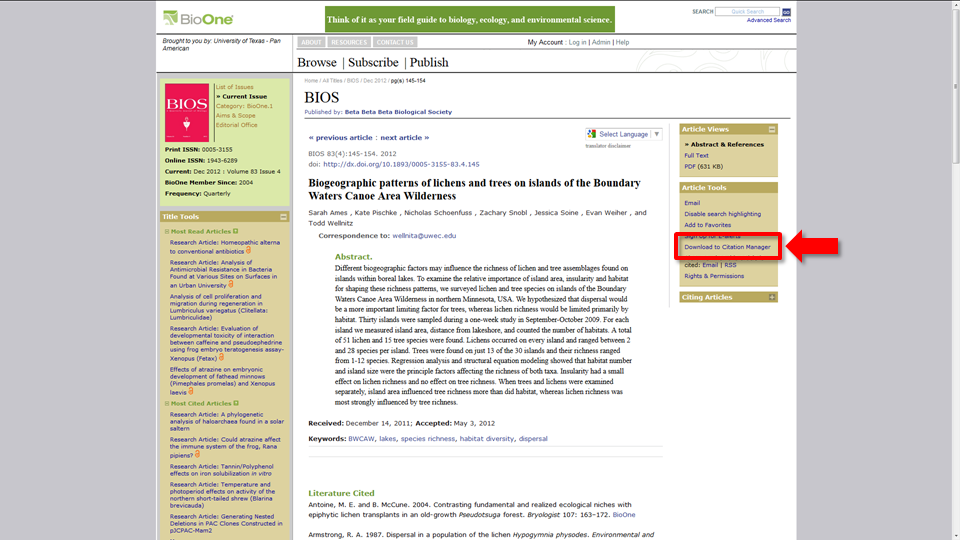
... and BioOne.


Even JoVE puts their export citation link, though the link is way down the page and may be offscreen in some views.


Very few journal websites put their link in the bottom middle of the page. Inter-Research is one.


Taylor & Francis is another.


Now things get a bit more tricky.

BMC journals drive me bonkers. Every other publisher calls the thing you are saving a “citation.” BMC alone calls them “references.” I can’t count the number of times I’ve started blankly at a BMC article, trying to figure out what to click (“I don’t want the references in this article, I want this article!”), until I remember this.


PLOS journals recently redesigned their websites, and in doing so, hid the citation button and asks for multiple clicks to get to it. First, you have to click “Download.”


Only then do you see an option for the citation. For the same screen real estate, PLOS could show three buttons, making it easier to find and saving us a click.


PNAS is one of the other websites that makes me crazy every time I want to save a citation. They have their link in the industry standard location, in the right margin. When I click...


... I get a drop down menu. A drop down menu with only one choice. Why are you making me click again?! You’re not giving me a choice, so just let me get the citation already! Life is a finite number of mouse clicks, and I don’t want to use any more of them than I have to!


Physics Today not only follows PLOS and PNAS in making you click multiple times, it is more cryptic, hiding the link under the mysteriously named “Tools.”


Clicking “Tools” then give you options, including citation export.


The “Hall of shame” award in this category, however, goes to JSTOR. JStor’s page doesn’t look so bad, with the link in the right side.


It gets the raspberry because you can only see the “Export citation” link if you have an institutional login. Seriously?! Is a citation so valuable that it must be password protected? For crying out loud, every other publisher gives you the ability to export the basic bibliographic information for free. For shame, JStor! Shame on you!

05 April 2012

Another reminder of what people think of professors

A student organization asked in a medical professional to come give a talk this week.

During this talk, this physician told the students that some their professors had “a chip on their shoulder” because couldn’t get into medical school, and took it out on students by refusing to give them As.

That ticked me off a little.

I have chips aplenty on my shoulder. But none are because I wanted to get into med school and couldn’t. I don’t know of any professor who was a failed med student.

05 March 2012

“Kids”

I get annoyed whenever I hear university instructors, either in person or online, referring to their students as “kids.”

It’s disparaging. It’s dismissive. It undervalues their abilities and undercuts their views.

University students are adults. They don’t deserve to be tagged as children any more.

(Exceptions will be made for any student who is a goat.)

27 February 2012

A day in the field

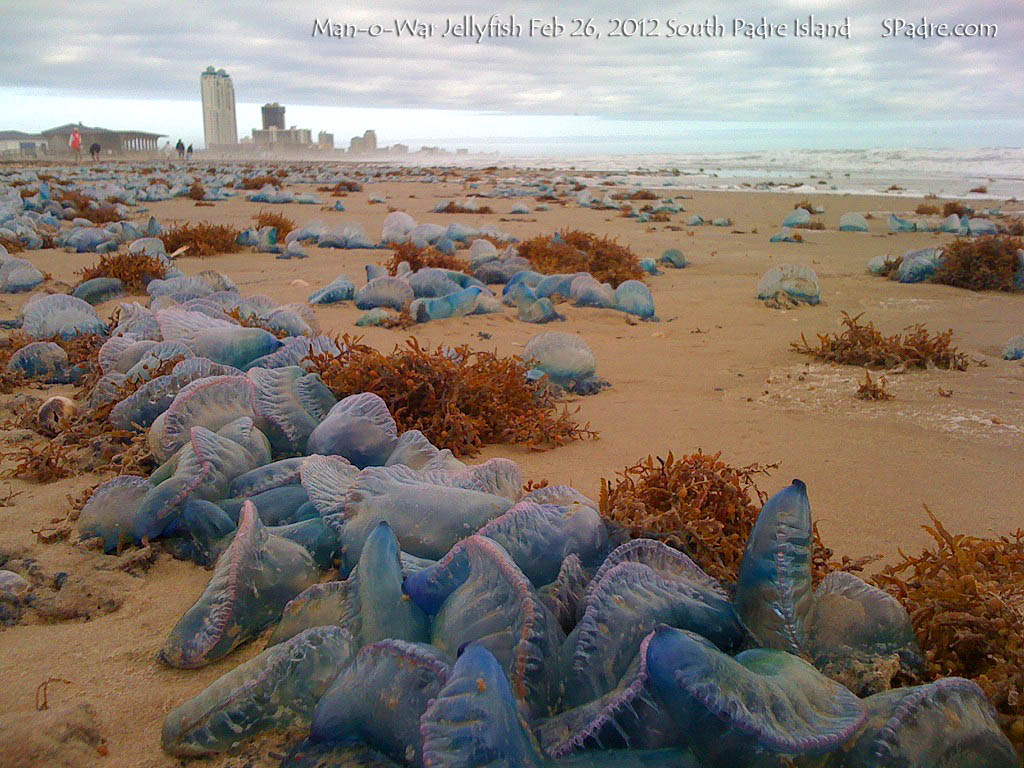
I have a project that is requiring monthly collection at the beach on South Padre Island. The weather hasn’t been great, or I’ve had other tasks to do, most of February. This meant I almost had to go out and collect this weekend.

I was surprised when I got there, because “blue” is not a colour I normally see a lot of on our beach.


And going closer, I realized...


That this was a veritable invasion of Portuguese men of war.


Despite my best efforts to avoid them, one caught in a retreating wave got its tentacles on my shins. And I can now say with certainty that this is not an experience I recommend. I would call it a stinging, burning sort of sensation. Rather like a localized sunburn.

Fortunately, the water was chilly, so the coolness of the water numbed the sensation. Somewhat.

I also learned that the covers of Rite in the Rain all weather notebooks are almost exactly the same colour as the sand on South Padre Island, which means if, say, a notebook were to fall down to the sand on the beach, it can be rather difficult to see.

Furthermore, while Rite in the Rain products – such as their No. 37 pen – are indeed waterproof, they aren’t sand proof. And I discovered sand can get into all sorts of places that can gum up the works of a pen.

The things one does for data.

Excuse me... datum. “Data” is plural, so we would need to have found more than one animal to have data.


Last pic from here.

24 February 2012

Models

“We did this experiment with a mouse model.”

What, like this?
Why not just say “mice” instead of “mouse model”?

If you want to say “mouse model,” make sure that you are clear what the mice are models of. Models are stand ins or representations for something else. In biomedical research, mice are models for human diseases. Saying, “We used a mouse model of human schizophrenia” or “mouse model of human obesity” is fine.

But for something like the genetics of fur colour on mate selection probably means the mouse are not a model for anything else, it’s just a straight up inquiry into mouse biology. Mice for mice’s sake.

23 December 2011

What to do with a Friday afternoon?

We used to have 50 minute classes - one hour with break between classes - on Mondays, Wednesdays, and Fridays. We had 75 minutes classes on Tuesdays and Thursdays. This was similar to other universities I'd been at, even if the stop and start times were a bit weird. (Why start hour long classes at quarter to?)

A couple of years ago, our class schedule changed. 

Tuesdays and Thursdays didn't change. We continued to have classes running three times on Mondays, Wednesdays, and Friday - but just in the mornings. Monday and Wednesday afternoons changed to have 75 classes.

Friday afternoon? It got turned into one 3 hour class slot, running 1:00-4:00 pm.

I didn't like this. I liked running classes three times a week, and there went my options to run such classes in the afternoon. I also thought it would contribute to the perception that professors weren't working a full work week.

This week, we got an email from administration complaining that there are no Friday afternoon classes.

Well, duh. A three hour class on a Friday afternoon? What the heck did you think would happen?

Administration is saying they need to offer classes in this time "to meet student demand." Colour me unconvinced that there's a big demand for Friday afternoon classes. Sure, I know that if classes get put there, there will be some students who will sign up. But I wonder if they will make, or how attendance will run over the course of the semester.

I could've warned them. But nobody asks me these things.

05 September 2011

Anything is possible?


Back in April, Nature had an extended podcast with David Eagleman. Eagleman has also been profiled here.

Eagleman described some of his ideas as “possibilianism,” which might be summarized as “Anything’s possible.” He said:

It’s not committing to either of these two sides (Theistic or atheism, apparently - ZF), which I think are way too limited for modern discussion.

It bugged me, and I had been meaning to write a critique of the idea since April. I blogged about other things instead, and Jerry Coyne beat me to it.

As a lover of science fiction, I love exploring possibilities. It’s a great form of intellectual play, and play can lead to serious work. But Eagleman seems think that generating possibilities is enough, and is unwilling to sort through them to determine which is the best that reflects reality. This struck me as throwing your hands in the air and refusing to make a decision. As scientists, the point of generating possibilities is to arrive at a conclusion, not just sit and ooh and aah at all the things that could be in the mind.


01 September 2011

Tin

I’ve been at my current position for ten years today.

Yet it only feels like 65 million years.


Photo by by Garrettc on Flickr; used under a Creative Commons license.

30 June 2011

But... for how long?

Correlation does not mean causation.

But after yesterday’s rant about our ice machine being broken for over a month and a half, look what I spotted in the bottom of our ice machine late this afternoon...


It’s white, cold, and wet when it melts... could it be?

And I managed to get The Manuscript That Will Not Die off my desk* and back into the hands of the editor!

* Figuratively speaking, of course. I’ve never printed the manuscript. It only exists as only computer bits, so never physically been on my desk.

29 June 2011

History repeating, not repairing

Warning: This post contains strong language. Four letter words. Curses! Swearing!

Set the wayback machine, Sherman. Back to the very early days of this blog.

Back in the early days of this blog, when I still had some of that new Assistant Professor smell, I wrote about our ice machine. Quite a bit, actually. The first post is here, dated late August 2003. It’s not a bad little rant, though I say it myself:

Over the last year, a distinct pattern has emerged. Ice machine breaks. Ice machine is taken away, leaving bare pipe sticking out of the wall where it should be sitting. My colleague Mike Persans (who is a self-admitted pushy New Yorker) keeps after the maintainence people, asking when it's going to be fixed.

Days turn into weeks. Weeks turn into months.

The ice machine finally returns. It works for about a week, and breaks again. Back to square one.

It's like some weird battle of nerves between the machine and maintenance versus the biologists. I think we biologists are going to be the first to break. Because as far as we've been able to determine, there seems to be absolutely no sense of urgency or comprehension on the part of almost anyone else that we scientists need this thing.

There are intermittent updates until about April 2004. Because that was about when we got this fancy new machine:


See? All stainless steel, looks like something you’d find in a real classy hotel restaurant or something.

But alas! Like Old Mother Hubbard...


We ain’t got no ice. Above the scoop is this sign:


It’s been like that for about six and a half weeks. That breaks the 40 day record back in October 2003.

And it’s the same goddamn shit all over again. Nobody outside of the department seems to have any interest in getting this simple piece of common equipment fixed during peak research season.

For. Fuck’s. Sake.

Administration tells us to use the one in the Chemistry Department. And yes, it’s good that theirs is working (even though it’s not as good as ours when it works). I mean, it’s wildly improbable that we would have two ice machines in two departments breaking at the same time... Wait, I have a blog post that records exactly that happening last time. Perhaps proof that probability is a lesser force in the universe than the Law of Maximum Inconvenience.

But dammit, what pisses me off is not that I have to go up one storey in the building. It’s the principle of the thing. This is exactly the sort of things that universities supposed to keep running with that cut they take out of research grants that faculty get. The principle is having things that work. About having requests met. It’s about competence of the people around you.

Which leave me wondering, to paraphrase Dr. Evil, why I am surrounded by friggin’ incompetence?

Cue the music, Miss Bassey: “And it’s all just a little bit of history repeating...”


15 September 2010

Make your saving throw versus CON

One of the problems of being in a bureaucracy is that administrations change more often than the main line of employees. In a higher education setting, administrators come and go while the faculty remains.

This means that you have to put up with seeing bad ideas over and over again.

And you know what? Willpower is finite. Thus, one’s ability to present the same points over and over again calmly may also be finite. Your mental endurance is tested over and over again.

And when you keep being forced to make those saving throws over and over again, you live knowing that at some point, you’re inevitably going to roll a 1.

Photo by Dr Stephen Dann  on Flickr, used under a Creative Commons license.

17 June 2010

The downsides of meritocracy

Academia is supposed to be a meritocracy: You rise through the ranks because your work (and, by extension, you) is better than someone else’s. I think this emphasis on merit might be doing people a disservice, in a couple of ways.

The entire process de-emphasizes happenstance and luck. People chase and chase and chase after those grants and high impact publications, figuring that if they just work that much harder, they must get them. Particularly in tight financial times like these, where there are more proposals and papers submitted than can be published, you’re essentially playing a lottery. There is just no way to be that much more outstanding than all the other bright people to ensure success.

And I think this can be very demoralizing for people. Academics are usually very bright people. For much of their lives, things have often been relatively easy for them academically. They do well in school, through their undergrad degree, grad school, and so on.

But then they start reaching the point where things aren’t working as well as one would hope. They get a job at an undergrad university instead of that major research university you’ve been working towards for a decade or more. They don’t get the grant. Again. You can’t get the publications in the journals you want. And when these things happen? There’s that little niggling voice in the back of your head saying, “Well, it’s a meritocracy, so you deserve what you get. Loser.”

From reading a lot of other academic blogs, and comments thereupon, I sense that a very particular path of success in research is presented to students that utterly buys into the meritocracy model and utterly discounts the lottery-like aspects of the career.

It could impede science more generally. People could be pursuing that last experiment, that last piece of data so that they can get it in a “better” journal, rather than publishing something that is perfectly interesting in its own right for others to see. People can get to be afraid of shipping.

For a supposed left-wing institution, academia often has some of the competitive elements associated with right-wing politics.

13 April 2010

Elevators versus stairwells

This Obesity Panacea post on staircase signs reminded me of a bugbear I’ve been meaning to write about for a long time. The Obesity Panacea post notes, “people don't use staircases that are hard to find,” but there’s another factor that I think impacts on staircase use.

Here’s a picture of an elevator on campus.


The elevator is well lit. There’s a television to look at while you’re waiting. Some have carpeting, maybe even some hardwood accents. In short, getting onto an elevator is an aesthetically pleasing experience.

Here’s a stairwell in the same building:


Dimly lit. Nothing but bare concrete. Unkempt. If I didn’t know I was in an academic building, I’d half expect to find a wino pissing in the corner.

Could it possibly look more like a place you are actively discouraged from using? You might as well put up a sign that says, “Enter at your own risk” or “The elevator that the fun people take is around the corner, loser.”

Why don’t architects make nice stairwells? Why not light them properly, put them in places that get sunlight, put some paint on the walls?

And we wonder why people don’t want to take the stairs, are less active, and are becoming increasingly obese.