Showing posts with label blogging. Show all posts

11 February 2025

#ArsenicLife in soft focus

I am glad to hear that Felisa Wolfe-Simon is doing well and still loves science.

But lots of other information in a new article in the New York Times about Wolfe-Simon is not as warming.

First, the timeline of events circa 2010 described in the article is very fuzzy at best. I’m not sure if it6s wrong or just cloudy.

By focusing on Wolfe-Simon, others involved in this story – notably Rosie Redfield – are reduced to namely “critics.” There are other elements of the story that are maybe over emphasized?

Critique soon became attack, and attack often became personal – focusing, for instance, on Dr. Wolfe-Simon’s appearance, including her dyed hair.

Several articles described her colourful hair positively. And Rosie Redfield dyed her hair, too. I cannot doubt some attacked her appearance, and that any of those comments can hurt bad.

 And soon, Dr. Wolfe-Simon said, she couldn’t get grants or publish papers.

A lot of researchers struggle to get grants or publish papers. There’s no way of knowing what proposals or manuscripts she was submitting or what the comments were.

Second, there is news that the journal Science is considering retracting the original paper. Current editor, Holden Thorp, expands on the possible retraction of the arsenic life paper in a thread on Bluesky. i asked what point a retraction would serve, to which Thorp replied, “Partly because of AI and even before with search engines that only look at the title, papers like this continue to get cited uncritically. ‘Retraction’ is added to the title in these cases.”

This strikes me as reasonable, but I still have some reservations. By the same argument, anyone who only looks at the title and sees “Retraction” will also view that uncritically and not read the retraction notice. This could mean someone would not cite this paper appropriately for its discovery of a new strain of arsenic-tolerant bacteria (which is not contests). 

Retraction is a blunt instrument.

Third, this article paints Wolfe-Simon as someone who was wronged, not as someone who was wrong.

Usually, professional consequences so severe are reserved for those who fabricate data or commit fraud, which no one has alleged with #arseniclife. Why, then, were the repercussions so resounding for Dr. Wolfe-Simon?

And from reading this article, it seems to me that Wolfe-Simon still thinks she found bacteria that use arsenic instead of phosphorus.

She also defended the discovery against scientific consensus. Some see that as an unwillingness to change a conclusion in the face of new information. Dr. Wolfe-Simon would say that information is wrong.

And...

To this day, Dr. Wolfe-Simon defends the work, noting that she wishes the team had saved less data for a second paper. The team published a response to critiques in Science, and Dr. Wolfe-Simon disputes failed replications of their findings. Other co-authors say they also stand by the integrity of the original work.

What I would like to know if whether the co-authors stand by the conclusions of their work. Do they think they discovered a bacterium that uses arsenic in place of phosphorus?

Wolfe-Simon throws Science magazine under the bus a bit:

She wouldn’t pursue a flashy journal that would impose a heavy hand in publication and press, she said.

We absolutely have to make space for making mistakes and being wrong in science. But researchers have to be willing to admit those mistakes.

External links

Her discovery wasn’t alien life, but science has never been the same. (Paywalled.)
 

30 May 2022

The big two oh blogiversary

Cake with "20" on the front
Happy blogiversary to me!

Twenty (!) years ago, I started blogging for the first time, right here on this blog. I can’t even remember the first title, though it certainly wasn’t NeuroDojo. 

Blogging became a habit. Besides this blog, I still maintain two other blogs that are updated regularly, Marmorkrebs and Better Posters.

And while many once active blogs have slowed down – including my own – I would never consider shutting down all my blogs. It has been far too rewarding. (I mean, I finally got to write a book because of blogging!)

For this blog, NeuroDojo, I have been proud of the times little things broke out of the blog and impacted other arenas. I am pleased that a horrible, sexist paper originally published on paper and retracted finally got a retraction notice slapped on its online version. I’m pleased that a journal worked on guidelines for presenting statistics because of something I wrote. The word “kiloauthors” took on a little life of its own.

And I want to say that for me, blogging still occupies a space that is still unmatched by social media. The longer format helps me clarify my own thinking on things. And once I have a post down, it’s so much easier to go back and find what I have written, when someone revisits a question on social media that I wrote about back in the day.

Thanks to Neil Gaiman for showing me the potential of the blog format.

Thanks to anyone who has stopped by to read anything here.

Photo by Kristine Hoepnner on Flickr.  Used under a Creative Commons license.

10 August 2020

New home page

DoctorZen.net viewed on phone

I’ve been thinking about making my personal website more mobile phone friendly for a while now. After all, more and more people browse the web on their phones. But I have been writing the HTML for my personal home page by hand, and the coding to get something that works for either a desktop or a mobile phone was beyond my skill.

Then I got an email reminder that I had once tinkered with Google Sites. Google is revamping the service, and sent me an email saying, “Hey, you better migrate your page over to the new service.”

I hadn’t touched it in years and had never really gotten anywhere with it. But it did get me to look at the new service and try it.

I’m pretty impressed. 

I had tinkered with automatic website builders before, especially Wix. I got some nice results with Wix, but the interface was so fiddly it drove me crazy. Google Sites was much more straightforward. 

But the big selling point was that the site finally looked good on a mobile phone!

There are many things that bug me about the Google Sites interface. You can’t even look at the underlying HTML, never mind fiddle with it. (You can still look at and edit your HTML in Blogger, which also recently got an overhaul.) You can used the “Embed” button to put in some custom HTML code, but the embedded section is “walled off” from the rest of the page. I’ve figured out how to add script to add Altmetric badges, but they don’t appear the way I want yet. 

It is, of course, very easy to add anything that Google owns and hard to add anything from anywhere else. Putting in a YouTube video has its own dedicated button and plays nice with the layout, but a Vimeo video is a very different, trickier job.

There are currently some deep limits on how much you can adjust the look of the site. You have a very limited set of typefaces, in particular. I am hoping that as this service matures that the options will expand.

I will keep updating my existing, made by hand with love website for the time being, but I decided for now to have my easy-to-remember URL, DoctorZen.net, point to the new site. It’s definitely a work in progress at the moment, and I will be getting

As far as I know, all you need for this service is a plain old Gmail / Google account.

05 February 2019

Second letter in Science!

I have yet another story of a publication that started because I was wasting time on the Internet. I say again: blogging is one of the best ways for an academic to work out ideas.

This new publication is my second brush with the realm of glamour magazines in my career. It’s a letter again and not a research article, but I’ll take it.

Blog readers and maybe some of my Twitter followers might recognize the arguments. They are the same ones I made in this blog post previously. Somewhere along the way, I found myself referencing it in tweets that I thought, “Maybe I can bring this to a wider audience.” More people read the glamour magazines than my blog. I chose to try for Science because it seemed to me that GRE discussions were most relevant to the US.

While the letter is short, it actually expanded from what I originally submitted. Letters editor Jennifer Sills pushed me to expand the last paragraph to include a few sentences about possible solutions. This was a good push, and the letter is better because of it.  I’ll quote Clay Shirky again (emphasis added):

(W)hat are the parent professions needed around writing? Publishing isn’t one of them. Editing, we need, desperately.

While blogging is one of the best ways I have found to develop and work through academic ideas, an editor who genuinely edits is invaluable in fine tuning and honing ideas.

References

Faulkes Z. 2019. #GRExit's unintended consequences. Science 363(6425): 356. https://doi.org/10.1126/science.aaw1012

Related posts

Letter in Science!
I come to bury the GRE, not to praise it
Publishing may be a button, but publishing isn’t all we need

10 June 2017

A blog quinceaƱera

I’ve been very excited by the way this graph has been coming along:

You don’t get many graphs like that in my business where the difference between the groups is so clear!

I get one, maybe two, points on that graph most weekdays, so that’s a few months of steady work there.

I’ve been so distracted by the awesome data above that I neglected to mention that this blog clocked past the 15 year mark. Fifteen years is one of those anniversary years that feels... almost not worth celebrating. But I was reminded because I was tweeting about what I do as part of the #NDTMeetScienceTwitter hashtag, and I mentioned the blog’s age.

It’s now been so long that sometimes even I forget how long this project has been running. I recently re-read a forthcoming piece I wrote about blogging, where I said I started this blog in 2003, not 2002. Whoops. That’s going to drive me crazy if I see that in print now.

While much of science online has moved to other media platforms (and to some degree, I have followed that trend), the longer I have done this, the more the value of this blog has risen for me. “Tweetstorms” and Twitter threads are okay, but I still like sentences and paragraphs for some things. Blog posts are easier for me to find. I refer back to old posts constantly for one reason or another. Lots of topics are practically evergreen in science and academia, so a blog post can have a very long tail.

25 May 2017

Incoming: ReSearch: A Career Guide for Scientists

I just signed an author’s agreement for ReSearch: A Career Guide for Scientists. It’s been a while since I’d thought about this project.

I didn’t write it, or even a chapter. Back in 2015, one of the co-authors, Nathan Vanderford, cold emailed me asking if I would be willing to write something about “personal branding.” I said, “Sure!” So I wrote a little sidebar as a case study.

The book is slated for release next month. I’m curious to see how my little contribution is woven into the text.

External links

Publisher’s website
Amazon page

10 November 2016

Favourite Quora answers

The search function on Quora sucks, and so I’m collecting some of my favourite answers here so I can find them again later.

Neurobiology


Crustaceans


Evolutionary biology


Academic writing


Academic publishing


Skepticism


Academic careers


Academia and higher education


Movies


Learning and memory


23 September 2016

Day of the Monkey


Sharp.

It’s a word that has both a negative and positive meaning when you say it of a person. And if I had to use one word to describe the pseudonymous blogger Drugmonkey, that’s the one.

Drugmonkey is sharp.

One friend said to me, “Drugmonkey is mean.” He is quick to unleash cutting remarks. He has called a lot of people he disagrees with “wackalooons,” and that’s when he’s feeling polite. He’s impatient and profane. I can probably make his blood boil by mentioning “pit bulls,” “professional editors with English degrees,” and “numbered references” in the same sentence. He’s got opinions, and sometimes it feels like he will never admit he was wrong or change his mind in the slightest. He can be infuriating. It’s not fun being on the receiving end when he thinks you’re wrong.

Drugmonkey is sharp.

He is smart. Nobody has written more about National Institutes of Health funding, or developing careers in biomedicine and – more importantly – nobody has written about it with more insight and intelligence. And he has consistently taken agencies to task on issues like racism and sexism, and asked why they are not doing better on long standing problems in ensuring more diversity. He wants to make sure senior scientists don’t pull the ladder up behind them. He cares about other people, not just himself, and wields his razor sharp and lightning fast writing skills to advocate for them, and for fair treatment.

That makes him one of the good ones.

He’s started a lot of conversations, and made a lot of people think. You can see evidence for it in the comments in his blog. (Justin Kiggins says he reads Drugmonkey’s blog for the comments.)

I have only been in a room with Drugmonkey once, at Madhatter’s in Washington DC, at one of Dr. Becca’s BANTER meet-ups during Society for Neuroscience. We didn’t have a chat to converse at length in person. But it doesn’t matter, because online conversations are real conversations. Thank you, Drugmonkey, for the many conversations we have had. I am not sure I have ever changed your mind, but you have changed mine. I have learned a lot from you, and I grateful for it.

And thanks to whoever came up with the idea of Drugmonkey day!

External links

Drugmonkey on Twitter
Drugmonkey blog
Another Drugonkey blog
#Drugmonkeyday
Unofficial Drugmonkey Day
An oldish dog learning new tricks #drugmonkeyday
Thank you Drugmonkey
appreciation #drugmonkeyday
Thanks Drugmonkey!
#drugmonkeyday
Did You Miss It? Big Research Investing and A Decade of DrugmonkeyBlog
Yesterday was #drugmonkeyday!

01 September 2016

In praise of lurkers

There’s practically a new emerging literary genre of academics writing pearl clutching thinkpieces decrying the sad effect of social media on academia and science.

Last week there was an opinion piece in PNAS. It was illustrated with this picture:


Then, there was this piece in Times Higher Education.

In return for feeding our desire for evidence of how we are doing in our social interactions – our narcissistic craving for others' approval – first Facebook and then a group of other social media corporations persuaded half of humankind to give up their most intimate personal details. 

Both of these pieces got soundly criticized, as they should, because they make some silly statements. For instance, the Egan piece says:

Students need to be helped to sever some of the ties that bind them to the people they already know and to discover new forms of connectedness in the shared writings of the wider world.

Jordan Gaines wrote:

This is...literally exactly why I started using social media more when I started as a grad student.

That’s my experience, too. Social media has given me a window into what other people are thinking in a way that I just haven’t had before.

A very common charge levied against social media is that is is mere “narcissism.” What these anti-social media types seem to forget is that there is another, largely invisible category of social media users: the lurkers. For every person who is active on social media (the “narcissists” posting material), there is an unknown number of people quietly reading, listening, learning.


If you condemn the posting of scientific or academia material on social media, you’re penalizing not just the producers of that material, but you’re saying that all the people who might learn from that don’t matter, and that their learning is somehow invalid and unworthy. Presumably because it’s not in a brick and mortar building.

This “cane shaking at social media” genre needs a catchy name. Like how people writing editorials about why they got out of academia became known as “Quit lit.”

External links

Science in the age of selfies 
Why academics should NOT make time for social media

Picture from here.

22 July 2016

Reasons to go back to blogging


Because my blog is a place I don’t have to put up with the proliferation of political memes.

16 February 2016

Science Blogging: The Essential Guide companion website up!


We’re exactly two weeks out from the launch of Science Blogging: The Essential Guide. When I got my review copy, one of the first things I did was to look for the online resource mentioned in the book, and was a bit nervous not to find it. But that is now remedied, and it is up for you to check out today at The Open Notebook!

Among the goodies is a Q&A with the editors here, with some good thoughts on the past and future of blogging.

Scicurious put together a Twitter list of all the authors and editors for your following pleasure.

Meanwhile, I noticed that Amazon will be offering a Kindle edition of the book for those of you who already have enough physical stuff lining your bookshelves. It’s also up for sale at other vendors, such as Barnes and Noble, although they don’t seem to have an ebook version available yet.

Update, 23 March 2016: Joanne Manaster interviewed the editors, Bethany, Christie, and Jason on her Read Science hangout series.


Update, 24 March 2016: Editor Jason Goldman is interviewed on Science Writing Radio, Episode 31!

Related posts

Incoming: The Complete Guide to Science Blogging
Incoming: Science Blogging
Science blogging book: now with blurbs!
Science Blogging: The Essential Guide book cover reveal
The unenveloping* of Science Blogging!
Science Blogging: The Essential Guide already making waves!

External links

The twain shall meet
Science Blogging on Yale University Press
Science Blogging page of Facebook
Science Blogging on Amazon

10 February 2016

Science Blogging: The Essential Guide already making waves!

We’re still more than two weeks away from the official release of Science Blogging: The Essential Guide, but the book has already racked up its first citation, in the New York Times Sunday Book Review.

It’s kind of a throwaway reference at the end of a longer book review (on atheism and religion, by James Jones, but it’s exciting. Early references to the book bode well for its reception.

Harker’s book, though of interest to anyone looking for a guide to such controversies, is aimed at college students in an introductory philosophy of science course. Should he ever decide to communicate these views more broadly — which is to say, to blog about them — he might consider picking up a copy of SCIENCE BLOGGING: The Essential Guide (Yale University, paper, $24), edited by Christie Wilcox, Bethany Brookshire and Jason G. Goldman, which offers practical advice on such matters as “blogging about controversial topics” and “persuading the unpersuadable.” For example: Always link to the relevant research, avoid “muppet flailing” (excessive fervor, I gather) and “don’t let the trolls get you down.” Words not just to blog but to live by.

“Words not just to blog but to live by.” That’s not a bad pull quote for a book blurb!

Additional, 8 March 2016: I guess I’ll use this post to compile reviews and features of the anthology. This article just in from Times Higher Education! It also has a very brief cameo at the end of this Canadian Science Press post, Science Blogging 101.

Additional, 17 March 2016: Andrew David Thaler, himself no slouch at blogging, reviews the book in Science magazine.

Related posts

Incoming: The Complete Guide to Science Blogging
Incoming: Science Blogging
Science blogging book: now with blurbs!
Science Blogging: The Essential Guide book cover reveal
The unenveloping* of Science Blogging!

External links

The twain shall meet (New York Times)
How to set up a blog about science (Time Higher Education)
Science Blogging 101
Blogging for beginners (Science, paywalled)

Sales links

Science Blogging on Yale University Press
Science Blogging page of Facebook
Science Blogging on Amazon

08 February 2016

The unenveloping* of Science Blogging!

It’s here!


It’s been a long time in writing and editorializing and proofing and printing (I first announced it in fall 2014), but the book is finally here! I can read Science Blogging: The Essential Guide! And you can’t yet, nyah nyah nyah!

Honestly, I’m excited not only as one of the chapter authors (first publication of 2016, I get to have some Canadian chocolate today!), but as a reader. I certainly didn’t know the complete list of chapter authors when I started writing. Looking at the other contributors to this volume is, frankly, terrifying. They are such great writers. I feel like:


I started working on my chapter on the plane to Science Online 2013. It’s almost exactly three years ago. I got 422 words written (less than many of my blog posts), which are still on my iPad. Here’s a snippet of the very start of the very first draft:

Ronin blogging
I have three science related blogs. I started what became NeuroDojo in 2002, followed by Marmorkrebs in 2007 and Better Posters in 2008,

There are advantages to belonging to a network, but they may not be as great as you think. Being on a network in and of itself does not guarantee readership.

While you are an independent blogger, you still need to develop a community.

And it goes on from there. Looking back at that first draft, it’s interesting to see how many of those first sketchy ideas survived into the final chapter.

I do have one disappointment in my chapter, though. Because this chapter references “ronin” as a metaphor extensively, I had wanted to pay tribute to Legend of the Five Rings and use this John Wick quote from one of the very first L5R promo cards, Dairya, to open the chapter:

“You call me a masterless man. You are wrong. I am my own master.”

Alas, that lead-in quote did not survive the edit, but I was able to get some L5R references in the main body of the text.

And the references to me being at The University of Texas-Pan American are also obviously out of date.

But I am so happy that this book is now out! I’m very happy with some of the turns of phrase in m contribution, and I cannot wait to work through everyone else’s chapters.

And, for the first time, something about this book has moved faster than expected! Previously, I announced it would be out 22 March, but Amazon is now showing it for sale on 1 March!

* Normally, the reveal of a fresh new something is called “unboxing,” but since this didn’t come in a box...

Bird picture from here.


External links

Science Blogging on Yale University Press
Science Blogging page of Facebook
Science Blogging on Amazon

Related posts

Incoming: The Complete Guide to Science Blogging
Incoming: Science Blogging
Science blogging book: now with blurbs!
Science Blogging: The Essential Guide book cover reveal

02 February 2016

Who is Jingmai O’Connor, and why is she saying nasty things about science blogggers?

We’re less than two months away from an entire book about science blogging dropping from a major university press (disclaimer: which I have a chapter in), and here we have a reminder that many believe blogs are not a legitimate form of academic writing:

What’s your view on social media and science? For example, the role of science blogs in critiquing published papers? Those who can, publish. Those who can’t, blog. I understand that blogs can be useful in affording the general public insights into current science, but it often seems those who criticize or spend large amounts of time blogging are also those who don’t generate much publications themselves. If there were any valid criticisms to be made, the correct venue for these comments would be in a similar, peer-reviewed and citable published form. The internet is unchecked and the public often forgets that. They forget or are unaware that a published paper passed rigorous review by experts, which carries more validity than the opinion of some disgruntled scientist or amateur on the internet. Thus, I find that criticism in social media is damaging to science, as it is to most aspects of our culture.

This quote is from an interview with Jingmai O’Connor, a paleontologist currently in China.

Let’s break down the problems here.

Those who can, publish. Those who can’t, blog.” There are many researchers who do both, productively.

I understand that blogs can be useful in affording the general public insights into current science...” It’s nice that we bloggers got tossed a bone (no pun intended). But science blogs do not just help the general public; there are many technical comments on papers that help provide needed context for other scientists, whose own research is tangential to published research: close enough to see the relevance, but without the deep expertise needed to pick out specific problems.

(I)t often seems those who criticize or spend large amounts of time blogging are also those who don’t generate much publications themselves.” O’Connor is hypothesizing that there is an inverse correlation between blogging and primary literature. This an interesting empirical question. It’s true that time spent blogging is time that cannot be spent writing primary peer-reviewed journal articles, so prima facie, there might be truth to this. But as far as I know, there is no actual peer-reviewed literature on this. Will update this post if I find any.

If there were any valid criticisms to be made, the correct venue for these comments would be in a similar, peer-reviewed and citable published form.” The venue a claim is published in does not determine the validity of the claims. She is correct that certain journals are averse to citing non-peer reviewed material, and that putting material in the literature helps to assure the long-term findability of the critique. But these matters are not central to the main issue: is the criticism valid? Then it does not matter where it was published.

The internet is unchecked and the public often forgets that. They forget or are unaware that a published paper passed rigorous review by experts, which carries more validity than the opinion of some disgruntled scientist or amateur on the internet.” Some things on the Internet are unchecked. Some things on the Internet are rigoruously checked. It should also be noted that some journals that call themselves peer reviewed provide checks that are, at best, cursory (see here and here, for instance). Even “top” journals have published papers that made pro scientists ask, “How did this get published?” Has Dr. O’Connor not heard of arsenic life or STAP cells?

I find that criticism in social media is damaging to science, as it is to most aspects of our culture.” I’ve written a whole article (Faulkes 2014) about why I find that criticism in social media generally valuable. To name just two: it is rapid, and provides a way to bypass powerful gatekeepers with vested interests.

I have no idea what damaging effects of social media on culture she is referring to. It’s off topic, in any case.

Not surprisingly, as soon as someone on social media found this, this quote began spreading like wildfire. But there is apparently a backstory that is not spreading as fast. Jon Tennant wrote:

In this situation, she’s actually right. There's a core of semi-pro bloggers who attack her work/never formally publish anything.

I went digging. And I was surprised, because my first impressions are that Dr. O’Connor is not a stereotypical stick in the mud, conservative older scientist that is sort of the stereotype for critiques of blogging and social media. Honestly, she seems... kind of... awesome.

I went through the first ten pages of Google results, and found tons of positive stuff about her, including tons of stuff on blogs. She’s had lots of high profile papers. She’s done some science outreach. She strikes me as smart, outspoken, and a little unconventional. Jingmai O’Connor seems like exactly the sort of person I’d use a counter-example to the “scientists are old white dudes” stereotype.

I did a Google search for her name plus “blog.” Went through multiple pages and still found nothing negative about her, or controversies around her work. Tried her name plus “controversy.” Still nothing.

Maybe the blogging criticism is behind the Great Firewall of China.

Even when intentionally looking for the backstory that might have motivated her comment, I can’t find it. Whoever the bloggers are who have criticized her, they didn’t appear to make a big dent in her online reputation to an outsider like me. Which makes me all the more puzzled why she would paint all bloggers with such a broad brush.

It’s unfortunate. I hope that the criticism of her ill-advised comments don’t cement her “The Internet is bad” opinions. If she had a blog, I would be reading it.

Additional: Lengthened the blog post with a line by line fisking of the quote.

References

Faulkes Z. 2014. The vacuum shouts back: post-publication peer-review on social media. Neuron 82(2): 258-260. http://dx.doi.org/10.1016/j.neuron.2014.03.032

O’Connor J. 2016. Jingmai O’Connor. Current Biology 26(1): R11–R12. http://dx.doi.org/10.1016/j.cub.2015.11.046

External links

Jingmai O’Connor home page
Interview with Dr. O’Connor
A teacher can never tell where his influence stops
Fashionista: Jurassic Jingmai
Jingmai Kathleen O'Connor: Badass archeologist (sic)
Society for Vertebrate Paleontology 2014

Blogging is wonderful for science. More scientists should blog and tweet.
Chill out about Jingmai O’Connor’s criticism of bloggers

18 November 2015

Presentation Tips for people in a hurry

Batman: [reads the second riddle] What people are always in a hurry?

Robin: Rushing people... Russians!

I’m very excited to announce that my itty-bitty ebook, Presentation Tips, is now available in Russian!


You can download the Russian language PDF here.

This translation is courtesy of Maksim, who took advantage of the book’s Creative Commons license. I’m so pleased someone found this resource useful enough to translate, and I thank Maksim to no end.

This arrives on the heels of yesterday’s post (about a citation of my paper published as blog post). Both the blogged paper and this ebook were released about the same time. Both were experiments in bypassing the traditional publishing route, just to see if you could make an impact. It took a few years, but it feels vindicating to see that these projects have made ripples, and didn’t vanish without a trace.

I never thought I would see my name in Cyrillic, never mind an entire work of mine in a language other than English.

External links

ПоГсказки ГоклаГчикам (Зен Фолкс, 2012)

Related posts

Presentation tips compiled
Presentation Tips for Kindle
Upload the universe: validating self-publishing
2012: waiting and DIY
Fanboying

17 November 2015

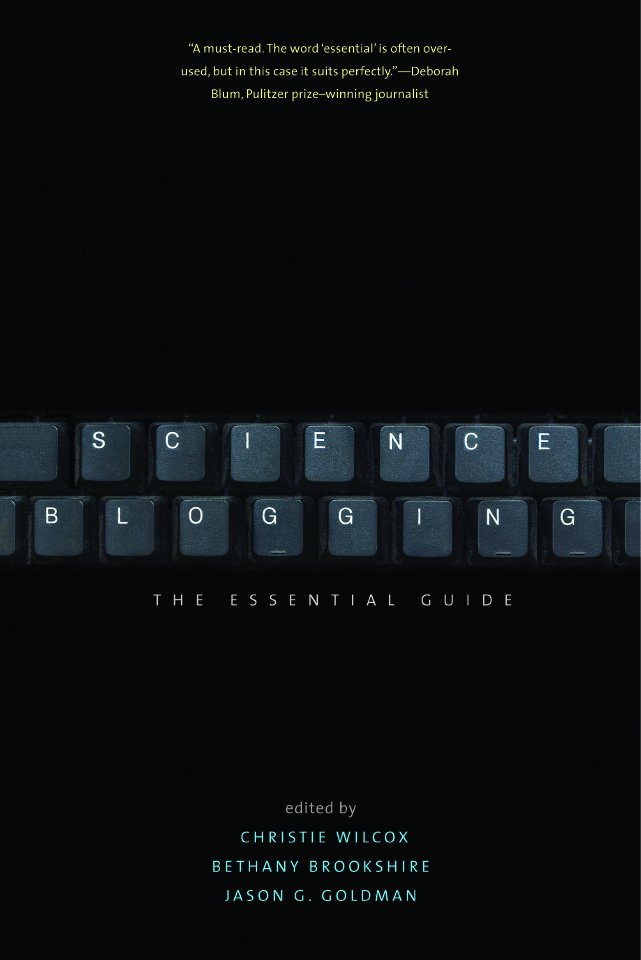
Science Blogging: The Essential Guide book cover reveal


I like it. Subdued and understated.

Related posts

Science blogging book: now with blurbs!

External links

Sci Blogging Guide Facebook Page
Yale University Press page
Amazon page

Paper published on this blog is cited because it’s a paper published on a blog

A few years ago, I published an original, data driven research paper here on this blog. As I wrote in a companion post:

I thought, “Let’s try something new.” ... I’ve also been paying attention to the people who say that scientific publishing is broken, and we should blow it up and start over. Lots of those people are basically advocating what I just did yesterday: “just blog the paper.” ...

Could blogging research work?

The acid test for whether blogging research could work is the same acid test for any academic product: do other people find it useful enough to re-use it? Usually, they show this by citing it. Admittedly, some journals are very narrow minded in what they allow you to cite, so that’s a big barrier for showing that others are using non-traditional online resources like pre-prints, blog posts, etc.

But I’m pleased to report that my crazy “self-published on a blog” paper has just got its first citation in an academic journal (Kooy, in press)!

As I expected, though, it’s being cited not because of the biology, but because it’s a paper on a blog.

Some scholars even post their research data and findings to their blogs.32

32 See for example, Zen Faulkes, “The Distal Leg Motor Neurons of Slipper Lobsters, Ibacus Spp. (Decapoda, Scyllaridae)," NeuroDojo, September 6, 2012, accessed January 3, 2015, http://neurodojo.blogspot.com/2012/09/Ibacus.html.

I expected this. The paper has been viewed 3,947 times, according to Blogger. The companion post explaining why I published the paper on this blog has been viewed 11,832 times. Publishing a paper is barely worth a mention, except to the authors and a few colleagues in the field. But publishing a paper on a blog is still remarkable. In fact, more than three years on, I can’t think of (m)any other examples where people have published entire original papers on their blogs.

Instead, biology is coming around to the concept of pre-prints. I think many people think of a pre-print server as a strange sort of journal: both serve to bundle traditional research articles in a single one-stop location. Plus, pre-print servers have been long running enough in areas like physics that depositing a paper on a pre-print server is a conservative move. Blogging a paper is still a radical act.

I am very happy that my publishing experiment has been cited by others. It’s a win for the discussion of alternate ways of publishing.

But I still crave complete victory: to see the paper cited by others because of the science, not just because it’s a paper on a blog.

Reference

Faulkes Z. 2012. The distal leg motor neurons of slipper lobsters, Ibacus spp. (Decapoda, Scyllaridae). NeuroDojo (blog): http://neurodojo.blogspot.com/2012/09/Ibacus.html [PDF version for printing]

Kooy BK. Building virtually free subject area expertise through social media: an exploratory study. College & Research Libraries: in press. http://crl.acrl.org/content/early/2015/08/11/crl15-759.abstract


Related posts

Why I published a paper on my blog instead of a journal
Why can’t I cite Mythbusters?

External links

Pre-print power

12 November 2015

Science blogging book: now with blurbs!

Science Blogging: The Essential Guide is now available for pre-order on Amazon!

The fun thing about the Amazon page, in comparison to the publisher’s page for the book, are a series of juicy blurbs. Here’s a couple:

“The word ‘essential’ is often overused but in this case, it suits perfectly.” — Deborah Blum, Director of Knight Science Journalism Program at MIT

“This is the guidebook science blogging deserves, and that every science blogger needs to read.” — Thomas Hayden, coeditor of The Science Writers’ Handbook: Everything You Need to Know to Pitch, Publish, and Prosper in the Digital Age

There you have it. You need a copy of this book! Make sure to order yours!

18 September 2015

Incoming: Science Blogging

After being listed as “in press” on my home page for some months now, Yale University Press has moved a step closer to publication of Science Blogging: The Essential Guide.

It now has a publication date (22 March 2016), an ISBN (9780300197556 – accept no substitutes), and a price (an affordable “buy one for yourself and one for a gift” price of $24.00).

Along the way, the book has gotten a slight title makeover from The Complete Guide to Science Blogging to Science Blogging: The Essential Guide. The change is probably a good one, as it puts the book’s subject matter right up front.

The cover is not up yet, but I’ll be sure to preview it when it’s available!

External links

Science Blogging on Yale University Press
Science Blogging page of Facebook

25 August 2015

Living the Matthew effect with kiloauthors

The word “kiloauthors” is getting some traction. Wow.

I make a cameo in this article in Times Higher Education (which is affiliated with the Times newspaper in London, not New York) about journal articles authored by large numbers of people.

It’s been interesting to see the Matthew effect at work. Getting attention in one high profile venue lead to another, and another, and another. While I knew intellectually that these journalistic outlets are copying from influencing each other, it’s something else to see it in action with your own stuff.

And it’s been a little weird to see how this post in May has rippled out past the usual confines of this blog’s limited readership, and how it compares to other stuff I’ve put out in the same time. Since March, I’ve had four data-driven papers (including one I thought might get some media attention), three book chapters, helped edit a book, and what gets the most attention? A quick blog post.

Related posts

When does authorship stop meaning anything useful?

External links

Is mass authorship destroying the credibility of papers?