Showing posts with label games. Show all posts

11 September 2017

Chasing pidgeys


In the game Pokémon Go, pidgeys are pokémon that you see everywhere. They’re super common, super small. They are not very powerful. You’d be hard pressed to win any gym battle with them.

When I started playing the game, I quickly stopped collecting them because, well, I had them already. And they seemed useless.

But I was wrong. And now I chase after them all the time.

There are a lot of different resources in Pokémon Go, but one is experience. You “level up” as a player with a certain number of experience points. One of the ways to get experience points is to evolve pokémon, and you get quite a lot of experience for doing so. It turns out that pidgeys are cheap to evolve. A few other pokémon are just as cheap, but they are much less common, and harder to catch.


Thus, what looks like something trivial and boring turns out to be one of the most reliable ways to advance in the game.

It occurred to me that this is a good metaphor for careers, including academic careers. Much of your success comes from chasing pidgeys: the boring, mundane tasks that you have to do a lot of, and that earn little recognition individually. Grading assignments, getting reviews back to editors, going to meetings, consistently working on papers.

(This post inspired by a student in General Biology who asked me what level I was at in Pokémon Go and whether I’d caught Raikuo yet.)

Picture from here.

24 April 2017

Time is the difference between superficiality and scholarship

Many science questions emerge from a place similar to what Penn Jillette describes in this quote about people’s attitudes to video games. (Emphasis added.)

You know, when I was 15, 16, 17-years-old, I spent five hours a day juggling, and I probably spent six hours a day seriously listening to music. And if I were 16 now, I would put that time into playing video games.

The thing that old people don’t understand is – you know if you’ve never heard Bob Dylan, and someone listened to him for 15 minutes, you’re not going to get it. You are just not going to understand. You have to put in hours and hours to start to understand the form, and the same thing is true for gaming. You’re not going to just look at a first-person shooter where you are killing zombies and understand the nuances. There is this tremendous amount of arrogance and hubris, where somebody can look at something for five minutes and dismiss it. Whether you talk about gaming or 20th century classical music, you can’t do it in five minutes. You can’t listen to The Rite of Spring once and understand what Stravinsky was all about. It seems like you should at least have the grace to say you don’t know, instead of saying that what other people are doing is wrong.

The cliché of the nerdy kid who doesn’t go outside and just plays games is completely untrue. And it’s also true for the nerdy kid who studies comic books and turns into this genius, and it is also true for the nerdy kid who listens to every nerdy thing that Led Zeppelin put out. That kind of obsession in a 16-year-old is not ugly. It’s beautiful. That kind of obsession is going to lead to a sophisticated 30-year-old who has a background in that artform.

I think about this quote a lot.

It seems to me that many people who ask questions about science are working from that background of “They listened to Dylan for 15 minutes.”. They’ve been exposed to a few basic ideas. They’ve maybe had one or two lectures in high school about evolution. They get reproduction is important. They get that natural selection leads to adaptation. They get “survival of the fittest.”


But they haven’t mastered the art. So they ask why human evolution has stopped (it hasn’t) or why some trait is so obviously bad (lots of reasons). They can’t get those nuances without having spent that time on task.

Same with people who think that half an hour Googling an answer constitutes “independent research” on climate change or vaccines or what have you. Sorry, that’s the equivalent of listening to The Rite of Spring once.

It’s similar to what I talked about recently: you need time to live with ideas to understand the subtleties.

Related posts

Some “light bulb moments” are controlled by dimmers, not switches

External links

Penn Jillette Is Tired Of The Video Game Bulls***

19 April 2017

My game is coming back. L5R is coming back!


Forgive me a fanboy moment as I react to the announcement of the new Legend of the Five Rings card game!

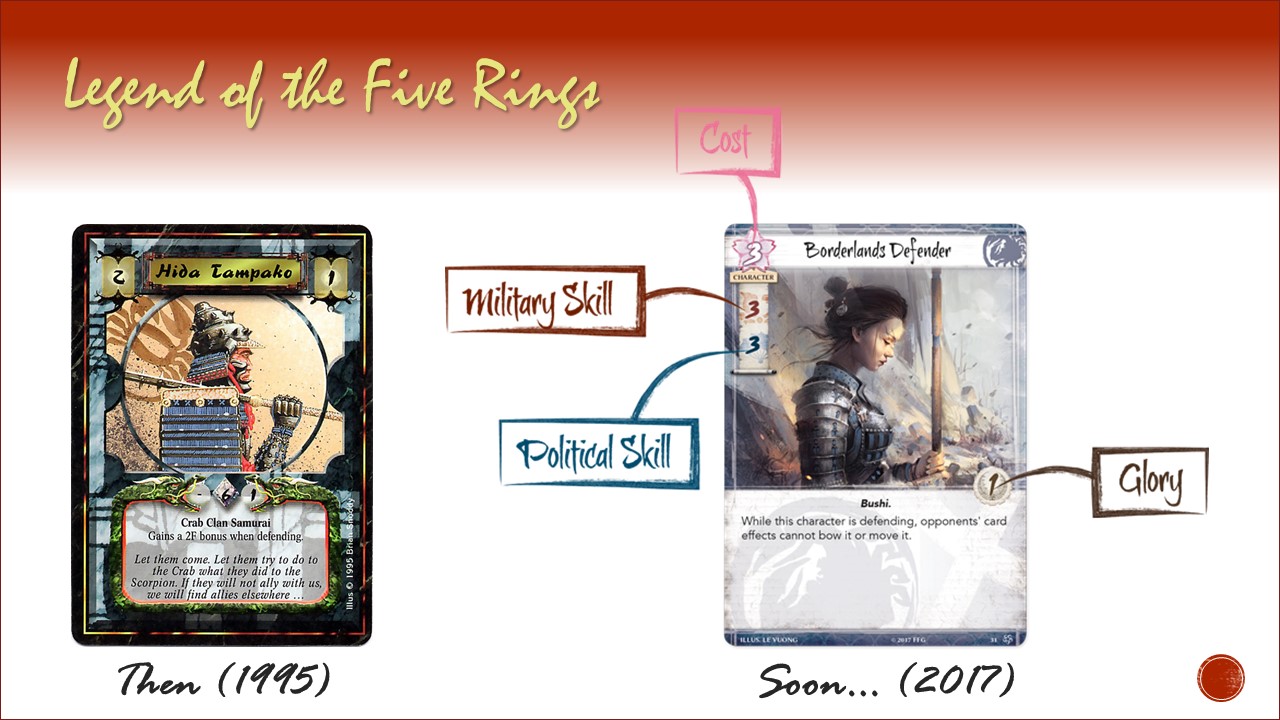
At first glance, it looked like the game I knew. Two decks, provinces, events, two main stats on the characters. Then, as I read deeper, I realized that the mechanics of the game were going to be almost entirely different. That will take getting used to.

But one of the things I always loved about L5R was the art. It was literally what made me pick up the game. And I have to say, I like the art direction. They’ve managed to keep the aesthetic, particularly for the characters and the clans.

I can’t wait to play my game again. I’ve missed Rokugan.

External links

A Peek Into The World of Legend of the Five Rings
Reddit AMA, 20 April 2017

11 July 2016

Pokémon in real life: biologists catch them all!


Pokémon are back in the news. The property that was a mega-popular trading card game in the late 1990s is back with a new smartphone game, Pokémon Go, that launched last week and is suddenly thing the thing on everyone’s lips.

You are going to read about a zillion hot takes and think pieces about this game, but remember: the Southern Fried Scientist, Andrew Thaler, got there first.

In our afternoon of wandering, it was clear there was no ‘typical’ Pokémon Go player. We saw parents with their kids, young adults, older couples, grandparents, and one gnarly Harley rider who excitedly called to his buddies in the Yorktown Pub “Hold up, I found a Pidgey!” The Colonial Triangle (Yorktown, Jamestown, and Williamsburg) in general is so snow-blindingly white that no one even thinks twice about calling it the Colonial Triangle. Yet, this afternoon was the most diverse gathering of people I’ve ever seen in Yorktown.

Asia Murphy has came up with the idea of creating a pokédex for real organisms. Thus, the #PokemonIRL hashtag was born.

I made mine up at the top, and you can, too! A template is here. You will need a graphics editor and a bit of experience, but you can make one pretty quickly. It’s a cool idea to spread the joy of finding critters, which are just as wild and exotic as any that the Pokémon Company creates.

Additional: The person who created Pokémon was a frustrated insect collector, Satoshi Tajiri (Thanks to Jon Mooallem).

Alex Lee points out that Pokémon is doing a much better job of inspiring kids than nature is. This is perhaps to be expected. To paraphrase Alfred Hitchcock, “A game is life with the dull bits cut out.”

External links

The power of Pokémon Go
#PokémonIRL (blog post) 
Pokémon in real life blank templates
Is ‘Pokémon Go’ Good for science?
If you must play Pokémon Go, ‘catch’ some real animals while you’re at it

13 September 2015

The move of L5R

On Friday, the game I think of as “my game”, Legend of the Five Rings, was sold by Alderac Entertainment Group to Fantasy Flight Games.

This made for a suprisingly emotional weekend.

Reading about the sale made me flush. I could feel my body temperature rise just from the surprise.

Then, as the weekend wore on, Facebook saw fit to put a lot of posts in my newsfeed that people had written about their memories of the game and what it meant to them. These were wonderful to read.

I thought about writing one of my own, but I couldn’t. There was too much, and the feelings were too deep.

I am just so glad the game is continuing. I can’t wait to play again. Maybe I should start planning a trip to GenCon 2017...

Related posts

Happy anniversary, L5R!

External links

A new emperor rises

01 September 2015

Academic free play unlocked


Lots of big adventure video games have a couple of different modes. There’s a story mode, where you have clearly defined objectives, whether they be called “goals,” “quests,” “missions,” or something else. Each one advances the narrative. You can have side missions or random encounters along the way. There may be a lot of different ways to accomplish a task. But essentially you are working towards some sort of conclusion.

(As an aside, if you have never worked through the story of a big adventure video game all the way through to the end... I recommend trying it at least once. The feel of accomplishment is very satisfying.)

But, to help games have replay value, lots of games also have a free play mode.


In free play, you get to play in the sandbox. You get the virtual environment, the random encounters, and you can roam around and do whatever you want. There are treasures to find, badges to collect, achievements to earn.

That’s usually the point I stop playing. Free play tends not to interest me very much. As the actors say: “What’s my motivation?”

Most of an academic career is like story mode.

  • Mission: Obtain Ph.D.
    • Objective: Find supervisor.
    • Objective: Pass qualifying exam.
    • Objective: Write dissertation.

Or...

  • Mission: Obtain tenure.
    • Current objective: Secure external funding.
    • Objective: Publish papers.

Today is my first day as a full professor. And I feel like I’ve just entered the free play mode of academia. Full professor is... the top of the heap. There isn’t any promotion for regular faculty after that point. (That is, unless you go into administration. But that’s a different story.)

This is not to say that I feel like I am about to stop. Far from it. Sometimes, there is a perception that faculty get lazy after getting tenure (hence this sea squirt joke), but I was pleased to realize that when I got tenure, I put my foot on the gas, not the brakes. I published a lot more as a tenured associate professor than an untenured assistant professor.

Being out of quests to pursue means that I’ve got to do some pretty significant psychological recalibration. It can be easy to wander around in the sandbox in free play, looking for something to do, but not accomplishing much.

Like the first day of my first promotion (to associate professor), I’m wearing a kilt today on my first day of being a full professor. Because a man in a kilt fears nothing, and that is still my reminder to be fearless. Since I am at the point where I need to set my own mission objectives, I want them to be good ones. Time to raise the difficulty setting off “easy.”

Additional, 2 September 2015: I wrote too soon. I didn’t get the memo below memo until after I posted this:


24 August 2015

A plea for pluralism in science

When I was heavily involved in L5R, there were recurring arguments between players about the “better” way to play the game. Probably the most common was between players who would use whatever cards they thought would win, and players who were also concerned with the story, who often imposed limitations on what cards they would play: using only cards from a certain faction, using no “evil” cards, and so on.

Wizards of the Coast did research on what people enjoyed about role-playing games to feed into their relaunch of Dungeons & Dragons, and came to a similar conclusion: there are a lot of reasons people play a game.

It took me a while, but in L5R, I came to the conclusion that there is no right way to play the game. What gives one player enjoyment may not give another player enjoyment.

And that’s okay. You shouldn’t denigrate people who play a game differently than you do.

Arguments in science sometimes remind me of those gamer discussions. Some accusasions of, “You’re doing it wrong!” are more reflective of the critic’s priorities than a wide view of the multiple ways there are to do science.

We need to be very careful about criticising particular forms of scholarship as “better” than one another.

External links

Breakdown of RPG players (Image source)
Whose problem is the reproducibility crisis anyway?
Ponderable

18 August 2015

Tuesday Crustie: Stay fresh!

I’ve been playing Splatoon recently (fun!), and was delighted to run across this character in the shops:


His name is Crusty Sean (get it?), and is the proprietor of Shrimp Kicks shoe store. I guess the though that since he was a decapod, he would have more feet and thus more need of shoes.


The game has a lot of other little nods to oceanic life, not least of which is that the leads are squid beings – hence their obsession with ink and use of camouflage.

External links

Splatoon
Live from Squid Research Lab

02 August 2015

Happy anniversary, L5R!


You may know me as Doctor Zen, but there was a time when I was known online as the Crab Clan Scholar.

This weekend was tinged with a little sadness for me, because it celebrates the twentieth anniversary of something pretty important in my life: the card game Legend of the Five Rings – or L5R, as fans know it. There was a big twentieth birthday party at GenCon over the weekend, and I was disappointed that I couldn’t go.

I was not there when the game debuted in demo form in summer of 1995, but I started playing in December of that year. And I got in deep. That there was an entire faction of the game called the Crab Clan helped a lot. I was a die hard Crab player, and took to tagging my sig as “Crab Clan Scholar” in my posts on Usenet. (Yeah, I’m old.)

I was intensely involved in L5R for well over a decade, first as a player, then eventually as a part of the Rules Team and freelance writer. I can’t even begin to summarize how much stuff I did with L5R. I can’t begin to tell you how important it has been to my life. This game is, as co-creator Ryan Dancy put it, welded to my DNA.

I haven’t played in a while, and I miss that badly.

But in the spirit of celebration, I wanted to draw attention to a couple of projects that chronicle the game’s early days.

I make a cameo appearance in the book 40 Years of GenCon. This book has a few pages about key events in L5R history when L5R was but a wee game of two and three years old (GenCon 1997 and 1998, to be precise).

The Legend of the Five Rings Gold Edition Encyclopedia is mostly a list of cards from that particular arc of the game. but I had the supreme pleasure of writing an introduction. The book opens with an 8 page section called, “L5R: Its founding and history,” which is one of my favourite things I’ve ever written. I got to interview a lot of people who were involved in the creation of the game, and tell the story of the creative process of making something as big and complex as a trading card game.

I had so much fun writing it, I turned in something that was substantially longer than what I had been asked to write. Now, I always try to be a professional, and write to requested length. I made sure that the extra stuff could be cleanly severed if they wanted to keep the length to what was originally planned, since I’d done it purely “on spec.” But I guess they liked it, because they kept it in.

For anyone who wants to see how L5R started twenty years ago, the intro to that book is the thing to read.

It is a wonderful thing to see something you love be a success. I couldn’t be happier than Legend of the Five Rings has been in pretty much continuous production for two decades.

Come hell or high water, I’ll make it to the twenty-fifth anniversary party, damn it.

Utz! BANZAI!!!

External links

Legend of the Five Rings Gold Edition Encyclopedia
40 Years of GenCon

Picture by AEG head honcho John Zinser on his Facebook page.

16 June 2015

Tuesday Crustie: Finish him!

My life may be complete. A crustacean fighting game. In case you didn’t get that: a crustacean fighting game!


It’s called Neo Aquarium: King of Crustaceans, and you can find it on Steam.


My happiness over finding something this... unexpected and weird is totally overwhelming my scientific side that is trying to shout, “Hey, that’s not how Ranina ranina move! You should know, you published a paper on that!” “Shut up, rational inner voice, I’m having fun here!”

There are so many energy beams I feel like I’m watching a Heisei-era Godzilla movie.


Hat tip to Miss Mola Mola.

19 November 2013

Feel my power!


Cartoon Action Hour is a role-playing game of vintage cartoons. And I really want the latest one...

The series focuses on an interdimensional madman known as Doctor Zen who brings his armies to our reality to transform our world into his world. The heroes of the series are special men and women who have been chosen by the “spirit” of each of their people and given a sacred weapon to fend off the threat with. In Britain, Merlin gives a young woman Excalibur. In Africa, Anansi gives a young man his “story web.” The spirit of Baba Yaga gives a young woman her mortar and pestle. And in the United States, the spirit of Coyote gives a young man his magical cloak that allows him to transform into any animal or person.

By the inimitable John Wick. Blurb from here; cover from here.

Related posts

The empire of Zen 
Master of Ancient and Forgotten Science: 2

External links

Spectrum Games

09 February 2012

When scientists’ and publishers’ motivations align

Continuing with the theme of the similarity between game publishing and academic publishing, I learned this morning that a game publisher had crowdfunded over $400,000 in less than 24 hours. As I look now, it’s passed half a million bucks. With 33 days to go.

As someone who worked his butt off for a month to hit a grand through crowdfunding, I am in awe.

This analysis is good. (Here’s another.) It takes apart the question if creatives need middlemen like publishers any more. But this bit made me stop and think about scientific publishing:

Are you trying to get famous or rich?
If the answer to either of these questions is yes, then it’s my opinion that you’ll still need a publisher. Why? Because your motivations are clearly aligned.

This is one reason why I don’t know if the calls to boycott Elsevier (say) can be sustained. There are a lot of scientists who are trying to get famous. (Probably not so many trying to get rich.)

For example, consider the discussions about the perceived need to publish in certain journals (here and here). I want to excerpt Björn Brembs’s description of his situation:

If you don't get any CNS papers in this field, you face only few job options, none of which mean that you’ll be able to spend much time on doing the research as you’re used to: 1) a teaching position at a small liberal arts college (and good luck with that with most of your time spent on research, but not getting a CNS) 2) salesman for the pharma industry 3) pipetteer for hire 4) flipping burgers. Which simply means that if you can't fathom doing anything else but science, you better get published in CNS.

Just take my example, which, from my experience and some statistics, is quite representative: In the last 6/7 years I have applied to about 120 tenure-track positions world-wide (i.e., North America, Japan, Australia, Europe), most applications went out before 2008, everything from small liberal arts to research one - basically I applied to anything that had ‘neuro’ somewhere in the description. Until then I had 1 Science paper, and 2-3 papers in the 7-10 IF range, approx. an average of about 1.2-1.4 papers per year, productivity wise. In total, I received less than 10 interview invitations and with very few exceptions, the other invited candidates had also all published in CNS (Cell, Nature, or Science - ZF). Informally, I was told that some positions I wasn’t invited for interview, this happened because I had to few hi-rank papers. With 60-600 applicants per tenure-track position, virtually everybody simply makes a cut at 1 CNS paper or so and then looks at the remaining candidates for a fit.

For many scientists, their goals remain aligned with the goals of academic publishers. Clearly some of that desire for “fame” is not actually a desire to be in the public eye, but scientific fame enough to yield job security. How do we break this? Attitudes of hiring committees would have to change, dramatically and explicitly. Even then, there might be enough scientists who want fame or wealth to keep the for profit academic publishers in the game for a while yet.

08 February 2012

From open gaming to open science

I am an academic, not a business person. With the ongoing move to boycott Elsevier, which has gained attention from academic news sources, I asked someone who was in business for his take.

I’ve know Ryan Dancey for about 15 years, from his creation of the game Legend of the Five Rings. He created a business called Five Rings Publishing Group that was sold to Wizards of the Coast. As part of that sale, he was involved in the move of the Dungeons & Dragons role-playing game from TSR to Wizards of the Coast.

Just before that sale, TSR had been viewed by players for years a big, greedy corporate publisher. Gamers often referred to it online T$R, which indicated an unhealthy disconnect between the company and their buyers, which reminded me of the disconnect between Elsevier (and other publishers) and scientists and librarians.

Once at Wizards of the Coast, Ryan oversaw the rollout of Dungeons and Dragons Third Edition. For those of you not involved in tabletop role-playing, D&D3 was notable because it was open. The d20 system that D&D had used for years was being given away, for other publishers to use, for free.

The rationale for opening the system was that the biggest strength of D&D was not the rules, or the world, but the number of people who knew how to play the game. Any gamer could go anywhere, and probably find other people who knew how to play D&D. It was less likely that they’d be able to find someone playing some less popular role-playing game, of the hundreds that proliferated over the years. By opening up the rules, players could be drawn in by other kinds of role-playing experiences besides the familiar “dungeon crawl” of D&D, and this would ultimately make D&D stronger in the market.

So Ryan has a few experiences with open versus closed publishing systems.

Ryan also knows a bit more about science than your average guy on the street. The open gaming license came from his understanding of open licenses in computing. Plus, he once told me that he was reading Steve Gould’s mammoth The Structure of Evolutionary Theory (I reviewed it here) for fun. This is not most people’s idea of fun.

I asked Ryan if he thought a publishing company like Elsevier could climb out of the hole it dug itself into.

Sure they can. Remember when Apple was viewed as being ridiculously high-priced without enough value-add to warrant the price premium?

I think the industry has a couple of inter-related problems. First, over many decades an entrenched culture of profit-taking has evolved in the science publishing field. Today you have large companies employing lots of people with stakeholders and shareholders who expect growth and profitability. The need of this industry to thrive has become a tautology - it exists because it exists.

At the same time you have real science being done more rapidly and interactively via things like on-line article repositories and various group chat venues. For the people who think science should be done transparently with full disclosure and communication of data and results, this only makes sense. The original need for the published materials was one:many communication, which was only really feasible using print. Now we have many:many communication facilitated by the internet, the old system has become not only redundant but it is charging a monopoly rent as well.

I think what will happen will be that the scientific community will move (slowly) away from a model where citations from peer-reviewed publications are the indicator of success to one where citations from highly-regarded internet publications replace them. To get there the community needs a reputation economy and a web of trust (although frankly the existing web of trust for peer review seems tissue-thin to and outside observer such as myself).

At the end of the day I wouldn't bet on the survival of any of the existing publishers in their current formats or with their current product line. The publisher that best provides for a transition to a social network-driven science model will likely win the race. Unfortunately, everyone involved is going to suffer the chaos and disruption that always comes with this sort of transition in process.

Were I CEO of Elsevier today I'd be working feverishly to get my business model off of getting paid to publish, and into getting paid for providing the service of managing the social network of the science internet.

Posted with Ryan’s permission.

16 January 2012

Dead again: Failing in games and classes

Video games aren’t fair.

When classes aren’t on, such as over Christmas, things calm down enough that I can play a few games. And I was reminded that when playing video games, you can’t win. Well, you can win, but you’re going to die a lot along the way. You’re going to restart the game many, many times.

Hm. I should be able to drop down behind that suck there, without alerting him and… Whoops, they’re shooting at me! Where do I go!? And… I’m dead. And the Joker’s laughing at me as they take away my body. Ugh, this is humiliating.

When you play many video games, it is impossible to succeed in a lot of tasks on the first go. You walk into a room, press a button to open the door,and suddenly you have monsters released from hidden candles in every section of the room completely surrounding you, and you're dead before you have a chance to react.

Or, as they used to say in the school ground, “Bang! You’re dead.”

Only after you have been in that room, made the mistake – usually multiple times – are you able to figure out a strategy for how to deal with monsters suddenly appearing out of every orifice, and leave the room alive.

And then there are fighting games where the entire point of the game is to get beat up. But as you’re getting beat up, you’re learning the patterns and the tells of your opponent so that you can anticipate which punch is going to be thrown next.

It is impossible to play most games all the way through without dying. Repeatedly. But it’s okay. Because you know you can easily retry what you just failed, and you get better as a result.

I know from my own experience that there are a lot of concepts and ideas that I really didn’t get in class. It was only through continually working with them that I really started to get a hold of them. Now, I think that a lot of learning consists of getting used to an idea. In other words, I kept retrying and kept replaying and kept redoing until I got it.

In teaching classes, it seems that we often expect the students to do the equivalent of playing through a very long, complicated game without dying. And the students expect situations where they will be able to do that: get through on the first try with no mistakes.

This may be particularly true of university students in the sciences. They might expect to be able to take a class and get through without ever falling off the moving platform into the toxic waters below (to use a game metaphor). They usually gotten to where they are because academics have been pretty easy for them. They may never have really had to struggle with classes. Some will encounter that, “This is really hard, and I’m failing! I’ve never failed before!” for the first time in their lives in university.

How often do we give students a chance to learn like they learn in a video game? Where they can keep trying until they get it?

I suspect that there are ways to build this into the structure of classes. Indeed, I think that there should be situations where we tell our students up front, “You will not succeed at this the first time. But the first time is not going to be the only time.” Below, Ryan Dancey talks about setting players up to fail in tabletop gaming. Just replace “GM” with “teacher” or “instructor”:

The delicate balancing act I am required to perform as GM is to make them pay the cost for their mistakes without letting random bad luck doom them (or allow them to know that random bad luck was altered by GM fiat). ...

When I was a younger player I often took the attitude that the players should be free to be as foolish as they wanted. Now however I feel it’s my responsibility to play the metagame back at the players directly. I flat out told them that they could not win this fight. That, combined with the obvious damage I was doing to the party, was enough to trigger the “correct” response – getting the hell out of there.

That payoff? Maybe it will be a little something like this:

The reward is in the story: the players are going to self-generate a fantastic epic tale that will be so much more meaningful because they have to work for it as opposed to just having victory handed to them.

By having students fail, maybe a few times, before succeeding might make them feel like heroes when they do succeed.

External link

How to tell if you suck at last year’s games.

“Run away!” When gamers can’t beat the monster.

08 October 2010

Keeping it pointless

Can a class ever be a game?

I’ve often tried to take lessons from gaming and apply them to teaching (or at least, thinking about teaching). This thought-provoking presentation, which I discovered via Julie Dirksen’s Usable Learning blog, suggests that this might be impossible.


You’ll have to see this one full screen to read the comments at the bottom, but it is worth it.

In addition to the points raised in the presentation, social norms may be just too entrenched for students to ever accept an instructor’s invitation to play, rather than play along.

As a bonus, check out this interview with game designer Kellee Santiago, to see why she thinks the GRE is a good example of applying gaming strategy.

06 July 2010

“You’re not Riptide the Barbarian... You’re Bob.”

The question of anonymity has been a bit of a recurring issue for me lately. So it’ll be interesting to see what happens when the makers of MMORPGs ditch anonymity.

Myers is right: Someone could do some great research with this.

Additional: Reaction begins.

11 May 2010

Master of Ancient and Forgotten Science: 2

I’ve mentioned before that my buddy John Wick made me a supervillain. The latest game to feature the villainous me is now available at DriveThruRPG. You get a role-playing game for the low price of $5. Come on, you know that fiver would just have bought you a lunch you’d regret later.

13 January 2010

Boredom: bug or feature?

Playing some video games I got for Christmas reminded me how much of a game can be boring. I’m not talking about bad games, but games I enjoy and put in many hours to complete.

I’ve played many games where you spend large chunks of time doing nothing but trudging from one location to another. Not fighting enemies, not solving puzzles, not making strategic decisions, just... walking.

And heaven help you if you miss a room in the dungeon. Back you go, tromp, tromp, tromp... Couldn’t you give me a shortcut back to places, guys?

It got me wondering if the “down-time” of boredom is actually deliberately put into the games to make the high energy moments seem more exciting.

This thought wandered out and connected with a section in Randy Olson’s Don’t Be Such a Scientist, where he argues that it’s not reasonable to expect getting an education without a certain amount of pain – including the boredom of studying.

As an instructor, I am often pursuing engagement relentlessly. I am keenly aware of the need to compete for students’ limited attention. But I wonder if students might be a more tolerant to a little bit of boredom than they’re given credit for. Can a little boredom enhance engagement? Is there some optimal level?

11 December 2009

The missing ingredient in educational games

This article asks, “Can gaming change education?” I’ve been writing a bit this lately, but I was frankly disappointed with a lot in the article. For one thing, how did “gaming” become “video gaming” only?

I was more surprised by the list of MIT’s principles for creating a game. They have 15 principles, and not one of them mentions the most important word about a game:

“Fun.”

In fact, “fun” appears just once in the entire 2,500 word article. With an attitude like that, is it any wonder that so many educational games have struggled to work?

Additional: MIT isn’t so dour as I first indicated; see the comments.

09 December 2009

How can we turn teaching problems into teaching puzzles?

For some time, I’ve been trying to think about what lessons games have for teaching. At the always invigorating Ted Talks, Scott Kim makes me wonder if I should also be thinking about puzzles. Kim defines a puzzle as a problem that is fun to solve and has a right answer. Games, he argues, have no “right answer.”


In teaching, we are often trying to get students to come to a “right answer.” (Indeed, students come to expect that there is always a right answer, somewhere in the back of the book somewhere. One of the hardest things to convey to students is how often the answer to a question is, “I don’t know, and I don’t think anybody does know.”) To help students remember the “right answer,” we give students problems.

Problems are easy to make; puzzles are hard to make. The problem keeps coming back to, “How do you make it fun?” Some people play games to entertain themselves, but others play to challenge themselves.