Showing posts with label behaviour. Show all posts

13 May 2022

This one is for Doctor Rubidium

This video of American woodcocks cropped up on Twitter, and Raychelle Burks asked for a mash-up with “Drop It Like It’s Hot. ” Who am I to argue?


Update, 15 May 2022: And here’s the second part of the request. Going back to 1969 with The Meters...


13 September 2021

Naming the animals in research papers

This is Bruce. 

Bruce, a kea with no upper beak, holding an object with his tongue and lower beak.

Bruce has been making the news rounds because of a new paper demonstrating that he uses pebbles to groom. Bruce is a kea, a parrot that normally has a large upper beak, which Bruce does not have. In the picture above, you can see him using his tongue and remaining lower beak to pick up an object.

What I want to talk about is not the tool use (although that is cool), but that I know this bird was given a name. Because I found this paper within days of finding another paper about an unusual bird: an Australian musk duck named Ripper. 

Ripper’s claim to fame was that he was able to imitate sounds, like creaking metal and even human voices. Ripper seems to have picked up the phrase, “You bloody fool” from humans around him. 

This is interesting because vocal learning is found in only a few lineages and hasn’t been documented in ducks before.

But what interested me in both papers is that the scientific papers repeated refer to these bird by the names that humans gave them. Not just once in the methods as an aside, but all the way through.

I can see the value of using a given name in news articles and blog posts like the one I’m writing. And maybe it makes scanning the paper a little easier. But the kea paper refers to “Bruce” 62 times; the duck paper refers to “Ripper” 40 times. The extensive referencing to these names in the journal articles gives me pause.

It’s been clear for a long time that the efforts to keep animals at arm’s length to avoid humanizing them (a position taken furthest, perhaps, by B.F. Skinner and other behaviourists in American psychology) is a lost cause. The approach of people like Jane Goodall (who named her chimps rather than just giving them numbers) has won. 

But these two approaches sit on opposite ends of a continuum. And quite often, there’s a pendulum swing in attitudes. I wonder if the pendulum has maybe swung a little too far towards our willingness to humanize animals in the scientific literature.

It’s easy to slip into teleology (assuming everything has a purpose) and anthropomorphism (thinking animals are like humans). And constantly referring to animals’ names throughout a paper seems to make that even easier. 

I’m not saying that the names we give animals should never be mentioned in papers. But maybe it could be once or twice instead of dozens of times. 

And hey, these animals didn’t get to pick their names. Maybe that duck was thinking, “I say ‘Bloody fool’, and they name me ‘Ripper’ on top of that? Could I be any more of a cliché Australian?)

A Twitter poll suggests I am not alone in being wary of this practice.

References

Bastos APM, Horváth K, Webb JL, Wood PM, Taylor AH. 2021. Self-care tooling innovation in a disabled kea (Nestor notabilis). Scientific Reports 11(1): 18035. https://doi.org/10.1038/s41598-021-97086-w

ten Cate C, Fullagar PJ. 2021. Vocal imitations and production learning by Australian musk ducks (Biziura lobata). Philosophical Transactions of the Royal Society B: Biological Sciences 376(1836): 20200243. https://doi.org/10.1098/rstb.2020.0243

29 July 2020

Animal Behavior Society virtual meeting, Day 1

A mix of old and new. The Animal Behavior Society (ABS) was the first scientific society I joined and the first scientific conference I attended. So I feel it’s appropriate that ABS is the first online conference I will be attending. And I’ve decided to do daily blog posts rather than tweet things, because I think it will be easier to create a coherent post from my desktop than it would be in a conference hall.

The first thing I want to talk about is also a mix of old and new. The virtual conference home page is new, because this is the first time they have done it, but the graphics?

Animal Behaviour Society virtual meeting landing page, with big "lobby" cartoon taking up most space

A very literal cartoon of a convention center. Not terribly high resolution. It kind of takes me back to 1990s Microsoft efforts like Microsoft Bob:

Microsoft Bob screenshot

It was a time when computers were becoming more common in homes, graphics were getting more sophisticated, and nobody was quite sure how people were going to interact with computers, so they interpreted everything as literally as possible.. Your calendar is shown as a calendar on a wall. Your desktop is a space on a cartoon desk.

I kind of thought we had moved past that. Most user interfaces are either more abstract and less literal (your decktop in Windows no longer has to be shown on top of a desk), or the interface is more graphically sophisticated (think of a 3-D video game environment; maybe Legend of Zelda).

Now, I suppose that for a first online conference, maybe that step back to a more literal convention center cartoon interface will help people. I don’t think it will be the sort of format you see for future conferences, though. We’ll see.

What else does the interface do? Well, there is a bookmarking function for talks you want to see. That’s good. But when you go get a list of your bookmarks, it doesn’t show when the events are. You have to click each entry individually, which defeats the purpose of bookmarking.

The times are all given in Eastern. There is a dropdown menu to change the time zone, but it doesn’t apply to all times. It will change a session time, but not the listed “Office hours,” which is confusing.

The format is that there are pre-recorded talks, live Q&A sessions, and “office hours.” You have to be really on the ball to watch the talks you’re interested in before the Q&A session starts! Hopefully, this is mainly a problem for the start of the meeting, and people can “get ahead” of the presentations before Q&A as the week goes on.

The live Q&A sessions are a little tricky, because all speakers for a session are there at once, each gets a tiny sliver of time, and questions are being taken using the chat function. So when a new speaker is on to take questions, there’s “dead air” when people start typing questions.

However, there is an asyncronous “ask a question” feature – a little like a bulletin board – which works very well. You can leave a question for the presenter, who gets an email with a notification, and then you get notified with a reply. So far, I have had 100% responses to my questions this way.

One nice thing I noticed was that recorded talks allow joint presentations. Just have people record their section, and edit together. Awesome. Nice way of showing teamwork and allowing multiple people to shine.

The system automatically logs you out after inactivity, and its not a very long delay before you’re kicked out.

But enough about the interface! What cool science did I see?

I saw some awesome talks updating me on a science story I have been following for some time: the evolution of Hawai’ian cricket populations that have lost the ability to sing. Some of those populations are evolving a new song, which is such a cool story of evolution in action.

Also saw some interesting talks related mostly to crustacean fighting.

To be honest, I didn’t see as many talks yesterday as I hoped, because yesterday turned out to be a much, much more interesting day that I expected, and I had stuff pulling me away from the computer.

That’s the biggest problem I’m finding: going to a meeting physically forces you to think about just that. An online meeting puts you in competition with the laundry, taking out the garbage, picking up mail, washing dishes, and all the innumerable little things that pull you away from the computer for a few minutes here and there.

External links

22 September 2018

Giving octopuses ecstasy

California two-spot octopus (Octopus bimaculoides)Nobody told me it was “Drug an invertebrate week.” But not only has a story of lobsters getting pot rather than going into pots made the round, now we have octopuses getting another recreational human drug. The story, according to headlines, is that giving ecstasy (MDMA) to octopuses makes them act more socially. And everyone’s comparing octopuses to ecstasy fueled partygoers at a rave.

It’s a nice narrative, but there isn’t enough evidence to conclude that.

There is some genetic analyses of MDMA receptors in this paper, but all of the interest in the press is about the behaviour experiments. The authors gave the octopuses the drug. The octopuses’ behaviour changed. The popular press is interpreting that behaviour in a cutesy way, using terms like “hug” and “cuddle” in headlines. (Even publications like Nature who should know better.)

That’s a problem. Octopuses hunt prey by enveloping them with their web and tentacles — effectively “hugging” them, if you will. Being eaten is rather different than cuddling. The authors provide no videos in the paper, just two still images (below), so you can’t see the behaviour in detail.

Photograph of Octopus social interaction under the saline condition on left and MDMA condition on right.

The sample size for the behavioural experiments is 4 or 5, as far as I can see. That’s tiny.

It’s worth noting that the behavioural changes were not always the same.

In addition, pilot studies in 3 animals indicated that higher submersion doses of MDMA (ranging from 10-400 mg/Kg) induced severe behavioral changes (e.g., hyper or depressed ventilation, traveling color waves across the skin or blanching, as well as catatonia or hyper-arousal/vigilance) and these animals were excluded from further analysis.

Dose-dependent responses are not at all unusual, but again, it makes the simple story of “MDMA means social” more complicated.

I do appreciate that this paper has an Easter egg for people who read the methods:

Novel objects consisted of multiple configurations of 4 objects: 1) plastic orchid pot with red weight, 2) plastic bottle with green weight, 3) Galactic Heroes ‘Stormtrooper’ figurine, and 4) Galactic Heroes ‘Chewbacca’ figurine.

But which Stormtrooper, people?


Which Stormtrooper?!

The paper is interesting, but it’s not getting attention from popular press because it’s particularly informative about the evolution of social behaviour. It’s getting attention because of the novelty of giving drugs to animals, and the “Oh look, animals are like us!” narrative.

Additional, 24 September 2018: Another interpretive problem. Normally, in an interview on CBC’s Quirk and Quarks, Gul Dolen notes octopuses overcome their asocial behaviours for mating. Dolen cites this as reason to think that there could be a way to “switch” the octopuses’ behaviour using a drug. So mating behaviour is the natural “social” mode for these animals.

But the octopus under the basket was always male, because the researchers found octopuses avoided males more than females.

Three of the four octopuses tested were male. (I had to dig into the supplemental information for that.) So most of the observations were male-male behaviour. I don’t know that homosexual behaviour has ever been documented in octopuses. A quick Google Scholar search found nothing.

A Washington Post story revealed that the authors’ wouldn’t even talk about some of the behaviours they had seen:

The authors observed even stranger behavior that they did not report in the study, Edsinger said. He was reluctant, even after extensive questioning, to further describe what the octopuses did, because the scientists could not be sure if the MDMA had induced these actions.

This is problematic. This suggests the behaviours in the paper are deeply underdocumented at best. And it seems to be done on purpose, because it doesn’t fit the authors’ narrative. This, combined with the description of behaviours at different doses, it further suggests that rather than “prosocial” behaviour that the authors and headlines are pushing, the exposure to MDMA is making octopuses behave erratically, not socially.

Reference

Edsinger E, Dölen G. A conserved role for serotonergic neurotransmission in mediating social behavior in Octopus. Current Biology 28(3): P3136-3142.e4. https://doi.org/10.1016/j.cub.2018.07.061

External links

Octopuses on ecstasy: The party drug leads to eight-armed hugs
This is what happens to a shy octopus on ecstasy
Octopuses on ecstasy just want a cuddle
Serotonin: octopus love potion?


Picture from here.

29 January 2016

Rabid Alaskan foxes


Karsten Hueffer was on our campus yesterday, giving an interesting talk on the biology of rabies in Alaska. And yes, whenever someone from Alaska comes to Teas, there were a few pointed jokes about the relative size of the two states.

Rabies is one of those diseases that almost everybody knows about, but not very many people actually experience it, either directly or indirectly. (Well, in North America, anyway: about 50,000 people worldwide die of rabies annually.) The pathology of rabies is still not understood: the brains of people who die from rabies are not dramatically different from those of people who don’t have rabies. almost 100% mortality for people who are infected.


Rabies in Alaska is a big problem, and is primarily spread by foxes. Most cases of rabies occur along the Alaskan coast, where arctic foxes predominate. Red fox dominate central Alaska. Hueffer hypothesized that Arctic foxes are main rabies reservoir, and red foxes are just spillover hosts. He tested this by examining the three different strains of rabies, and looking at the population structure of the arctic foxes. It turned out there were three populations of Arctic foxes, and they all lined up very well with the three rabies strains.

Hueffer went on to do some species distribution models of rabies, to answer why is there no significant rabies problems in central Alaska? The models predicted rabies distribution well, but was also good at predicting the occasional outbreaks that occur sporadically in central Alaska. The species distribution models also predicted that the rabies will retract in the future, due to climate change.

Hueffer then switched gears to look at how rabies affects its host mammals. Normally, lethal infections doesn’t spread well, because the hosts are killed before the infection spreads. Rabies is able to beat this problem, in part, by manipulating their hosts into biting other animals. One protein in the rabies virus binds to nicotonic acetylcholine receptors, which are surprisingly similar to snake bungarotoxins.

In collaboration with molecular biologists, Hueffer and colleagues were able to create a toxin that was derived from the rabies protein (basically, a portion of the whole protein, if I understood right). From an experimental point of view, this is convenient because you can study the effects of rabies on nervous systems with none of the normal immune responses, and so on, that are triggered by infections.

They were able to show in a disk that this toxin interacted with acetycholine receptors. They then moved to testing their toxin in Caenorhabditis elegans (a.k.a. “a worm model”), and the rabies-derived peptide blocked normal feeding in their worms.

When this rabies-derived peptide was put in mice, the effect on behaviour was dramatic. The infected mouse kept running around its cage, up to ten times more than control mice. This strongly suggests that the virus is manipulating its host by directly interacting with neuronal receptors. While many viruses bind to cell receptors, usually they are doing do to trick the cell into bringing the some part of the virus into the cell. Rabies does not get into the neurons at all.

The entire rabies virus consists of just five genes. Rabies appear to be a particularly nice, simple model for behavioral manipulation by infectious agents.

External links

Karsten Hueffer’s faculty page
Karsten Hueffer on Google Scholar

Fox photo by Ralf Κλενγελ on Flickr; used under a Creative Commons license.

22 September 2015

Tuesday Crustie: Speedster

This animal has a superpower:


Speed.

Undinula vulgaris has one of the fastest reaction times in the the animal kingdom: 1.5-3 milliseconds. Most animals can barely get a message from one neuron to another in that amount time, never mind detect a stimulus, process it, send a signal to muscles, and make them contract.

How do they do it? Part of the answer is that they have myelinated neurons, which is unusual for an invertebrate (Lenz et al. 2000, Wetherby et al. 2000).

Reference

Lenz PH, Hartline DK. 1999. Reaction times and force production during escape behavior of a calanoid copepod, Undinula vulgaris. Marine Biology 133(2): 249-258. http://dx.doi.org/10.1007/s002270050464

Lenz PH, Hartline DK, Davis AD. 2000. The need for speed. I. Fast reactions and myelinated axons in copepods. Journal of Comparative Physiology A 186: 337-345. http://dx.doi.org/10.1007/s003590050434

Weatherby TM, Davis AD, Hartline DK, Lenz PH. 2000. The need for speed. II. Myelin in calanoid copepods. Journal of Comparative Physiology A 186: 347-357. http://dx.doi.org/10.1007/s003590050435

External links

What animal has the fastest reaction time?

Photo from here.

14 November 2014

“If you’re in your house, why are there elevators there?”


I’m fascinated by how we make and hold beliefs, often in the light on contrary evidence. You see how easy it is for us to have false belief in many patients with brain injury. Many have false beliefs and explain away contradictory evidence effortlessly, which is called confabulation.

This is one of my favourite examples of confabulation, heard by neuroscientist Michael Gazzaniga (from Gazzaniga 2000):

In one patient I had, the patient was a woman who, although she was being examined in my office at New York Hospital, claimed we were in her home in Freeport, Maine. The standard interpretation of this syndrome is that she made a duplicate copy of a place (or person) and insisted that there are two.

This woman was intelligent; before the interview she was biding her time reading the New York Times. I started with the ‘So, where are you?’ question. ‘I am in Freeport, Maine. I know you don’t believe it. Dr Posner told me this morning when he came to see me that I was in Memorial Sloan-Kettering Hospital and that when the residents come on rounds to say that to them. Well, that is fine, but I know I am in my house on Main Street in Freeport, Maine!’ I asked, ‘Well, if you are in Freeport and in your house, how come there are elevators outside the door here?’ The grand lady peered at me and calmly responded,

‘Doctor, do you know how much it cost me to have those put in?

Gazzaniga goes on to explain the reason for this woman’s false belief, due in part to a lesion in her brain:

Because of her lesion the part of the brain that represents locality is overactive and sending out an erroneous message about her location. The interpreter is only as good as the information it receives, and in this instance it is getting a wacky piece of information.

It’s easy to think of this as just an amusing story of someone with brain injury. I think we all have the same mechanisms in our brain that are making sense of the world as best they can. We can all have beliefs that make perfect sense to us, but seem bizarre to outside observers.

Reference

Gazzaniga MS. 2000. Cerebral specialization and interhemispheric communication: Does the corpus callosum enable the human condition? Brain 123(7): 1293-1326. http://dx.doi.org/10.1093/brain/123.7.1293

Photo by Boston Public Library on Flickr; used under a Creative Commons license.

11 July 2013

The frog came back, the very next day

Given how often we can’t find our car in a parking lot, it’s no wonder that the wayfinding abilities of animals impress and amaze us. We’ve all heard the stories of pets that find their way back to their homes, how salmon find their way back to the particular they were hatched in years after roaming around in the open oceans, and how pigeons can find their roost, even when taken to places that they have never been before.

A new paper adds another animal to the list of pathfinders, and it’s this little guy here:


This is a poison dart frog (Allobates femoralis). We normally don’t think of amphibians as animals that travel great distance, but this species has complicated territorial behaviour. The frogs defend a territory that is is about 14 meters across, which is pretty large compared to their body size. This led Pašukonisand and colleagues to test whether this frog could find its way around in its natural habitat.

The experimenters “translocated” a bunch of male frogs from their territories to new locations. To these frogs, this is probably what the scientists seemed like:


Translocation is basically the scientific equivalent of stuffing you in a car trunk, driving around for a few hours, then letting you out in the middle of the nowhere and telling you that you’re walking home.

The frogs were moved anywhere from 50 to 800 meters. The frogs performed very well for distances up to 200 meters: 87% of them made the long walk back to their original territory. At 400 meters, only about a third of the frogs got home, and none made it back from 800 meters.

The authors looked at a few other variables, like the directions the frogs were moved, the presence of streams or rivers between the catch and release sites, but distance was the only factor that predicted whether the frogs found their way home. The authors also think that the failure of the frogs to get back from the long distances is not likely to be due to things like exhaustion or predation. The frigs can go quite long distances, and because they are poison dart frogs, predation seems low.

How do these frogs do this? There are many ways that animals can navigate, from simply learning the local area very well (fails if you move to a new place) to true navigation (where you can find your way back from anywhere). Trying to sort out the mechanism the frogs are using to get back to their favourite spot is surely one of the next logical experiments to do, although the authors seem to favour the “know the locale really well” hypothesis.

Maybe the frogs have ruby flippers. “There’s no place like (croak) home.”

Reference

Pašukonis A, Ringler M., Brandl HB, Mangione R, Ringler E, Hödl W, Tregenza T. 2013. The homing frog: high homing performance in a territorial dendrobatid frog (Dendrobatidae). Ethology: in press. DOI:

Photo by Sean McCann (ibycter.com) on Flickr; used under a Creative Commons license.

20 May 2013

Baby geniuses: young guppies show number skills

I have vague memories of the first time I counted to a hundred. It felt like one of those landmarks like tying your shoes for yourself the first time, or riding the bicycle more than a few feet without the training wheels or dad holding you up.

Of course, I don't come anywhere near Adam Spencer:

Once when I was about 7, I counted to 10,000 just to check the numbers didn't run out before then #NerdConfessions

Counting large numbers is not something that comes easily for us humans. A new paper claims this little guy, a baby guppy, may be a superior number cruncher as soon as it pops out of mama’s belly:


A couple of years ago, I reported on a paper that looked at the development of “counting” ability in guppies. In that paper, they claimed that it took about 40 days for guppies to develop the sort of ability to distinguish numbers that they had as adults. Now, the same team is back, testing very young guppies again, but this time using new methods.

The team asked these tiny guppies if they recognized numbers of things by showing animals dots while they have them food. Here are the three stimuli the team used.


Both A and B differ in the number of spots, but A also differs in the average sizes of those spots (which the authors call a “continuous variable). C differs in size, but not in the number. This is try to control for the fact that when you change number of things, you also change many other factors, like amount of area reflecting light, etc.

The authors then measured the amount of time the guppies spent near each set of dots as an indication of “preference”, on the assumption that the guppies are more likely to spend time near the dots where they got food if they learned certain dots meant food. If animals don’t learn where the food is, they may well not be able to tell the stimuli apart.

The authors place these pairs of dots at the end of the tank while fish are feeding when they were four and five days old. As a control, they either feed the fish food or just in a little water without food. On day six, they placed the babies in the tank to see which set of dots they gravitate to. On day seven, they repeat this, but flip the positions of the dots.

The fish were significantly more likely to be around the set of dots that promised food when they differed by number (A and B, above), but not when the dots varied in size. That said, the guppies were not great at this. The guppies got it right only 60% of the time, which is only a slight improvement on a coin toss.

However, the authors themselves admit that this paper is hard to compare with their previous one because the stimuli are so different. The previous paper used other live fish as the stimulus, not just static dots. They also note that this test is slightly different from other training tests, which generally ask the animal to do something even more specific than “hang out at one end of an aquarium.”

It is an interesting suggestion, though, that animals so small and so young can cope with differences in number. But I still think I’ll beat them at counting to a hundred.

Reference

Piffer L, Miletto Petrazzini ME, Agrillo C. 2013. Large number discrimination in newborn fish. PLOS ONE 8(4): e62466 DOI:

Related posts

One fish, two fish... can fish count?

Picture by Shaojung on Flickr; used under a Creative Commons license.

08 May 2013

“Can you hear me now?” The new record holder for hearing

This is our new winner, ladies and gentlemen.


This unassuming moth is a greater wax moth (Galleria mellonella). Don’t let its drab appearance fool you, friends. This is a record-setting animal, with one of the most extreme sensory systems yet found. Its speciality? Hearing.

When you listen to anything, there are two main properties inherent in the sound: loudness and tone. The volume is determined by the size of sound waves; the tone is set by the frequency of sound waves. Humans hear tones where the sound waves vibrate back and forth at several thousand times a second. Something that moves back and forth once a second has a frequency of one Hertz (Hz); a thousand times a second is one kiloHertz (kHz).

People differ in how well they hear sounds at the high end. In particular, you lose the high frequency sounds as you get older. You can test how high you can hear at this website. Note that it stops at 22 kHz, because very few people can hear that high.

Animals, of course, have different limitations than humans. Cartoons often reference a dog whistle, with a pitch that humans can’t hear, but dogs can.


(Note: “Dog whistle” is not to be confused with “wolf whistle.” Know the difference!)


Moir and colleagues did two experiments to show the wax moth’s superior high-end hearing. First, they used a technique to show whether the ear drum (tympanum) was vibrating. If you can’t vibrate something at at the same frequency as the sound, you can’t detect the tone of the sound. They found the ear drum was able to keep up with every frequency they tested.

The critical experiment, though, is the neurophysiology. It doesn’t matter what the ear drum does if the neurons don’t convert anything into a signal. The wax moth has an ear with a grand total of four neurons devoted to picking up sound. Thus, analyzing the signals is fairly straighforward.

They found the moth’s ear could pick up sounds all the way up to 300 kHz. That’s twice as high as the previous record holder:


Sorry, Lymantria dispar. You had a good run.

The wax moth doesn’t hear equally well across the range. It is particularly good at picking up sounds in the 60 kHz range. For the wax moths to hear the end frequency sounds, they have to be much louder. At 60 kHz, the wax moths can pick up sounds of a volume about 50 decibels of sound pressure level (dB SPL); at 300 kHz, the sound has to be more like 90 dB SPL. That’s a loud sound. And at the very high end (280-300 kHz), some of the moths don’t respond at all to even loud sounds, suggesting this is near the upper limit of their hearing.

Why does the wax moth need such amazing hearing? The general explanation for why insects can hear at these high frequencies is because of these:


Bats hunt insects using high frequency sounds, and many insects have evolved ears that can hear the sounds bats make. This does not seem to be coincidence. The bats are thought to be exerting extreme selection pressure on insects, so hearing predators approaching is an adaptive advantage.

In this case, there is just one little puzzle. No bat makes a sound that hits 300 kHz. Why does the greater wax moth ear reach way up that high in the frequency spectrum? The authors suggest that this highly responsive ear allows the moth to react faster to sounds. After all, if your ear can vibrate at 300,000 times a second, and it takes 300 vibrations for the ear to pick up the sound, you could pick up the sound in a thousandth of a second, compared to about a hundredth of a second for an ear vibrating at 20 kHz, like our crappy human ears.

Reference

Moir HM, Jackson JC, Windmill JFC. 2013. Extremely high frequency sensitivity in a 'simple' ear. Biology Letters 9(4): 20130241-20130241. DOI:

Related posts

Good night, Dr. Griffin, where ever you are...
Crickets fly away from bats, but do they run away, too?
Do bright bugs banish bothersome bats?
Let your neurons relax, the predators are gone!

Photo by dhobern on Flickr; used under a Creative Commons license.

19 December 2012

That looks like it smells: a tale of sensory mash-up

We normally think that each of our senses is more or less distinct. Sure, there’s that condition called synesthesia, where people experience numbers with colours and that sort of thing, but that’s pretty rare, right?

Maybe not. A new paper suggests our different senses may be influencing each other more often than we think. The team looked at how smell, something we normally think of as one of our weaker, less important senses, hold sway over our vision, the sense that most people normally think of as our strongest, most important, senses.

Zhou and colleagues used a phenomenon called binocular rivalry to test this. Binocular rivalry is not when two binocular stores are competing on price.

Normally, the two halves of our brain get complementary information coming from each eye, which the brain stitches together into one almost seamless visual experience. Using a little bit of visual trickery, it’s possible to get all of the left brain being fed one image, and all of the right brain being fed a completely different, incompatible image. Face with two competing sets of information, people see only one image image at a time, alternating with the other, alternating with the other every few seconds, in an unpredictable way

You can get a sense of it from this picture. If you let your eyes cross so that the images are superimposed (a little like a 3-D stereogram).


In the overlapping image in the center, you will tend to see either green circles or red bars, not the half and half images. The two images will alternate back and forth in an unpredictable way.

In their main experiment, Zhou and colleagues showed people rival pictures of a rose and a banana at the same time. While doing this, they gave their volunteers the smell of a rose, and people became more likely to see the image of the rose.

When they gave them the smell of the banana, they were more likely to see the banana.

They also got this effect with a mix of images and words. In a second experiment (which must have been less fun for the volunteers), the rival images were a male torso and a set or words. When presented with the smell of, um, body odor. When presented with good ol’ B.O. (eeewww), the subjects were more likely to see the person instead of the words... but only if the smell of sweat was given in the right nostril.

Why does the nostril matter? Like the rest of our body, each nostril is wired to one half of the brain, so the input from each nostril has a different effect on one side of the brain than the other.

The “nostril” effect can be broken fairly easily, though. If you show a picture of a banana, with a rival image being the word “rose”, the scent of the rose still makes you more likely to see the word “rose,” but it no longer matters which nostril through which you smell the rose-like scent.

The one thing I can’t quite understand is why this paper is in The Journal of Neuroscience. There is no neuroscience in this paper. No brightly lit brain blobs, no EEGs, no neurons, nothing. This is a straight sensory perception paper.

Reference

Zhou W, Zhang X, Chen J, Wang L, Chen D. 2012. Nostril-specific olfactory modulation of visual perception in binocular rivalry. Journal of Neuroscience 32(48): 17225-17229. DOI:

Binocular rivalry image from here. Nose by Caro's Lines on Flickr; rose and banana by cproppe on Flickr; both used under a Creative Commons license.

03 December 2012

Prime times for survival

How long can an insect live? Cicadas might be up near the top. Some cicadas are famous for remaining in the larval stage for thirteen and seventeen years/ That makes them a pretty long lived insect, even if they spend most of that time as larvae underground, out of sight.

A lot of cicadas are synced up in these thirteen and seventeen year cycles, so that in peak years, huge numbers of these insects emerge. Then they are everywhere, singing to attract mates so they can get the next brood of baby cicadas on their long road to maturity.

Now, these two times – thirteen and seventeen years – are notable because they are both prime numbers. As I understood it, the leading explanation is that lots of things in nature tend to cycle. But most of those cycles are fairly short. One possible advantage of something that cycles with a prime number is that it’s unlikely that any other short cyclic events will consistently coincide with the emergence of the new adult cicadas.

Imagine cicadas emerged on a twelve year cycle. Any predator that was on a roughly two, three, four, or six year cycle could sync up with the food feat of cicada emergence – provided there was a little give in their cycles so they could line up in the first place. But that sort of synchronization between predators and prey is much harder to do with a prime number. Thus, cicadas never face large numbers of predators just waiting for them to come out from their long larval stage.

A new paper suggests that the cicadas might even reap a bigger advantage than that.

Koenig and Liebhold do a new analysis estimating how many birds are during each year when cicadas emerge in large numbers, and how many birds when the cicadas don’t. They have population estimates for fifteen predatory bird species over 45 years. Their data set is as old as I am.

Surprisingly, there are routinely fewer birds on the years when cicadas emerge. The authors propose that this indicates that the long cycle has somehow allowed the cicadas to emerge during years that are safer than usual.

The authors do briefly mention alternative hypotheses. Cicadas are famously loud insects. Maybe the cicadas are so abundant and noisy that they actually drive birds away from their normal habitats. They authors say this is unlikely, because the bird counts go down even in places where the cicadas are not calling.

Koenig and Liebhold suggest that it's more or less coincidence that the cicada broods last for a prime number of years. They suggest that the emergence of these huge numbers of insects has some sort of knock-on effects, such that when they occur, the bird populations are effects, and go through booms and busts of their own - and the birds' low point comes around again in about thirteen or seventeen years.

The details of how this might happen aren't clear.

I suppose that the good news about being a cicada researcher is you have time to plan new studies. The bad new is that it probably doesn't take thirteen years to plan those projects... or seventeen years

Reference

Koenig WD, Liebhold AM. 2012. Avian predation pressure as a potential driver of periodical cicada cycle length. The American Naturalist: in press. DOI:

Photo by fmerenda on Flickr; used a Creative Commons license.

23 October 2012

Bees don’t know much about art, but they know what they like

Artistic “style” is often immediately recognizable, but – given the track record of successful forgeries of paintings – almost indefinable.
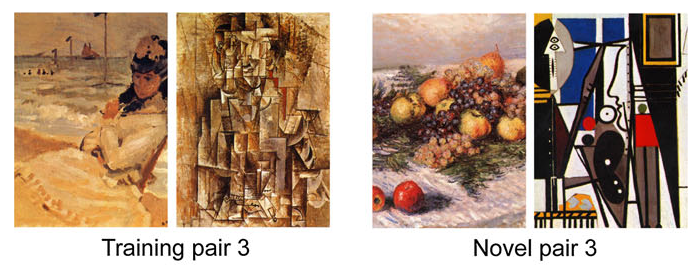
Could we turn to honeybees for help?

A new paper by Wu and colleagues asks if bees can learn to differentiate paintings based on artistic style. They’re not interested in detecting forged paintings; they’re interested in learning.

We know bees can learn to tell flowers apart, like flowers that give food rewards from those that don’t. But there’s some controversy on how sophisticated their learning abilities are. Some argue that the bees are looking for only simple primary cues, like "white” and “circle.”

Humans, on the other hand, routinely combine those primary cues into larger categories. For a long time, categorization was considered very high-level thinking, requiring intent. Philosophers of mind often touted categorizing as something that only humans could do, because animals and machines did not have intent (the argument went).

Wu and colleagues had a simple enough experiment: present the bees with two paintings. One was by Claude Monet (on the left in the pairs below), and one was by Pablo Picasso (on the right in the pairs below). They placed a food reward behind one, and let the bees try over and over again to find the food.


The bees were able to learn if a Monet meant munchies or if a Picasso portended a picnic. They never got perfect, though. They tended to top out at choosing the right master about 75% of the time. When given five pairs of pictures to learn, the bees continued to perform at about the same rate, getting to about 75% accuracy across all the pairs.

The bees showed no preference for the impressionistic Monet or the cubist Picasso. They started off choosing each about half the time.

But did the bees actually recognize the artists’ distinct styles, though? Would they generalize? The experimenters tested this by training the bees to several different sets of painting, again to where the bees were choosing better than chance. Then, they gave the bees new pairs of paintings by these artists that they had never seen before. If the bees had developed categories for style, those rewarded for going to a Monet should keep going to a new Monet.

The bees... were not great at this task. Their performance usually sank down to near chance success rates. In a few cases, the bees choose the new “correct” painting by the artist they had been trained to at about the same rate as they had been trained to previously. That they can do this at all suggests that the bees are paying attention to more than just simple properties of the visual stimuli. Bees seem to be able to learn categories, but they’re not great at it.

Wu and colleagues suggest that with time, bees could learn to do this task better. The problem is that honeybees are short-lived, and would not make it through the semester of an art appreciation class.

Reference

Wu W, Moreno AM, Tangen JM, Reinhard J. Honeybees can discriminate between Monet and Picasso paintings. Journal of Comparative Physiology A: in press. DOI: 10.1007/s00359-012-0767-5

Picture by celinecelines on Flickr; used under a Creative Commons license.

03 August 2012

How the cow got its spots

ResearchBlogging.orgWhy do some mammals have spots, stripes, or other sorts of markings on their fur? Usually, this has been chalked up to camouflage or because the patterns might be sexy. But a new idea has been making the round this year: that it helps keep bugs away.

In March, Egri and colleagues published a paper suggesting zebra stripes deterred biting flies. Having tested stripes, the same team are back in a new paper to test spots. In their new paper, the team is working with slightly less exotic animals, but with more practical implications: cows.

If you’ve seen cows in a field, you’ve probably seen them swishing their tails to bat away flies. Flies are not just an annoyance: they can affect cows so much that they seriously harm the cows’ health. The flies bite and suck blood, and can transmit disease this way. Plus, the distraction can be so great that the cows don’t feed enough and lose weight.

To test the idea, the team set out boards painted with varying amounts of spots, but with the same proportion of black and white. They covered the boards with a glue, so that if a fly landed on it, it would be stuck, allowing them to easily measure the attractiveness of the surface. The more small spots, the fewer flies they found on the board. They tried this with the boards in different orientations, but the results kept coming out the same.

The team then moved on to a more realistic, cow model. Covered in glue, naturally – potentially annoying any cow tippers who happened to be in Szokolya, Hungary, where the experiment was carried out. The results were the same: lots of small spots meant few flies captured. Dark brown cows had lots of flies landing on them.

What is going on here? The team suggest that this all happens because of one important fact about the flies: they lay their eggs in water.

How do you get from that to cowhide? Like this:

Flies lay their eggs in small pools of water, so they need to have reliable ways to detect bodies of water.

Light reflected off water is polarized, and many insects, including these flies, can see polarized light. Thus, the flies have a built-in detection system for, and a preference to move to, polarized objects.

The dark fur of cattle polarizes light more than the white fur. (This is the one point in the study where the researchers used actual cows, not just painted models.)

The team goes on to suggest that besides having some agricultural applications, humans might take a few lessons from this research, since flies that bite cattle can just as easily bite humans:


Seems to be working: no flies on her.

References

Blahó M, Egri Á, Bahidszki L, Kriska G, Hegedus R, Åkesson S, Horváth G. 2012. Spottier targets are less attractive to tabanid flies: on the tabanid-repellency of spotty fur patterns. PLOS ONE 7(8): e41138. http://dx. doi.org/10.1371/journal.pone.0041138

Egri Á, Blahó M, Kriska G, Farkas R, Gyurkovszky M, Åkesson S, Horváth G. 2012. Polarotactic tabanids find striped patterns with brightness and/or polarization modulation least attractive: an advantage of zebra stripes. Journal of Experimental Biology 215: 736-745. http::/dx.doi.org/10.1242/​jeb.065540

Cow photo by Brenda Anderson on Flickr; dress photo by VancityAllie on Flickr; both used under a Creative Commons license.

13 July 2012

You can hide those lying eyes

Near the end of the second season of the TV show Prison Break (Episode 15: “The Message”), there was a bit where two escapees release a taped confession.

The authorities start examining the tape, paying particular attention to the way the eyes of the people in the tape are moving. When Lincoln Burrows says, “I was sentenced to death for a crime I did not commit. I did not murder Terrance Stedman,” he glances up and left. There,” one investigators says. “The eyes. See them?” Another says a moment later, with some confidence, “He’s lying.”

ResearchBlogging.orgOh, television, you led me wrong again.

The notion that eye movements are particularly revealing about people’s thought processes appears to trace back to neurolinguistic programming. This is a discipline that I’ve heard other people refer to occasionally, and I got the impression it had enthusiastic devotees outside the scientific community and effectively no support within the scientific community.

A new paper by Wiseman and colleagues indicates that my impression was not far off the mark. The paper takes aim at the notion that you can infer anything about whether someone is telling the truth by watching their eye movements.

You can’t.

The new paper has three experiments, but the first one is key.

People in the experiment were told either to tell the truth or lie up front. They went into an office came out, and were filmed asking three questions about stuff in the desk drawer of the office they were in. Then, the video recordings were watched and coded for eye movements. The eye movements were not correlated with whether the person told the truth or not.

Are we done here? Well, not quite. The second experiment looked at real time judgments, rather than video analysis, as neurolinguistic programming says lie detection can be done “live.” Unsurprisingly, doing it on the fly is not more accurate than detailed frame-by-frame analysis.

The third experiment tried to get away from the lab setting. After all, one might argue that the effect might not be seen in a relatively safe setting of a psychology experiment. Wiseman and colleagues used videotapes compiled by other researchers of people who were making public please for return of a loved one who had been abducted. In half the tapes, there was good evidence that the person making the plea had committed the crime him- or herself. In other words, this is a massive lie with real consequences, not just an innocent fib.

Still nothing.

This was not a huge surprise to me. I did a decent amount of reading on research about detecting deception for an ethics paper I wrote. There’s a lot of interest in detecting lies reliably, and no technique is even close.

Oh, and in Prison Break? The characters were coached by someone who had done the “lie detection” before, so were able to give signals the exact opposite of what was expected, and fool the authorities into thinking that they were lying, when they weren’t.

Still no word on whether a smile is a thin disguise, though.

Reference

Wiseman R, Watt C, ten Brinke L, Porter S, Couper S-L, Rankin C. 2012. The Eyes Don’t Have It: Lie Detection and Neuro-Linguistic Programming. PLoS ONE 7(7): e40259. DOI: 10.1371/journal.pone.0040259.t003

External links

Neurobonkers take on the paper

02 July 2012

Banishing bacteria by blowing bubbles?

Fighting fish are just big softies on the inside.


ResearchBlogging.orgWhy build a nest if you’re a fish? A bird’s nest can be up in a tree to keep away from predators, but a fish nest is, well, in the water. Siamese fighting fish (Betta splendans) are one of several aquarium fish that are bubble nest-builders. The male builds the nest and cares for the eggs after laying. Indeed, the male drives the female away from the nest.

One of the problems with putting all your little developing embryos or babies in a confined space like a nest is that if an infection hits, it might hit all of them. Betta nests without males are often hit by water molds (the same obscure group of organisms that also cause crayfish plague). Lots of other animals have some element of their nest that act as antimicrobials, and Brown and Clotfelter hypothesized this might also be true for the fighting fish.

Reasonable idea, but wrong.

They tested bubble nest material against two bacteria and a water mold. There was no evidence any of the bacteria were held back or inhibited by the nest material compared to a control.

Surprisingly, the presence of the nest material, made things worse With the water mold! More eggs were infected faster in the presence of bubble nest material than in plain water. Nests seem to be a horrible idea!

But wait! Brown and Clotfelter suggest that nests have an important function. Siamese fighting fish are popular in aquariums precisely because they are used to living in very low quality water, with little oxygen. The nests may be necessary to keep enough oxygen to the eggs for them to develop. And, because so few other animals can live in the same waters as Siamese fighting fish, the risk of predation may not be very high.

It might explains why you have parental care by these fish: this may be the one thing keeping those eggs viable and parasite free.

It’s nice to see that there are still interesting research projects that can be done even with these common aquarium pets.

Reference

Brown AV, Clotfelter ED. 2012. Fighting fish (Betta splendens) bubble nests do not inhibit microbial growth Journal of Experimental Zoology A: in press. DOI: 10.1002/jez.1740

Photo by christyfrink on Flickr; used under a Creative Commons license

21 June 2012

Do cephalopods dream of aquatic sheep?

A ScienceSeeker Editor’s pick!

Lovecraft might have liked this new paper by Frank and colleagues, since he though squid-like beings could dream...

In his house at R’lyeh, dead Cthulu waits dreaming.

ResearchBlogging.orgSleep is a surprisingly thorny behaviour to explain. Why should an animal stop attending the world around them (or, to put it in human terms, losing consciousness), leaving itself vulnerable to how knows how many shocks and threats?

Research on human sleep has defined and driven sleep research. The question of invertebrate sleep, for example, was very slow to develop because of the problems in comparing invertebrate neurophysiology to vertebrate neurophysiology. Research on human sleep had been revolutionized by the Hans Berger’s introduction of electroencephalography (EEG), which allowed us to see the differences in brainwaves during sleep. EEGs defined sleep research so much that one researcher I know was told that she could not say an invertebrate was sleeping because there were no records of brain waves, regardless of what the behaviour was.

Cephalopods are potentially very interesting subjects for sleep research because of their brainwaves. When you try to record brainwaves from most invertebrates, you get very spiky recordings rather than waves. Cephalopods, and particularly octopuses, have brain waves that are more vertebrate like: wavy, not spiky (Ted Bullock wrote about this quote a bit). So for those who define sleep by changes in brain wave activity, cephalopods may offer more points of comparison.

This new paper by Frank and company doesn’t have brainwaves, but could be an important first step in developing methods to study sleep in cephs. They do two things here.

First, they document that cuttlefish go through periods of behavioural sleep: prolonged inactivity. They call this an experiment, but there isn’t any manipulation, so it’s really just a study. They do document some intermittent behaviours that they argue are analogous to rapid eye movement (REM) sleep in mammals, though I don’t buy that at all.

The second experiment is much more interesting. I’m sure everyone has had the experience when you don’t get enough sleep. When you’ve been deprived of sleep, the next time you do sleep, you sleep more than normal. That “rebound” is evidence that the inactive state is sleep and not just inactivity.

So Frank and company sleep deprived their cuttlefish. Now, sleep depriving an animal is a very tricky business. How do you stop a cuttlefish from sleeping?

This was one of those rare times I was glad I read the methods section.

A vertically-facing LCD computer monitor was positioned beneath the bottom of the tank. Hans Zimmer’sKing Arthur” film score (2004) was played (Microsoft’s Window Media Player) and the visualizer option was used to project random shapes on the screen. Angled mirrors placed around the sides of the tank reflected the screen image all around the cuttlefish to ensure constant, gently moving visual stimulation.

That’s... oddly specific.

Regardless of their choice of film scores, Frank and company did indeed find that after being prevented from “sleep,” their cuttlefish did indeed sleep more when next given the chance.

This is a very cool and promising start on sleep research in cephs. But I’ll tell the authors this for free: if you want to push this further and catch the attention of mainstream sleep researchers, you’re going to have to record brain activity. It will be maddeningly hard, but if you can get those data, that’s when things will start to get fun.

Additional, 23 June: I have an answer to the question I posed in the title!

Reference

Frank MG, Waldrop RH, Dumoulin M, Aton S, Boal JG. 2012. A preliminary analysis of sleep-like states in the cuttlefish Sepia officinalis. PLoS ONE 7(6): e38125. DOI: 10.1371/journal.pone.0038125

Cuttlefish photo by Eric Burgers on Flickr; used under a Creative Commons license.

27 April 2012

Turn on your shark light

Sharks! Feared ultimate predator of the sea! Striking terror into... ah, no can’t say it with a straight face when the shark in question is this:


This is the smalleye pygmy shark. It may be tiny, but it has a cool trick that few fish have.

You’ve probably noticed that the belly of fishes are lighter than their top sides. The typical explanation for this is countershading. We often see fish in tanks, with light coming in from all directions. But in water, the only source of light is above. This means the underside of the fish is in shadow. Having a lighter underside than top makes the fish blend into it surrounding, making it harder to see.

But the problem is that light varies in intensity as you go up and down in the water. It would be an advantage for a fish to be able to change how bright its underside was.

The smalleye pygmy shark (Squaliolus aliae) pulls this trick off thus:


Its underside lights up.

ResearchBlogging.orgA decent number of fish are bioluminsecent, but this little shark is a bit different. Some fish, like the flashlight fish, generate a glow using bacteria. To turn the glow on and off, they cover or reveal the patch.

In this shark, the glow is generated by light generating organs called photophores. And the shark controls the brightness more directly. It’s a little bit closer to the way a cephalopod changes colour, but not as fast.

Claes and colleagues have been studying photophores in sharks for a few years now. In this new paper, they looked at how the shark controls the brightness of its photophores. It’s a neat system.

The shark switches its light “on” using a hormone: melatonin. Melatonin is a widespread chemical, and so not surprising that it would be found in these sharks.

The shark switches its light “off” using neural control: the neurotransmitter GABA will turn the light off... eventually. It’s a very slow decline, and GABA never shuts the light off entirely. The authors showed this by bath applying the GABA. Ultimately, I would like to see neural stimulation turning off the glow, but this is a good start.

I was a bit frustrated with the writing here. The story is simple, but the prose is complicated. For instance, the very first sentence starts with an exception:

Except Dalatias licha, a benthopelagic shark that can attain almost 2 m in total length (TL)...

This caveat not so important that it needs to be the first thing on the page.

A nifty finding, though. I can think of cases where a single organ has both endocrine and neural input for fast and slow changes, but I can’t think of another effector where the two opposing effects are controlled by two different organ systems off the top of my head.

Reference

Claes J, Ho H, Mallefet J. 2012. Control of luminescence from pygmy shark (Squaliolus aliae) photophores. Journal of Experimental Biology 215(10): 1691-1699. DOI: 10.1242/jeb.066704

20 April 2012

Red returns: What women wear for wild times?

ResearchBlogging.orgNote: This paper in this post is also being covered by the mighty Scicurious in her weekly Friday Weird Science!

Last week, I wrote about women and red. To recap: Men think that women wearing red look smokin’ hawt. (That’s the technical term.)


There’s a lot of questions you can ask about that fact. Last week's paper tried to figure out if red was sexy because it reminded men of the colour of female sex organs. (No.) Another question, tested here, is whether women use red to show their interest in sex.

This new paper by Elliot and Pazda has some similarities to the hypothesis of the previous paper. The authors imply that red is a sexual signal because of biology more than culture. The paper's first sentence is:

Females in many primate species, such as baboons and chimpanzees, display red on their body (e.g., chest, genitalia) near ovulation.

(Because of lead time, Elliot and Pazda don’t mention the paper from last week. They couldn't have known that the “red makes men think of women’s sex organs” hypothesis was not supported.)

The authors did three studies, all online. But I am frustrated by a lot of missing details. The authors mention their own website, and other existing “dating websites,” and we aren’t told anything else about them.

See, here's the thing. The Internet? It's a big place. (I live in Texas. “Big” is kind of a local obsession.) If you want to argue that the effects you’re seeing are biological rather than cultural, we need to know something about the particular websites used. What was the primary language of the website, for instance? I’m almost willing to bet that these were English language sites based in the United States.

That sort of detail could make a big difference in the strength of the interpretation. It’s hard to rule out or control for confounding factors, particularly good old culture (as Sci notes). This research would be much stronger if it had a cross-cultural component. For instance, in China, red is associated with good fortune... and I don’t mean “getting lucky.” Elliot and Pazda do note that they had a mix of ethnic groups in their first experiment, but not their nation of origin.

In the first experiment, they asked women hypothetically what they would show in a profile pic on a dating website, and varied the instructions as to whether there is a mention of casual sex or not. When casual sex was mentioned, “red” was the most popular colour chosen by women, and it was was a significantly more common choice than when casual sex was not mentioned. Blue was the most common colour when casual sex wasn’t mentioned.

Things get more complicated on the existing, functioning dating websites. On these websites, most women were wearing black – more than red and blue and green combined. Those women who indicated an interest in casual sex were more likely to be wearing red in their picture, which is consistent with the hypothesis. But the popularity of black doesn’t make for a straightforward interpretation.

Maybe these were dating sites for goths?


We just don’t know!

In the discussion, Eliot and Pazda do add nuance. They still seem to favour a biological interpretation of their results, with some references to primate literature. They admit, however, that they can’t rule out the cultural explanations. They also talk about whether red is simply a signal to men, or whether it is also intended as a signal to other women (that is, potential competitors).

I do find it odd that this paper frames its discussion from a heterosexual perspective. There is no speculating on whether red would be used by people of other orientations in the same way. This seems a curious omission, because Elliot and Pazda mention that their first two studies contained women who identified themselves as bisexual.

Maybe I’ve been spoiled. Frankly, OK Cupid did this kind of stuff better. Their OKTrends blog posts were often much more detailed and rich than this paper, and I’d love to have seen them tackle this question. I imagine they wouldn’t just have data on what the women wore, but they’d have data on how often men responded to those profile pics where women wore red. And how gay women responded to pics with red. And bi women. And so on.

I’d like to know how women wearing red would answer, “Do you like the taste of beer?

Now that you’ve reached the end of my post, don’t forget to read Scicurious!

Additional: Also covered at The View from Helicon.

Reference

Elliot A, Pazda A. 2012. Dressed for sex: red as a female sexual signal in humans. PLoS ONE 7(4): e34607. DOI: 10.1371/journal.pone.0034607