22 November 2007

Classic graphics #5: Brainbow

Blogging on Peer-Reviewed ResearchMotor end plates in Brainbow mouseIs it presumptuous to award "classic" status to something that's less than a month old? Normally, yes. But sometimes, something is just so stunning that you strongly suspect it will be shown for years to come.

This essay is different from the previous ones, which each focused on a single image. This one pans out to review a veritable gallery of images that will surely just be the first of many galleries.

At the start of this month, Livet and colleagues published a paper in Nature that has arguably the most beautiful pictures of neurons ever taken. And that's a tall order, because most neurons are really beautiful in their own right, particularly when you get a good stain, and you're really able to see their structure in detail under a microscope. But these leave you open mouthed, gaping "The colours, man, check out the colouuuuurs..." like a hippie on an LSD trip in the Summer of Love.

The authors have created mice whose neurons glow a variety of colours. Hence, brain + rainbow = Brainbow.

Unfortunately, in contrast to the beauty of the pictures, the prose of the actual article is not accessible to anyone but real specialists. By specialist, I don't mean, "biologist" or "neurobiologist," I mean, "transgenic mouse neuroscientists." The paper is loaded with cryptic abbreviations ("XFP" means "fluorescent proteins" -- I get the FP, but the X?) and hinges on what the authors call the "widely used Cre/lox recombination system," which I had never heard of, and got sent to a 22 page review when I tried to make heads or tails of it. And even though the word that will probably stick in most peoples' heads when they sit down to search Google Scholar is the neologism "Brainbow," the word "Brainbow" is not in the title.

As far as I can tell, here's what they've done.

GFP miceIt's been a reasonably common trick in biology for some years now to be able to take a gene from one organism and put it into another. These are transgenic organisms, and when they're plants, they're also known as genetically modified (GM) crops. A fairly well known example is to take a gene from a jellyfish that makes then glow called green fluorescent protein (GFP) and introduce that into other animals (like mice), so now that other animal gains the ability to fluoresce, just like the jellyfish.

Now, how were Livet and colleagues able to get neurons to glow a bunch of different colours?

After people were able to put GFP into new organisms, people started tweaking the sequence and found they could make other colours -- like red fluorescent proteins. Other people took genes from other animals that glowed different colours. By doing so, researchers developed a palette of different colours. But as an artist knows, the trick is in combining the colours on the palette.

Livet et al. Figure 4The authors introduced several of these fluorescent genes (up to four different ones) into mice, and found a way to get each neuron to activate a random selection of these genes using this Cre/lox system. If you remember colour theory, you can mix two colours together to create a third. If you mix three colours, the range of possible new colours is very large indeed. By having these multiple genes activating in unpredictable combinations, each cell glows a particular colour that is shared by few of its neighbours. The authors estimate there are at least 89 distinct colours that they can see.

Now, there is some more genetic trickery involved here that I don't pretend to understand fully. One is that the expression is not automatic in all cases -- it can be turned on in specific regions of the nervous system (Figure 3e in the paper shows neurons "lit" only in the retina of the eye). There's also some jiggery-pokery involving crossbreeding some of these genetically modified mice. Sometimes, the mice gave only the single "primary colours," indicating that only one protein was ever expressed. Some others showed the mixtures, giving many different colours.

The paper goes on to show that the colour of a neuron appears to be consistent throughout its length, an important consideration given that neurons have such long projecting branches. They also show the colours stay stable over time by tracking some neurons for 50 days.

As far as I can tell, this paper is a real technical tour de force. There are a lot of experiments compiled here, that appear to be very thorough. The authors did not just stop and publish when they had a few pretty pictures. ... Okay, make that breathtaking pictures.

It will be very interesting to see how this technology develops, and what it will reveal about neuronal wiring. Because so much research is driven by what we can see.

Meanwhile, here are some more pictures.

References

Livet, J., Weissman, T., Kang, H., Draft, R., Lu, J., Bennis, R., Sanes, J., & Lichtman, J. (2007). Transgenic strategies for combinatorial expression of fluorescent proteins in the nervous system Nature, 450 (7166), 56-62 DOI: 10.1038/nature06293

Supplemental info: http://www.nature.com/nature/journal/v450/n7166/suppinfo/nature06293.html

When "annual" means nine months

I walked into the building today, and haven't seen a single person since. Ahhhhhhhhhhhhhhhhhhhhhhhh. Bliss.

I spent the morning chunking away on the first annual report of the REU program. This is the first time I've had to submit an annual report to the NSF, and it's a bit weird on a few counts. First, the annual report is due 90 days before the end of the award year. So I'm not actually reporting on a full year's worth of work. Plus, the reporting system is very structured and slightly finicky, about what kind of information you have to present in what order. Still, I think that now that I've gone through it once, it'll be much easier the second time around.

I'm also doing another kind of report -- on student short essays. I'm also grading today, and hope to finish that up before I go home today.

Also on the agenda during this break before classes start again next Monday: animal care, recommendation letters, student research project planning, and maybe some science blogging.

21 November 2007

That was last month

Thanksgiving is in October! Why can't Americans understand this and stop wishing me "Happy Thanksgiving" in November?

They could wish me a happy Grey Cup weekend instead. Go Blue Bombers!

20 November 2007

Getting to the bottom of things

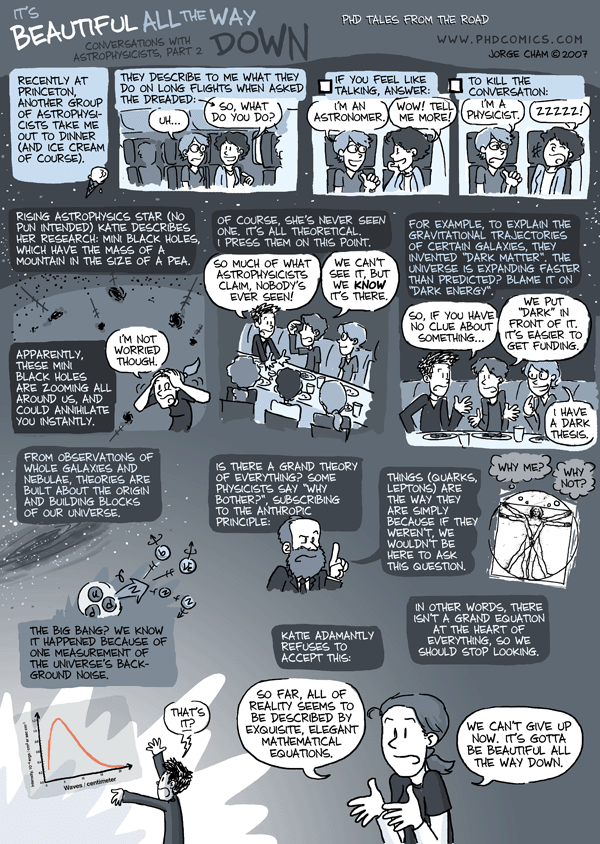
Ph.D. comic for 20 November 2007Today's Ph.D. comic captures something that's not fashionable for practicing scientists to talk about, in this age of restricted and competitive funding. Any comment by me might spoil the punchline, so just check it out.

19 November 2007

The Zen of Presentations, Part 11: The Chinese Run-Through

John Moschitta, Jr. in FedEx adWant to test that you really know your talk?
This is a trick I learned from actors, where it is often called a Chinese run-though. Or Italian run-through. Or [Insert name of language other than the one you speak] run-through. It's typically one of the last stages of rehearsal.

Do the entire talk out loud as fast as you possibly can.

You should sound like one of those frantic radio ads for demolition derby Sunday or the old FedEx ad.

It becomes incredibly obvious where you don't know your stuff, where the transitions are weak. And talking as fast as you can really gets your energy levels up. So do the Chinese run through it as near to the actual presentation as you actually can.

18 November 2007

The embarrasment of networking riches

I've spent the last couple of days adding in sharing / social networking / bookmarking tools to this blog. I don't think the process is complete. Compare the list of option currently added on the "Share and subscribe" list (about 9) to the little patchwork quilt of sharing icons that I found on another website (pictured).

While any one of these may be all someone needs as a reader, it's very frustrating as a writer. You want to provide useful tools, but there are so many competing services that it's very hard to stay on top of them all.

16 November 2007

A new blog in town

Spot the babiesMy latest venture is to launch Marmorkrebs.org, and an associated Marmorkrebs blog. The reason why should be fairly obvious: it’s a new animal I’m gearing up to work with, and I’m excited about it and want to evangelize it.

They are more technical websites and blogs than this one, which is meant to be loosey-goosey. (And I like it that way!) So if there’s nothing of note over there, you can click on the picture here and try to count the baby crayfish.

A new icon in town

If you look back through some of my old posts, you may start seeing something new. You may see a little icon with a paper and a check mark, and it says, "Blogging on Peer Reviewed Research." The icon and the idea behind it can be traced back to BPR3 – itself a blog, naturally.

Although reviewing papers isn't the main thrust of this particular blog, it does crop up occasionally (and maybe more often now that I have a cool icon to use). Some recent examples include the "Classic graphics" entries I've been writing. Perhaps a little different than the majority of blog posts that cover recent papers, but they're still peer reviewed. Those are the first I've tagged with the new icon.

11 November 2007

We think you're clumsy

Watch your stepThey've stuck these signs up around my campus at various places. At first, I thought it was just near some of the places they're doing construction, but no, it's all around.

That's right, we cannot be trust to walk safely without warnings. I'm sure there's a pithy comment about standing on your own two feet in there somewhere.

It's absolutely emblematic of the mania for safety that has gripped our current society. Everyone must be safe. Everyone must be appraised of every possible risk, so that nobody is culpable if you get hurt.

I'm surprised they don't have these next to every stairwell.

11/11

Poppy

10 November 2007

Classic graphics #4: Cortical wiring

Blogging on Peer-Reviewed ResearchIn the last installment of this series, I talked about cortex. And here we are again at the cortex.

I got the idea for looking at this graphic from the recent Neuroscience meeting, where I saw this diagram in at least two of the featured late afternoon talks. So I reckoned that qualified it as a classic. Of course, it probably didn't hurt that one of the authors of the paper that featured this diagram was the current president of the Society, David Van Essen. I was able to track it down, and it's freely available online in the original paper (it's figure 4, on page 30).

It also didn't hurt the fame of this diagram that it was printed in the very first article of a brand new journal, I imagine.

And I'm pretty sure I saw this picture prominently featured in a commentary by Nobel laureate and DNA structure describer Francis Crick in Nature. He used it as an example of something we know in monkey, but we should know in humans. We discussed the Crick paper when I was a grad student at our weekly "neurolunch" seminar. (Checking this now, it was Crick and Jones, actually.)

This figure shows the wiring diagram of the part of the brain responsible for visual processing in macaques -- which, because primates are visual animals, and because it's easy to control visual stimuli, is one of the best understood regions of the brain. 32 areas, 10 hierarchical, levels, and 187 linkages, most two-way between connected areas.

I should say, though, that the original was published in colour, based on comments in the text. That the PDF online now is in black and white is probably an oversight.

This diagram is clearly not famous because of its elegance. It's very hard to interpret and looks like the electrical wiring from the Chilton's manual of the car you hope you never own. Heck, even the authors write, "The sheer complexity of Figure 4 makes it difficult in many places to trace the lines representing specific pathways." (They go on to describe a computer representation that allows you to highlight specific connections. Sadly, that diagram does not appear to have made its way online, though I haven't looked hard).

But then, that's the point. It's considered a classic, not despite its complexity and difficulty in interpretation, but because of it. It emphasizes the tremendous complexity of the cortex and how different areas are connected to others.

And make no mistake: this diagram certainly represents a nearly heroic compilation of experimental results. And perhaps that admirable feature has helped people view it favourably over time.

Looking at the text, though, I'm struck by the several qualifiers, provisions, caveats, and tentative interpretations about the information that went into making this figure. The diagram, in a way, is often shown as factual, but is in fact somewhat hypothetical. Something which is not often mentioned when this picture is shown. It's possible, I suppose, that all the hypothesis have been shown correct in the following 16 years of research -- though I doubt that.

Next in this series, I will probably be looking at some graphics by Jerison on brain size.

References

Felleman DJ, Van Essen DC. 1991. Distributed hierarchical processing in the primate cerebral cortex. Cerebral Cortex 1: 1-47.
http://cercor.oxfordjournals.org/cgi/content/abstract/1/1/1-a

Crick F, Jones E. 1993. Backwardness of human neuroanatomy. Nature 361: 109-110. http://dx.doi.org/10.1038/361109a0

Late SfN pics 2007

airport adWhen was the last time you saw an ad directed specifically at scientists in an airport? Science journals, sure. Science websites, sure. Airports?

The view from my far too nice hotel room, overlooking the San Diego convention center.

The main, overwhelming fact about the Society for Neuroscience meeting is that it is big. You can't really grasp the vast number of people in a single picture, but some give you hints.

And more people...

I was listening to the Nature podcast for 1 November, and they estimated 25,000 attendees. A substantial underestimate of the actual attendance of 31,000 plus.

A featured lecture; Jeff Hawkins prepares to give a talk. It's pretty rare that to need a big screen at a scientific conference to determine that the speaker does, in fact, have a face.

Again, an attempt to convey the airplane hanger-like size of the poster sessions / vendors area.

Note that the exhibitors row numbers (top) here is in the low hundreds; the other end is up in the thousands.

Slow SubwayFinding lunch can be a challenge. Especially if you make the mistake of going to the world's slowest Subway... :(

And of course, there's the enticement to attend next year.

07 November 2007

The flight home

Has been made much more pleasant because I had the good fortune to be seated in the first row behind first class. Extra leg room - yes!

Also got seated next to a very nice neuroscientist from Baylor University who works on development of the cortex in mice. Whisker barrels, in particular. Had a very nice talk to her.

And we even got some food, which is an unpredictable rarity these days on planes. Not getting food on the plane would not be such a problem if airport restaurants stayed open longer. Flights come in from around the world, at odd times, with people coming from different time zones... but the restaurants close at 9 or so. C'mon -- if Wendy's drive through can stay open late or even 24 hours on some odd highway somewhere, why not in an airport? I'm just saying.

06 November 2007

How connected are we?

There are two people on the shuttle back to the airport: myself and another neuroscientist. I mentioned I had been at J.B Johnston Club. She asked if Joe Ayers was a participant.

Two people out of 31,000. 1 degree of separation.

Joe Ayers was the external examiner on my Ph.D. defense.

SfN, last day

Insanity: Doing the same thing and expecting different results.

It pays to be insane, I guess, sometimes, since I kept trying to get wireless in the convention center for days before it worked. And I seem to have finally found one -- and seemingly only one -- room where it works with my Pocket PC. Strange.

FUN social last night was packed. Very much busier than previous years, I hear.

Last morning for me here, partly spent revisiting the world of cricket hearing. I have an afternoon flight back, and will be home late tonight.

SfN, Monday

Good thing there weren't many posters I wanted to see this afternoon - not much chance to see after the symposium.

Celebrity spotted: Daniel Dennett (author of Breaking the Spell and philosopher of science), seen near the lectern after the evolution symposium. He's taller than I expected!

Speaking of evolution, the FUN committee meeting on evolution was good. Went perhaps a little long, because the topics lend themselves to wide ranging conversation and it can be tricky to stay task oriented. If you're in San Diego, the --

31,731 (attendance value just announced)

Dussini Mediterranean Bistro is worth visiting just for the menus alone. Heavy, metal bound, coppery-looking things in a trapezoid shape.

05 November 2007

Wireless!

The SfN wireless is finally working!

The Evolution of Nervous Systems symposium is FULL.

31,300 and change

That's the attendance total for Society for Neuroscience.

Lots of cool posters today. Crayfish sleep, katydid attention, and found some good stuff in the vendors.

Problem remains finding lunch and dinner company. Because you really feel like such a loser to be eating alone at a meeting over over 31,000 people.

SfN, Days 1 & 2

So the hotel wants $$$ for wireless, and the free wireless at the convention center isn't working for me, for some unknown reason.

Cool posters from yesterday: nociception in fruit flies helps them escape parisitoid flies, and a cool neuron in the STG with multiple spike initiation zones.

Not cool: featured lecture in the evening with barely legible slides in a huge hall with a speaker who rarely looked at his audience. Cool topic spoiled by not tailoring the talk to the huge venue.

Today the vendors open up.

SfN, Day X

Yep, it's reaching the point where it's all a big blur.

And why is even freaking Starbucks wanting people to pay for wireless?

On today's agenda:

FUN evolution committee lunch meeting.

Paul Katz's evolution of nervous systems symposium. Which is the main reason I'm still at this meeting.

SfN, Pre-day 1

I'm in the San Diego conference center, sitting on the hallway floor, after finally getting wireless to work. First lecture in 75 minutes.

JB Johnston Club meeting was good. The talk went well on many fronts. I had some good discussions with some cool new people I hadn't met before (Hi Kara! Hi Sarah!).

I am completely kicking myself now, though, over a purchase several months back. My PDA has two expansion slots -- one for a Compact Flash (CF) car, and one for an SD card, both of which are also used in digital cameras. I could just take pictures with the camera then swap them over to my PDA directly to email and such. But no... I had to go and buy a Sony with its silly memory stick.

Neuroscience food

Things I like about SfN meetings in San Diego:

CineCafe, across from the convention center, is the only place I've found in North America that keeps Violet Crumble in stock. (An Australian chocolate bar.)

The conference center sells these soft pretzels, and the cinnamon one is very nice.

31 October 2007

JBJC Day -1

According to some of my intel, I should have 'Net access for much of this trip. So I'll be trying a little reportage on this meeting.

Currently in the McAllen airport waiting to fly to Houston. McAllen has free internet; :)Houston makes you pay. :(

The talk is as ready as it's going to be. Fortunately, I can practice on the long flight to San Diego on my Pocket PC. I remembered to copy the talk over to it... Whew!

California dreamin'... I wish

Didn't sleep well last night. Don't expect to sleep well tonight. I'm getting on a plane later today and going to San Diego for the annual meetings of the J.B. Johnston Club and the Society for Neuroscience.

I'm giving a talk at the J.B. Johnston Club, and the talk was not at the point I wanted it to be last night. So I was having a bit of a freak-out trying to get it to where I wanted it to be. I'm almost there, but a couple of practice runs are needed to be sure.

And there are so many things I wanted to do before I left that are not done.

On the plus side... someone read one of my papers! And cited it!

One of the nice things about living in the digital age is that lots of things can be done automatically. Many journals offer "Citation alerts" that send you an email when a particular paper has been referenced in another journal. Yesterday, I got my very first one! And the best part was.. it was by someone that I personally do not know. It's very easy in this business sometimes to think that the only people who have looked at your stuff are people that you have actually met, so small is this community.

And even better was that the paper was actually relevant to some other projects I'm currently doing.

Right. Time to continue panicking for conference trip.

27 October 2007

And the suck factor goes up again

Damnit damnit damnit damnit!

I just discovered that an abstract I submitted for an upcoming meeting has a typo in it. In the title. In the species name.

Once, this probably wouldn't have mattered so much. But now, since this is being published, it means that people who are searching for papers on that species through Google or something won't find it.

This alone does not prove that I suck. What proves that I suck is that this is the second frickin' time I've done this.

Mad at myself now.

26 October 2007

Denied!

Forgot to mention something from Monday.

Various funding agencies have limited submission programs: they only accept a set number of proposals from an institution. So, when more people want to submit proposals than there are slots available, there has to be some mechanism to sort out who will submit.

So I had submitted an internal preproposal for one of these limited submission grants. Previously, we had our Dean review these and decide. This year, for the first time, for reasons I don't entirely understand, instead of just reading the preproposal (which was about 5 pages, if I remember right), they formed this little committee to review the preproposals, and asked the authors (like me) to come in and give a presentation justifying our preproposal.

I spent several hours working on a little song and dance for this.

Since you read the title for this entry, you know I got turned down.

At this point, I am not convinced that this new review mechanism adds any value to the submission process. It just seems to eat up more time.

Weather watching

California firesThe fires around San Diego are really scary. But according to the Society for Neuroscience, the show is going on. I expect the air quality to be atrocious, but if that the biggest problem I personally have, I reckon I have nothing to complain about and a lot to be thankful for. I've been putting a fair amount of time tweaking my talk for the J.B. Johnston Club over the last couple of days, which I'll be attending right before the Neuroscience meeting. Unfortunately, a few other things are going way on the back burner.

Ugh. No pun intended.

23 October 2007

Fire

California firesI'm supposed to got to San Diego in 8 days for the Society for Neuroscience meeting.

Today, I start seeing headlines like this:
Half a million flee California wildfires

President declares emergency as wildfires continue to rage unchecked across drought-struck region.

It's going to be an interesting week.

19 October 2007

Time tricks

I was gone to Texas A&M for less than 48 hours, but I feel like I've been gone the better part of a week. Weird.

I really enjoyed the trip. A&M is very, very different than any other uni I've visited in some ways. I haven't been on another campus where I've seen people standing around handing out bibles in the middle of campus, or any place with so many cadets with crew cuts and knee high boots.

Met several very nice scientists, and I think my talk went well. Had lunch at the Dixie Chicken, which has atmosphere to spare and good pub grub. Dinner was at The Republic, which had excellent steak and what I called "the schizophrenic desert" – a key line cheesecake / creme brule combo, that worked unexpectedly well.

Mike Smotherman, you rock! Thanks for the invite!

Aggieland

I'm in College Station tonight. Tomorrow, I'm giving a guest seminar at Texas A&M University. A&M was just named best university in the U.S. by The Washington Monthly and which has a football stadium that may be visible from low Earth orbit.

Last night, my talk was not in a state I was happy with, and I did not sleep well because of it. Tonight, I'm still terrified / intimidated, but the talk is in much better shape. And I've had a hot bath to help me relax. So I hope for a good night's sleep.

14 October 2007

04 October 2007

Learning curves

A learning curve
I was thinking about something this morning, and I thought of the saying that something has "a steep learning curve." I started thinking about graphs showing learning.

And realized what a stupid expression that was.

The term "learning curve" comes from psychology. Typically, you plot time on the X axis on the bottom and proficiency (or accuracy, performance, percent correct, or what have you) on the Y axis on the right.

The typical learning pattern is much different from the graph I sketched up for this blog post. Usually, people improve quickly with very little practice, and then it gets harder to get better. The graph I drew goes in the reverse pattern, but it doesn't matter to the point at hand.

When you're getting better at something quickly, the graph shoots up at a steep incline. The closer to vertical, the faster you're learning.

So when you say something is hard to learn, you should really say that thing has a shallow learning curve, not a steep one.

It's strange that I've studied learning and behaviour and such for years, and have used the cliché "steep learning curve" meaning hard for years, but never put the two together until this morning.

Of course, other people have beat me to this realization. But at least I arrived at the insight through my own independent thinking.

30 September 2007

Ignorance

A cashier in a store said to me today, "College professors have the cushiest jobs." Or maybe it was, "easy jobs."

I didn't clench my teeth physically, but I did the mental equivalent. I was really ticked. I replied, "You don't know anything about my job." It took a lot of willpower not to say more.

19 September 2007

Life imitating art scaring the pants off of life

It Came From Outer SpaceI watch and read science fiction. Have done as long as I can remember.

Last night, I watched Episode 2 of Torchwood, about the havoc wrecked after a meteorite hits.

War of the Worlds movie adaptation. People thought the Martian spaceships were meteors.

It Came From Outer Space. In a meteorite.

And there was the "Lonesome Death of Jordy Verrill" segment of Creepshow.

This scares me.

17 September 2007

Classic graphics #3: The somatosensory cortex

Blogging on Peer-Reviewed ResearchMotor homonculusWhen I lived in Montreal, I had the unusual experience of living in a city where a scientist was not just known (unusual enough), but frankly, revered. That scientist was Wilder Penfield.

I worked at McGill University, I worked on Dr. Wilder Penfield Avenue. And when I went to some talks at the Montreal Neurological Institute, I heard a speaker talk about having the chance to meet with "the great man," with no hint of irony.

Although it was probably Penfield's reputation as a surgeon that cemented him in the minds of Montrealers as a great individual, one of his most lasting scientific contributions is the map of the somatosensory cortex. This is truly a classic figure, that has been reproduced many times, and is virtually a standard in any textbook that even mentions brains.

Indeed, this picture has been used to study how textbooks copy from one another. In one redrawing of this diagram, a right hand got drawn onto the left side of a body (or vice versa). The error was then propagated in textbook after textbook.

I think this diagram comes from The Cerebral Cortex of Man: A Clinical Study of Localization of Function, co-authored with Ted Rasmussen and published in 1950.

The one up top shows half the story, namely the motor cortex. An equivalent diagram is available showing the sensory side.

What makes this figure a classic is that it uses images so successfully to tell the story. Wrapping the images of the highly distorted body takes something that is actually very abstract and makes it much more easy to relate to. If I am not mistaken, Penfield made these maps during open brain surgery, often with the patient awake. He would stimulate these regions, and observed what the patient did in response to the stimulation (on the motor side), or what the patient reported.

The diagram compiles all those observations of various body movements and miscellaneous reports of sensations.

This edited version of the figure has all the same information as the top one, only using text labels. Indeed, the text labels on the top diagram are almost redundant. But it is clearly nowhere near as compelling as the one showing all the bits of body, with some regions enlarged and some shrunk.

Some people have gone the other way, and created representations of a body sized proportionately to the area of the brain that represents them. In my estimation, these are not as powerful, either.

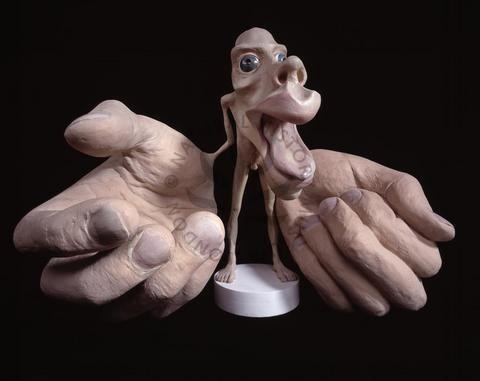
homunculusThe distorted body (sometimes called a homunculus, which means little man) is now isolated from the brain. You lose that sense that this is something tied to how the brain works. Such representations have a certain interest, but I don't think they make the scientific point about how our body is represented in the brain anywhere near as well as the original.

Additional, 15 February 2015: Ran across this academic article describing how this diagram changed over time. The first effort, in 1937, was confusing compared to the famous 1950 version.

Schott GD. 1993. Penfield’s homunculus: a note on cerebral cartography. Journal of Neurology, Neurosurgery, and Psychiatry 56 329-333. http://jnnp.bmj.com/content/56/4/329.full.pdf

Villainy II


Take the Villain quiz.

16 September 2007

Villainy I

The RiddlerYour results: You are Riddler

Riddle me that, riddle me this, who is obsessed with having a battle of wits??


Riddler
75%
Dark Phoenix
69%
Apocalypse
68%
The Joker
65%
Poison Ivy
65%
Magneto
64%
Mr. Freeze
61%
Dr. Doom
61%
Venom
55%
Catwoman
54%
Juggernaut
53%
Lex Luthor
51%
Mystique
45%
Green Goblin
33%
Kingpin
33%
Two-Face
29%


Click here to take the "Which Super Villain am I?" quiz...

And it's The Riddler, thank you.

15 September 2007

Did I miss my calling?

Careers I would apparently like...

1. Taxidermist (What?!)
2. Desktop Publisher (Kind of did that)
3. Veterinary Technician
4. Industrial Designer
5. Cartoonist / Comic Illustrator (Done a bit of that)
6. Animator
7. Fashion Designer
8. Costume Designer
9. Set Designer
10. Botanist (Getting close)
11. Artist
12. Graphic Designer
13. Paleontologist
14. Critic (Sort of did that)
15. Writer (Does blogging count?)
16. Computer Animator
17. Biologist
18. Political Aide
19. Activist
20. Communications Specialist
21. Market Research Analyst
22. Public Policy Analyst
23. Print Journalist
24. Website Designer
25. Interior Designer (Could you picture me on Trading Spaces?)
26. Translator
27. Medical Illustrator
28. Technical Writer
29. Animal Breeder
30. Craftsperson
31. Potter
32. Marine Biologist
33. Public Relations Specialist
34. Veterinarian
35. Zoologist
36. Criminologist
37. Anthropologist
38. Professor
39. Biological Tech
40. Optometrist

This meme courtesy of John Wick.

13 September 2007

Lights out

A few minutes before five o'clock, the power went out in my office. My building. And I soon learned the power was off on the entire campus. It took a while to find out a transformer had gone out, and power wasn't coming back on in a few minutes.

At least this was at the end of the day. If it had been earlier, it would have been very disruptive to the site visit of the regional director for Beta Beta Beta. Students are trying to establish a chapter – they need a faculty advisor – and I said, “Okay.” So part of establishing a chapter is the visit, and I think that went well.

In other emergencies...

Our president had to go through major heart surgery unexpectedly. And we also just found out that one of our scheduled Science Symposium speakers for HESTEC has to cancel because he has to go in for major heart surgery (triple bypass). And our Beta Beta Beta visitor was the recipient of quadruple bypass surgery not too long ago.

12 September 2007

Another sad day

Some become so famous that one one name is needed. Elvis. Madonna.

In the field of animal behaviour and psychology, most people knew about Alex.

Poor Alex died unexpectedly last week. When I saw a new story about a "famous parrot" dying, my heart sunk, because I knew there was only one parrot that it could be.

Alex was the African grey parrot that Irene Pepperberg had worked with for 30 years in her classic studies of comparative cognition. People had always known parrots were clever, but started to show just how clever. Categorization, counting, concepts... Work with Alex really started to undo a lot of the thinking that had permeated animal behaviour since the Clever Hans affair and the radical behaviourism of American psychology in the mid-20th century. For decades, anything that remotely smelled of "thinking" was exiled from scientific study in animals, and sometimes even humans.

Irene Pepperberg's work can be seen at the Alex Foundation.

08 September 2007

Classic graphics #2: Crayfish tailflips

Blogging on Peer-Reviewed ResearchTailflips from Wine and Krasne 1972This particular picture is not famous outside of my own field. But it has been reproduced many times, and as such, I think warrants the classic designation.

Crayfish tailflipping was one of the first natural animal behaviours that neuroethology really cracked. It was one of the first cases where we could explain how the connections between the neurons explained a lot about how the behaviour of the animal worked.

One of the little oddities in the story of understanding the escape response of crayfish was that the major neurons involved were recognized back in the 1920s. These huge neurons became known as the lateral giant (LG) and medial giant (MG) neurons, but even in the flapper era, there was pretty strong evidence then these giant neurons were involved in tailflipping.

But it took over 40 years for people to explain why there were two sets of neurons involved in tailflipping. And they can be forgiven for not figuring this out quickly, because this behaviour is so blindingly fast, you can't make it out with the naked eye.

When people finally got around to using high speed film, the answer became clear. There wasn't one behaviour. There were two. There were two different kinds of tailflips, each triggered by a different set of neurons. (Actually, it turned out that there were three kinds of tailflips, but that's another story.)

What fascinates me about this particular figure (from Wine and Krasne, 1972) is that it was not the first to make this point. Priority is huge in science. Normally, the first to show anything gets priority, and hold a very strong sway on our imaginations. Ask someone who was the second person to climb Mount Everest, or the second person to fly solo across the Atlantic. Heck, I don't know.

Tailflips from Larimer and colleaguesJust a few months earlier, in the same journal, another group of researchers led by Jim Larimer (which included my intellectual predecessor, Don Kennedy) published a picture that shows the same thing: that stimulating the different neurons generates different movements.

In this case, I think it's pretty clear why the later picture became the canonical representation of crayfish escape behaviour: context. You see the stick tapping animal, and you see the whole animal, moving through space, rather than an isolated part of an animal being held static. The advantages of this are huge.

The top diagram makes it forcefully clear what advantage there is to having two tailflips: both tailflips take the animal away from the source of the offending stimulus, but do so by throwing the animal in different directions. The crayfish jackknifes into the water when the LGs fire, but heads straight back when the MGs fire. You can sort of extrapolate that from what's shown in the earlier figure, but since you can't see where the stimulus would be, you don't have that immediate "Aha!" insight.

Sometimes, it isn't better to be first. It's better to be better.

References

Larimer, J. L., Eggleston, A. C., Masukawa, L. M. and Kennedy, D. (1971). The different connections and motor outputs of lateral and medial giant fibres in the crayfish. The Journal of Experimental Biology 54, 391-404.

Wine, J. J. and Krasne, F. B. (1972). The organization of escape behaviour in the crayfish. The Journal of Experimental Biology 56, 1-18.

Classic graphics#1: The Cartesian reflex

Blogging on Peer-Reviewed ResearchReflex from Trait de L'HommeOne of my side interests is in graphics. And I'm curious about what makes an image famous. Particularly scientific images. So I'm going to try exploring that from time to time, focusing on my own field of interest, neurobiology.

Over at the left is an image that I've seen reproduced many times. So often, in fact, that I'm having a hard time finding exactly the original source, to my embarrassment. It's from the work of René Descartes, 17th century French intellectual. I think it's from Treatise on Man, published around 1662 after Descartes' death.

I do not know if Descartes drew his own figures. I doubt it, because preparing woodcuts is a pretty specialized talent. And Descartes, I've heard, loved a life of luxury. I don't think he was the sort to handle woodcutting tools. Be that as it may...

What the figure is showing is Descartes' conception of how behaviour worked. It looks fairly modern. Even if you understand only a bit of modern biology, you might think, "You have a sensory stimulus, impulses travel up the spinal cord to the brain, are processed, and you get a withdrawal from the painful stimulus."

I think that's one reason why this particular diagram is famous: because it is almost eerily prescient.

And indeed, in broad strokes, that's what this is showing. Descartes was the first to develop a reflexive theory of behaviour, although I don't think he used the term "reflex." Because Descartes is so famous for his ideas on the soul, his arguments that much of behaviour -- even in humans -- is purely "push pull" sorts of automatic, reflexive responses is often overlooked.

That the picture looks quite modern in some ways actually sort of overshadows some important problems. Descartes had what I consider to be a pre-scientific concept of behaviour. The discovery of biological electricity was centuries away, so Descartes followed the ancients in thinking that behaviour was controlled through the movements of "animal spirits."

Reflex from De HomineIs the picture at top famous because of the idea that it shows? I don't think it's just that. Over to the left is another picture showing the same basic idea, again from Descartes, and I think even from the same book. Regardless, you see the same basic elements: a fire, an outstretched limb, and "animal spirit vessels" leading to the brain.

Yet this one I have not reproduced seen over and over again like the top one. I would say the top one is a classic, but the bottom one not. And here, the actual rendering of the diagram might be important in why this one isn't reproduced that often.

I find the second one is kind of disturbing. The figure has sort of babyish proportions. The torso sort of floats out of a cloak, which no obvious indications of a bottom half. Plus, the "animal spirit vessels" don't go right out to the fingers, making the idea that there's a connection between the stimulus and the person's brain harder to understand.

Or maybe the reason the top one is more famous is that editors are always looking for excuses to put in more nudes in their books.

07 September 2007

Oh, no.

I was just looking for something for another post I was writing, and boom, learned Barry Beyerstein was dead.

Geez.

I can't say I knew him well, but he was someone who did me some favours. When I was a grad student, he invited me over from UVic to SFU to give a talk to the BC Skeptics after reading an article I published in The Skeptical Inquirer. It was my first invited talk. Later, he was a special science guest at I-Con 2, a SF convention I helped organize in Victoria.

He was wonderfully friendly guy. I'm sorry I'll never get a chance to run into him again.

Additional, 20 March 2014: Here’s someone who heard Barry Beyerstein at I-Con 2, which, as I said, I was involved in organizing and inviting Barry to. He calls hearing Beyerstein speak, “a life-altering shock to me, a road to Damascus moment.”

If only it were that easy to get rid of a cold

Vitamin CI have a cold. And being a guy, I am a crybaby about it. But even a simple cold gives a chance for some thinking about science.

Someone who stuck her head into my office said, "Drink some orange juice." While I like orange juice, the advice is wrong on two counts.

As far as I can tell, the idea that orange juice does anything for a cold can be traced back to Linus Pauling. Pauling was no doubt a clever person, judging by his measure in the world's universally recognized international cleverness unit, the Nobel Prize. Pauling won the prize for chemistry in 1954 and again for peace in 1962. But winning a Nobel prize is no guarantee against going off the rails, which Pauling did on at least one point in the 1970s or so.

For some reason, Pauling became convinced that megadoses of vitamin C could prevent colds. Apparently he was quite obsessive about taking vitamin C, particularly when there was the slightest symptom of a cold.

And what's a good source of vitamin C? Orange juice, of course.

But it doesn't work. There was no evidence that Vitamin C did anything for a cold that a kleenex or off the shelf cough suppressant couldn't do.

So that's the first way the advice is wrong.

The second thing is, even if Pauling was right (which he wasn't), orange juice still wouldn't be the way to go. Pauling didn't advocate just having vitamin C in your diet, the way that you might get from orange juice. No, he advocated megadoses: amounts many, many times over the recommended daily amount. And sometimes, you got to admit monks are onto something with that whole moderation thing. Huge doses of vitamins are not without their risks; it is possible to overdose on some. High vitamin c amounts are associated with diarrhea -- perhaps not life endangering, but still.

And that's how the advice is wrong twice.

We can't even get our wrong bits right.

31 August 2007

You know you're having a tough week when...

...You get halfway through the day with your shirt on backwards.

And nobody tells you!

Time to prep a lecture. Or my tenure folder. Or research. Or administer the grad program. Or clean the seawater tank. Or...

Right. No more blogging.

29 August 2007

Most fun of the day

glue
The most fun of the day was when I had a couple of faculty from the art department in my office and a bunch of art grad students asking how they could make glue from natural sources.

I was especially pleased because I was able to find a book in my office (and I did have to hunt for it), look in the index, and find an answer. Bones, hides, hoofs, and the ever popular "fish remains." And I learned that "collagen" and "collage" are basically similar words, collagen was the major material in some kinds of early glue. Thank you, Steve Vogel, for writing Life's Devices, which is where I got the answer.

Paying dues

NCSE logoI finally joined the National Center for Science Education. I probably should have joined a long time ago. What finally pushed me to join was a couple of recent stories about individuals on the Texas Board of Education talking about how school textbooks should address "weaknesses" in evolutionary theory.

Translation: "We think evolution is wrong, but we can't say that we object on religious grounds in science classes because the courts have repeatedly ruled against teaching religion in public schools in the United States, so we'll just attack it at every opportunity."

And because I live in Texas, but, as a Canadian citizen, can't vote, this seemed one way that I might be able to contribute ensuring that my research discipline isn't weakened in Texas schools.

What's the alternative?

John Kennedy in Dallas, 1963Who killed John F. Kennedy?

Do you believe the official story that Lee Harvey Oswald acted alone?

Recently, I've been posting about distinguishing a serious scientific skeptic from someone who is a crank. (Previous posts: Lying with statistics, Skeptic or denier, Science is a democratic process).

A recent article about HIV deniers in PLoS Medicine throws some valuable light on this matter.

What you often see is that the "minority view" has no consistent position apart from saying the consensus view is wrong.

Those who claim HIV doesn't cause AIDS have a zillion alternative theories about what does. From the PLoS Medicine article: "In Africa, HIV deniers attribute AIDS to a combination of malnutrition and poor sanitation, i.e., they believe that AIDS is simply a relabeling of old diseases. In America and other wealthy countries, they claim AIDS is caused by drug use and promiscuity."

Climate change critics are probably divided on many issues. Some will say there is not significant change (not many now, though, I suspect). Some say there is significant change, but propose a whole slew of alternatives for what might be causing it, with solar radiation being only one idea.

So you say evolution is a lie? So tell me, is the Earth about 4 billion years old, or about 6,000 years old? Young Earth Creationists and Old Earth Creationists have deep disagreements on this point.

Who killed JFK? Depending on who you listen to, it was the mafia, the Cubans, the Russians, the CIA... and the list goes on.

For an alternative to a consensus view to be credible in science, the alternative itself needs to establish a consensus. Credible criticisms tend to get stronger over time, because they develop more evidence and more consistency. Because nature abhors contradiction.

Incidentally, first author on the HIV article, Tara Smith is a Panda's Thumb contributer, and writes her own thoughtful blog, Aetiology.

25 August 2007

Evidence and policy

In a previous post, I drew some parallels between scientific and democratic processes. Another thought that occurred to me is that evidence in science functions somewhat like policy in politics.

On election day, you have a chance to vote for a government with a particular set of policies. Those policies, however, are very liable to change. And people can change their minds about a policy that isn't working, or if a new policy is introduced that they disagree with.

In science, people change their minds as new evidence becomes available.

In neither case is a decision now and for ever, once and for all.

Of course, it's often much harder to show that policy is faulty than it is to show scientific evidence is faulty. To paraphrase Feynman, if your basic understanding of physics of balances and strains and stresses is bad, your building falls down.

Champions of stink

Dead things, we know, stink. Dead things that live in water stink more. Dead things that live in seawater stink more. And I think echinoderms may be the top of the list.

We have a new seawater tank, which I've been looking after. Unfortunately, had a water quality problem and a lot of animals in it died. But the sea cucumbers were really wretched things to clean. Now I can tell my student Sakshi that it's not just starfish that die horribly in an awful mess.

My hands are very itchy and dry from having been in salt water much of the day.

24 August 2007

Mysticism in the lab

If you were to look for an exemplary case of mysticism, close to the top would have to be the out of body experience. Many people have reported this, and has been used to promote ideas such as astral projection and life after death.

Not one, but two papers in this week's Science have now created this experience in lab settings. The first is here, and the second is here. And a third article commenting on the other two is here.

There one sense, some might feel that this debunks astral projection and the like. But in another very real way, it validates those reports. Various people who had out of body experiences were not (necessarily) frauds who were just making it all up, but reporting "real," albeit illusory, experiences.

17 August 2007

Science is a democratic process

I was listening to an interview was former New Scientist editor Nigel Calder yesterday, and he insisted a couple of times that, “Science is not a democratic process.”

The point he was making was that views that were once a minority position often become conventional wisdom. Which is fair enough. That’s a valid point. As Calder himself says, “I have in my time been criticised for saying that black holes might exist, the continents move, that an asteroidal comet wiped out the dinosaurs.”

Calder fails, however, to say what he thinks the scientific process actually is, if not democratic. It’s like saying I am not American, don’t dance the tango, don’t like pickles, and don’t own a dog. You know everything about me now, right?

If you want to use political analogies, what are the alternatives? Science is certainly not a monarchy or any other sort of authoritarian system. Everyone is allowed to engage in the scientific process. Science doesn’t care about who originates an idea or who promulgates it – it cares about evidence.

So who decides if evidence is credible? It’s a consensus developed by a community. And the views of that community can change over time, as more evidence becomes available, or as people have more time to think over an idea. After all, any real democracy worthy of its name reviews and has regular opportunities to change governments. (Even in Alberta.)

What other elements does science share with a democratic system? How about accountability? Scientists are typically for crediting sources, for allowing others to examine their findings, allowing others to replicate them.

Of course, it’s more complex than that. Earlier this week, reading Ryan Dancey’s blog, he mentioned the reputation economy, which is something I have to think about more. A similar idea crops up in today's entry in Seth Godin's blog. I think this has the potential to describe why some scientific ideas thrive and some do not in the sort term.

But as Arthur C. Clarke once noted, science tends to get to the bottom of things in about 50 years, if there is any bottom to be gotten to. The evidence will out. People will either admit they have been wrong, or relegate themselves to the fringe.

There’s also another sort of fallacy that Calder engages in: that because minority views have become majority views before, it will happen again, and specifically in this case – and he’s talking about human-induced climate change. Unfortunately, lots of fringe ideas have stayed fringe ideas.

Also, I think Calder might agree that regardless of climate change, there are other reasons to get away from the status quo of running our economies by burning fossil fuels.

16 August 2007

“I am thinking now”

When you're an educator, it's easy to get bogged down in details. Often petty details. And it's easy to forget the big picture.

In this TED talk, Patrick Awuah talks about how universities create the educated people that can drive nations to succeed. And how the lack of such people can cause national crises.


He calls this leadership, but I'm suspicious of that word.

13 August 2007

Cloudburst!

Lots of lightning and raucous thunder late this afternoon. Internet access at uni dropped out. The usual flood points were, as expected, flooded. I can make it almost home with only the souls of my feet getting wet... but there's a couple of ankle deep spots near the end of my trek. Alas.

Meanwhile, spent a good chunk of the afternoon – before everyone started to worry about being smitten with Thor's hammer – troubleshooting some DNA sequencing. It looks like we simply had too much DNA. Yes, for our delicate sequencer, it is possible to have too much of a good thing.

The sequencer is broken again, though, and so we won't have a chance to test our suspicions until Wednesday, probably.

12 August 2007

Revision of a figure

Yesterday, I did a quick revamp on our Neuroethology poster for HESTEC. Previously, I wrote about the design of one of the data figures for that poster. Interestingly, I found out at the meeting that I was too clever for my own good in designing the Neuroethology poster. The problem was that I used the bars coming from the boxes to represent the minimum and maximum. Several people interpreted these as error bars (standard deviation or standard error). Because overlapping error bars usually indicate that groups are not significantly different, and error bars are smaller than minimums and maximums, this led some viewers to momentarily question the results.

Consequently, I went back to a more standard bar graph in the revised HESTEC poster. It's similar to this one, except it shows transformed data rather than the raw data, and the colour is not bright red.

The size of the HESTEC poster was also smaller, so a lot of cutting text and general simplification occurred. It's probably a better poster as a result.

I also started work on my annual compilation of everything I've done in the last year. It's a dreary process, although sometimes it can be nice to see how much you've done.

10 August 2007

Getting closer...

Raw DNA data
It may not look like much. And it isn't. Nevertheless, it's my first little steps into a new area of research: DNA analysis.

The traces above show a small snippet of an attempt to sequence a bit of DNA. Ideally, there should be a nice sequence of evenly distributed peaks of about the same height. Each peak indicates a single nucleotide. Unfortunately, our sample is not ideal and there's a lot of noise in the measurement. My student Unnam and I need to do some troubleshooting and try again.

Another indication of our problems is that DNA is made of a sequence of four letters: A, T, C, and G (nucleotides, really, but the names need not concern us here, and the letter symbols are universally used). The sequencer gave us A, T, C, G... and N. "N" is a symbol for "any nucleotide," which basically means that the machine couldn't figure out what it was and spit out a "I dunno."

We were very excited to be sequencing -- finally -- yesterday, so that it was really not all that usable was disappointing. Or, as Unnam wrote, "THAT SUCKS. A lot."

Still, after my buddy Virginia was always bugging me... "Zen, you have to get into molecular biology to show the world that you're a modern biologist," I do feel the need to point out that I'm moving in that direction.

07 August 2007

Omit needless words

Lately, I've been seeing a lot of headlines that say things like, “10 places to visit before you die.”

Is there really any other time to visit those places? Does anyone think, “Oh, that's okay, I'll get to that after I die...”?

05 August 2007

A rule

Nature doesn't abhor a vacuum.

Nature abhors a contradiction.

02 August 2007

Busted

DNA sequencer: $100,000.

Electron microscope: Tens of thousands of dollars.

Floor centrifuge: Tens of thousands of dollars.

The feeling you get when all of them break in the space of a week or so: Priceless.

I swear, this place was built on an ancient Indian burial ground. Sometimes I think a curse is the only explanation.

One of my students has been working for over a month to get DNA samples ready to sequence, and came in this morning only to learn the sequence broke Wednesday night.

Art and science

I was talking to an artist yesterday who wanted to incorporate some microscopic images into a new pork she is preparing. This got me thinking about the similarities between art and science. Here's a few.

Both are profoundly creative endeavors.

“The overriding message of all art... is ‘Pay attention.’” - Harlan Ellison. You could say the same thing about science: the message is, “Pay attention!”

Both are hand crafted, not mass produced. At least, in their original form.

Both, at their best, transform the way you see your world.

31 July 2007

Headspace

I was sick on Saturday, had an uncomfortable overnight flight back to Texas on Sunday, have had the south Texas heat kicking my ass every time I walk out the door, and am still sleeping in way too late.

My head is not yet back in the game.

Some of the routine paperwork is done now, but that's about it.

Champions never quit

Brian May, of the legendary band Queen, has finished writing his doctoral thesis. Thirty years after he started it.

Now that would be a graduation ceremony to see...

30 July 2007

Scene at customs

"Edinburg," says our customs officer in the Vancouver airport. "Who lives there?"

"There's a university there," I say.

"Pan Am," he says, which makes my eyebrows crawl up my forehead. Nobody knows where Pan Am is...

"I'm from McAllen," he says.

"What?!"

Much better, though, than the flight attendant on the flight from LAX who kept calling McAllen, "McLean."

29 July 2007

ICN 8 continued

Museum of Anthropology rocks.

So many delegates leaving on Thursday night when the conference ends Friday afternoon sucks.

26 July 2007

ICN8 (with news on 9)

Vancouver Aquarium rocks. The beluga whales really are hypnotic. And sea otters are pretty darn cute. And so much more.

Fireworks rock. Went on a dinner cruise and stayed in Vancouver harbour to watch Spain's entry in an international fireworks competition. Nice big explosions.

ICN9 will be in Spain in 2010.