18 April 2013

Whale sharks are even more awesome than I thought


Al Dove spent Tuesday at UTPA as part of the Office of Graduate Studies STEM lecture series. Al is a longtime friend of this blog, and I knew about of his whale shark work. But before the day was out, my vision of whale sharks had been transformed.

I used to think of them as slow moving, placid, sort of dumb beasts. Before the day was half over, my view was more like this.


Whale sharks are scary armoured stalkers.

Whale sharks stalk smaller fish around the ocean, waiting for them to have sex so they can eat all their children. (That is, fish eggs. This is why they aggregate in huge numbers off the coast of Mexico; de la Parra Venegas et al. 2011).

If you bother them, they’ll swat you with their tail, like a horse swatting away a fly with its tail. Only a tap from a whale shark tail is like getting hit with a ping pong table covered in sandpaper.

They have four inches of skin with the grit of sandpaper on their back, the thickest in the animal kingdom. Their skin is so thick that titanium barbs fired at point blank can’t pierce it reliably. Nothing is able to take a bite out of them, not even cookie cutter sharks.

They may look like they are slow swimmers because of their size, but whale sharks swim faster than any diver can keep up with.

Al did a tour of some of the biology labs and met with students in the morning and over lunch. In the afternoon, he met with a few classes where the focus shifted from science to science communication.

Al talked to several classes about his experience in outreach. He was inspired to take his science to the streets, as it were, after seeing Randy Olson’s Flock of Dodos: The Evolution-Intelligent Design Circus (available for viewing instantly on Netflix). This led to his involvement with Deep Sea News, and his various Twitter accounts. In addition to his own account, he impersonates a whale shark on Twitter, Domino, and shared his plans for a new account, Whale Shark Watch.

Whale Shark Watch is not ready for prime time yet. The avatar is still just an egg, and there are only a few experimental tweets, and I was follower number 5. The plan is that the account will post location data from tagged whale sharks in near real time. This will give anyone the opportunity to follow along. I can see this being particularly great for students at almost all levels.

The evening came for Al’s keynote address. The room was lively, with about 350 people there, and many of them were K-12 students.

One of the nice things about Al’s talk was that he took to heart that it was a STEM talk, not just biology. He talked about the creation of the Georgia Aquarium, the newest and biggest aquarium in the world, and all the technology and engineering that goes into creating a tank big enough to hold whale sharks. Indeed, some of the technology to make the acrylic viewing panels is still a trade secret.

It’s all the more impressive when you consider that Atlanta is not a city on the coast. They don’t have a ready supply of seawater. Everything is artificial and engineered.

I was also gobsmacked by the amount of science effort that goes into transporting and maintaining the whale sharks. There’s a three month acclimation process before the shark even gets close to a plane to move to Atlanta.


And once they’re on site, maintaining them is another challenge. They taught them to follow a boat. Each boat had a different coloured bucket, and the sharks have learned which colour bucket has their meal and not the other sharks.


I think almost everyone left the talk wanting to visit the aquarium.


Of course, Al also talked about his field work. One of his themes for the day was that even though whale sharks are the biggest fish in the world, we know almost nothing about the very basic biology. How long do they live? Don’t know. How do they reproduce? Don’t know; they’ve never been seen mating or giving birth.

He ended his talk with this picture.


He called it, “two kids having their mind blown.” He said this was the point at which all the technology melted away, and was completely invisible to these kids. All they were doing was simply reacting to the awe of being able to see this amazing animal. This, he said, was a moment where they were open and receptive and you had the opportunity to connect and educate people.

Afterwards, there was a long question and answer session, with a lot of excellent questions. He had lots of people wanting to take picture with him. Because he is a rock star.


Al Dove blew 350 minds at UTPA this week. Including mine.

Related posts

Calling South Texans!
Abandonment issues
The small brain of the biggest shark in the world
SICB Day 2
Passion for evolution

External links

Deep Sea News
Georgia Aquarium
Swimming with whale sharks

References

de la Parra Venegas R, Hueter R, González Cano J, Tyminski J, Gregorio Remolina J, Maslanka M, Ormos A, Weigt L, Carlson B, Dove A. 2011. An unprecedented aggregation of whale sharks, Rhincodon typus, in Mexican coastal waters of the Caribbean Sea. PLOS ONE 6(4): e18994. doi: 10.1371/journal.pone.0018994

17 April 2013

“It’s the STEM jobs, stupid”

Anne Glover, Europe’s chief scientist, thinks that science has an “image problem” (video below).

Europe's chief Scientist Anne Glover is spearheading a drive to attract more people into science. First, we need to change the image of scientists, she says.

She tells a story that will be familiar, because it’s been repeated many times: kids think scientists are old bald men. “How many people would be attracted to that as a career?” she asks.

Has anyone done the same experiment with medical physicians? Here is a web page that gives kids instructions on how to draw a doctor: male, bespectacled, white. And yet there is no shortage of students who want to be physicians.

Later, she notes that the thing most kids want to be is a celebrity. But what young kids think about a career may not matter all that much, because they are a long way from making meaningful career decisions. They’ll change their mind multiple times before entering the workforce in a serious way.

Getting more people into science is easy to say: give them a clear pathway to jobs.

People on the ground know this. Last week, I saw a recruiter for graduate program from University of Texas San Antonio. What did she emphasize as a reason why someone should go to graduate school? Increased lifetime earnings was number one. I think low unemployment was second.

Let’s say that again. Recruiters are telling prospective students that you should go into grad school not for the intellectual joy of problem solving, not helping society, not creating the future. They’re telling people to do it for the money.

While this is easy to say, this is hard to do right now. Those lifetime earnings statistics are not enough to give people a lot of confidence. Sure, you may make more money over the course of your lifetime, but you’re still left with career prospects that are incredibly cloudy. You get a doctorate. What job are you going to do after that? Look at the last graph from this article:


It used to be that more than half of biology doctorates got tenure track jobs in universities. Now that figure is closer to 15%. In general, most people who get doctoral degrees are using them in ways related to their work, but a doctoral degree looks less like a pathway to a career and more like a spin of the roulette wheel.

Meanwhile, law schools are freaking out “just” 56% of law school graduates have “stable jobs in law.”

Can you imagine the howls if only 15% of students who went into medical school became practising physicians? I went looking for how many medical school graduates ended up not being physicians, but couldn’t find any data.

This suggests that other professional programs are doing a better job of delivering on putting students in their profession than science is. The data I present are from the US, not the EU, but I haven’t seen much evidence the situations are all that different in the two.

Glover, like many high level types, talks like there is a scientist shortage. Instead, there is significant evidence that there is a scientist oversupply.

(Aside: Remember, when people talk about the “need” for STEM students, they mostly mean computing. With a little bit of engineering.)


Now, that said, Glover is not alone in saying that science’s image isn’t as good as it could be. This is why people create “Rock stars of science” and “Science cheerleaders” and “Science: it’s a girl thing” and “This is what a scientist looks like” and “50 sexy scientists” projects. Some of these work; some don’t. Almost all are controversial.

Me, I think science’s image has never been better. The geeks have inherited the earth.

But image, while possibly solvable, is trivial. If there are well paying science jobs, and people know how to get them, you won’t be able to beat people off with a stick.


Glover herself seems to have an idyllic scientific experience. At 20:30 in the video above, she talks about “a morning in the life of a scientist.”

If I’m a laboratory scientist, I go into my lab, I go into my lab with my head full of ideas, and I have in front of me every possible facility to allow me to test those ideas, to look at the output of ideas, talk about those ideas. It’s the most amazing thing to do, and every day is different.

If Glover has always had everything she’s every need to answer any question she’s ever wanted to ask, and has never done the same thing over and over (What are her samples sizes? Has the woman never replicated experiments?), then her experience is unusual.

At about 32 minutes in, she talks about how to improve science recruitment for no money. “Just train young scientists to communicate better.” While I’m all for communicating (blogging for a decade here), it’s astonishing to hear someone to underplay how important a role funding plays in science, including science recruitment. Make it easy for people to get jobs, and they’ll study science.

Update, 18 April 2013: Rxnm has a post up on training doctoral students. His suggestion – let people pay for their own doctorates – is aimed at the American funding structure, but might be transferable to other countries. I think there is a larger problem that needs to be addressed, which I may do in another post later: Why do high level officials keep insisting there are scientist shortages?

Anne Glover pic from here.

Related posts

Science cheerleaders
Good idea, bad idea: Rock Stars of Science

External links

Let’s drop the caricature to close the skills gap
The Ph.D Bust: America's Awful Market for Young Scientists—in 7 Charts
Once more, with feeling: computer science job growth dwarfs all others
“Science: It’s a Girl Thing”: Lab Barbie, Extra Lipstick
So crazy it just might work

16 April 2013

Tuesday Crustie: Clarity

Last week, the science news world was all a-flutter about a new technique to clear brains described in the paper, “Structural and molecular interrogation of intact biological systems.” (Argh, what a title. Would you have guessed what they did from that title?)

We in the invertebrate neuroscience community have been clearing brains for decades. Here are some examples from my own work.

Assembled in the dying days of straight edges and Letraset and photographing photographs, here are leg motor neurons from spiny sand crabs (Blepharipoda occidentalis; Faulkes and Paul 1996). The nerve to the leg splits into two branches. A shows the neurons in the combined nerve, B shows the neurons just from the front branch of the nerve, and C shows the neurons in the back branch of the nerve.


Here are homologous neurons from the legs of slipper lobsters (Faulkes 2012), presented here in colour for the first time. There is the equivalent to part A in the composite above. This one is darker than some of the others because it has gone through a process called intensification.


Same species (Ibacus peronii) but this time we have neurons in the tail. These are abdominal fast flexor motor neurons that power the big tasty muscles that everyone likes to eat (Faulkes 2004).


Here are the homologous cells in a spiny lobster (Panulirus argus; Espinoza et al. 2006). This is a composite “stack” of images compiled with Helicon Focus. That’s why this one is prettier than the others; more of the neurons are in focus.


Now compare the two above to this one from crayfish (Procambarus clarkii; another Helicon Focus composite, previously seen in the 2011 J.B. Johnston Club calendar). Notice how there are seven in the pictures above but eight in the one below (two on the left are overlapping)? It’s because the species above lack a specialized giant motor neuron that crayfish have related to escape tailflips.


The technique create these images is called cobalt backfilling, developed in the 1970s (Tyrer and Altman 1974; Bacon and Altman 1977; Altman and Tyrer 1980). I think the clearing of neural tissue was developed at this time. All the water in the neural tissue is removed and replaced with absolute alchohol. The tissue is cleared in methyl salicylate.

References

Altman JS, Tyrer NM. 1980. Filling selected neurons with cobalt through cut axons. In: NJ Strausfeld, TA Miller (eds.), Neuroanatomical Techniques, pp. 373-402. Springer-Verlag: Berlin.

Bacon JP, Altman JS. 1977. A silver intensification method for cobalt filled neurons in wholemount preparations. Brain Research 138(2): 359-363. http://dx.doi.org/10.1016/0006-8993(77)90753-3

Chung K, Wallace J, Kim S-Y, Kalyanasundaram S, Andalman AS, Davidson TJ, Mirzabekov JJ, Zalocusky KA, Mattis J, Denisin AK, Pak S, Bernstein H, Ramakrishnan C, Grosenick L, Gradinaru V, Deisseroth K. 2013. Structural and molecular interrogation of intact biological systems. Nature: in press. http://dx.doi.org/10.1038/nature12107

Espinoza SY, Breen L, Varghese N, Faulkes Z. 2006. Loss of escape-related giant neurons in a spiny lobster, Panulirus argus. The Biological Bulletin 211(3): 223-231. Abstract and reprint

Faulkes Z. 2004. Loss of escape responses and giant neurons in the tailflipping circuits of slipper lobsters, Ibacus spp. (Decapoda, Palinura, Scyllaridae). Arthropod Structure & Development 33(2): 113-123. http://dx.doi.org/10.1016/j.asd.2003.12.003

Faulkes Z. 2012. The distal leg motor neurons of slipper lobsters, Ibacus spp. (Decapoda, Scyllaridae). NeuroDojo (blog): http://neurodojo.blogspot.com/2012/09/Ibacus.html

Faulkes Z, Paul DH. 1997. A map of the distal leg motor neurons in the thoracic ganglia of four decapod crustacean species. Brain, Behavior and Evolution 49(3): 162-178. http://dx.doi.org/10.1159/000112990

Tyrer NM, Altman JS. 1974. Motor and sensory flight neurones in a locust demonstrated using cobalt chloride. The Journal of Comparative Neurology 157(2): 117-138. http://dx.doi.org/10.1002/cne.901570203

Related posts

A virtual camera lucida
Tuesday Crustie: Neural

External links

See through brains clarify connections
Getting better views of brains by turning them invisible

Comments for first half of April, 2013

SciCurious takes apart the double standard in academic dress.

Girls are Geeks look at the BRAIN Initiative.

Mike Taylor examines fake journals.

Haters gotta hate. And Pro-Like Substance is a hater of numbered references.

Dr. Dr. A. at Blue Lab Coats examines how journal impact factors are used.

Benchfly asks if grad school is broken.

Texas state representative Bill Zedler has revived a pointless intelligent design protection bill.

15 April 2013

Lab dreams


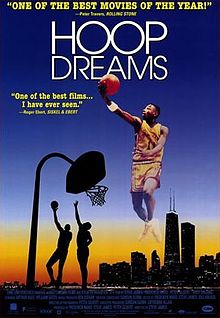
Imagine this movie synopsis:

This documentary follows two inner-city Chicago residents, Ally A. and Bill G., as they follow their dreams of becoming science superstars. Beginning at the start of their high school years, and ending almost 5 years later, as they start university, we watch the boys and girls mature into men and women, still retaining their “Lab Dreams.” Both are recruited into the same elite high school as their idol, astrophysicist Neil DeGrasse Tyson. Only one survives the first year; the other must return to a high school closer to his home. Along the way, there is much tragedy, some joy, a great wealth of information about inner city life, and the suspense of not knowing what will occur next. This is not a “by-the-numbers” film.

This is not a real movie. That is actually a slightly edited version of the plot summary of Hoop Dreams.

Last Friday, I attended a planning meeting for graduate program that our university is participating in. During a break, I overheard one of the other participants talking. He noted that a young person who shows some talent at sports will often be brought to the attention of scouts. The job of the scouts is to identify talent. And there is the potential to gain rewards in the near (university sports scholarships) and long term (professional sports). People know this and pursue it, hard.

After the official meeting was over, I ran into him again. He talked to me about how important it had been to him that someone in school had told him that he had potential. That he could code, do computing, engineering, those sorts of things.

That brings up a few points. First, there aren’t very many venues where prospective scientists can show their skills. Science fairs, maybe. Science fairs are a little limited, though, in that they tend to be annual events, and they aren't terribly close to the way professional scientists work. Student athletes have consistent venues to show their skills: games where the players are constrained to play using the same rules as professional athletes. That’s important.

Second, recruiting for science is radically different than sports. It seems that most attempts at science recruitment are just widely cast nets to encourage people in general to enter university programs in science. Sports recruiting is very targeted to find individuals.

Of course, if you've seen another sports movie, Moneyball, you know that sports recruiters don't always get it right. A major plot element of that film is that Billy Beane (played by Brad Pitt) is recruited at an early age into a sports career that just doesn't pan out.

Additional, 16 April 2013: Science fairs are often seen as potential recruitment tools. This post makes some excellent points about how science fairs might just show off the Matthew Effect (the rich get richer).

There is no equity of access to lab facilities and equipment or access to scientific mentors, meaning some students are disadvantaged from the start. Projects done in the lab or with the help of a scientist mentor are inherently more impressive. While a kid who investigates pollution in a local watershed and a kid who looks at the effects of a chemotherapeutic drug on different cancer cells may be equals in the rigor of their scientific method, the kid with the lab-based project simply stands out more. So, unfortunately, the students who win these science fairs will often be the ones with the best access.

Photo by nashworld on Flickr; used under a Creative Commons license.

14 April 2013

Leadership as the family business

The election of Justin Trudeau to the leadership of the Canadian Liberal Party gives me pause. (Note to those not familiar with Canadian politics: his father, Pierre Trudeau, was Prime Minister in the late 1960s and 1970s.) Former Prime Minster Paul Martin's father was also a highly successful politician, though never Prime Minister.

In the United States, the presidencies of the Bush family, and the prospect of a second Clinton presidency, give me similar pause.

Passing leadership of a nation within a family was the defining property of monarchies, not democracies.

13 April 2013


Scene from Roman Holiday.

11 April 2013

A field guide to exporting citations

I use a reference manager (currently, EndNote X5). A lot. And while importing a bunch of articles over the weekend, I got frustrated playing hunt and click trying to find the button to put a reference into my reference manager.

For one thing, there’s not consistency in what the websites are asking you to do. Half think you want to “export” the citation, and the other half think you want to “download” the citation. It’s split right down the middle.

Here is the result of my comparative study so far. First, I like ScienceDirect: it puts the button in the first place you look, up in the upper left, following the Cosmo principle.


Science doesn’t put it at the top, but it’s on the left.


Nature does the same, though not in a sidebar.


But... not all journals from Nature Publishing Group follow the same layout and format as the flagship. This is odd.


One of the other big publishers, Wiley, puts the button halfway down on the right hand side.


Middle right is probably the most common location for the export citation buttons, exemplified by another one of the big academic publishers, Springer. (By the way, Springer, when will be be able to export the article abstract along with the citation again?)


The Royal Society journals (which has one of the most explicitly described links)...


...Brill...


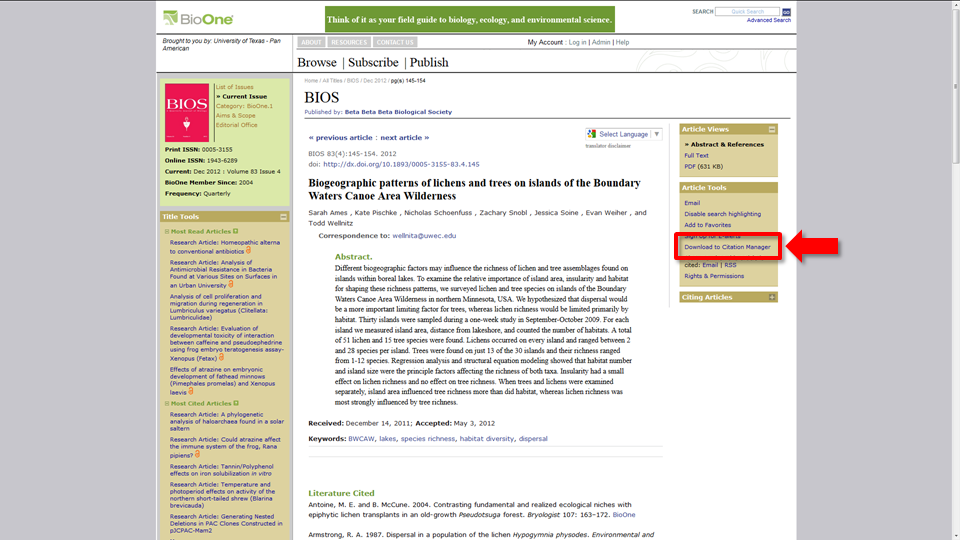
... and BioOne.


Even JoVE puts their export citation link, though the link is way down the page and may be offscreen in some views.


Very few journal websites put their link in the bottom middle of the page. Inter-Research is one.


Taylor & Francis is another.


Now things get a bit more tricky.

BMC journals drive me bonkers. Every other publisher calls the thing you are saving a “citation.” BMC alone calls them “references.” I can’t count the number of times I’ve started blankly at a BMC article, trying to figure out what to click (“I don’t want the references in this article, I want this article!”), until I remember this.


PLOS journals recently redesigned their websites, and in doing so, hid the citation button and asks for multiple clicks to get to it. First, you have to click “Download.”


Only then do you see an option for the citation. For the same screen real estate, PLOS could show three buttons, making it easier to find and saving us a click.


PNAS is one of the other websites that makes me crazy every time I want to save a citation. They have their link in the industry standard location, in the right margin. When I click...


... I get a drop down menu. A drop down menu with only one choice. Why are you making me click again?! You’re not giving me a choice, so just let me get the citation already! Life is a finite number of mouse clicks, and I don’t want to use any more of them than I have to!


Physics Today not only follows PLOS and PNAS in making you click multiple times, it is more cryptic, hiding the link under the mysteriously named “Tools.”


Clicking “Tools” then give you options, including citation export.


The “Hall of shame” award in this category, however, goes to JSTOR. JStor’s page doesn’t look so bad, with the link in the right side.


It gets the raspberry because you can only see the “Export citation” link if you have an institutional login. Seriously?! Is a citation so valuable that it must be password protected? For crying out loud, every other publisher gives you the ability to export the basic bibliographic information for free. For shame, JStor! Shame on you!

10 April 2013

The emergence of a fake quote?

While reading an article on Brain Pickings inspired by the question of authorship of Shakespeare’s work, I noticed this quote:

A theory should not attempt to explain all the facts, because some of the facts are wrong.

It was attributed to Francis Crick, one third of the Nobel prize winners for work on DNA structure. The publication of the famous Watson and Crick Nature paper is celebrating its sixtieth anniversary this month. It was published 25 April 1953.

I love the idea encapsulated in the quote. I immediately typed it into Google to see if I could find a more exact source.

Nothing. Not in Wikiquotes, either. (I added it as an “unsourced” quote.)

I put it in quotation marks, forcing Google to look for the exact phrase. The first few pages (I went down seven pages deep before quitting) give me the exact same list on the Brain Pickings site. You can tell this at a glance because the words immediately before the alleged Crick quote begins are, “(Arthur Conan Doyle),” the author of the quote preceding the alleged Crick one.

They all seem to emerge from the AKA Shakespeare website in one way or another. This makes me extremely suspicious of the Crick quote. Quotations have a funny way of being conjured out of thin air and attaching themselves to names we know.

For instance, this made its way onto a Facebook page I co-moderate:


The problem is, there are no records of this quote before 2004 – about 49 years after Einstein’s death. And I’ve already given examples of quotes misatrributed to Charles Darwin.

A challenge, hivemind! Can anyone find the original source of the Crick quote? Or can someone who met Crick confirm that this was something that he said? I mean, other than in the AKA Shakespeare book itself, or its derivatives?

(And yes, the irony of suggesting that there is an unsourced, or unverified, or misattributed, or possibly fake, quote in a book about the authorship of Shakespeare’s work has not escaped me.)

Maybe Abe Lincoln said it best:


Update, 1 December 2014: I may have found the source of the quote, and it’s not so much a quote as a paraphrase.

A review of Francis Crick’s book What Mad Pursuit includes this excerpt from the book:

Jim was a little more brash, stating that no good model ever accounted for all the facts since some data was bound to be misleading if not plain wrong.

I need to check, but I am guessing that “Jim” is none other than James Watson. It’s interesting to see how not only the source changed, but the wording becomes shorter. Quotes become sound bites.

Related posts

This Darwin Day, please stop using quotes that Darwin never wrote

External links

AKA Shakespeare
Was Shakespeare Shakespeare? 11 Rules for Critical Thinking

Lincoln meme from here; Einstein from here.

08 April 2013

PACE 2013 Bioethics conference, day 3

The last day of this conference featured a keynote by Ivan Oransky, co-founder of Retraction Watch and Embargo Watch. His slide deck is below. The slides are much better when accompanied by Ivan, who presents with an appealing, slightly dry sense of humour. Ivan’s talk was video recorded, but it is not up yet. Plus, I am not sure how good the sound will be; the mic was off because it was generating a lot of white noise.

To be honest, because I know Ivan’s work and follow many of the issues that he talks about online, I was expecting all this stuff to be old hat to me. But even I learned something that dropped my jaw to the floor.

Journals have always been in the business of selling reprints of single articles. Typically, these are sold to the author, who can then use them to send to other researchers. In the days before PDFs, you would often get little “reprint request cards” in the mail. Because of that experience, it never occurred to me that anyone other than the author of a paper would be interested in buying reprints of articles.

It turns out that medical journals have a huge market for article reprints: drug companies. Journals make hundred of millions of dollars a year selling paper reprints to drug companies. The drug companies distribute these to the pharmaceutical representatives, who in turn give them to physicians to promote whatever new drug the reps are promoting to the physicians.

Medical journals have a massive incentive to publish research articles that show new drugs in a positive light. They have no incentive to publish negative results. Who will buy articles that show something doesn’t work?

The last panel I saw was one on Internet security. It was devoted to a proposal that someone at Microsoft put forward that Internet security could be modelled after public health. For instance, just as an unvaccinated child might not be allowed to attend a school, a computer with the latest anti-virus software might not be allowed to connect to the Internet.

One issue around this is that any sort of public health model always involves a certain amount of coercion, since it only works if you have universal (or nearly so) adoption. This means less privacy, less autonomy, and so on.

Another question is whether public health is the right model for thinking about Internet security. What is the Internet equivalent of the plague or Spanish flu? Perhaps Stuxnet? Most computer viruses are not like Spanish flu, sort of “in the air”; there are more like sexually transmitted diseases, in that it requires very specific action on the part of the user to cause trouble (e.g., opening *.exe attachments; contacting that Nigerian prince). There are places where the analogy breaks.

A final point on the panel was that by buying a smartphone, you are taking on certain obligations. Smartphones are connected, and that means you are part of a community. You have responsibilities above and beyond paying your monthly phone bill.


Here’s a storify pf Ivan’s keynote:

05 April 2013

PACE 2013 Bioethics conference, day 2


The PACE conference continues to go well, as far as I can tell. I was not able to spend as much time at the conference today, but a panel on the business of healthcare early afternoon was filled to the brim. I apparently should have been there, because a pharmaceutical representative was apparently making all manner of... interesting... claims about the efficacy of brand name versus generic drugs, among other things.

Cross border shopping for health care: The panel started off with this segment from The Daily Show, which the audience seemed to enjoy.


I polled the audience as to how many of them had gone to Mexico for some form of health care (including buying medicine), and at a rough count, slightly more than half had. Dental work of some sort seemed to be very popular, and one of the panelists said that the main reason people went to Mexico was the lack of insurance.

I told the story story of Celltex, a company offering experimental stem cell treatments that have not been approved by the US Food and Drug Administration. The company's first patient was Texas governor Rick Perry. Despite Perry's high profile support, the company has continued to be on the receiving end of controversy. In February, Celltex packed up and moved to Mexico, where it didn't have to put up with the FDA regulations. This raised questions about whether patients should be allowed to seek unproven treatments in other countries. Would a patient who went on medical tourism could lose insurance. Could a physician refuse treatment to that patient if complications ensued?

Another issue of cross-border comparisons that arose from an audience question was the relative pay of doctors. For instance, in 2008, the average wage of an American physicians was about $189,000 after expenses, but a Canadian physician made about $125,000. Thus, not only are patients "cross-border shopping," physicians are, too.

Yerberias: Oh, but this turned out to be an interesting panel. I was moderating it, and it turned out to be an interesting challenge.

"Yerberias" are, as far as I can tell, a distinctly Hispanic cultural institution. They might be described as an intersection of magic shops, herbal remedies, and Christian paraphernalia (note the saint on the door in the picture at right). So the idea was to talk about traditional compared to science-based medicine.

One of the scheduled panelists said that asked someone who knew more about this to replace her, and the replacement turned out to be a naturopath practicioner, Shirley Layton. I mentally did a double take when she started talking about homeopathy as effective treatment. Later, she started talking about "double helix" water that was "aligned" to better pass into cells of the body. I think she also had some unconventional ideas about root causes of cancer. And toxins.

Another panelist was discussing "energy healing."

On the other hand, I was there as moderator, and I am skeptical of these things, to say the least. But my job is to ensure the conversation kept going, the audience members had a chance to ask questions, and not pull a Bill O'Reilly style, "I'm unplugging your microphone."

As it happened, we had another faculty member from biology, Andrew McDonald, who has lots of experience in ethnobotany. He characterized things like "double helix water" as "nonsense," (which was also my take) and spoke strongly about the importance of the scientific method. If you don't have reproducible results, you are involved in faith, not science.

At one point, Layton said something along the lines of, "I have knowledge, but not proof," and McDonald replied, "That is something a quack might say." Layton responded, "I am not a quack" in a way that stopped the poster session in the next room. McDonald said, "I didn't say you were a quack, but that is something a quack might say."

I also brought up the point that a Google Scholar search for "yerberias" returned several papers on things like lead and arsenic poisoning. Layton agreed that this was a problem. This might indicate that there might be a role for greater regulation.

Honestly, I loved this panel because there was a frank exchange of views from people who did not agree with each other. After last year's conference, I thought there was too much agreement, which kind of defeats the purpose of panel discussions.

Photo by cobalt123 and houston mamacita on Flickr; used under a Creative Commons license.

04 April 2013

PACE 2013 Bioethics conference, day 1

I spent most of the day at an ethics conference here at the university. Let me give you a brief round up. I didn’t see everything (schedule here), but here’s a round up of some stuff I did see.

Texas cancer scandals: Panel discussion about the woes of CPRIT, a Texas cancer center supported by a state mandate to give $3 billion in research money over 10 years. CPRIT has gone from prominent hiring of Alfred Gilman, Nobel prize winning scientific advisor setting out to create world class peer review system, to grant given $18 million without scientific review, to announcing yesterday that the organizing will be closing in 60 days.

Doctor Google: This was a discussion of potential problems caused by people looking up their symptoms on Google, using cell phone apps, or other online resources rather than seeing a physician. I was surprised by two things. First, everyone in the room admitted to googling their symptoms when they felt sick. Second, the physicians are grateful for this. Both the physicians on the panel said that had changed treatments multiple times based on information that patients found in the Internet.

Freedom to be fat: The New York regulation on large soft drinks was the jumping off point for this discussion on diabetes and obesity. This one had probably the best audience participation (the timing was good to have lots of people in the room). There were a lot of different positions, ranging from “People have autonomy, full stop, and we should not do anything that interferes with that” to some people suggesting regulatory agencies did have a role to play. However, everyone’s favourite solution was “education.” I don’t think this was because it was necessarily the most effective solution, but it is one that everyone can get behind.

Open Access: I was on this panel, and readers of this blog will probably know a lot of the issues we faced. This one didn’t have a great audience participation, as not a lot of people in the room are actively publishing. One interesting moment, though, was when I asked the audience how much it cost to publish a scientific article. One medical physician, in trying to work through the problem, listed the things that would cost money. And he got to, “Paying the reviewers...”

That’s when I stopped him and asked if this was something that happened in medical journals. As far as I know, it doesn’t. Authors write for free, reviewers review for free, many editors edit for free. But it did highlight that unless you are right in the thick of scientific publishing, the issues are not clear to a lot of people.

Healthcare delivery: I got a sense of frustration out of this one. One panelist definitely was working a Tea Party vibe (“government can’t get anything right”), but there were things to learn.

One of the biggest surprises to me was the problem of electronic medical records. Now, as someone who sees nothing but benefits from digital, I was surprised that the panelists said some physicians said they’d quite or retire before dealing with electronic medical records. I asked why, and one answer was that the record keeping actually slows people down, by about 10%. Kristy Lam on Twitter described it thus:

Friends in healthcare talk about the nightmare of pop up assessments on screen. Unwinnable whackamole.

There’s also concerns about the initial cost outlay of putting in a medical record system.

External links

PACE home
UTPA kicks off annual bioethics conference (photo source)

02 April 2013

Tuesday Crustie: Belize it or not!


This crab was photographed off the coast of Belize. There are so many brachyuran crabs, I am always in awe of people who can come up with even tentative pecies identifications. This one, the photographer thinks is Mithrax spinosissimus.

Photo by gus_the_mouse on Flickr; used under a Creative Commons license.

01 April 2013

Better off blind

Eyes are good things to have in the light. But if you lived in the dark... all the time... would those eyes become so much a nuisance that you might lose them?

Animals that live in caves are often blind. People sometimes mistake this as evidence that features can be lost just by a “Use it or lose it” rule. That would be an example of inheriting an acquired character, which doesn’t happen in evolution. Instead, the typical explanation is that because there is no advantage to maintaining eyes if you’re a cave dwelling population, any mutation that messes up making eyes is on an equal footing with the genes for making eyes.

It’s not that there’s an advantage for blindess... it’s just that there’s no disadavantage to it. And eyes are complex things to make, so lots of mutations could interfere with making eyes.

A recent paper by Klaus and colleagues suggests that sometimes, blindness in a cave-dweller is an advantage, not just neutral. They examined a group of crabs (genus Sundathelphusa; pictured, showing most cave adapted at bottom) in the Philippines. These are freshwater crabs, and some live in lakes and rivers and such above ground, and some live in caves. In fact, these crabs invaded caves over half a dozen times in the genus. The repeated examples make for nice natural experiments.

Using a combination of genetics plus the shape of the animal, they found that the eyes of the cave crabs had evolved just as fast as other features. Klaus and company argue that if the loss of eyes was genuinely neutral, you would expect it to be happening more slowly than other features, which are presumably under selection. Instead, the eyes were evolving just as quickly as the other featured, which suggests there is some sort of advantage to being blind.

What the advantage might be... the authors don’t say, surprising. In the introduction, Klaus and colleagues mention the idea that losing eyes “frees up” compuational power for other sensory organs. But they don’t follow that up in the discussion. They don’t even speculate a tiny little bit in the discussion. Other papers have also suggested some sort of advantage to blindness, but as far as I know, nobody has yet come up with a testable hypothesis. That it seems to be the case with both vertebrates and invertebrates suggests that whatever that selective factor is, it is very general.

Additional, 17 April 2013: Another take on this paper is at Mostly Open Oceans.

Reference

Klaus S, Mendoza JCE, Liew JH, Plath M, Meier R, Yeo DCJ. 2013. Rapid evolution of troglomorphic characters suggests selection rather than neutral mutation as a driver of eye reduction in cave crabs, Biology Letters 9(2) 20121098. DOI:

Related posts

Turning light and going blind: A tale of caves and genes
Once more into the cave

Comments for second half of March 2013

The NSF DEBrief blog asks what proportion of awards should be awarded to beginning investigators and undergraduate institutions? (Pushed to comment there by Prof-Like Substance.)

A mole crab post! By someone who is not me! Instead, it is Beach Chair Scientist! Of course I shall comment!

Can formal training fix bad science talks? Leopold Leadership suggests every grad student get formal training on talks. I’m not sure this will do the job.

InBabyAttachMode considers the always vexing issue of work / life balance, given that blogger Dr. Isis is saying she could well be out of academic science in less than year.

The conversation about family friendliness continues at The Barefoot Doctoral.

Good post on scientific publishing in the attention economy.

When is professional development worth it when you’re a grad student or post-doc?

Amy Freitag looks at whether acceptance to grad school means anything if you didn’t get a stipend.

Girls are Geeks look at geeky band names.

On Google Plus, David Brin takes an overly optimistic view of a recent paper on brain imaging of convicts and a recent TED talk on desertification that is apparently going viral, but where the science is questionable.

Running Ponies looks at inky slugs, a research program I’ve talked about before.