26 June 2022

Prediction: American creationists will try again to get evolution out of schools

On Friday, the United States Supreme Court repealed Roe v. Wade, which was precedent for the nation-wide legal right to an abortion.

That sucks. 

I won’t pretend for an instant that I have anything particularly insightful to say about that particular case. But I do want to post something here about something this signals that are relevant to my own particular interests, namely science education.

It is clear that the US Supreme Court repealed Roe v. Wade because they could. Far right conservatives have been wanting this and threatening this for years. It was always clear that as soon as there was conservative majority on the court, Roe v. Wade would be under threat. And now it’s done.

There was not a reasoned legal decision. This was a partisan power play to give far right conservatives what they wanted.

There is every reason to think that far right conservatives are going send a host of cases going to the Supreme Court. Andy Kim reported hearing, “Let’s keep this going now” on the floor of the House of Representatives. 

Judge Clarence Thomas (who will not bury a hatchet) practically invited it when he laid out three cases that he thinks the court should revisit. They are all high on the conservative wish list to repeal and all concern people’s sex lives. (Which is, by the way, super creepy.)

But Edwards v. Aguillard has to on the far right conservative hit list. 

That’s the ruling that said it was unconstitutional to teach creationism (or “creation science” as it was called for a while) in science classes in US K-12 public schools because it violated the Establishment Clause of the First Amendment. That said, “states can’t get promote one particular religion over the others.”

No, Edwards v. Aguillard hasn’t been mentioned by name by Thomas or others. I haven’t seen anyone else bring this up yet. But I would bet that creationists are already looking to line up court cases in hope of getting the issue on the docket of the Supreme Court. 

Given that Kitzmiller v. Dover never got to the national stage, it wouldn’t surprise me if the Discovery Institute or some other entity decided to make another run at making “intelligent design” legal in schoolrooms.

Creationism is important to the same far right, religious fundamentalist conservatives who have been spearheading the assault on Roe v. Wade. Mike the Mad Biologist has often written about “Nothing in movement conservatism makes sense except in the light of creationism.” (2012, 2019, to give a couple of examples.) My take is similar. The tactics used by creationists for decades were eventually adopted by the wider US conservative political machine as their default mode of operation.

The teaching of creationism will be come up, and soon, if the court continues the way it’s been acting.

This week, the national meeting of the Society for the Study of Evolution has been happening and I’ve asked a couple of times if anyone is even talking about Edwards v. Aguillard. No answer yet. This makes me worry that my colleagues are going to be shocked and appalled if this goes to court and they lose, because they won’t have taken any action or prepared for such an eventuality.

This is small potatoes compare to the big ticket fantasies that conservatives have (i.e., terrorize people who are not white conservative Christian fundamentalists). An enormous amount of damage could be done well before the courts get to repealing a science education case.

But it’s not nothing, either. 

Attacks on education undercut the future you can even imagine, never mind the future you can build.

Edit: On reflection, it might not be creationism that goes up for a court challenge. It might be Engel v. Vitals, which ruled against prayer in schools. Or something else about Christianity (disguised as generic “religion”) in public schools. Because it’s one of their big bugbears. They know the power of public education in shaping culture and they want to influence it.

Update, 27 June 2022: Well, this morning’s ruling on Kennedy v. Bremerton School District seems relevant to this post. In particular, the Supreme Court rejects the so-called “Lemon test” that I have seen cited consistently in cases regarding the teaching of creationism.

This is getting out of my knowledge base very fast, but here is one early reaction:

(T)he Supreme Court effectively grants special, heightened First Amendment rights to religious speech, allowing public school teachers to pray on the job while denying most other public employees basic free speech rights.

And from David Shiffman:

I went to public school in a very blue part of a purple state.

As a Jew, I requested that our music class “holiday concert” include at least one song that’s not a Christmas song.

A Christian classmate threatened to murder me.

Today the Supreme Court sided with him, not me.

This seems to be a very clear move towards more religion in public schools. And that would include science classes.

Update 2, 27 June 2022: Something that puzzled me in the decision was verbiage that the Supreme Court had long ago abandoned the Lemon test or words to that effect. Steve Vladek disputes this.

As Leah notes, the conservative majority in Kennedy overrules SCOTUS’s major prior Establishment Clause precedent in Lemon, but tries to pretend that the Court had already overruled it in prior cases (spoiler alert: it hadn’t [Emphasis added.]). This is sketchy even if you think it's correct.

And other people seem to agree. This isn’t ye olde coute rulyngs, but the first time the Supreme Court has explicitly rejected the Lemon test. Tweets here and here, for instance.

14 June 2022

End abstract sponsorship for the Neuroscience meeting

Logo for Neuroscience 2022 meeting
Tomorrow is the deadline to submit abstracts for the Neuroscience meeting (the biggest academic meeting in the world).

This meeting does something that I have never seen at any other meeting. Every presentation and poster needs a society member to “sponsor” the abstract. And a member can only sponsor one scientific and one “metascience” presentation.

“So just become a member.” Not that easy, because membership also requires you to be sponsored by two active existing members. So if you are in a smaller campus, there may be no existing member who can sponsor you.

If you are in a lab with three society members but want to present four posters, you’re stuck.

The problem is so obvious that the Society’s Twitter account has taken to trying to help people rustle up a member to sponsor abstracts by retweeting requests. Like this.

Desperate last minute request from a @UniLeiden postdoc! Would anybody mind sharing their @SfNtweets membership ID for me to be able to use as a sponsor? Much appreciated ðŸ™ƒ

Or this or this. Not to mention this and this.

This is a failure on a couple of levels. First, it’s a stressful waste of time for people who want to present at the meeting. Second, it’s clear that people are willing to sponsor presentations they had nothing to do with.

I suspect that this policy could also cause problems with around representation, which occur pretty much any time you create an obstacle that has anything to do with money.

And it shouldn’t be up to a social media account to try to fix a conference admission problem.

I can see three possible reasons for this policy – two okay and one bad.
  1. Keeps out cranks, kooks, and quacks who want to present crackpot ideas. I think there are better ways of achieving this.
  2. Limits the size of the meeting. Sorry, but that ship has sailed.
  3. Drives membership. This is the bad reason. Look, either make membership worth having or increase the registration fee for non-members to compensate for lost revenue.

The meeting has done this for a long time. I ran into the problem the very first time I submitted an abstract. And that was, as they say, a while ago now. It feels like the kind of policy that sticks around because “We’ve always done it this way” instead of serving any valuable purpose.

It is time for the Society to publicly say why they limit submissions this way, or get rid of the policy altogether.

External links

Neuroscience call for abstracts

06 June 2022

New podcast epiode for ABT Time

ABT Time podcast. The world never has to be boring.
My newest podcast interview is the ABT Time podcast, episode 39, hosted by Randy Olson.

Randy has featured on the blog a few times before, so long time readers may recognize that “ABT” in ABT Time is an abbreviation for “And, but, therefore” – the key words for making a concise narrative.

The ABT structure features prominently in the Better Posters book because it is an powerful tool for encapsulating a project in a sentence. 

The podcast mostly talks about narrative and posters, but because I’ve crossed paths with Randy a few times, our chat is more conversational than formal interview.

The ABT Time podcast should be available wherever you get your podcasts (Apple, Spotify, YouTube, etc.).

External Links

ABT Time #39 on ABT Agenda

30 May 2022

The big two oh blogiversary

Cake with "20" on the front
Happy blogiversary to me!

Twenty (!) years ago, I started blogging for the first time, right here on this blog. I can’t even remember the first title, though it certainly wasn’t NeuroDojo. 

Blogging became a habit. Besides this blog, I still maintain two other blogs that are updated regularly, Marmorkrebs and Better Posters.

And while many once active blogs have slowed down – including my own – I would never consider shutting down all my blogs. It has been far too rewarding. (I mean, I finally got to write a book because of blogging!)

For this blog, NeuroDojo, I have been proud of the times little things broke out of the blog and impacted other arenas. I am pleased that a horrible, sexist paper originally published on paper and retracted finally got a retraction notice slapped on its online version. I’m pleased that a journal worked on guidelines for presenting statistics because of something I wrote. The word “kiloauthors” took on a little life of its own.

And I want to say that for me, blogging still occupies a space that is still unmatched by social media. The longer format helps me clarify my own thinking on things. And once I have a post down, it’s so much easier to go back and find what I have written, when someone revisits a question on social media that I wrote about back in the day.

Thanks to Neil Gaiman for showing me the potential of the blog format.

Thanks to anyone who has stopped by to read anything here.

Photo by Kristine Hoepnner on Flickr.  Used under a Creative Commons license.

23 May 2022

RIP Robin Overstreet

I learned yesterday that Dr. Robin Overstreet died.

Dr. Overstreet played a small but important part in my research. When I realized that things I was seeing in shrimp nerve cords were not staining artifacts but were alive, my colleague Brian Fredensborg contacted Dr. Overstreet. Robin generously keyed them out to the genus at least. Polypocephalus, a larval tapeworm.

I think the three papers I co-authored about that animal would have been much harder to sell to editors, reviewers, and readers, if we’d had to write something like, “Unidentified parasite A.”

I met Overstreet at a American Society for Parasitology meeting in San Antonio in 2017 in front of my poster. I was glad I was able to thank him for helping me, my student, and colleague. We talked a little about potential for more collaboration, but alas, it wasn’t to be.


16 May 2022

New interview on Scholarly Communication podcast

Scholarly Communication podcast logo
I’m fortunate enough to be on the Scholarly Communication podcast with Daniel Shea! (I think it’s episode 91, but they don’t number them by default.)

While the ostensible reason I was on was to talk about the Better Posters book, the conversation ranged widely. Daniel and I talk about narrative, collaboration, and efficiency in the realm of academic communication more generally.

Here are a couple of posts I mention during the interview.

First, this is the post where I talk about my wariness anyone says, “We need to do a better job training Ph.Ds in...”.

Second, this is the post where I talk about how my writing class completely, totally, 💯 rejected the idea that storytelling has any place in science. So storytelling is dead, long live narrative.

You can listen at the New Book Networks website or probably any other place you get your podcasts (like Stitcher).

External links

Scholarly Communication podcast home

Scholarly Communication: Better Posters

13 May 2022

This one is for Doctor Rubidium

This video of American woodcocks cropped up on Twitter, and Raychelle Burks asked for a mash-up with “Drop It Like It’s Hot. ” Who am I to argue?


Update, 15 May 2022: And here’s the second part of the request. Going back to 1969 with The Meters...


03 May 2022

Newest podcast interview

Lecture Breakers logo
I’m on the Lecture Breakers podcast this week!

I saw host Barbi Honeycutt on a YouTube video, and heard about her work with teaching in alternative formats besides lectures. I reached out to see if she was interested in chatting about using posters for teaching without realizing she had already a great blog post on the topic herself.

I had a blast talking with Dr. Honeycutt, and I hope the fun comes through on the show.

In preparing for the interview, I listened to a few episodes of the podcast, and I am now a regular listeners. If you are an educator, do yourself a favour and subscribe to this podcast. The enthusiasm is high, the questions are smart, and the guests are thoughtful educators. It’s a great listen for anyone teaching in higher education.

Related posts

Using poster assignments in courses

External links

Lecture Breakers #121

6 Ways to Use Teaching Posters in Your Course to Increase Student Engagement (2019)

04 April 2022

The NSF GRFP problem, 2022 edition

NSF GRFP logo
I am not even in the US any more so should not care about this, but...

The National Science Foundation announced the 2,193 awardees of their Graduate Research Fellowship Program (GRFP) awards and yet again, some single institutions outperformed entire American states.

83 awards went to students from one institution, the Massachusetts Institute of Technology (MIT)

61 awards went to students in the entire University of Texas system.

This seems biased. But I don’t know what the applicant pool looks like because NSF don’t release that data.

I don’t have bandwidth to do more analysis, but check out the links before for some previous years.

Related posts

NSF GRFP award skew in 2021
The NSF GRFP problem, 2020 edition
The NSF GRFP problem continues (2018)
Fewer shots, more diversity? (2016)


28 March 2022

Sand crab podcasting

Sand crab (Emerita analoga) digging into sand

I’m on episode #56 of the Western Outdoor News podcast for a segment called “Sand crab 101”!

It was fun to reach back into my scientific roots and talk about one of the first species I got to do research with.

This is I’ve done a couple of podcasts I’ve done recently. I hope to do some more!

20 January 2022

Ghoulish university administrators

In the last few years, Tressie McMillan Cottom has been persistently reminding academics that institutions won’t love you back.

Somewhere in maybe the last year, though, university administrators have moved somewhere from at least pretending to care, or perhaps indifference, to outright hostility.

Here’s just a couple of examples.

Rachel Anderson posted:

State of the world: raging pandemic with my university experiencing the highest case rates yet, and I’m teaching 5 days/week in person. My university’s email this morning: Have you considered including a gift to us in your will? We’d love to talk to you about estate planning.

Katie Kennedy posted:

I'm required to put a statement in my syllabus saying that if I die during the semester, the college has a replacement for me. It was written in first person--by the administration. It says I've been consulted in who my replacement will be. None of this is true.

It feels like administrators are not only expecting their faculty to die, but are busy looking for how to that into an opportunity. Silver linings and all that.

And let’s not forget that one institution all but wheeled out a coffin to teach a class.

And don’t get me started on the foot dragging and jumbled reactions on return to campus when many areas are experiencing the biggest number of cases and hospitalizations yet.

The tone deafness and failure to navigate these problems is just astonishing. All of these things are just eating away at trust.

Even if the current wave of the omicron variant of SARS-CoV-2 is the last major one in many places (which I doubt), things are not going back to normal in higher education soon. Too many cracks have been exposed. Too many cracks have already turned into breaks, and more are undoubtedly coming. The consequences of these sorts of bad leadership are going to continue for years.

Related posts

Classes taught by the dead and copyright


05 January 2022

The predictability of “accelerated publication”

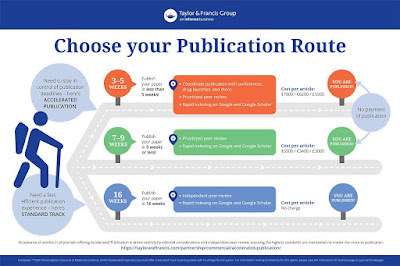
Academic publisher Taylor & Francis are offering a new service: “accelerated publication.” expedited review.

Choose your publication route

An example:

Publish in 3 – 5 weeks from submission

  • Submission to acceptance: 2-3 weeks
    • 1-2 weeks for peer review
    • week for author revision
  • Acceptance to online publication: 1-2 weeks, with proofs within 5 working days and 48 hours for author review
  • Cost per article: $7000 / €6200 / £5500

Of that $7,000 (US dollars, presumably – hey everyone, currencies of many nations are called “dollars”), a small sliver of that goes to reviewers: “In recognition of the time constraints required of them, reviewers of Papers taking the 3-5 weeks option are paid an honorarium of $150.”

Of course, there are some people who will complain that 5 weeks to publication is still too long because there are a lot of academics with unreasonable expectations of how long peer review should take

So now we enter the cycle. 

Step 1: Academic publisher says something about journal operation that involves money.

Step 2: Academics complain. 

In this case, there’s good reason to complain. This scheme has issues. But I’m not  going to do a detailed analysis of problems with paying for “accelerated publication,” because other people are going to do it better.

Instead, I want to point out that this is a 💯 percent predictable outcome of the pressures on academics.

There are a lot of academics whose publishing strategy is, “Send it to someplace with high probability of acceptance and get it out anywhere as fast as possible.” Heck, I see questions on Quora almost daily: “What is a journal in [field] with high acceptance rates, fast publication, and no article processing charges?”

(I’m surprised they don’t ask for a pony, too.)

I don’t think it’s any coincidence that the Taylor & Francis “accelerated publication” scheme looks like MDPI’s publishing model. I think both are being driven by the same forces.

I can’t prove it, but I strongly suspect that many of these academics prioritizing high acceptance and fast turnaround are not in G20 countries. This might explain why discussions of things like “accelerated publication” and MDPI on the Twitter community I’m in (G20, English speaking) are so negative, but publishers keep acting like there is high demand for this kind of publication.

If publishers are responding to demands from academics, we should be asking why customers want the things they want. Who are the authors who are freaking out so much over a few extra weeks in review and why?

Hat tip to Alejandro Montenegro on Twitter.

09 December 2021

University tells scholars what journals to publish in

University of SOuth Bohemia logo and MDPI logo

The latest news around the controversial publisher MDPI, from Katarina Sam on Twitter:

Our uni made official statement about publications in MDPI journals: Such papers will not be funded, supported, and considered as a valid scientific result. We were also recommended not to do any services for them.

From her Google Scholar page,  Katarina appears to be at the University of South Bohemia (which is an awesome name, incidentally). When I search for “University of South Bohemia MDPI,” I can’t find any official statement. The first page of hits is a list of MDPI articles where one or more authors have an affiliation with the University of South Bohemia. Searching the university website also returns no policy statement, but a few articles publihsed in MDPI journals.

I am interested in the policy statement because this seems to me to be very weird and very bad.

I was under the impression that the ability to choose which journals to publish in was part and parcel of academic freedom. Indeed, one of the arguments against open access mandates from funding agencies and others was that it compromised academic freedom. But I think people made a fuss there because such mandates meant they wouldn’t be able to publish in glamour mags like Nature and Science

Here, I am less sure people are going to make a fuss because a lot of people... dislike MDPI. 

I am very, very nervous about an institution trying to ban its faculty from using, not a single journal, but an entire publishing company.

I think MDPI will be outraged because the people in charge seem to have thin skins, but I don’t think they will be harmed much. MDPI clearly has authors who value their services.

I’m more concerned by the harm this precedent sets.

Update: Charles University has a vice-dean writing blog posts about MDPI. Not so much policy, but an expression of concern, I suppose.

But what’s the point of noting that MDPI is a “Chinese company (with a postal address in Basel, of course).” How is national origin relevant to the quality of an academic publisher? What is being implied here?

More edits: The National Publications Committee of Norway (they have one of those?) announced a new listing for dubious journals: “level X.” The article begins by singling out an MDPI journal that got added to the list.

I was about to tweet earlier today that “I wonder if the push against MDPI was because an institution was unhappy about paying open access fees.” And sure enough:

The phenomenon Røeggen refers to is open publishing with author payment. - Many are worried about the phenomenon. Not for open publishing, which I experience that there is great support for in Norwegian research, but the solution we have received in open publishing where the institutions have to pay when the authors publish, says Røeggen. ...

In recent years, the requirement for open publication, through national guidelines and the so-called Plan S, has created a significant shift. Now more and more money is being paid for publishing, instead of paying to be able to read the magazines.

Emphasis added. 

And I’ve said it before, but I’ll say it again: It is weird to me that academics will bitch and moan about how long journal reviews take (“Careers are on the line here! People’s lives are put on hold because reviews take so long!”), but then consistent and prompt review is used as a reason to suspect a journal.

Questions have been asked about the rapid pace from submission of manuscripts to publication and that this is in line with research quality.

MDPI is not alone here, though. Frontiers publishing and more traditional publisher Taylor & Francis also have journals making the “level X” status. Norway is also avoiding the “carpet bombing” approach taken by the University of South Bohemia.

Still. This is not a great week for MDPI specifically and perhaps for open access more generally.

Related posts

The paradox of MDPI

My resolve not to shoot the hostage is tested

External links

The same week that the researchers' article was published, the journal ended up on the gray zone list (Automatic translation of Norwegian title; article in Norwegian, naturally)

30 November 2021

PolicyViz interview

The real reason to write a book is to do interviews.

I’ve long noticed that I know the basic arguments of many books I’ve never read, because of the interviews authors gave arising from the book.

So I was very excited to talk about the Better Posters book with to Jon Schwabish (author of the excellent Better Data Visualizations, which I reviewed here) on the PolicyViz podcast. The episode is now available wherever you listen to podcasts!

Jon is a great person to talk to, and his questions got me thinking about some new topics that I hadn’t considered before.

This season, Jon has been experimenting with a video version of the podcast. I already knew of my bad speaking habits as an interviewer on audio (I go on tangents way to easily, I start sentences without knowing where they’ll land), but now I get to see entirely new bad habits (looking away from the camera, shifting my weight).

I mean seriously, why am I looking to my right so much? There’s nothing there...

If you are not interested in my voice or my face (and I can’t say I’d blame you), the show notes boast a complete transcript.

External links

PolicyViz podcast Episode #206: Zen Faulkes show notes 

22 November 2021

UK eyes new crustacean legislation

The Guardian is reporting that there is the potential new animal welfare regulations that would affect decapod crustaceans and cephalopods. The London School of Economics, whose report is being used to justify the move, seems rather more confident than The Guardian and is basically saying this is a done deal and that it will happen.

I am a little concerned by the backstory here, particularly cased on this:

The study, conducted by experts from the London School of Economics (LSE) concluded there was “strong scientific evidence decapod crustaceans and cephalopod molluscs are sentient”. ...

Zac Goldsmith, the animal welfare minister, said: “The UK has always led the way on animal welfare and our action plan for animal welfare goes even further by setting out our plans to bring in some of the strongest protections in the world for pets, livestock and wild animals.

“The animal welfare sentience bill provides a crucial assurance that animal wellbeing is rightly considered when developing new laws. The science is now clear that crustaceans and molluscs can feel pain and therefore it is only right they are covered by this vital piece of legislation.”

See, I want to know what Minister Goldsmith knows that I don’t. Because I follow scientific literature on this topic and the science on whether crustaceans “feel pain” is nowhere near as clear as Goldsmith claims. We are only barely getting a handle on whether crustaceans have nociceptors,

And “sentience”? Yeah, I don’t think there is a generally agree upon set of criteria for that, either.

A cursory glance at the London School of Economics report shows that none of the authors have stated experience in crustacean biology. (One studies cephalopod cognition.) A major review on this topic by Diggles (2018) is not included. Some of the references in the report are dated 2021, so leaving out a 2018 paper is a puzzling omission. 

But at first blush, this report looks more comprehensive than the documents used to argue for legislation in Switzerland. But I’ve only glanced at it so far, and will need some more time to read in detail.

References

Diggles BK. 2018. Review of some scientific issues related to crustacean welfare. ICES Journal of Marine Science: fsy058. http://dx.doi.org/10.1093/icesjms/fsy058

Related posts

Switzerland’s lobster laws are not paragons of science-based policy

External links

Boiling of live lobsters could be banned in UK under proposed legislation

Review of the Evidence of Sentience in Cephalopod Molluscs and Decapod Crustaceans

Octopuses, crabs and lobsters to be recognised as sentient beings under UK law following LSE report findings

19 November 2021

Do not make professors guess a student’s childhood

I was filling in recommendation forms for students today, and was gobsmacked by this question:

English Competency: For students whose first language is not English, please rank the applicant’s ability and comment on the applicant’s English competency in the box provided below.

Wow, that’s a bad question. Wait, let me upgrade that. That’s a freaking terrible question.

Why am I only asked to assess the English competency of students “whose first language is not English”? I know a lot of students who are native speakers whose linguistic skills are not good.

More to the point, how can I possibly know what a student’s first language is?

Maybe a student will mention this to me, but probably not. It’s not in a student’s records for a class. I am quite confident it is not part of a student’s university record.

(And this was a non-optional part of a form, which is also weird, because presumably I am supposed to skip it for native English speakers?)

The only way anyone could complete this part of the form is by making assumptions. So this question is code for:

“Does this student speak with an accent?”

“Does this student’s name look European?”

“Does this person have black or brown skin?”

The question singles out some people as needing extra “assessment”, but it’s based on the recommender’s stereotypes about who a “non native English speaker” is.

If you’re going to ask a question about language proficiency, ask, “Rate this applicant’s proficiency in communication” for every single applicant. Don’t even mention the language. Because there are some people who will never speak English who should be afforded the opportunity to have an education. (I’,m thinking of people who sign, for one.)

Update, 23 November 2021: In this case, a happy ending! The program changed the question so that every recommender is simply asked to comment on language skills for every applicant.

08 November 2021

The University of Austin: Stop it, you’re just embarassing yourself.

 Spotted on Twitter this morning (hat tip to Michael Hendricks):

We got sick of complaining about how broken higher education is. So we decided to do something about it. Announcing a new university dedicated to the fearless pursuit of truth::

It offers no degrees. It has no accreditation. This is its physical location:

REsidential house in Austin Texas that does not look like a university campus.

But they offer “Forbidden courses” where students can have “spirited discussions” about “provocative questions.”

Presumably for a tuition fee. Since this wouldn’t lead to any degree or course credits, not at all clear why would a student do this when they can just have an drunken argument in any bar with “provocative questions.”

Having been through the creation of a new university (in Texas, no less), I can say with confidence:

This is trash.

This is probably one of two things.

One possibility is that it’s a wild mix of huge egos and a cash grab. It will come to nothing besides  separating a few suckers from their money. It reminds me of a “university” created by a former US president that was sued and gave out a settlement of $25 million

Or maybe it’s a pure criminal operation

Everything about this stinks like the kind of stink that make you involuntarily gag and fight the urge to vomit.

Update: Sarah Jones reminds me:

I’m not convinced this experiment is going to last, but they seem to have money and as a general rule I think it’s wise to take the right as seriously as it takes itself.

This is true. Being badly wrong has not prevented many ideas from having amazing longevity.

31 October 2021

Science Twitter calaveras

Thanks Namnezia!

Skeleton wearing t-shirt with crayfish standing in front of poster
Poor ol' Zen Faulkes, 

the mob confused him for Guy Fawkes. 

Said "You got the wrong guy, I study crayfish!" 

But they thought he was being all selfish. 

From the bonfire he yelled "No, really, look at my poster!" 

That didn't work,they thought he was another imposter.

2011

25 October 2021

How to fix an author in 10 ways

Wow, it’s been far too long since I’ve had a new paper with my name on it.

I got an email out of the blue asking if I would be interested in participating in writing this paper. It arose from my earlier paper on authorship disputes (Faulkes 2018) and why I think we should have more alternative dispute resolution in academic publishing.

I said yes, obviously.

You will notice that there are an equal number of “strategies” and “authors.” This is not coincidence. For the most part, each person on the author list tackled one section of the paper.

I’m section #8. 😉

My section was originally something like “Seek arbitration.” This was obviously inspired by the title of my previous paper, but I wanted to make something that was a little more expansive and wasn’t as close to what I’d written before.

After we each wrote our sections, all the authors read through and left comments for each other. Steven Cooke did the work to smooth out the rough edges and harmonize the contributions of all the authors.

I made one other contribution. I think after the first draft went for review, Steven Cooke suggested it would be nice to have some sort of figure in the paper. I made this very quick and dirt concept figure in PowerPoint:

Flow chart with causes of disputes on left, dispute in middle, and solutions for disputes on right.

The final version in the paper is much better! It added more elements (four solutions instead of three). It used a lot of icons to make it much more visual.

So I am extremely pleased to have been part of this paper. I hope people find it useful.

References

Cooke SJ, Young N, Donaldson MR, Nyboer EA, Roche DG, Madliger CL, Lennox RJ, Chapman JM, Faulkes Z, Bennett JR. 2021. Ten strategies for avoiding and overcoming authorship conflicts in academic publishing. FACETS 6: 1753-1770. https://doi.org/10.1139/facets-2021-0103

Faulkes, Z. 2018. Resolving authorship disputes by mediation and arbitration. Research Integrity and Peer Review 3: 12. https://doi.org/10.1186/s41073-018-0057-z


24 October 2021

Science isn’t the only one fighting recommendation algorithms and bemoaning education

This article about crises in American evangelical churches resonates with crises we see in science communication.

The churches’ problems? People aren’t getting enough education and social media’s recommendation algorithms are too influential.

“What we’re seeing is massive discipleship failure caused by massive catechesis failure,” James Ernest, the vice president and editor in chief at Eerdmans, a publisher of religious books, told me. Ernest was one of several figures I spoke with who pointed to catechism, the process of instructing and informing people through teaching, as the source of the problem. “The evangelical Church in the U.S. over the last five decades has failed to form its adherents into disciples. So there is a great hollowness.” ...

“Culture catechizes,” Alan Jacobs, a distinguished professor of humanities in the honors program at Baylor University, told me. ... Our current political culture, Jacobs argued, has multiple technologies and platforms for catechizing—television, radio, Facebook, Twitter, and podcasts among them. People who want to be connected to their political tribe—the people they think are like them, the people they think are on their side—subject themselves to its catechesis all day long, every single day, hour after hour after hour. ...

(W)hen people’s values are shaped by the media they consume, rather than by their religious leaders and communities, that has consequences. “What all those media want is engagement, and engagement is most reliably driven by anger and hatred,” Jacobs argued. “They make bank when we hate each other.(”)

And wow, does that ever sound familiar.

The clergy bemoaning the lack of education in religious instruction puts a twist on the long-running arguments about teaching creationism in public schools. It suggests the reason some fundamentalists fought so hard on those issues because at some level they saw their own catechesis was failing.

Related posts

Recommendation algorithms are the biggest problem in science communication today

External links

The evangelical church is breaking apart


13 September 2021

The rise of TikTok in misinformation

Ben Collins’s Twitter thread about how misinformation about medication to get worms out of horses has become the cause du jour for many.

Can’t stress how wild the ivermectin Facebook groups have become. So many people insisting to each other to never go to an ER, in part because they might not get ivermectin, but sometimes because they fear nurses are killing them on purpose “for the insurance money.” ... It’s just a constant stream of DIY vitamin therapies and new, seemingly random antiviral drugs every day — but not the vaccine.

This is distressing, but I wanted to home in on this comment in the thread.

The ivermectin Facebook groups also offer a window into how pervasive antivaxx COVID “treatment” videos are on TikTok.

The groups serve as a de facto aggregator for antivaxx TikTok, a space that is enormous but inherently unquantifiable to researchers.

When I last wrote about the dangers of recommendation algorithms (in pre-pandemic 2019), I focused on YouTube. TikTok existed then (it started in 2016), but it wasn’t included in Pew Research’s list of social media platforms until this year.

Graph showing use of social media platforms in the US. 81% use Youtube, 61% use Facebook. No other platform is used by more than 50% of Americans. 21% of Americans use TikTok.

Even today, TikTok isn’t even used by one in four Americans. It’s more like one in five. It’s impressive that it’s pulled close to Twitter, which has been around far longer. And also frightening that it is having this outsized effect that is leading people to try... anything

Everything is a miracle cure, or it isn't, but every drug is worth a shot. Except, of course, the thing that works: the vaccine. Anything pro-vaccine is instantly written off as “propaganda.”

There are lots of issues raised here that I can’t process all at once. But I think Collins’s comment that TikTok is unmeasurable for researchers strikes me at something important. Could the requirement for more data transparency in how TikTok selects what videos to show someone help? Not sure. 

But we may be at the start of an arms race between social media platforms using data to show things to viewers, and researchers trying to “break the code” to figure out just what the heck people are actually seeing.

Related posts

Recommendation algorithms are the biggest problem in science communication today

External links

Social Media Use in 2021 - Pew Research

Naming the animals in research papers

This is Bruce. 

Bruce, a kea with no upper beak, holding an object with his tongue and lower beak.

Bruce has been making the news rounds because of a new paper demonstrating that he uses pebbles to groom. Bruce is a kea, a parrot that normally has a large upper beak, which Bruce does not have. In the picture above, you can see him using his tongue and remaining lower beak to pick up an object.

What I want to talk about is not the tool use (although that is cool), but that I know this bird was given a name. Because I found this paper within days of finding another paper about an unusual bird: an Australian musk duck named Ripper. 

Ripper’s claim to fame was that he was able to imitate sounds, like creaking metal and even human voices. Ripper seems to have picked up the phrase, “You bloody fool” from humans around him. 

This is interesting because vocal learning is found in only a few lineages and hasn’t been documented in ducks before.

But what interested me in both papers is that the scientific papers repeated refer to these bird by the names that humans gave them. Not just once in the methods as an aside, but all the way through.

I can see the value of using a given name in news articles and blog posts like the one I’m writing. And maybe it makes scanning the paper a little easier. But the kea paper refers to “Bruce” 62 times; the duck paper refers to “Ripper” 40 times. The extensive referencing to these names in the journal articles gives me pause.

It’s been clear for a long time that the efforts to keep animals at arm’s length to avoid humanizing them (a position taken furthest, perhaps, by B.F. Skinner and other behaviourists in American psychology) is a lost cause. The approach of people like Jane Goodall (who named her chimps rather than just giving them numbers) has won. 

But these two approaches sit on opposite ends of a continuum. And quite often, there’s a pendulum swing in attitudes. I wonder if the pendulum has maybe swung a little too far towards our willingness to humanize animals in the scientific literature.

It’s easy to slip into teleology (assuming everything has a purpose) and anthropomorphism (thinking animals are like humans). And constantly referring to animals’ names throughout a paper seems to make that even easier. 

I’m not saying that the names we give animals should never be mentioned in papers. But maybe it could be once or twice instead of dozens of times. 

And hey, these animals didn’t get to pick their names. Maybe that duck was thinking, “I say ‘Bloody fool’, and they name me ‘Ripper’ on top of that? Could I be any more of a cliché Australian?)

A Twitter poll suggests I am not alone in being wary of this practice.

References

Bastos APM, Horváth K, Webb JL, Wood PM, Taylor AH. 2021. Self-care tooling innovation in a disabled kea (Nestor notabilis). Scientific Reports 11(1): 18035. https://doi.org/10.1038/s41598-021-97086-w

ten Cate C, Fullagar PJ. 2021. Vocal imitations and production learning by Australian musk ducks (Biziura lobata). Philosophical Transactions of the Royal Society B: Biological Sciences 376(1836): 20200243. https://doi.org/10.1098/rstb.2020.0243

02 September 2021

Gender’s role in authorship disputes: Women try to prevent fights but still lose out

Black king and white queen chess pieces.
Sometimes, I hate being right.

Ni and colleagues have an important new paper on authorship conflicts that confirms something I sort of predicted back in 2018. That people with less professional and social power get hosed by authorship disputes. In 2018, I wrote, “loss of credit due to authorship disputes may be a little recognized factor driving underrepresented individuals out of scientific careers”.

Ni and colleagues confirmed that women get into more authorship disputes than men. This is despite women more often trying to negotiate authorship in advance. (To me, most surprising and depressing finding.)

To me, this supports the argument that we need more ways to help authors resolve disputes and support authors with less power. I suggested mediation and arbitration could be more common. I don’t care if people buy into that idea, but I hope that people can see that the status quo harms our efforts to create a more equitable scientific culture.

A caveat about the new paper. For some analyses, the paper guesses at gender by using an algorithm on names. This has problems. (Edit: Several authors tweeted a clarification for how this algorithm was used and that it was tangential to the main findings. Ni, LaRiviere, Sugimoto) This suggests journals should capture more data about authors than name (usually in English only), institution, and email. Or maybe that could become part of an ORCID profile. Actually, I like that idea more.

A logical follow up to this new paper would be to look at how authorship disputes shake out in other historically excluded groups. I’ll bet a dollar that white men consistently experience fewer authorship disputes than anyone else.

The Physics Today website has more analysis. (I was interviewed for this, but didn’t end up with any quotes in the article.) So too does Science magazine news.

Additional, 3 September 2021: I just want to emphasize why I think authorship disputes are so important for us to talk about.

There is a lot of research on gender differences in science. We know things women tend to get cited less than men, women tend to win fewer awards than men, women tend to be invited speakers less often then men.

But we know all these things because they are public.

It’s a major win for researchers have get access to journal records of submissions, because it’s something that is typically not disclosed and is very informative.

When we analyze citations and the like, we kind of assume that they reflect the work done. Maybe not perfectly, but reasonably.

Authorship disputes are kind of insidious because they are generally private, and affect what gets into the public record in the first place. It is an unrecognized and unacknowledged filter affecting people’s careers.

References

Ni C, Smith E, Yuan H, Larivière V, Sugimoto CR. 2021. The gendered nature of authorship. Science Advances 7(36): https://www.science.org/doi/10.1126/sciadv.abe4639

Faulkes Z. 2018. Resolving authorship disputes by mediation and arbitration. Research Integrity and Peer Review 3: 12. https://doi.org/10.1186/s41073-018-0057-z

External links

Women in science face authorship disputes more often than men

Are women researchers shortchanged on authorship? New study highlights gender disparities

Pic from here.

29 August 2021

Kill the chalk talk?

A “chalk talk” is an unscripted presentation that allows a job candidate to outline something “on the spot,” live. In many departments, this is supposed to be a chance for a candidate to talk about their research and how they plan to create an ongoing, funded research program.

Since chalkboards have mostly been abandoned for years, the term probably only still exists because it rhymes. In fact, in engineering and computing business and industry job interviews, these are called whiteboard interviews. But there, some have pointed out that whiteboarding is a problematic interview practice.

It’s got nothing to do with the skills needed to succeed at the job.

Wayne Brady
Asking a scientist to try to create a grant proposal on the spot is like asking a film actor to do an improv comedy scene as part of an audition. If that were the norm. Wayne Brady would probably be the biggest start in Hollywood. Sure, some actors are great at improv, but that’s generally not how film works. Films have scripts and preparation time. 

Chalk talks are likely to be one of those common practices that contribute to academia’s low diversity. It seems likely that there could be many people who are thoughtful but slow to process questions who might fare poorly in a chalk talk. On the other hand, there may be people who are exceedingly good at oral explanations but who are undisciplined writers. 

And if this is all allegedly about grants, grants live or die on the page, not the stage. Besides, job candidates always send a research statement as part of the application package. So marking someone explain it all again feels more like hazing than a useful way of assessing a candidate.

Departments don’t need these. I witnessed a fair number of academic job interviews in at least three institutions in as many countries. None of them asked a job candidate to do a so-called “chalk talk.” 

Update, 30 August 2021: Unsurprisingly, some people disagree with this. Jason Rasgon offered this defense (I’ve stitched together a few tweets):

Chalk talks have some value for a very narrow slice of institutions (generally soft money Medical or professional schools). I agree, mostly useless for other places. But when I was soft money I saw many faculty applicants who had a written document who couldn't articulate a plan of attack at the chalk talk. Several of them were still hired, they didn't last. When you’re soft money (the institution pays little to no salary, you have to pay your own salary by your own grants - ZF), you don’t have luxury of taking your time to organically develop a research program. You have to hit ground sprinting from day 1. Chalk talk should be easy, as you should have all this developed (and maybe submitted already). If you don’t, you’ll have problems. The people I saw have issues knew in general what they wanted to do but hadn't sat down and worked out the specifics.

Michael Eisen writes (again, stitching tweets together):

I’ve attended over 100 faculty candidate chalk talks, and would say they've played a significant role in hiring decisions maybe a dozen times, all in the favor of the candidate, because they gave us insights into strengths that did not manifest in their application. In contrast to the dominant opinion, which seems to be that chalk talks are about gotchas or testing peoples' ability to think on their feet, in my estimate their major role in the process is to give people an opportunity to address weaknesses in the rest of their application. When the format and purpose is clearly articulated, and when individual faculty are not allowed to derail the process (which can happen), they are an immensely useful part of the process. ... (T)he call for eliminating chalk talks is a copout that doesn't actually address the problem, and is part of a bad trend to provide candidates with fewer ways to demonstrate their qualities

I’m thinking about these points. I appreciate what they are getting at, but I think the qualifiers in these are hugely important. “When the purpose is clearly articulated” is my big one, but “when not derailed” is also up there.

We want job candidate to interact with people and answer questions about their research, but it seems unclear what people are trying to assess and whether this is the best format to do it.

Eisen is right that if you remove part of the interview process, you have less information about the candidate. So re-evaluating the chalk talk concept should also include “Can we come up with something that more directly evaluates the relevant skills?”

If the goal is to evaluate someone’s research, maybe those statements of research interest that is required of every job application should play a bigger role? 

A written statement better reflects grant writing. It’s faster and more time efficient to read a few pages than listen to hour long talk. And it’s less stressful for candidate.

If the research statement that was part of the initial application is too short, maybe creating a beefed-up version can be part of the shortlist interview process.

More additional: Later, Eisen wrote:

i actually wish we had prospective candidates teach a class, but that's obviously a bit too much to ask of them
For many institutions, asking a candidate to prepare a research seminar and a guest lecture in a class is probably more helpful than asking a job candidate to effectively give two research talks (seminar and chalk talk).

Andy Fraser wrote:

I have seen candidates with stellar CVs that gave extremely polished research talks that apparently could not cogently discuss a single part of their research proposal or who reacted with hostility to questions. I don't know how else I would have found that out.

In light of the excellent commentary, I have added a question mark to the title of this post. 😉

External links

It’s time to end whiteboard interviews for software engineers

14 August 2021

Are we trying to solve the wrong problem with anonymity in peer review?

One of academia’s evergreen topics, anonymity in peer review, has cropped up again on Twitter. 

This is something I’ve changed my mind about a lot since I’ve been blogging. But today, the thought struck me that we put too much emphasis over whether review should be anonymous or not.

We do not put enough emphasis on people not being assholes about getting reviews.

The whole thing driving arguments around anonymity is, as far as I can see, driven by fear of retribution. “If I write a bad review of someone else, they will be petty and have the ability to sink something of mine later.”

As much as I appreciate the argument that people are horrible (they are) and you have to account for things that people regularly do (people are often petty and vindictive), it seems to me there is a lot of possibility to move the dial on author behaviour. To say, “We won’t put up with your little revenge plots.”

Do I know how to do this? No, not yet. I’m just blogging here.

It’s also likely that a lot of bad behaviour here is driven by the sense of research being a zero sum game. Which, in the current funding climate, it is dangerously close to being. If there was no so much competition and windows of opportunity were not so small, people would worry less about whether some jerk is going to try to give you a bad review on a grant because you were critical of their manuscript.

10 August 2021

Thanks to you, ComSciCon!

Zen Faulkes on Zoom screen with Godzilla in background.Just briefly wanted to follow up on my appearance last week at ComSciCon. The storytelling panel I was part of was excellent (despite my presence) and I was also able to work with small group on short journalism pitches. 
There was not a coherent thread or panel hashtag, so here are tweets from the storytelling session. (Darn it, I miss Storify.) These are in roughly chronological order, and I would normally cut and paste the tweet text, but I have some other tasks to do and it would take too long to make it pretty right now.

Thanks to the organizers for posting a non-derpy Zoom screenshot of me!


Related posts
 

26 July 2021

The currency of science is currency

Coins and bills from many countries.

 I used to tell students, “Your publications are gold. Peer reviewed journal articles are the currency of science.”

I don’t think I’m going to tell them that any more.

Kat Milligan-Myhre brought this blog post to my attention, bemoaning that administration at University of Wisconsin sees money as an end, not a means to an end. This aligns somewhat with my own experience in the US. I want to talk a little about we got to this point. 

In the early 2000s, two things happened.

Graph showing basic research expenditures from US goverment agencies from 1976-2020, with NIH having the largest budgets.

First, in the US, the National Institutes of Health (NIH) doubled their budget throughout much of the 1990s. Universities responded to that incentive and built infrastructure and hired faculty in biomedicine. But that budget doubling stopped in the 2000s. When you account for inflation, the budget shrank over the next few years. Universities had invested so deeply that they couldn’t back out, and were determined to get that money. 

In my experience, many university administrators were not truly aware that the budget had stopped increasing and did not realize how competitive grants had become. They had spend the better part of a decade hearing how big the NIH budgets were and couldn’t face the new reality.

You may object that this is only biomedicine and only in the US. True. But the NIH had the biggest basic research budget, and trends in the US tend to get reflected elsewhere.

Plus, something else happened in the 2000s. Academic publishing embraced the Internet and stopped relying on paper copies.

I point, as I often do, to the debut of PLOS ONE in 2006 as a significant turning point in academic publishing. It only reviewed for “technical soundness,” not “quality.” Because of that, people complained that “they will publish anything” (even when this was clearly not so). Nevertheless, it certainly expanded the range of papers that were publishable.

It not only published more papers, but other publishers copied the model. The number of peer-reviewed journals expanded significantly. 

And we also got journals that only pretended to be peer-reviewed adding confusion to the mix.

People evaluating faculty had often counted the number of publications because it is simple and does not require deep knowledge of the content of the papers. But as a whole swathe of new journals arrived, I am willing to bet that more and more faculty were able to push out papers somewhere.

From the point of view of someone attempting to evaluate faculty (because “excellence” and everything), this meant that publication number was not informative because there was less variation, and because administrators often aren’t active researchers themselves, they worried about noise and whether they could trust whether the journals were “real” journals.

But the grant process was still exclusive, and – importantly – still run by scientists. Grants still had the imprimatur of peer review.

Even if you put aside the desire for money, I could see how an administrator might prefer to switch from a simple metric that has lost much of its signal and is potentially corrupted (number of publications) to a different simple metric that is more exclusive and is still perceived as having integrity (number of grant dollars).

At this point, maybe we should update our vocabulary. Instead of “professor” or “researcher,” we should call people “research fundraisers.”

From now on, I’ll probably be advising students to look for competitive opportunities like scholarships and society grants as much as I advise them to publish.

External links

wtf uw 2: the new wisconsin idea is money

23 July 2021

ComSciCon 2021

I’m excited to be presenting at ComSciCon 2021! I’ll be part of a panel and workshop on creative storytelling on 5 August 2021

It’s a bit intimidating to be sharing space with:

I look forward to contributing!

External links

ComSciCon


22 July 2021

Mission declined

Should you choose to accept it

Terry McGlynn tweeted (in reply to an article I couldn’t see): 

Want more people to accept and understand evolution? 
Your mission, should you choose to accept it, is to emphasize that religion and evolution are compatible.

My problem with this is that “religion” is not one thing. There are thousands of religions. There are even many branches of what is ostensibly a single religion.

For many people, they are not concerned with whether some scientific claim like evolution is compatible with some religions. They are concerned, often deeply so, if a claim is compatible with their religion. I do see how saying, “The Catholic church is okay with evolution” is supposed to convince a Protestant. 

Trying to convince someone that “religion and evolution is compatible” mean trying convince people to change their religion. I am not prepared to wade into theological disputes between religions.

I do not want that mission.

19 July 2021

Damn it.

Dr. Kristine Lowe
One of the things I was most proud of doing in my time at The University of Texas-Pan American was chairing the search committee that recommended hired Dr. Kristine Lowe.

Kristi died yesterday.

Damn it.

Kristi was great with students and had a lot of them go through her lab.

Given that we had, like, 60% women as our students, I think her presence was so important for our department. At the time, there was only one woman on tenure / tenure track in the entire department.

Eventually, she started to step more into administrative and leadership roles and had been chair of the department for several years. Unsurprisingly given the department composition she came into years ago, she was the first woman to chair the department.

She was always friendly, supportive, and always willing to work with you. She was a good colleague and I hate losing her.

Damn it.

04 July 2021

You don’t have to use bad data

 A routine case of a bad paper attracting a lot of criticism and then getting retracted

The one thing that I wanted to comment on was one of the authors trying to defend their work.

We are happy to concede that the data we used… are far from perfect, and we said so in our paper. But we did not use them incorrectly. We used imperfect data correctly. We are not responsible for the validity and correctness of the data, but for the correctness of the analysis. We contend that our analysis was correct. We agree with LAREB that their data is not good enough. But this is not our fault(.)

My head is kind is spinning from this argument. If you know the data are bad, you could, you know, leave it alone and not write an entire academic paper that depended on it. Especially when it concerns an ongoing public health crisis.

The data may not be your fault, but that does not mean you are without fault.

External links

https://retractionwatch.com/2021/07/02/journal-retracts-paper-claiming-two-deaths-from-covid-19-vaccination-for-every-three-prevented-cases/


01 July 2021

Ant bites

In two days, two insightful pieces of writing have dropped that feel like bookends to each other. Both deal with the effects of social media – or, to be more specific, Twitter – on individuals who get on the wrong end of anger.

First is a retrospective and analysis by Emily VanDerWerff of how Twitter controversy about a single science fiction short story effectively crushed the writer’s desire to ever write again. And that was probably the smallest effect the controversy had on author Isabel Fall.

Second is a description of how social media dynamics are still not grasped by journalism as a field. Charlie Warzel provides brings some useful terms that I hadn’t seen before, like “context collapse” to the discussion.

Both remind us that human beings are used to dealing with small social networks. We aren’t ready for the level of attention that you can get if you become the center of a viral online discussion. VanDerWerff writes:

But in any internet maelstrom that gets held up as a microcosm of the Way We Live Today, one simple factor often gets washed away: These things happened to someone. And the asymmetrical nature of the harm done to that person is hard to grasp until you’ve been that person. A single critical tweet about the matter was not experienced by Isabel Fall as just one tweet. She experienced it as part of a tsunami that nearly took her life.

Warzel says:

Many leaders at big news organizations don’t think in terms of “attack vectors” or amplifier accounts, they think in terms of editorial bias and newsworthiness. They don’t fully understand the networked nature of fandoms and communities or the way that context collapse causes legitimate reporting to be willfully misconstrued and used against staffers. They might grasp, but don’t fully understand, how seemingly mundane mentions on a cable news show like Tucker Carlson’s can then lead to intense, targeted harassment on completely separate platforms.

The “Ant bites” of the title of this post?

When you tweet something, it can feel like you have the power of an ant. And a single ant is usually inconsequential. “Squished like an ant.”

But in 1998, Joe Straczynski wrote a warning (in the usenet newsgroup rec.arts.sf.tv.babylon5.moderated).

(E)ven a whole human being can be eaten by ants.

It’s easy to make the mistake of tweeting at or about someone and think you’re just making conversation. Sure, if you were in a room with a person and knew them, it’d probably be fine. But you forget that you probably see only the tiniest sliver of that person’s experience. Your tiny little comment might be part of a much bigger pattern for the recipient. A single ant bit. But the person on the other end might be getting eaten alive by ants.

I am thinking back to a lot of online controversies in science around, say, a decade ago. I think we probably underestimated how rough those could be on researchers. Nobody had a “social media IQ” then. The good news was that the online communities were smaller then, so the anthill might not have delivered quite as many bites as it could now.

External links

How Twitter can ruin a life

What newsrooms still don’t understand about the internet