
24 August 2009
Ditching carrots and sticks
I’ve been waiting to see this talk, and am not disappointed. To sum up: Businesses try to improve productivity using rewards, but rewards impair performance on many kinds of tasks. Performance is enhanced more by mastery, autonomy, and purpose.
Dan Pink puts all of this in the context of business: business works an an incentive, reward-bases system that only produces results in a very narrow range of tasks.
Education is suffering from the same problem as business. If anything, education is far worse off.
Increasingly, what we want students to do is not simply master rules. (There are some exceptions, perhaps: basic arithmetic, maybe.) We want students to learn how to learn, solve problems, develop their bullshit detectors. We want people to be able to solve “candle problems,” as Pink puts it.
But education is mired as deeply in this incentive structure as business; arguably more so. What are A grades if not carrots? What are F grades if not sticks?
Being an academic and an instructor, I should be able to do something about this in my own classes, right? Frankly, I’m too gutless to try. Academia does not look kindly upon instructors who try to throw those carrots and sticks away. I think a lot of students would also revolt.
So far, I have only the inkling of one idea how to tackle this. Pink talks about a couple of companies who let their employees work on anything they want for 10-20% of the time. That might be a starting point: not prescribing topics, but allowing students to have part of their grade rest on doing a project that was important or interesting to them.

Doing the wave, crab style
 Editor's Selection Icon
 Why do animals of a particular species living in different regions show different behaviours? One possibility is that animals have a big behavioural repertoire, and that they tweak their behaviour to suit the particular conditions they find themselves in. Alternately, animals might be somewhat more stereotyped in their behaviour, and different populations have been selected to perform different behaviours over evolutionary time.
 This new paper by Zayasu and Wada looks at this question in a little crab, Ilyoplax pusilla. I’d never heard of this species before this paper (not surprising, because they are an Asian species), but now I’d like to see them. They do a behaviour called waving with their claws, shown at right. I think it looks cute.
The function of the wave is not 100% clear. The authors imply that only the males wave, and that it can be either a sexual display for females or a threat display towards other males.
Some researchers had noticed that in one region, the Yakugachi River, the crabs waved more than the other populations. The river region there is described as somewhat gravelly area, near mangroves.
To answer whether there was something about this one region that led the crabs to wave more often, and whether the crabs could adjust their displays, they simply carted a bunch of crabs from Yakugachi River to Uchinoura (a bare, muddy region) and vice versa. If there was something about the environment the crabs were responding to in real time, you would expect all crabs, both natives and imports, to do the same amount of waving.
The crabs were all housed individually at these sites in small boxes, roughly one metre apart, and video recorded at set times for almost a week. Because there are regions where these crabs live, they could also measured how many non-captive crabs were around their subjects.
The bottom line is that the crabs kept right on doing what they were doing, regardless of the new environment. The Yakugachi River crabs kept waving way more than the others. The difference in frequency didn’t seem to affect how many crabs were around at all.
This difference in waving behaviour could be the result of natural selection. If so, the question becomes what advantage does waving provide to the crab?
Zayasu and Wada also raise the possibility that, because these were adult animals, they could have learned what the typical waving rate when they were young, and are now stuck with the waving of the crab society they grew up in, much like human accents. If that were so, you might expect the “norm” to drift from year to year, but the authors imply that this is not the case. It’s hard to judge how plausible such a learning hypothesis might be without knowing more about the natural history of the species.
Reference
Zayasu, Y., & Wada, K. (2009). A translocation experiment explains regional differences in the waving display of the intertidal brachyuran crab Ilyoplax pusilla Journal of Ethology DOI: 10.1007/s10164-009-0177-5
21 August 2009
They might be giants: How do sticklebacks get so big?
Weird things happen when organisms get cut off into small areas. Look at islands. Homo floresiensis, the Flores Island “hobbit,” was a very small human that probably evolved on an island. On the other hand, you’ve also got wetas, which are the biggest crickets you’ll ever see, which also evolved on an island. It seems that big things get small and small things get big on islands. I guess the perfect size for any animal on an island is a rabbit.
Ponds and small lakes are also islands. They’re wet instead of dry, but from the point of view of evolution, you have a lot of the same factors that come into play: small populations, sometimes few competitors or predators, and new niches to exploit.
 This paper looked at evolutionary body size changes in nine-spined stickleback. These hardy fish are sometimes the only fish in small ponds and lakes in their range in northern Europe, but in larger lakes, rivers, and the ocean, they are one among many fishes – often bigger fishes, with large appetites.
Although the title refers to “giantism,” giant is a relative thing. The largest fish they found had a length of about 7 cm; “palm of the hand” kind of size. But when you consider that many other populations had lengths of about 4 cm, you have to admit that almost twice the size probably counts as giant for that species.
Those largest fishes were found in the isolated ponds, as suspected. The pond fish sorted out into two groups. The smallest sticklebacks were in ponds that also contained three-spined sticklebacks or trout.
When they reared eggs from fish collected from these various ponds in the lab, they found the “giants” were on a completely different growth trajectory almost from the get go. So it did not seem to be the case that the large fish were large just because they were living longer because there were few predators around. Turned out the big ones also lived longer, giving those populations a double whammy to reach their large size. These two points suggest that these size differences are genetically controlled, and thus heritable, and are not due to increased food availability, say, or other environmental effects.
The authors rightly refer to the all of their lakes and rivers as “natural experiments.” Still, a natural experiment is still not as clean as a lab experiment, and perhaps there could be some manipulations to test some of the hypotheses coming from their data. And although this paper supports the idea that islands are hotbeds for evolution of body size, it doesn’t seem to help move forward in predicting if a species in isolation is going to get bigger or smaller.
Reference
Herczeg, G., Gonda, A., & Merilä, J. (2009). EVOLUTION OF GIGANTISM IN NINE-SPINED STICKLEBACKS Evolution DOI: 10.1111/j.1558-5646.2009.00781.x
20 August 2009
Smart is sexy for satin bowerbirds
Bowerbirds are one of those fascinating species that you just have to love. The male constructs elaborate structures (bowers) to lure in females, going to great lengths to find just the right pieces. Some say that such structures are analogous to human artwork.This new paper is the first to test an hypothesis that has been around for a few years that general cognitive ability may affect reproductive fitness. Kaegy and colleagues list a few ways that this could happen. Good cognitive skills may:
- Be indicative of good genes.
- Allow a parent to be a better provider.
- Allow one individual to trick another into mating (similar to an idea in this paper).
- Let one individual to attune courtship and mating behaviour to the desires of a wider variety of partners.
Curiously, in three of these four, they list the male as being the one that benefits from good cognitive performance. Why enhanced cognition should be an advantage for males, but not females, in providing for offspring (say) is not at all clear.
 They tested the bowerbirds’ problem solving ability by exploiting the birds’ colour preferences. Males love having blue objects in their bowers, and they hate having red objects in their bower. The team somewhat evilly conspired to place a bunch of red objects in males’ bowers... but made them rather difficult to remove.
 In one case, they covered the red objects with a container. Birds had to removed the cover before they could get to the offending red bits. Males differed in how long it took them to solve this task, so there is variability that could be subject to selection. Males who solved the problem faster tended to have more mating success.
In the second test, the authors placed three tiles (one blue, one greed, one red) near the bower in a triangle. All were bolted down, so the bird literally could not remove them. The solution is not to take the red objects away, but to cover the red tiles with other materials. Here, the outcome is more complicated. The amount of red tile covered was not correlated to mating success until some statistical jiggery-pokery is done to correct for the males’ age. The position of the red tile in the triangle was also having an influence. The amount the red tile was covered did correlate with mating success, if the tile was in the position closest to the nest.
Somewhat strangely, getting a good score on the one test (clear covering) was not correlated with a good score on the second test (bolted objects). Again using some statistical procedures I am not really familiar with, the authors say when both results are considered, that problem solving correlates well with mating success.
The females didn’t see any of these males’ mental gymastics, as they rarely visited the bowers.
In this species, these results suggest that general cognitive skills are not due just to being a good provider, because since the males’ success was just in getting more copulations, not rearing offspring. It also seems unlikely that cognitive ability is being directly assessed by the females, since they weren’t around to see all this.
The discussion returns to a very strangely male-centric point of view. For instance, let me add some emphasis to this quote:
One prediction is that species with more intense sexual selection, such as polygynous species, should have enhanced cognitive abilities because of more intense selection for males with better cognitive performance.
It seems odd to argue that selection pressure on males specifically. Many of these hypotheses include the notion that females are constantly assessing males – and assessment is a cognitive task, just like problem solving is. You have to remember, compare, and so on. (There are some sections of the paper that are a little more nuanced, but still.) If New Scientist can be chastised for its “geeks get the girls” line on this story, the authors could also do with a little egalitarian editing.
Media coverage here and here. I confess to being a bit disappointed because I had planned to blog about this before those articles came out, but I was too slow this time.
Reference
Keagy, J., Savard, J., & Borgia, G. (2009). Male satin bowerbird problem-solving ability predicts mating success Animal Behaviour DOI: 10.1016/j.anbehav.2009.07.011
Picture by user bdonald on Flickr and used under a Creative Commons license.
Texas Higher Education and Creation Research, Part 35
The Panda’s Thumb has an update on the lawsuit the Institute for Creation Research has launched against the Texas Higher Education Coordinating Board, a story which I have tracked here.
The previous version of the suit was described as “gloriously insane.” The new version, according to Panda’s Thumb writer Timothy Sandefur?
The previous version of the suit was described as “gloriously insane.” The new version, according to Panda’s Thumb writer Timothy Sandefur?
20 pages of non-stop, thigh-slapping hilarity.
18 August 2009
Tuesday Crustie: The colour purple

A porcelain crab, Petrolisthes violaceus.
From Ivan Hinojosa on Flickr and used under a Creative Commons license.
15 August 2009
Comments for first half of August
A post from this blog is featured at the Carnival of Evolution #14.
At The Ethical Paleontologist, I weigh in on the vexing problem of appropriate lunch gear.
I also answer this question posted by All My Faults are Stress Related:
At The Ethical Paleontologist, I weigh in on the vexing problem of appropriate lunch gear.
I also answer this question posted by All My Faults are Stress Related:
Are you inspired by the things you think are supposed to spark your ideas?
14 August 2009
“We cheated death”
I was planning on going to the South Padre Island beach today and showing a student a bit about sand crabs.
Didn’t make it.
About a half hour into the drive, I noticed a truck in the lane to my right suddenly had smoke coming from the driver’s side front wheel well and started to swerve towards my lane.
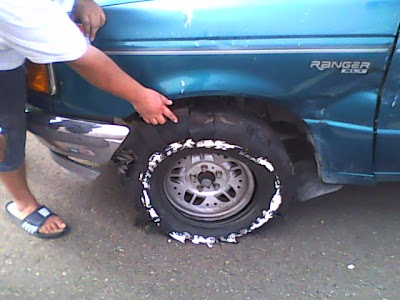
“Well there’s your problem right there.”
The tire on the truck had blown out. I tried to get out of the way, but failed. We hit each other. He skidded towards the barricades (and thought he was going to go over), I skidded and stopped straddling the two center lanes of traffic. But the only things either of us hit were each other, which was good considering the circumstances.

The picture shows the good news about this whole thing: relatively minor damage to both vehicles, everyone fine, both vehicles still drivable. The other driver, Juan, was about as composed as could be expected, but did say at one point, “We cheated death.”
And with a highway speed tire blowout, I can’t really disagree with him. It could have been one hell of a lot worse. As it was, it was just one step up from a fender bender. My body didn’t even kick up an adrenaline rush, let alone the whole “life flashing before my eyes” or pithy last thoughts.

I made a few phone calls (luckily, I had mine with me; the other guy didn’t) to my insurance company, who gave me the local police department number so I could report the accident.

And so we were later joined by a couple of fine Mercedes police officers who took our accident report, and stayed around to help the other driver until someone could show up to help replace the tire. He had a spare, but not a jack to lift the truck.
So I phoned my student and a few others to let them know, and headed back home rather than risking a longer round trip, in case there was some hidden damage to the car that might act up on a longer trip.
So that was my morning.
Didn’t make it.
About a half hour into the drive, I noticed a truck in the lane to my right suddenly had smoke coming from the driver’s side front wheel well and started to swerve towards my lane.

“Well there’s your problem right there.”
The tire on the truck had blown out. I tried to get out of the way, but failed. We hit each other. He skidded towards the barricades (and thought he was going to go over), I skidded and stopped straddling the two center lanes of traffic. But the only things either of us hit were each other, which was good considering the circumstances.

The picture shows the good news about this whole thing: relatively minor damage to both vehicles, everyone fine, both vehicles still drivable. The other driver, Juan, was about as composed as could be expected, but did say at one point, “We cheated death.”
And with a highway speed tire blowout, I can’t really disagree with him. It could have been one hell of a lot worse. As it was, it was just one step up from a fender bender. My body didn’t even kick up an adrenaline rush, let alone the whole “life flashing before my eyes” or pithy last thoughts.

I made a few phone calls (luckily, I had mine with me; the other guy didn’t) to my insurance company, who gave me the local police department number so I could report the accident.

And so we were later joined by a couple of fine Mercedes police officers who took our accident report, and stayed around to help the other driver until someone could show up to help replace the tire. He had a spare, but not a jack to lift the truck.
So I phoned my student and a few others to let them know, and headed back home rather than risking a longer round trip, in case there was some hidden damage to the car that might act up on a longer trip.
So that was my morning.
13 August 2009
Texas Education Agency and Chris Comer, Part 39
The NSCE website is reporting that Chris Comer is appealing the court decision that rejected her lawsuit against the Texas Education Agency (TEA).
I’ve followed this story closely since its beginning. Click the link if you really want the long, sad tale.
I do not claim to have any deep knowledge of the American legal system, but my impression from reading the judge’s summary is that an appeal will be hard to get.
The heart of the TEA’s argument against Comer’s lawsuit was that their policy does not allow endorsement. That being the case, I wonder if Comer’s complaint might have gotten further if it focused on whether reasonable individuals would agree that forwarding an email with “FYI” constitutes an “endorsement.”
I’ve followed this story closely since its beginning. Click the link if you really want the long, sad tale.
I do not claim to have any deep knowledge of the American legal system, but my impression from reading the judge’s summary is that an appeal will be hard to get.
The heart of the TEA’s argument against Comer’s lawsuit was that their policy does not allow endorsement. That being the case, I wonder if Comer’s complaint might have gotten further if it focused on whether reasonable individuals would agree that forwarding an email with “FYI” constitutes an “endorsement.”
Investigations into albino murders being dropped
Last year, I wrote about the murder of albinos in Tanzania to make magic potions. I still cannot believe this story does not get more attention.
Now, court cases investigating these murders are apparently being dropped, according to a press release from Under The Same Sun.
Consider signing the petition. Agitate. Educate. Organize.
Now, court cases investigating these murders are apparently being dropped, according to a press release from Under The Same Sun.
Consider signing the petition. Agitate. Educate. Organize.
Putting my head down and getting it done
Not been blogging as much as I’d like recently, as I am acutely aware that I only have a few weeks left before classes start in which to finish writing about four manuscripts. Not the least of which is one the editor emailed me about last night. Ouch.
Data is being analyzed, and my office door is usually closed. As is often the case, some stuff I thought would be very simple isn’t.
Meanwhile, just for fun, here’s one of the few things that’s given me real joy the last few months. I’ve fallen in love with the music of Little Boots. She is such a great songwriter. And after days like the last few, I could do with a remedy.
Data is being analyzed, and my office door is usually closed. As is often the case, some stuff I thought would be very simple isn’t.
Meanwhile, just for fun, here’s one of the few things that’s given me real joy the last few months. I’ve fallen in love with the music of Little Boots. She is such a great songwriter. And after days like the last few, I could do with a remedy.
12 August 2009
It’s the old boy meets moth, moth meets girl story
It is an obvious fact to most humans that finding a mate is a difficult thing. Now trying doing that without moving.Of course, this is the problem faced by many plants. Some of the most successful, flowering plants, use animals to overcome this. But the addition of pollinators into the reproductive mix doesn’t change that there are differences in the interests of male and female plants. As in many animals. males are thought to be capable of producing more gametes, so gain greater reproductive success by dispersing as much pollen as possible.
 Wealti and colleagues examine whether those different reproductive interests of male and female flowers translate into how the flowers attract pollinators. They used a white campion (Silene latifolia), which has lychnis, a nighttime moth (Hadena bicruris) as one of its main pollinators. The females of this moth lay its eggs in the seeds of the plant.
The predictions are first, that male flowers should put more “effort” into attracting pollinators than females, and that this should actually work. That is, the moths should be more attracted to male than female flowers.
Because this is a nocturnal moth, you’d expect that things like flower shape and colour would not matter as much as odour, so that’s what the authors collected: floral fumes! Technically tricky, but once accomplished, they found that the male flowers released more odorants than females. The authors note that the amount of odorants are variable, however; indeed, other studies had looked for this difference, and didn’t find it.
To test the responses of moths to flowers, they reared moths in the laboratory, so the moths had no previous experience with flowers. The male moths were significantly more likely to approach male flowers; the female moths showed no preference.
 Wealti and company say that their results are consistent with the theory, because males more attracted to male flowers. On the other hand, it seems equally valid to say that their results are inconsistent with theory, because females moths are not more attracted to male flowers. That the behaviour of the moths is sex-specific raises interesting questions. The authors suggest that because females lay eggs on female flowers, female moths’ attraction to flowers might depend on the mating status of the females.
 Whether or not this is the case, it wouldn’t actually explain why unmated females show no preference to male or female flowers. If female moths can change from “no preference” to “preference for female flowers,” there seems to be no strong reason why a change “preference for males flowers” to “preference for female flowers” is somehow less probable.
References
Waelti, M., Page, P., Widmer, A., & Schiestl, F. (2009). How to be an attractive male: floral dimorphism and attractiveness to pollinators in a dioecious plant BMC Evolutionary Biology, 9 (1) DOI: 10.1186/1471-2148-9-190
Flower picture used under a Creative Commons license.
Moth picture by user troubleatmill used under a Creative Commons license.
11 August 2009
Tuesday Crustie: Part of the sea

Japanese spiny lobster (Panulirus japonicus).
Something about this picture just makes me think of old shipwrecks and things that have been in the ocean for a long, long time.
From user Nemo’s great uncle on Flickr, used under a Creative Commons license.
10 August 2009
Argument graph
At the Cosmic Variance blog, Sean Carroll presents what he calls the “Graph of Disputation.”
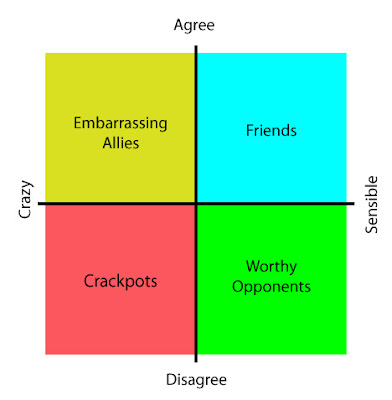
Sean’s point is that if you’re going to argue with people, you should spend your efforts in the lower right corner of the grid. I have two problems with this.
First, the X axis – whether an argument is sensible or crazy – can be incredibly difficult to recognize. I’ve blogged about it a lot here, usually under the “skepticism” label. Nobody is born with a bullshit detector; every one has to try to create one through experience.
Second, you ignore the crackpots in the lower left corner at your utter peril. Not all fools drool. Because people disagree over where things fall on the craziness continuum, the crackpots can suck normally sensible people over into realm of total wackiness.
And it often feels like the crackpots have infinite effort.

Sean’s point is that if you’re going to argue with people, you should spend your efforts in the lower right corner of the grid. I have two problems with this.
First, the X axis – whether an argument is sensible or crazy – can be incredibly difficult to recognize. I’ve blogged about it a lot here, usually under the “skepticism” label. Nobody is born with a bullshit detector; every one has to try to create one through experience.
Second, you ignore the crackpots in the lower left corner at your utter peril. Not all fools drool. Because people disagree over where things fall on the craziness continuum, the crackpots can suck normally sensible people over into realm of total wackiness.
And it often feels like the crackpots have infinite effort.

09 August 2009
Antiquated, heavy, expensive
 The title of the post is a quote by California governor Arnold Schwarzenegger in the New York Times. It could be a fun guessing game to figure out what he’s talking about. Ah, so many punchlines...
He’s talking about textbooks.
This article looks at the move toward digital textbooks, but I don’t think it goes far enough.
“I want our teachers to have the best materials available, and with digital textbooks, we could see the best lessons taught by the most dynamic teachers,” said John A. Roach, superintendent of the Carlsbad, Calif., schools. “But they’re not going to replace paper texts right away.”
Why not?
There’s only one substantive reason given in the article not to switch this instant:
Not every student has access to a computer, a Kindle electronic reader device or a smartphone, and few districts are wealthy enough to provide them. So digital textbooks could widen the gap between rich and poor.
I am still trying to figure out how textbooks have held on as long as they have, and whether there are any pedagogical reasons for keeping some of them.
08 August 2009
Compare and contrast
This summer, I have been making an effort to do more writing about peer reviewed papers. Several papers I featured ended up as featured articles elsewhere, which is a bit of a weird feeling. For instance, I write about gobies on 11 June, and New Scientist runs a story less than two weeks later.
Now, another research story I blogged about is handled by a major national magazine – with a horrible headline, by this reckoning.
Now, another research story I blogged about is handled by a major national magazine – with a horrible headline, by this reckoning.
04 August 2009
Tuesday Crustie: Back off!

Red-jointed fiddler crab (Uca minax).
Photo from Jax shells web page, and used under their terms of use.
01 August 2009

Comments for second half of July, 2009
Subscribe to:
Posts (Atom)