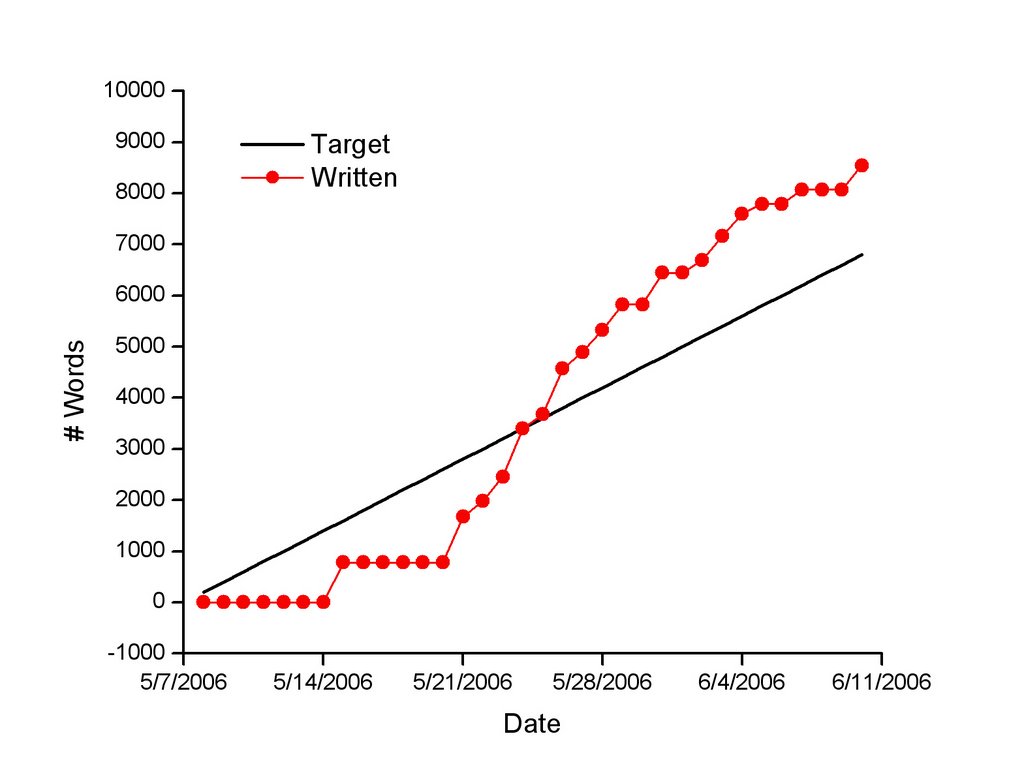
01 November 2006

Conference tidbits (delayed)

Been meaning to mention a few things about the NSF regional conference in Maryland last week.

I think the tone may have been set a little on Sunday, which was a day before the conference officially started. I went to attend a workshop there. There's supposed to be a morning and afternoon workshop on the grant application system NSF uses, called Fastlane. I got told at the registration desk that the person who was supposed to give the workshop just... vanished. Went AWOL. No show, no call, no notice... nothing.

I walk around a bit, thinking maybe this will be resolved by the time the second workshop shows. I show up at the building, which -- because it's Sunday -- seems to be locked up pretty tight. I eventually find one open door, and a couple of other prospective attendees and I go into the building. The workshop room is on the fourth floor.

The elevator only lets you go up to the third floor. The fourth floor you need a special key to be allowed to access. Okay, we try the stairwells. Locked.

Eventually, the few faculty (four of us), run into a woman who was instructed to allow us to the mysterious fourth floor. She tells us she was told to let people in at 12:30 -- our notes all said workshop was at 1:30.

The speaker is still, apparently, walkabout. Nobody for us to talk to.

One of the attendees tries to get a conference organizer on her mobile phone, only to get a message that the organizers are attending the NSF region conference for the next few days. Uh-huh. Eventually, I think someone gets an organizer on a cell. They suggest we slide into a similar workshop in another building, which is mean for administrators rather than faculty, but we are assured much of the information is still the same.

One of my favourite moments was when...

Actually, to understand the next bit, you should probably view a few pictures of the buildings at the University of Maryland, where we were. Check them out here.

Go on. I'll wait.

Really, I'll be here when you get back.

Dum dee dum de dum dee dumm...

Ah, there you are. Okay. After deciding to try to hit the other workshop, we walked out and we were trying to locate the building the alternate workshop was in. The woman next to me pointed and said, "Is it that brick building?"

I just had to turn to her and say, "They're all brick!"

"Oh, wait, let's narrow it down, the brick building with the white trim!"

(They all have white trim, too.)

Another moment that made me laugh was at the very end of the conference. They gave us little conference bags to carry around notes and programs and such. The conference officially ended at 4:00 pm Tuesday.

The shoulder strap on my conference bag broke at 4:01 pm.

Things always break just after the warranty expires...

Favourite saying of the moment

"It's like I'm living in a straw factory, there's so much suckage going on."

I went out to the Coastal Studies Lab today to pick up some animals, and sort of hit two out of three. With help from a couple of the lab guys, I pulled in some fresh sand crabs, and I found brought back some tunicates.

The missing third was pretty bad, though.

All the spiny lobsters I'd ordered in from Florida died the day or two before I got there to pick a couple up. Twelve poor shelly corpses in the courtyard attracting flies instead of being studied for science.

Yeah.

30 October 2006

Seen at the gym: profession assassination

I seldom watch news channels, but when I'm at the gym, I can't really help it, because they have televisions in almost every place you might look. Despite the wonder that is TV B Gone, they're usually silent with subtitles, so they're not as annoying as they could be.

This Sunday I was reminded again of why I dislike news channels so much. Great vast chunks of airtime filled with pundits, people who offer opinions on anything. This time around, CNN was featuring college costs. And right before a commercial, one of the panelists talked about tenured professors who make $100,000 a year, teach two classes a week, and take the entire summer off.

Then there was some comment about how this would be fixed right up if someone with real management skills could take over.

First, most professors do not make $100,000 a year. Not even tenured full professors. Some surely do, but this is a little like saying actors make millions for a movie. Some do, but most don't.

Teaching two classes a week is probably about right for a lot of institutions. But professors do more than just teach classes. They do research, advise students, serve on committees, and much, much more.

And would you work for free? If professors take the summer off, it's probably because they have a nine month salary, and don't get paid to be around during summer. I have no information on how many "take the summer off," but many professors do work for free during summers.

Not sure how the impression of the profession can be raised, but maybe it needs it.

27 October 2006

The negative pressure continues

This week just keeps sucking. There's not too much I actively look forward to in a week. Doctor Who is one. And the stupid Sci-Fi channel has to go change the schedule without notice, so I miss part of the episode. Drat and double drat.

Back in Texas

And it's been downhill ever since.

The National Science Foundation (NSF) regional conference was okay, I suppose, but I was the wrong person to send to it. It was very much geared to people who had little to no experience dealing with the NSF, and that's not me, given that I have a dozen rejection letters to my credit. I will probably write more about it later.

Speaking of rejection, I came back to find a rejection letter waiting for me on my most recent manuscript. The reviewer claimed the experiments I did repeated some done 50 years ago. But I looked for precedent and couldn't find them, and did the reviewer provide me with a reference for the experiments? NoooOOOooo...

I am thwarted at every turn.

21 October 2006

I'm off!

To Washington, D.C. for this little NSF Regional conference. No idea how much internet I'll have over the next few days, but promise to tell you all about it when I get back.

17 October 2006

Mammals

This week's Raised Eyebrow Award goes to the editors of the brand new issue of PLoS Biology. One of the very interesting new articles in this release is, "Morphological evolution is accelerated among island mammals" (my emphasis) by Virginie Millien, who works at McGill, one of my old stomping grounds.

To illustrate this article on the table of contents, the editors put a very nice picture of a tortoise.

Er.

There's just one little problem.

Tortoises are not mammals.

And if that wasn't puzzling enough, try making sense of this sign.

16 October 2006

Grey October day

And when you see that headline, you probably think brown leaves, a jacket, maybe a light pair of gloves and a scarf...

Not in Texas. Still sweating like pigs here. Worse than usual, somedays, because the large amounts of rain we've had in the last month have made it very humid. Not to mention enough standing water to make it mosquito breeding season.

Looking forward to leaving this weekend for the NSF conference. I don't particularly have great expectations for the conference, but it would be nice to get out of the ever-present heat.

12 October 2006

A sudden departure

Rather unexpectedly, our Research Office offered me a chance to go to a National Science Foundation conference in Maryland. Only a week and a half away -- which is rather fast. This will be the first time I'll have flown since they've cut down on carrying liquids and such on board. Electric razor, no contacts, buy toothpaste at the other end...

Another new species


Wow, the second new vertebrate species in a week! This time, a mouse in Europe. I like the point that the article mentions: "it was generally assumed that the European biodiversity had been entirely picked over by the natural history pioneers of the 19th century."

We are heavily ignorant of our natural world and the creatures that live in it. Which makes it all the more maddening that most biological research is focused on four or five species for which we have the most genetic information: mouse, fruit fly (Drosophila), the plant Arabidopsis, a little nematode worm C. elegans, and maybe zebrafish (Danio) now being the fifth.

10 October 2006

Driving birdos bonkers


Because now there's just one more for their life lists.

I love it when new species are found, particularly "charismatic" species, like this gorgeous little bird found in South America, whose discovery was announced today. I just keep hoping that these findings will drive home the point about how liitle we know about our natural world. And what behaviours might these guys have that have never been described before? A Ph.D. is just waiting for someone...

;;;;;

I was listening to this weeks's Ockham's Razor podcast , and had one of those "Aha!" moments that are always so cool: where you connect two previously unlinked facts. This episode described eminent eighteenth century scientist Francois Peron, who, when he was my age, had been dead for five years. (Apologies to Tom Lehrer for pinching that joke.) Peron did a lot of very intereesting science in many areas, not the least of which was biological surveys around Australia. The presenter mentions in passing that "many Australian species bear Peron's name as specific epiphets" (e.g., "sapiens" in Homo sapiens).

I heard that little one line comment and the light bulb went off. I suddenly realized I not only knew such an animal, I had actually published two papers about it: the slipper lobster species, Ibacus peronii.

I love not only the flash of putting two previously unconnected facts together at the moment, but also that reminder of past science as something conducted by real, breathing people with great stories to tell.

06 October 2006

Tied for best professional year yet

I received some of the editorial changes to my most recent manuscript yesterday, and it looks like the new paper will be out before the end of the year. December issue of The Biological Bulletin -- watch for it!

In practice, it wouldn't surprise me if the actual issue, particularly the printed copy, weren't on library stands until early 2007. But I kind of like the cover date, because it means I will have published three papers in 2006, which is as productive as I've ever been. The only other year I've had three papers was 1997, when three papers from my Ph.D. dissertation appeared in the span of about a month. This isn't quite the same heady feeling, since this year's papers are spread over a much longer time (first published in February, second around April, and the third in December), a wider set of topics (all different species), and wider geography (data on two of the papers were collected back in late 2000 and early 2001 in Australia).

Now, if I would just get a decision on the manuscript I have in review... I actually received an apology from the editorial office saying they were trying to get it finished a while ago. For such a short paper, it's taking a fetchin' long time to hear a yea or nay.

05 October 2006

Who doesn't love meetings?


I was in three consecutive meetings today, back to back, from 11:00 am to about 3:30 pm. There was substantial overlap between them, but it still made for a long day.

First, we had a meeting about the possibility of a marine science program at our university. Things look promising there.

Second meeting was a meeting of the Center for Subtropical Studies. This is a research center that's sort of existed on paper since before I came here. But this is the first peep I'd ever heard about the center. First meeting I knew about, first time there seemed to be any serious discussion about projects we might do. To put it another way, the Center's existed for five-plus years now, and today were were working on a draft constitution that would describe how the thing runs.

Finally, a meeting about the Coastal Studies Lab. Again, some promising things are going on here. Though you still can't tell by looking at the website. (A "last updated" tag of 1999 gives an impression we don't really want.) Updating their website was one of the items we discussed.

It'll just be nice when some of the plans we talk about come to fruition. But these are slow, slow growing seeds.

04 October 2006

Sometimes chemists cop the biology prize

As I mentioned previously, there is no Nobel prize for biology. But there are a surprising number of chemistry Nobel laureates who show up in my general biology lectures, and this year seems to be another case of that. An award to Roger Kornberg for the study of how DNA makes RNA, which I also mentioned in my previous post.

Also interesting is that this is a rare case of a family with two Nobel winners -- Roger's father Arthur Kornberg won it in 1959 for Medicine, but he was also studying genetics. I knew of one other example: the Tinbergen brothers, Jan (Economics) and one of my own intellectual heroes, Niko (Physiology or medicine, but really animal behaviour). But there are several others...

02 October 2006

There is no Nobel Prize for biology

But sometimes, physiology or medicine comes close.

This year's Nobel goes to the people who discovered RNA interference (RNAi). I never knew who developed that technique, though I've certainly heard a lot about it. Here's the deal.

In my introductory biology classes, I teach this simple little mantra: DNA makes RNA. RNA makes protein. Like so many things, that's a gross oversimplification, but it's a useful starting point. In particular, this little six word summary of what DNA does really underestimates the versatility of RNA. RNA has a structure similar to DNA, and actually binds to, and temporarily substitutes for, DNA in normal cell physiology. Or, for that matter, RNA molecules can bind together.

We know a lot about DNA. The traditional way that people figured out what different stretches of DNA did -- that is, what protein that bit of DNA ultimately made -- was to look at individual organisms with mutations. Very useful, but rather unpredictable, since it was usually hard to generate mutations at one point in the DNA only.

What RNA interference does is allows you to turn off particular bits of DNA that make particular proteins in a selective, controlled fashion.

Here's roughly how.

DNA makes RNA. A sequence of DNA has a code within it for a particular protein -- that's a gene. But DNA is stored in one place in the cell, and proteins are made somewhere else, so there has to be an intermediate. RNA is that intermediate. In particular, a type of RNA called messenger RNA binds to the DNA, makes a sort of mirror image copy of that gene. Then the messenger RNA goes off to meet with the protein making machinery. My understanding is that in RNA interference, an RNA molecule (usually experimentally chosen) binds to the messenger RNA, and breaks it apart, thus first obscuring, then destroying, the message the messnger RNA carried from the gene.

The Nobel for this discovery is interesting, because at this point, it's much more of an experimental technique than it is a basic discovery the unravelled something new about how cells work. There are definitely suggestions that RNA interference goes on in actual, living cells, but I think this is getting the prize much more because other scientists are finding it useful. In this sense, the selection is reminiscent of the award for polymerase chain reaction (PCR) some years ago.

And certainly, way down the road, it's easy to start imagining this technique being used to treat genetic disorders or perhaps certain viral infections.

Interesting.

30 September 2006

So much for my tipping

One point?! So much for my prediction of a blowout in this year's AFL Grand Final. Congrats to West Coast.

29 September 2006

Posters and symposium

Despite that my student won the poster competition for the HESTEC Science Symposium, the symposium this Monday was very disappointing. The big problem was a huge disconnect between the speakers and the audience.

The organizers and speakers had the idea that this was an research symposium geared to fellow academics.

The organizers had masses of high school students carted in to the symposium.

Those poor high school students. They were basically prisoners a our symposium, being forced to listen to talks on the spinach principle: "It's good for you!" The speakers did not speak to things that interested the students, so the students were bored and noisy and constantly getting shushed. It was like being back in a high school auditorium.

The speakers were average at best, and they projected their slides in such a way that they got distorted (too wide).

Then, after the morning talks, it was time for poster viewing. After being advertised there would be free lunch during the poster viewing sessions, organizers decided to tell student poster presenters and faculty that the food wasn't for them. Apparently, it was only for the high school students.

One student got told she had to provide her own mounting board for her poster because the organizers had run out.

The afternoon roundtable was not bad, although the speakers admitted that they were expecting to be talking to university students rather than high school students. And when the moderator said a couple of times they wanted to give students the chance to ask questions, Congressman Hinojosa decided to get up and talk for several minutes instead, cutting into the actual discussion that should characterize roundtables.

Finally, it was time for the students who had won the poster competition to give their talks. And shortly after that started... most of the audience left. The imported high school students had to get back on their buses and leave. So these poor students were giving these talks (the sort you'd hear at national academic conferences) to mostly empty rooms with a few stragglers who probably didn't have the background to understand a lot of what was being said. Heck, I'm an academic, and I didn't understand large chunks of most of the student talks.

The day left me very sad to have seen such a missed opportunity.

But at least my student won a laptop for her poster.

A quick tip

West Coast vs. Sydney: I don't have a strong feeling for which way it'll swing, but I'm betting that it's going to be a blowout instead of a close game like last year. That was certainly the case the last time two teams (Collingwood and Brisbane) faced each other in back-to-back premierships: a close match the first year, a blowout the second.

28 September 2006

Another step towards administration

Today I found myself elected as secretary of PAUF, the local branch of the Texas Faculty Association. Being secretary also puts me on the Executive Committee for the group. I try never to pass up a chance to seize power -- I mean, work collaboratively with fellow faculty members.

Joining the YouTube craze

YouTube is one of the websites of the moment, so who am I to argue? I've been meaning to put up some video to supplement one of my recent articles, and this seemed as good a way as any.

The video shows slipper lobster digging, which I wrote about in this article in Journal of Crustacean Biology.


The video is also archived here.

Additional: But mayhap I spoke too soon...

24 September 2006

Thunderous

For the second time in as many weeks, we've had horror movie thunderstorms. Flashes of light followed by huge, explosive cracks, sheeting rain, long rolls of sound that go on and on... In my barely awake state around 7:00 am this morning, I found myself thinking, "Wow, that's really thunderous."

Well, duh. It's thunder.

;;;;;

In the cosmic coincidence category, I mentioned in my last post that I was lecturing about Otto Loewi's discovery of chemical neurotransmission on Friday. And that little science story was mentioned later that night on the season premier of Numb3rs. Eerie. I'll have to ask my students if any of them caught it.

Speaking of Numb3rs, I had previously made fun of the show for the lead character, Charlie Epps, being a professor at what seemed to me to be a ridiculously young age (26, when most academics are about half-way through grad schools). I have since learned, courtesy of the ever informative Science Show, that Epps is based on Caltech's Alexei Borden, who became a full professor at the age of... you guessed it... 26.

Math careers just aren't like biology, I guess.

Numb3rs is just one fraction (pun intended) of the reason why, in America, Friday is becoming the biggest night for TV geeks since X-Files left Fridays. Not only do we have Numb3rs, one of the few shows featureing academic science, but there's the amazing Avatar: The Last Airbender. Weeks to come will see the return of the revived Battlestar Galactica, and best of all, the second season of the new Doctor Who series. My geek cup runneth over.

22 September 2006

I wish I was surprised...

...When I ran into my colleague Anita on the walkway, fuming. As I've mentioned previously, she was lead on a successful equipment grant we received earlier this year for a DNA sequencer. The agency gave the university the money, the university set up the account, and then didn't give Anita the right to spend it.

She was on her way to about the third consecutive office that morning, trying to get permission she needed to spend her grant money. Yup. They created an account for her but didn't give her access to it. Unfortunately, incidents like this don't surprise me any more.

I gave her a hug. Unfortunately, that was about all I could do at the moment. Later, she told me that the problem would be fixed by the end of today. We'll see if the DNA sequencer shows up next Friday as it ought.

;;;;;

Meanwhile, something that really did surprise me... My student Veronica won the award for best poster for next week's HESTEC Science Symposium. I was slightly nervous about sending out the announcement to our department, because I was also the departmental representative for the symposium, and I was worried about someone giving me a bad time about fixing the result. Not that I think anyone would say that in anything other than a joke. Because if I'd wanted to fix things, my students would have won last year's competition, too.

So now Veronica has the weekend to dust off a talk she gave at the end of summer for her HHMI symposium, hopefully improve it, and give it on Monday.

;;;;;

I was lecturing today about Otto Loewi, the Nobel laureate who first proved that neurons communicated by releasing chemicals from their synapses. The idea for the Nobel winning experiment came to him in the middle of the night on Easter Sunday. He wrote it down, got up in the morning, but couldn't read his own handwriting. He spent the day trying to remember, but couldn't. The next night, he woke up again and remembered, rushed to the lab and did the experiment in about two hours.

Great story.

I, on the other hand, spent last night dreaming about the best chess scenes in science fiction movies and television. The three that come to mind: the 3-D chessboard from the original Star Trek TV series, one of the astronauts playing chess with HAL 9000 in 2001: A Space Odyssey, and Professor Xavier and Magneto playing chess at the end of X-Men.

Hm. Don't think I'm going to get a Nobel prize out of that dream.

Poor NASA

I'm afraid this article -- "Conspiracy theorists must face the truth of Mars hill" -- is a triumph of hope over experience. Conspiracy theorists do not change their minds in response to evidence. This is one of the things that make them both fascinating and scary at the same time.

It's an excellent example of why, if I were still in psychology, I'd probably be studying the psychology of belief. I find it absolutely fascinating that we have some beliefs based on experience and evidence, some beliefs for which there is not evidence either way, and how some people form beliefs depite evidence to the contrary.

;;;;;

In an earlier post, I mentioned I had a paper accepted for pulication this week. For what it's worth, it'll be:

Espinoza SY, Breen A, Varghese N, Faulkes Z. Loss of escape-related giant neurons in spiny lobsters, Panulirus argus. The Biological Bulletin: in press.

No big surprise there, as I've had abstracts about it published in 2004 (Society for Neuroscience meeting) and 2005 (Society for Integrative and Comparative Biology meeting). I'm expecting it'll be out early 2007. Ack, that means I'l have been working on this simple project for how long? Four years?

One thing I'm pleased about it that the three first authors all worked on the project as undergraduates, and the first, Sandra, has also worked on it as a graduate student.

18 September 2006

Papers and puppies

It's a good day today for my student and myself. First, we got a final acceptance letter on a manuscript we'd been working on, and revising for what seems like forever. It means that I made some work for myself, because I had to update my tenure binder, which was supposed to be "set" and submitted last Friday. But that's a nice problem to have, because it pushes a "key performance indicator" (number of papers published) away from the minimum.

Second, she'd had her apartment broken into late last week, and had lots of things stolen, not the least of which was her new puppy! Stealing a puppy? That's low. Fortunately, police work were able to catch suspects, and much of her stolen goods -- including her puppy -- were returned.

(Who says I never write feel goods stories on my blog?)

15 September 2006

Breaking my heart

It's been heavy on my heart to read about the Dawson College shooting the last couple of days. There are just so many little ties and memories... I used to live in Montreal. I was going to graduate school when the L'Ecole Polytechnique shooting occurred, and was so sad to hear about another shooting at a institute of higher learning. One of the things I hate about living in Texas is seeing signs on building about carrying guns into it. I hope I never see those signs when I go back to Canada.

Time's up

In my email box today:

This is a friendly reminder that your tenure "folders" are due by 5:00 PM today.

My tenure clock has now timed out. I either get tenure and promotion or I get fired.

Looking at where I was hoping to be when I interviewed and where I am?

I was expecting that we would have a Ph.D. program by now. When I interviewed, several people said, "Ph.D. in biology in about five years." Here it is, five years later, and we're further from a Ph.D. than when I interviewed.

I really thought that I would have an external grant by now. I suppose I sort of do, since I'm co-PI on an equipment grant, but I thought I would have some sort of money of my own. Unfortunately, I have no promising leads in that department. No encouragement at all.

I thought I would have more research papers published. I've been publishing consistently, but a lot of that was getting stuff out where the data were actually collected during my highly productive last post-doc. I've published two papers based on stuff since moving to Texas (which is the minimum required), and only one of them has actual data. I do have two papers on editor's desks under review, however, and that makes me feel a little better, though not much. I had expected to have the final word on one of them by now; it would be nice to be slightly higher then the minimum. Apparently, I can update by folder before final review.

And I haven't worked on my book mauscript in months.

07 September 2006

In the "What were they thinking?" department

The Age has a report on scientific conference entertainment here.

I've been to enough scientific conferences in places like New Orleans to know that scientists are not averse to having a good time. Even good times of a decidedly adult nature. But never as part of the official conference.

I can't believe nobody said, "This may not be a good idea...".

04 September 2006

In honour of Labour Day...

I laboured. At least part of the day, anyway. I started and more or less finished a poster for the HESTEC science symposium. Then I went out and saw a movie.

02 September 2006

Nothing like the original

It's a good month for cinema geek purists.

This month sees the DVD release of a couple of movies that I've been waiting to buy in their original versions. The Japanese release of Godzilla and the 1977 version of Star Wars. Both have been available before—the Americanized Godzilla with Raymond Burr, and the special edition version of the first three Star Wars movies, but I resisted buying earlier releases, because I wanted the original.

But it's not a great month for television geek purists. I was disappointed to read plans to redo the original Star Trek series. Hopefully, they will go the route taken by Star Wars and some of the DVDs of classic Doctor Who series and have an option where you can choose to view the original version or the new version.

I'm not opposed to tinkering with works of art in all cases. I went excitedly to the theatre when the Star Wars trilogy special edition was released, and the new effects and such were cool. But I don't want the originals to be lost.

Does this post have anything to do with science? Sort of. In Beautiful Evidence, Edward Tufte talks about summarizing as a potential source of corruption of evidence. The market for summaries in science is huge. You only need to think about textbooks. They repackage and summarize.

There are many notorious cases of errors being perpetuated because textbooks copy from each other. Stephen Jay Gould wrote an essay about the "fox terrier clone" about how, in text after text, small prehistoric horses were compared in size to fox terriers, rather than any other dog (Gould, 1988). In one draft of a textbook I reviewed, I spotted another error that has been perpetuated by copying: a somatosensory map of the nervous system where the homonculus has a left hand attached to the right side of the body.

But even if the information is correct, quite often important context is lost. For example, some introductory biology books talk about the "Z scheme" when discussing photosynthesis to describe the energy levels of electrons. But many well known textbooks show it like below.

The "Z scheme" is shown by the yellow.

Do those yellow lines trace the letter Z?

They most emphatically do not.

At least in my world, that's an N, not a Z.

Never mind confusing the students, I have no idea why the heck the thing is called a Z scheme when faced with a diagram like that.

I strongly suspect that the diagram in the original scientific article describing electron energy in photosynthesis was rotated 90°, but I haven't been able to track it down to confirm. So I'm left with mysterious name I have to teach that is divorced from its original context, and makes no sense as a result.

I am really pleased to see is that more and more old research articles are becoming scanned and posted to the web, thanks to sites like JSTOR. More and more, I am able to read what the original authors thought and see the original evidence.

References
Gould, S.J. 1988. The case of the creeping fox terrier clone. Natural History 96(1): 16-24. (Also collected in: Gould, S.J. 1991. Bully for Brontosaurus: Reflections in Natural History, pp. 155-167. New York, W.W. Norton & Co.)

01 September 2006

Google knows I'm typing this

This article picks up on something that has been worrying about. Many academic journals have started to use Google Scholar to link to other articles. There are similar, public databases -- like PubMed -- but Google Scholar does a lot that others don't, probably has more coverage of articles. It's worrying to me, though, that a private company has so much control over our ability to find scientific content. And nobody seems to notice. I think I will have more to say about this later, as it links up with some thinking I'm having about dispersing scientific information.

Shout, shout, let it all out

I love scientific passion, so was actually pleased to read this description (in this week's Science) about the debate about Pluto's status as a planet:

To Gingerich’s argument that the proposal rested on physical criteria, asteroid researcher Andrea Milani of the University of Pisa in Italy, literally screamed, “Dynamics is not physics?” Other astronomers protested the committee's neglect of extrasolar planets, only to be angrily silenced by outgoing IAU President Ronald D. Ekers, who declared such issues to be “out of order!”

Of course, maybe that is a little over the top, but I don't know if I completely agree with this:

“It should never have become this emotional,” says astronomer George Miley of Leiden University in the Netherlands.

Sometimes I think scientists need to be more emotionally involved, demonstrably so. It’s not like cold rational arguments have made a heck of a lot of headway against people denying global warming or evolution or other scientific matters.

28 August 2006

Abbrev. commod.

I've spent the last three of four days making revisions to my most recent manuscript, which is getting shipped overnight to the editorial office today. Yay! In doing so, however, I spent a lot of time thinking, "There must be an easier way."

First, this journal has incredibly stringent guidelines for digital art. The guidelines for their artwork are on the authors' instructions now, but I'm not sure if they were back at the beginning of the year when I first submitted the article. In any case, this meant reworking every figure for fussy things like making sure the pictures were in TIFF format rather than JPG, had a sufficient number of dots per inch, were in CYMK rather than RGB format, and various other things that matter to professional printers. Oh, and printing off a high quality copy on glossy photo paper (in case the digital versions were wonky). Tedious, but fortunately, it didn't take as long as I was fearing.

Second, I spent a fair amount of time worrying about journal abbreviations. For those of you who are not regular readers of scientific journals, referencing is a big deal in several ways. Highly referenced papers are indicative of important findings, and in some places, can be used as evidence for things like promotion. Heck, that I had papers referencing my work was important in proving that I was a bona fide international scientist when I was applying for premanent residency in the United States.

Making sure the reference list is correct is one of the most tedious portions of the writing and proofing process.

Part of this tediousness is that different journals have different rules for referencing. Each one is a punctuation nightmare. For instance, here's how one of my papers might look if it was cited in The Biological Bulletin:

Faulkes, Z. 2006. Digging mechanisms and substrate preferences of shovel nosed lobsters, Ibacus peronii (Decapoda: Scyllaridae). J. Crust. Biol. 26: 69-72.


Here's the same one as it would appear in Brain, Behavior and Evolution:

Faulkes Z (2006) Digging mechanisms and substrate preferences of shovel nosed lobsters, Ibacus peronii (Decapoda: Scyllaridae). J Crust Biol 26:69-72.


And here it is in The Journal of Experimental Biology:

Faulkes, Z. (2006). Digging mechanisms and substrate preferences of shovel nosed lobsters, Ibacus peronii (Decapoda: Scyllaridae). Journal of Crustacean Biology 26, 69-72.


Each one is just a little bit different. But I want to draw your attention in particular to the name of the journal this article was published in. I daresay that few journals list the entire name of a journal in the references; instead, most use some sort of abbreviation. I think the original idea was to cut down on the number of printed pages, and possibly even the number of letters a typesetter had to set. Before the advent of computers, typesetting was a highly specialized craft.

Looking above, you'll notice that one journal abbreviates with periods, another without.

That's the easy difference.

But think about this a little further. This journal has a fairly struaghtforward name. Still, why is it "J Crust Biol" instead of "J Crust Bio" (no "L" at the end)? For that matter, how do you decide how to abbreviate some really obscure journal, or one that is published in a foreign language?

It turns out that there are massive lists of journal title abbreviations. Actually, make that competing lists of abbreviations. There's one standard called MEDLINE for medical related journals. There's an abbreviation standard that used to be called ISI. Apparently there is a World List of Scientific Periodicals which also has abbreviations. And those are just a few that I'm aware of from my dealings in biology. Heaven only knows what the chemists or engineers do, let alone people in the humanities.

The journal that I am submitting to asks for BIOSIS abbreviations (except they list a few exceptions to the way BIOSIS abbreviates, adding even more complexity).

How do you get a list of BIOSIS journal abbreviations?

You have to buy it.

This is around the point where my head starts to hurt. It strikes me as completely bizarre that abbreviations are a commodity (hence my title for this entry).

Many have remarked on how more and more, people are being restricted from doing things because of intellectual property concerns. For an excellent discussion of this, you could do worse than to listen to "Free Culture" presentation by Lawrence Lessig, then head over the Creative Commons website.

Science is supposed to have been about sharing of ideas. Obviously, there are various limits to that, but I'm still trying to figure out how we've ended up in the weird situation where I can't get information I need to write a paper properly, or even figure out what journal something was published in if it was abbreviated.

Why make something harder to understand by using cryptic abbreviations? Are there still some great hidden advantage to using abbreviations in the digital age? Do we save that many pages, or time, or effort?

Journal abbreviations are broken.

One solution is blindingly obvious, of course. Don't abbreviate journal titles. But are editors and publishers willing to take the lead?

Coming soon: My rant against "et al."

23 August 2006

Back in place

New UTPA logoThe trip to Science Park was reasonably successful on several levels. Got some new slides for a manuscript my student Sandra and I are revising; figured out that no, we weren't doing anything stupid on our techniques; got to visit my good friend Virginia; saw how the other half lives (that is, saw lots of expensive scientific equipment that we don't have); and the change of scenery was nice.

Meanwhile, there were a whole bunch of meetings which I missed. I am not sad I missed them. Our president Bambi spoke for a whopping two and a half hours at a general university convocation this morning. The convocation saw the debut of the university's new logo.

I am not wild about it. Rectangles around a star. Whooooo.

It's a bland, generic, geometric design. It says nothing to me about the institution. At least the old one had a palm tree, which gave a hint about our location -- someplace warm. The new logo also reminds me of a swastika. Swastikas have a long and honourable tradition in many cultures, but still has bad connotations. But maybe other people won't see any such resemblance.

20 August 2006

Road trip!

In mere moments, I should be off to Science Park to, well, do science. Will be back late Tuesday. A day of meetings and preparation, then classes start Thursday. Never raining, just pouring.

18 August 2006

Start to finish

Sometime in the year 2000, I walked into the Queen Victoria Market and saw one of the seafood stores had live spanner crabs, which I had been very interested in seeing. I bought some and did some experiments with them.

That project was sort of officially laid to rest this last Wednesday. That was the day I got the actual printed reprints from the journal article I published about them in Crustaceana.

So what happened in between?

I moved across the Pacific and got a new job in September 2001. I worked on the manuscript off and on, and finally submitted it to the first journal #1 in May 2005. It was rejected in June 2005, but comments suggested it might be appropriate for a different journal.

Taking the reviewers' cue, I resubmitted that same month. The reprint I received incidated they got their copy on 5 July 2005. The reprint also notes the final version of the manuscript came in 19 October, so the external review, my revisions and corrections, and editorial decision took about three and a half months.

From there, the paper was actually published in the February issue of Crustaceana, but I didn't see anything in electronic form on the web until May 2006. I'd be interested to know when libraries actually got their copies in the mail. And that makes another three months from online publication to printing and shipping of actual reprints.

Coincidentally, I also finally received a copy of Crustacean Experimental Systems in Neurobiology. I have a chapter in that book, and it was published four years ago now. But it has an average price tag for specialty academic books (triple digits), so it's not the sort of thing you go out and buy on a whim. Buying it was a little reward to myself I got with the money I got for teaching a grad class this summer.

11 August 2006

One more year

I got the paperwork appointing me for the 2007 fiscal year today. And I got a 3.3% raise. I think that's above inflation, except maybe for gasoline.

Meanwhile, I've been spending most of the day thinking about undergraduate research, as I am banging away on the fourth attempt to land an NSF Research Experience for Undergraduates grant. Three other times, they liked it and encouraged revision and resubmission. That I'm writing it a fourth time is a testimony to the triumph of hope over experience.

09 August 2006

Expertise

As an academic, you're a professional expert. But sometimes you think, "But why does this take so long?" Bachelor's degree, graduate work, post docs more often than not. One answer may be because that it takes about ten years of hard study to become truly expert in anything, according to this article in Scientific American online.

That's the bad news. The good news seems to be that innate talent doesn't seem to be the deciding factor in developing expertise: continued study is.

On a somewhat related note, expertise -- not to mention passion and intelligence and lots of other good things -- are on glorious display at the TED website. The talks are wonderful, sometimes astonishing, must visit links. The blog has plenty of excellent tidbits as well.

04 August 2006

Another week, another talk

Yesterday we had our first symposium for our HHMI students. We're just finishing up the second year of a four year undergraduate research grant funded by the HHMI, and this was something we'd said we'd do. The first year, we were just getting geared up and so it didn't happen. But it went reasonably yesterday.

There were ten students who gave presentations, with a couple of double acts. Some were students who'd already been in the program, and some were just starting. My student, Veronica, gave hers in the afternoon and was fine. Even though her moron supervisor (me) gave her a mislabelled slide. For the record, I know that morula stage comes before gastrula, not after. I can make fun of myself now because luckily, if anyone caught it, they were too polite to mention the gaffe during the talk.

I also found out a few other things that I'd not been completely aware of. Like, that we have a dedicated webpage about our HHMI program. Also found out about some of the stuff going on in our core lab facility, and toured our big mobile lab bus for the first time. The bus is a working molecular biology lab on wheels, which goes out to schools to show kids things like DNA technology. They've already had something like 5,000 kids go through it since it started earlier this year.

We also brought back three previous seminar speakers to provide evaluations of the program. And they took that role very seriously during the day, before they went out drinking -- I mean, to dinner -- with us that night.

If I had a nickel...

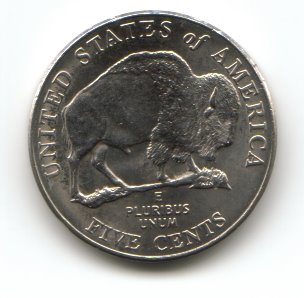
Bison nickelIn 2005, the United States put a picture of North American bison on their nickel. It wasn't the first time they'd done so -- it had been on the nickel back around the 1920s. The U.S. Mint did this was done to commemorate the Lewis and Clark expedition.

I got to thinking, though, about how the bison represents just how much of an ecological disaster the settlement of North American caused. Bison, of course, used to be incredibly abundant. They numbered in the tens of millions (here). In the 1800s, they were brought to the verge of extinction. Fortunately, things were -- maybe not put right exactly, but at least outright disaster was averted for bison.

I wonder if the U.S. Mint ever thought they would be commemorating a huge ecological mistake. It would be like putting cod on Canadian coins. Or, if you wanted a social equivalent, like putting slave ship on a coin. There's another big mistake that played a significant role in American history that is no longer done. Somehow, I don't think the U.S. Mint would have put that image on a coin.

28 July 2006

Best of times, worst of times, best of times

Today was the last official day of the program for my summer intern Amanda (supported through the Hispanic Health Research Center (HHRC)). It's been a good last week with her. On Wednesday, she gave a presentation to the community advisory board for the HHRC -- and she kicked ass with both feet. She was flat out awesome. Note: Not "awesome for a high school student." Awesome. No qualifiers. Full stop.

To round out the last day of her research experience, the cherry on top, as it were, we submitted a short manuscript to a research journal of her project. It doesn't get much better than that: to have a project work so well that it's worth taking a crack at publishing it. Any day in which a manuscript is submitted is a good day.

Meanwhile, mixed news on the grant front. Today, the status of a NSF equipment grant from the was officially changed from "Pending" to "Recommended." I was a co-PI on that one. It's not got quite as big a deal as usual, since it's the one I mentioned previously, so I knew this was coming.

The equipment grant that I was lead PI on was rejected. Bummer. No confocal microscope for me this year. Oh well. Try, try again...

19 July 2006

Clickety-click-click-click

I was the first on this campus to use a wireless remote polling system, a.k.a. "clickers." I gave talks about it within campus, got at least one other faculty in my department to try it, and pushed.

Today the university committed to adopt a single system, campus-wide.

I made a difference. I don't think we'd have the clicker system in place if I hadn't started the ball rolling.

18 July 2006

Under the wire again

Just submitted another NSF proposal. I kept asking the Sponsored REsearch office who I had to buy lunch for getting it in on time, because this one -- totally my fault, I admit it -- was late. Mainly because of the graduate class I was teaching in summer session I.

The sad thing is, I am reaching the point where I'm not writing these in hope of actually getting funded. The odds are just too long. But to paraphrase Robert Heinlein, "Of course the game is fixed, but don't let that stop you. If you don't play, you can't win."

At this point, I'm mainly writing research grant proposals because even an unsuccessful grant proposal counts towards my merit folder. In fact, writing three unsuccessful proposals is worth as many merit points as one successful one. Which rather does promote quantity of proposals -- maybe not more than quality, but volume definitely has advantages.

15 July 2006

Getting help

InternA trip out to the Coastal Studies Lab was encouraging. I met the new research assistant, Felecia, who was at one point a nationally ranked surfer. Cool. I talked to her about some of the plans I have in mind, and what she can do to facilitate them. I was also able to bring back some more tunicates for experiments that my students and intern (shown with slide overgrown with tunicates and other marine invertebrates) are doing.

12 July 2006

Summer I is dead, long live Summer II

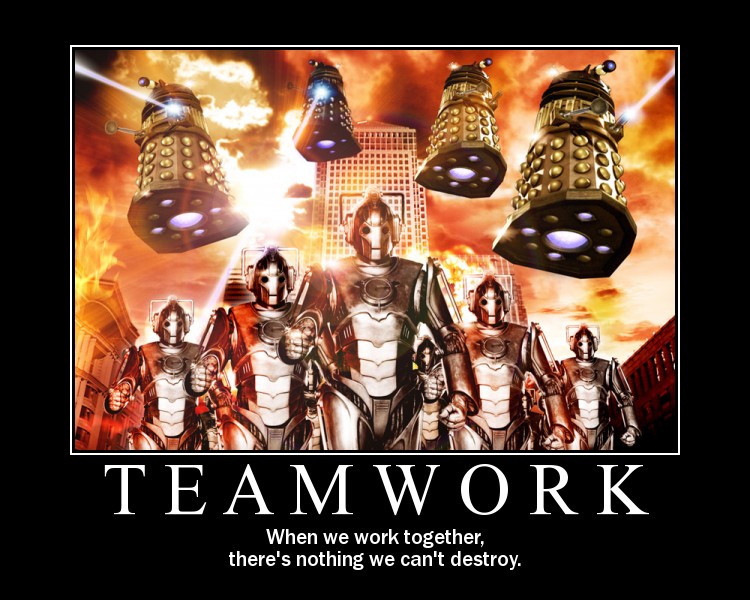
Teamwork motivational posterI've just finished posting the final grades for the graduate course in Evolutionary Theory that I've been teaching with Anita. An evil evo duo, working together to cause students a 10 on a scale of 1 to 10, "Oh my God what have I done to myself?!" challenge. (This came from the feedback session, which surprised me -- I was thinking the course would be a 7 or 8 on a scale of 1 to 10 challenge.)

It was a great experience, though, truly team teaching a course. In most cases, team teaching means, "One instructor for the first half of the class, who walks away and you never see again, who is then replaced by a second instructor, who gives very few signs of having communicated with the first." In contrast, we were both in the class every day. (Except that one bad day when Anita's partner walked out of the house with two sets of keys... one of which was hers.) We took turns lecturing and leading discussions, but every so often there would be times when we would end up on opposite sides of a sketch on the chalkboard, going back a forth, making complementary points. It felt, I think, a little bit like what jazz musicians do with music, only we were doing it with scientific concepts.

Great fun. But I'm definitely glad it's over.

09 July 2006

Film is dead, long live the movies

They had better be working on a new Pirates of the Caribbean movie right now.

Yes, I was among those making this a big boxoffice weekend for the Pirates movie, which was something of a revelation for me.

Little known fact: I was a projectionist through a good chunk of high school and my undergraduate degree. So I'm rather picky about projection quality. Plus, during my doctoral work, I thought a lot about film and video for behavioural analyses. In one of my earliest publications on movement analysis, I wrote, "Film's quality is still unbeatable," that's not true any more.

When we went to see Pirates of the Caribbean today, I noticed just before the movie started a little clip that stated the movie was shown on a digital projector. And I was amazed. The image was uniformly crisp across the screen, in contrast to most screens, which sort of have spots where the picture goes a little soft. I would daresay the Imax films I'd seen would have a hard time matching the image quality (though I haven't seen one of those in a few years, alas).

I honestly wonder if there's any market left for film at all now.

;;;;;

One last lecture tomorrow, and summer class is all over but the marking.

07 July 2006

When things break, break, and sometimes fix themselves

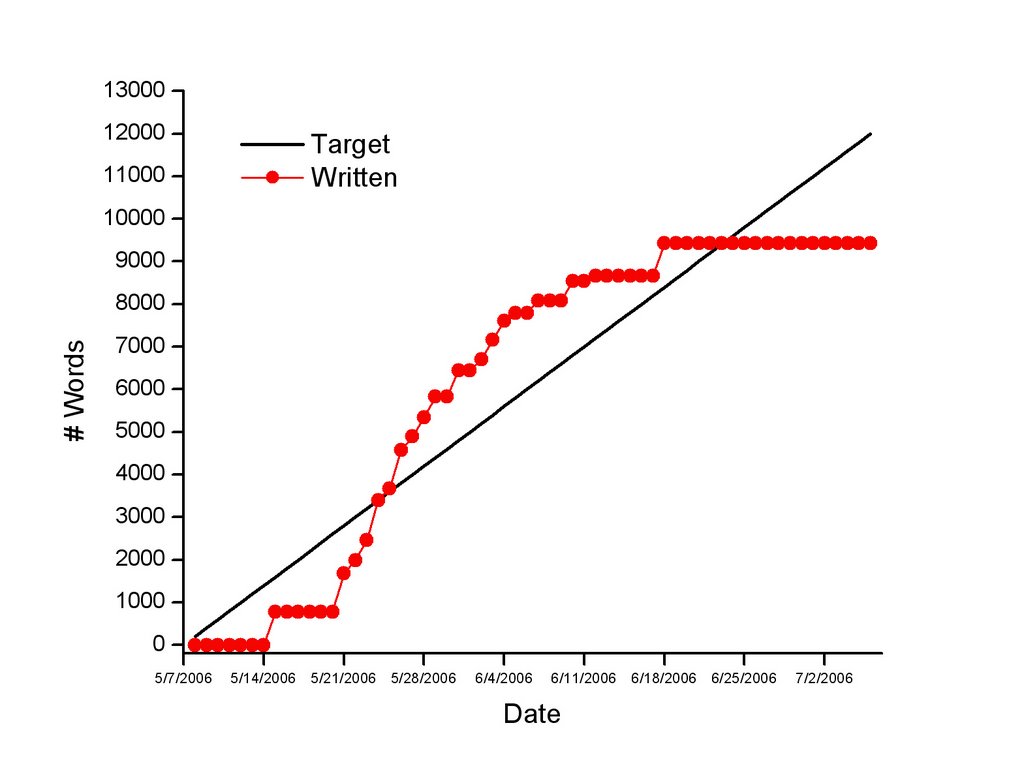
The book manuscript has ground to a screeching halt, as my obsessive graph shows. I'm hoping to get caught up somewhat after the middle of next week, when the summer class I'm teaching will be over.

I've been having weird computer problems. On Saturday night, my computer screen at home blanked out and died. So Sunday was spent shopping for a new one. The new one is very nice, considerably larger and with a sharper picture than the old.

But things got stranger on Monday night, when I lost my internet connection after a pretty severe electrical storm. Do the usual troubleshooting stuff. Wait for a day in case the connection went down temporarily. No luck. Ah, I think, the DSL modem is toast, so I shell out for overnight delivery of a new one. No, that's not it. Phone the ISP and get a walk-through, and they diagnose that my network card drivers are somehow shot. Network cards are dirt cheap, so I buy a new one later that night.* Plug in the new one, check the drivers... and see the old one back on the system. Plug the cable back into the old network connection and the old modem...

And everything is fine.

What?

Things are not supposed to fix themselves like that.

Now I have to try returning a DSL modem and a network card.

* Tangent: The network card came with all its drivers on a 3.5" floppy disk. A floppy? A floppy?!? When was the last time a computer got sold with a floppy drive? You have to order them special now! What are retailers doing putting software on floppies?!?

01 July 2006

Truth, justice, and the Canadian way

Tying together Canada Day and the current summer blockbuster release and my last blog entry, it seems fitting to remember that one of the co-creators of what is now seen as a quintessentially American character -- Superman -- has a Canadian connection. Joe Shuster, the artist who created Superman's look, was born in Toronto. Clark Kent's newspaper was originally not the Daily Planet, but the Daily Star, a name it shared with a Toronto newspaper. And the Fortress of Solitude lies within Canadian waters, I'm sure.

I might go see Superman Returns to celebrate Canada Day this weekend. It might be appropriate, even though in another twist of globalization, it was filmed in... Australia? At least the television series Smallville is filmed in the lower British Columbia mainland.

30 June 2006

It must have been the long hair


You are Supergirl


Supergirl
87%
Hulk
70%
Spider-Man
65%
Green Lantern
65%
The Flash
65%
Wonder Woman
62%
Catwoman
55%
Batman
55%
Robin
52%
Iron Man
45%
Superman
40%
Lean, muscular and feminine.
Honest and a defender of the innocent.


Click here to take the Superhero Personality Test

28 June 2006

Feeling like a scientist

Very, very busy day today, what with class, paperwork, and working with students and colleagues. The good news today for me was that I was working with two students on experiments that have been sputtering for a long time -- started, but not really carried through to completion. Students would start things but abandon them before we could finish, or we would run out of animals. I'm thinking that may, just maybe, I'll be able to push those projects further along. I actually felt like something approaching a productive researcher.

Getting worried about how fast I'm going to have to get ready to lecture for Friday, but not much I can do about it.

The not so good news was that camera system on one of our major microscopes was acting very flaky and unpredictable. I think there's something going wonky with the computer, but it's very hard to pin down.

27 June 2006

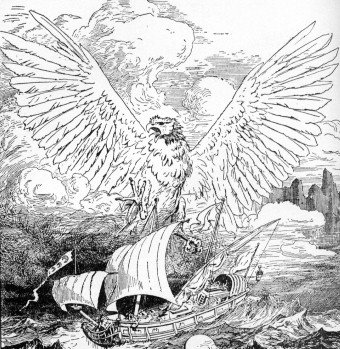
Bagging a roc with a slingshot

RocWe got one.

After so many tries in the department to get external funding solo, my collegue Anita has managed to pull down a six-figure equipment grant from the National Science Foundation.

Let there be much praise sung and much chocolate purchased for our mighty hunter, who brought down seemingly impossible prey.

As it happens, I also submitted a proposal to the same program at the same time. I should be hearing news on my proposal "Real Soon Now."

24 June 2006

Beautiful Evidence reviewed

Baeutiful Evidence coverEdward Tufte's three previous books -- The Visual Display of Quantitative Information, Envisioning Information, and Visual Explantions -- were good purchases. They're the sort of book that I go back to again and again, sometimes just browsing through just to get a little inspiration.

Consequently, I looked forward to receiving Tufte's fourth major book on information design, Beautiful Evidence. There was something different about reading this book compared to the others, though. Tufte has posted several sections on his discussion board well in advance to get feedback on the ideas. I was one of the many "Kindly Contributors," as Tufte calls them, on those chapters, particularly one on phylogenetic trees. Further, one chapter had already been printed as a little booklet on PowerPoint. It so successful that it went to two editions.

Furthermore, a cursory glance reveals many examples that Tufte has already talked about at some length in his earlier three books. There's the works of Galileo. There is a whole chapter about Minard's chart of Napolean's march towards Moscow, which Tufte pretty much single-handedly made famous in The Visual Display of Quantitative Information, in which he said it might be the best statistical graph ever. High praise from a demanding taskmaster!

Given that a good chunk of the book was already familiar to me, was there anything new to be learned? Absolutely.

The first chapter concerns annotating pictures, which Tufte calls "mapped images." Right away, two of the books themes emerge. First, the importance of integration of different types of data. Here, pictures are the focus with the words providing supplemental information. Second, a concern is raised about dubious evidence, with the work of Ernst Mössel. Mössel tried to create a universal description of art, but ended up with a system that was so all encompassing that it could not be shown to be wrong.

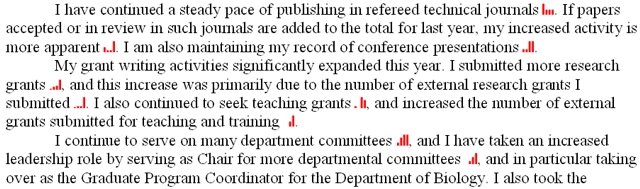
The second chapter continues on the theme of integrating information in Tufte's concept of sparklines. Sparklines are little mini graphs that are meant to be fully incorporated into text. To my disappointment, the HTML that would be required to stick a sparkline in the blog falls into the "more trouble than it's worth" category. But a few people are experimenting with these, and there are a few sparkline plug-ins for word processors that can be found on the web. I've used one of these in my own writing, though; shown here is something from one of my annual review documents.
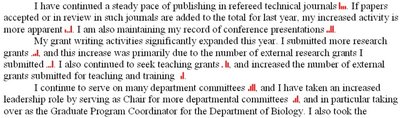

It will be interesting to see if any high end technical journal will consider using these routinely.

The next chapter concerns using lines to link together. Tufte argues that most lines are underutilized, and could contain much more information and be much more useful than they usually are.

The fourth chapter is, to my mind, the heart of the book: "Words, numbers, images -- together." That statement is simple, but the many excellent examples make this a deep exploration of the idea. A chapter section on Galileo's work is wonderful. Every scientist knows Galileo's contributions, but seeing them through Tufte's words and pictures gave me a much deeper appreciation of the impact Galileo had. Tufte credits Galileo with a "forever idea," which, in a word, might be "empiricism." More to the theme of the book, however, Tufte uses Galileo's work to show how his arguments were enhanced by an integration of word and image. Again, this is an idea that Tufte has talked about before, that good displays put many comparisons in "eyespan," but the point is pushed farther in this book than before.

Similarly, the fifth chapter on Minard's chart is worth Tufte's revisit, as he uses it to exemplify powerful general principles we can learn about how to make "intense" displays that generate credible, powerful evidence. One simple example lesson from this chapter: sign your work. Credibility is enhanced by accountability.

Bad evidence, which had been introduced in the beginning, returns in force in the next two chapters, the second of which contains Tufte's already famous indictment of PowerPoint. Making a graph, Tufte argues, is an ethical act. Again, this is not a new idea for Tufte, since he introduced the "lie factor" in his first book. What is new is his argument that consuming such information is also an ethical act. Too often, we are lazy and don't hold liars accountable. These are powerful and important messages in an age of spin and truthiness. As I've said before, a lie left unchallenged gains the perception of truth.

The book's last chapter, on pedastals for sculptures, is the weakest and could have been omitted. It is disconnected from the rest of the book. The book, after all, is supposed to be about evidence. Nobody that I know of has ever claimed that scultural pedastals were ever intended or perceived to be evidence. Instead, the chapter showcases one of Tufte's other interests, outdoor abstract scultures. Still, Tufte's passion and thoughtfulness still shines, so much so that this deviant chapter is almost forgivable. Almost.

Similarly, I am puzzled by the choice of dust cover, which shows a series of pictures of one of Tufte's dogs leaping into a lake. Beautiful they may be, but are they evidence? If so, of what?

And I'll put out just one more thing that annoyed me in the text. In a few points, Tufte suggests that we ask ourselves, "What would Richard Feynman think?" I find this just as annoying as, "What would Jesus do?" I have no way of knowing how bright (Feynman) and profound (Jesus) people will respond to new and novel situations. Isn't this one of the reasons we find these people to be bright or profound? It's more useful to invoke their principles than trying to use imprecise empathy to figure out what to do. Particularly when I ask, "What have I done?" and see that I've approached the same problems in several different ways, often with equal success. In other words, when I see a bad graph, I think it's more useful to think of one of the many simple but deep ideas presented in Beautiful Evidence ("Show comparisons, contrasts, differences") instead of asking, "How would Tufte redesign this graph?" I could only really answer the latter question if I have buckets of money to try to hire Tufte as a consultant.

Finally, I am left wondering about cases where the evidence may be highly credible -- but is not beautiful. While working on this review, I was reading a scientific paper for my evolution class (Pellmyr, Olle & Leebens-Mack, James. 1999. Forty million years of mutualism: Evidence for Eocene origin of the yucca-yucca moth association. Proceedings of the National Academy of Sciences of the United States of America 96: 9178–9183; click here for abstract). The evidence is highly credible and believable, but I daresay that it is not beautiful. The argumentation is precise, but deadening. Tufte talks about ways that flawed evidence may be concealed (second hand repackaging: e.g., textbooks presenting summaries of technical papers that very few have read). But papers like this raise another way that flawed evidence might hide that Tufte does not discuss: "If it's incomprehensible, it must be brilliant." * People have become accustomed to research using techniques that are so new, few people understand them. Unintelligibility itself becomes an indication of credibility. That's bad. I think there's more to be said here, but perhaps that will be Tufte's book five, since the introduction promises he has more to say on the subject.

This book is, of course, going to be widely read and highly praised. But I don't think it will it be read enough. It is frustrating to read something like this advocating ethical scholarship and standards for evidence when there are new books that flat out lie about science (yeah, I'm looking at you, Ann Coulter). And when you can lie about science -- that part of human endeavor that Galileo transformed with his forever idea that it was all about evidence -- you can lie about anything.

To do your bit to kill truthiness, you could do much worse than following the principles in Beautiful Evidence.

* I call "If it's incomprehensible, it must be brilliant" the 2001 principle, because I think it explains why so many people sing praises to the movie 2001: A Space Odyssey. Many virtues it has, I admit, but the thing does not make sense.

I knew it

Back in March, I gave a public talk for Brain Awareness Week, "Brain Scans and the Magic Lasso." (An archived version is here).
In it, I talked about how I saw the use of fMRI as imminent in legal situations. And I was right, as I learned listening to the Nature podcast this week (transcript here). Companies called No Lie MRI and Cephos are going to sell commercial lie detection systems based on fMRI. And I pretty much called that in my talk. Legal challenges will happen, I predict.

23 June 2006

Thought from an administrator

Quote from yesterday's provost candidate that I quite liked:

"A vision without a plan is fantasy. A plan without a vision is drudgery."

Even though I'm unsure if he's my favourite candidate, hey, at least I got a good quote from going to the ope forum...

22 June 2006

The time monsters

This week is one of those weeks. Forgot about finding time to blog or work on the book manuscript, finding time to go to the washroom is a major accomplishment. This week consists of: Get up, get ready for class, class, run to tail end of faculty senate meeting with provost candidate, lunch, get quiz ready for class, for to open forum with provost candidate, work with intern Amanda, few minutes to try to tie up loose ends, home for dinner, exercise, sleep.

And that's the day. Repeat five times. Use weekend to catch up.

I'm horribly behind on some classwork and a few other things, largely because the provost interviews are chewing up a big chunk of the day. But it's really important to see those interview situations, because this is the #2 job on the campus. It's one of the ones that can have a huge impact on the overall health of the place. Not to mention my own career.

18 June 2006

Flashback

Athropod Structure and Development Top 25Hey, I was almost hot (scientifically) in July through September 2004. Go way down to #22. Never noticed that before.

Oh, yeah...

As a Canadian, I am contractually obligated to say:

Go Oilers.

Now back to paperwork. I mean it this time.

Bookwork

Manuscript word count for 18 June 2006I think there's something to be said for this obsessive tracking of a project in a public forum. It was able to get me off my bum and get a few hundred words in on my book manuscript, after a week or so of thinking about other things (class, interns, etc.). I've heard B.F. Skinner used a similar technique when writing. He would keep track of what he was doing, and would only allow himself to take speaking engagements when he was above his target number.

Anyway, back to the many other tasks that need doing. Many, many other tasks...

17 June 2006

Taxonomic romance

Blepharipoda occidentalisIn our graduate evolution class yesterday, my colleague Anita revealed that there is a group of beetles named after her.

I was instantly jealous.

By way of a few quick reminders, the traditional method of classifying organisms is to have seven levels: Kingdom, phylum, class, order, family, genus, species. The names have to be in Latin or Greek, although "latinizing" names or words from other languages is allowed. Ths person who describes a group gets to name it. Names are often descriptive of the organism's look or living space. For instance, take the case of the sand crab Blepharipoda occidentalis (pictured), which I studied for my doctoral work. Blepharipoda, the genus name, means "eyelash feet," which refers to the fringes of hairs (setae) that line the beautifully curving leg tips (dactyls) that they use for digging into sand. They live on the west coast of North America, and their specific name, occidentalis, reflects this, as it means "western."

Taxonomists are free, however, to name species and genera and so forth whatever they want. Locally, when my colleague Bob Edwards described a new species of fish, he named it Gambusia clarkhubbsi after a Texas ichthyologist, Clark Hubbs.

But you don't need to be a scientist to get a species named after you (though it probably helps). Returning to sand crabs for a second, Chris Boyko works on the taxonomy of sand crabs like Blepharipoda. He's also a fellow comics enthusiast (loves Chester Gould), and a man who made my writing life hell by splitting one sand crab family into two, making it much harder to describe some work I did. Be that as it may. He named one sand crab after The Simpsons creator Matt Groening: Albunea groeningi. He named another after Peanuts character Lucy (infamous for her "crabby" disposition): Lepidopa luciae.

Anita got a genus of beetle named after her because, well, she happened to be dating a beetle taxonomist at the time.

I'm so jealous.

I have genus envy.

(Yeah, that's right, I wrote this whole long blog entry just to make that one lousy pun.)

16 June 2006

Ah.

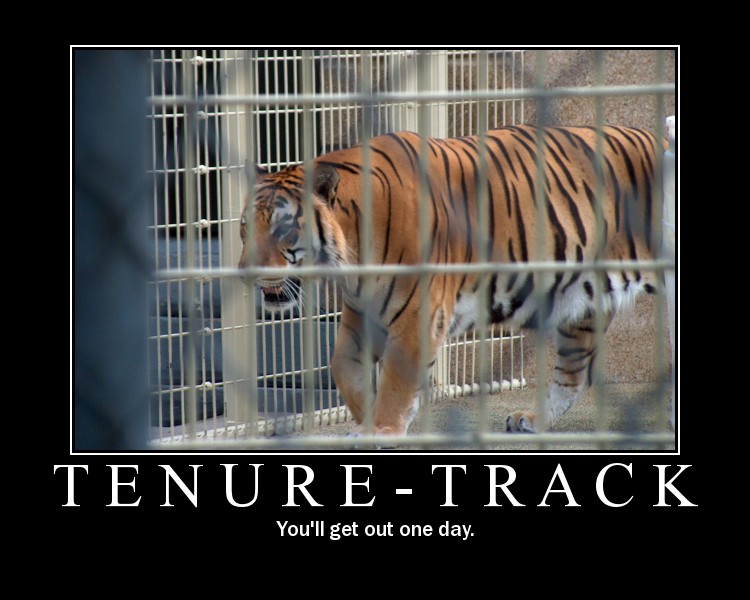
Motivator: Tenure-track
Friday afternoon has been nice to me today. No talk to think about that's less than 24 hours away. Nobody bothering me, for the most part. Just a chance to stop and think for a few minutes and get my head organized. I realized several NSF grant deadlines were coming up, so I started work on at least one of those. I may take a crack at more than one, who knows. Still many things that need doing and not enough of them done (must email grad students and prospective grad students...), but I didn't feel as rushed-pushed as I felt much of the week earlier.

15 June 2006

In turn...

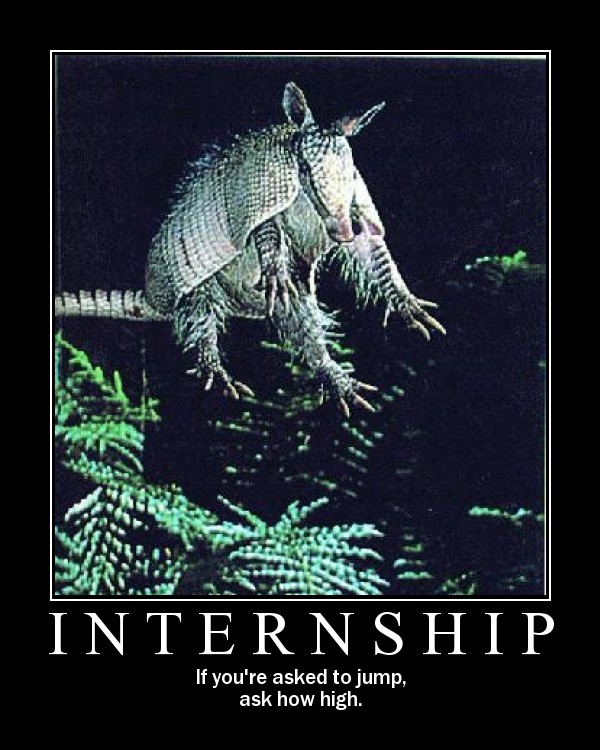
Internship motivatorIn another one of those still-not-quite-sure-how-this happened events of the summer, I spent this afternoon meeting with various people about a summer internship program with high school students. I'll have a student, Amanda, working with me for six weeks starting next Monday. Not quite sure what I'll have her do yet. Will have to spend some time sorting out project ideas next week.

Speaking of the grad class, it's going very well, all things considered. My colleague Anita thought today went well -- which was good, considering it was on a very subtle topic (units of selection).

12 June 2006

Today's loss of productivity

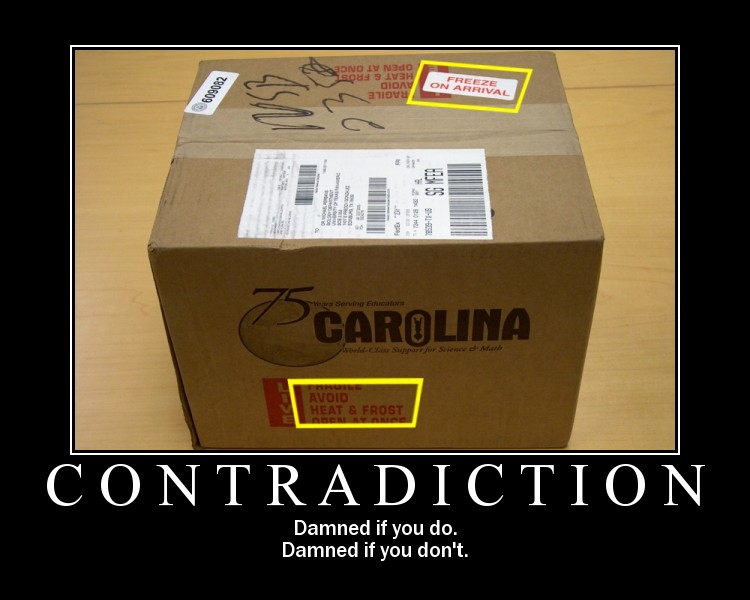
Contradiction motivation posterClick image to enlarge if you can't read the text. I took the picture of the box that I actually received from Carolina Biological Supply, but created the fake poster style with the instantly addictive Motivator.

10 June 2006

Ahead of the game?

Manuscript count 10 June 2006One week of summer class down. The class (Evolutionary Theory) is going as well as can be expected for the first time. The thing I'm enjoying about it the most is that, as I expected, my colleague Anita and I have very different strengths and interests. She can put together lectures on stuff that I couldn't. At least, not without way more preparation, difficulty, and stress on my part.

As far as the book manuscript goes, I have no idea how I'm managing to keep the word count above the 200 words a day target (graph). But I am, though the curve is clearly starting to flatten, and the writing is going to start getting harder very quickly.

04 June 2006

Heritage

Just as people are curious about their family lineage, academics are curious about their intellectual lineages. An intellectual lineage is more complex than a family lineage in some ways, because of course while we're restricted to two parents, we are often fortunate to have many excellent teachers who contribute to our intellectual development.

Nevertheless, the usual tradition is to trace intellectual influences back through Ph.D., since that's the highest degree, and usually the one that people spend the most time on, and the one that typically establishes the closest working relationship between student and mentor.

I knew my Ph.D. supervisor, Dorothy Paul, worked with Don Kennedy. Don Kennedy is a pretty well known figure in science, because he edits the journal Science. But I couldn't find out in my digging who Don Kennedy worked with. I decided to use a rather old fashioned technique to find out: I wrote a letter.

To my surprise, considering how hectic being Science editor must be, Don Kennedy wrote me back a short but very nice letter back very promptly. To my surprise, he worked with Don Griffin, whose work is famous in biology. He demonstrated how bats found their way in the dark: by echolocating. In animal behaviour, he was also a strong advocate for the field that became known as cognitive ethology.

I have yet to work out who Don Griffin did his doctoral work with. May take a while, but I'll keep it in mind.

03 June 2006

Here we go 'round again

I spent a good chunk of the day in my lab doing work related to my current manuscript that's in revision. It's necessary but unglamorous grunt work: all I'm trying to do is to get some pictures of already known results.

One of the great joys of doing research is that you get to find out new things. But the downside is that you always have to do it more than once. Replication is critical to science. In fact, I was listening to an interview with a parapsychologist (A little searching reminds me that it was Michael Thalbourne) who talked about the "well-known fact" that results in parapsychology get weaker over time as people try to replicate them, not stronger.

And I thought, "There's your sign."

The effect gets worse the more you try to study it? That's the exact opposite of regular science, and to me speaks volumes about why parapsychology doesn't get respect. It's pathological science to say, "Oh, effects get weaker as we look for it again."

In my case, I'm trying to get a few pictures of crayfish neurons. The ones I'm interested in were well described about 30 years ago, and are well known. But, since the point of the paper I'm working on is to compare similar neurons in a species that is not a crayfish, it helps to have pictures showing that I can in fact see what everyone else has described, and that any differences are not just due to dodgy techniques on my part.

And, to make matters even less interesting, I even have some pictures of the relevant cells. They're just not very pretty. But, because I think this manuscript has a chance to actually be a bit more widely read than some of my other stuff, I figured I might as well take the time to try to get some stuff that looks nice.

Necessary, but trying to maintain enthusiasm while doing replicates is awfully hard for me. Research is much more fun when you don't know what the answer is going to be.

02 June 2006

Holy cow, it's June?

Yeah. It's June. My new graduate class, Evolutionary Theory, starts Monday. It runs every day and I'm just working on Friday's talk. Luckily, I'm co-teaching it with my colleague Anita Davelos Baines, because otherwise, I'd only be working on Wednesday's talk and I'd getting ready for complete panic on Thursday. Instead of moderately nervous for the following Monday (10 days time).

Fortunately, I've managed to get somewhat ahead in my target word count for the book manuscript. Which is good, because I think that red line is going to flatten next week.

29 May 2006

The blog as art

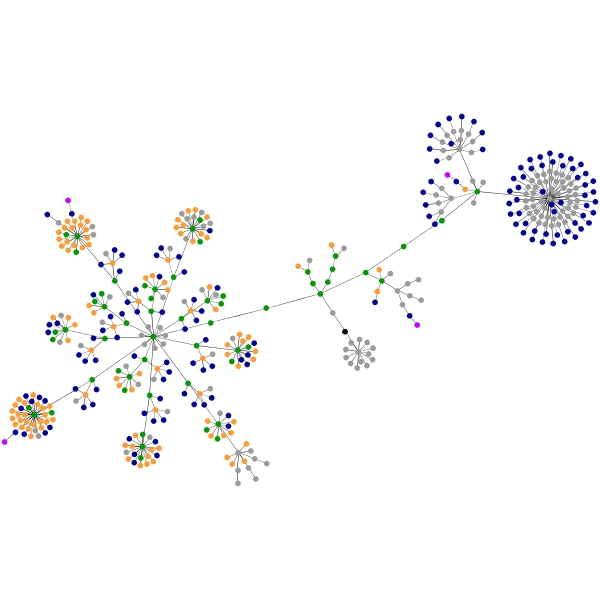
NeuroDojo structure graph
Neuroethology.org structure graph
Zen's UTPA webpage graph
Zen's hobby page graphThe graphics on this page shows the way a webpage is written. The first one on the left is the page you're reading (prior to making this post, which should change the structure slightly). I suspect that many Blogger-driven blogs will look the same, due to common blogger templates and such.

To the right of that, with lots of red, is the structure of the International Society for Neuroethology webpage, which I oversee but did not write. The preponderance of red indicates a lot of tables being used to structure the page.

Interestingly, but not surprisingly, authors seem to have distinct styles. The third and fourth graphs are both pages I created -- my academic home page (left) and one of my hobby pages (right). The substantial amount of blue and orange in the bottom two graphs shows that I like links and text, respectively.

The original description of the project, and a link to make a graph of any website you want) is here. It's really quite fun to watch the program run, as the graphic "grows" out, very quickly at first, then finally settling down to a pattern. More discussion, including some very helpful interpretation, is found on this discussion thread on Edward Tufte's website.

27 May 2006

Lies that scientists tell

I wrote previously that honesty is a core value for scientists, but that doesn't mean that scientists don't engage in, shall we say, "spin."

  • "This work could have practical applications." Maybe it will and maybe it won't, but that's not why you did the research, is it, you fibber? You did it to test the dominant theories. It might be a dominant theory in the field that you want to support, it might be a little upstart theory that you think makes no sense or attacks your findings. Most scientists are scientist entirely because they love the ideas. It's the engineers' job to worry about practical applications.

  • "I'm just following the data." The idea that scientists are dispassionate observers does not, in any way, jive with my experience woking with scientists. I've seen and read too many arguments from researchers studying the origin of bird flight to be convinced otherwise. (It seems, from a distance, to be one of the most polarized, divided into us and them warring intellectual camps that you'll find anywhere.) Scientists I know are very often emotionally attached to their theories. After all, as I mentioned a while ago, people like to have their beliefs confirmed. But if you understand science in a deep-in-your-bones kind of way, you know that you have to try to murder your darlings. You have try to strangle your absolute best to see if they really hold up.

  • "Introduction - Materials and Methods - Results - Discussion/"
  • This is the standard format of scientific papers. It's supposed to reflect the order of events that goes on in performing research. Ha! More like, "Methods, preliminary results, more methods, results we had to throw out because equipment broke / animals died / grad student didn't take measurements when he was supposed to / supervisor didn't take measurements that she was supposed to, more methods, statistical analysis of results so far because the poster for the upcoming conference is due next Tuesday, more methods trying to fix the criticism you got from the conference poster, results that you might actually be able to trust, start researching discussion, write introduction to make it seem that this experiment was designed to test a theory that you weren't even aware of until you started researching the discussion."


(This post inspired by several similar ones over at Guy Kawasaki's blog.)