Unexpected fact: The outside main floor of the National Science Foundation building has a Quiznos and a bagel shop.
Despite the ugly early start for my flight to the NSF, everything went about as smoothly as could be hoped for. I got there about on time. I got to have lunch at Ruby Tuesday (which we don't have locally, but see ads for all the time).
I got my PocketPC successfully set up for NSF wireless internet access – in fact, the staffer who help me told me she had fun doing it, because she'd never tried to set up their wireless system on a Pocket PC before. I got a tiny bit lost, because the initial poster session was not on the room written on my badge, but again, found the starting poster session in time.
The featured speaker at dinner, Elaine Seymour, was very good, very thought provoking. And just to prove that the scientific community is way too small, met someone at dinner and found we had one degree of separation between us: he knew someone in our department, my buddy Fred.
I never sleep well in hotels, particularly the first night, so I wasn't real pleased that the next day started early and went long. But heard quite a few important things, and had no shortage of things to think about. Another keynote speaker, Tyrone Hayes, was awesome. Although he said to me later he is normally a "PowerPoint maniac," he made absolutely the right choice in ditching all that and delivering a fairly personal talk about his experience being a minority in research, and some of his success in mentoring minorities in research.
After the afternoon sessions finished, I just walked around some of the stores in a nearby mall, and ran into a few workshop participants for dinner at the Rock Bottom Brewery. (They'd been told there was a Macaroni Grill in the mall, but it had shut down!), and ended up talking with several of them in the hotel bar for even longer after getting back to the hotel.
It was really a stupidly long day. But in the morning, I was able to find a place with good croissants for breakfast, which I appreciated. It's so hard to find good croissants in southern Texas...
And since getting back, I've been trying to get this undergrad research program up and ready to run. Many meetings, many emails, many things to plan. I'm quickly finding that I have to be thinking about things that are years away, which is not easy for me. So I look forward to receiving the massive wall calendar / planner I asked for.

10 March 2007

07 March 2007
Finally
Way back in December, I wrote about a project that I couldn't talk about and some of the excitement I felt about it.
Now I can finally talk about what all that was about.
The National Science Foundation gave us a Research Experiences for Undergraduate grant. This is getting funded in portions, but over $156,000 is set and ready. If the funding to the NSF doesn't collapse, we'll get another year and a bit and the total will be over $284,000.
Hooray.
I've been sitting on that since December. Waiting and watching, hoping that the U.S. Congress will pass a good budget for the NSF. Congress was supposed to pass the NSF budget before Christmas, but didn't. They waited until the last possible second, which was the last day the continuing resolution ran out on 15 February. Much was written about this wait in the pages of Science and elsewhere. The delay was so bad that many funding agencies had to scale back planned projects. Reading those articles was highly nerve-wracking.
But in the end, NSF got a bit of a budget increase, fortunately, when many other federal research agencies got no increase. Whew.
And another thing I mentioned cryptically: an upcoming conference? It's actually a workshop for people running NSF sponsored undergraduate research programs. My flight leaves verrrrrrrrrrrrrrrrry early tomorrow morning.
It's just a relief to go to a conference knowing that I actually have the award. I would have sucked to go to this workshop not knowing if we were getting it or not.
Playlist for the day: Finally by CeCe Peniston, New Man by Sonic Hub, Food For Songs by Del Amitri, and especially Won More Time by God Made Me Funky.
Now I can finally talk about what all that was about.
The National Science Foundation gave us a Research Experiences for Undergraduate grant. This is getting funded in portions, but over $156,000 is set and ready. If the funding to the NSF doesn't collapse, we'll get another year and a bit and the total will be over $284,000.
Hooray.
I've been sitting on that since December. Waiting and watching, hoping that the U.S. Congress will pass a good budget for the NSF. Congress was supposed to pass the NSF budget before Christmas, but didn't. They waited until the last possible second, which was the last day the continuing resolution ran out on 15 February. Much was written about this wait in the pages of Science and elsewhere. The delay was so bad that many funding agencies had to scale back planned projects. Reading those articles was highly nerve-wracking.
But in the end, NSF got a bit of a budget increase, fortunately, when many other federal research agencies got no increase. Whew.
And another thing I mentioned cryptically: an upcoming conference? It's actually a workshop for people running NSF sponsored undergraduate research programs. My flight leaves verrrrrrrrrrrrrrrrry early tomorrow morning.
It's just a relief to go to a conference knowing that I actually have the award. I would have sucked to go to this workshop not knowing if we were getting it or not.
Playlist for the day: Finally by CeCe Peniston, New Man by Sonic Hub, Food For Songs by Del Amitri, and especially Won More Time by God Made Me Funky.
02 March 2007
26 February 2007
Odd instructions
From a conference I'll be going to in the near future:
“You will be expected to be present to respond to questions from delegates for half of the time during this session.”
Meaning... I can ignore questions from delegates the other half of the time?
“You will be expected to be present to respond to questions from delegates for half of the time during this session.”
Meaning... I can ignore questions from delegates the other half of the time?
22 February 2007

20 February 2007
“... and it's only Tuesday!”
This week is going to be ratty ugly nasty busy. There are two job candidates interviewing for positions today and Thursday. Tomorrow I'm currently slated for four meetings and office hours. Thursday I'm running out the Coastal Studies Lab for some animal collection, and Friday I teach and have Journal Club. Which reminds me... I have to pick a paper for that.
I really do feel like the punchline to the old joke: ”This has been a horrible week, and it’s only Tuesday!”
On the plus side, I was isolated all weekend so I was able to finish reading a book I'll be reviewing for a journal. Now I just have to actually think and write the review.
I really do feel like the punchline to the old joke: ”This has been a horrible week, and it’s only Tuesday!”
On the plus side, I was isolated all weekend so I was able to finish reading a book I'll be reviewing for a journal. Now I just have to actually think and write the review.
16 February 2007
You can learn a lot from a game
“Kill the wounded monster first” is quickly becoming a mantra of mine after reading this post.
Another favourite quote on the subject of games: "You can discover more about a person in an hour of play than in a year of conversation." - Plato.
Another favourite quote on the subject of games: "You can discover more about a person in an hour of play than in a year of conversation." - Plato.
15 February 2007
Reviews
I feel like much of what I'm doing intellectually this week is just reviewing other people's stuff. I'm reviewing one paper for Journal Club tomorrow. I'm reviewing one paper to help out a local newspaper reporter at The Monitor. I'm reviewing a manuscript for one scientific journal, and reviewing a book for another.
I'm particularly pleased to be reviewing for journals. A lot of my colleagues have been mentioned reviewing articles at one time or another, and I really haven't been asked to do many since I got here. When you're asked to do those sorts of things, it's one of those signs that you're "known" in the field.
So far, I haven't run into the problem that one of my supervisors warned me about. Because editors have trouble finding reviewers who make constructive comments, and get the reviews done on time, once you do a couple of reviews well, you get asked to do a lot of them.
I'm particularly pleased to be reviewing for journals. A lot of my colleagues have been mentioned reviewing articles at one time or another, and I really haven't been asked to do many since I got here. When you're asked to do those sorts of things, it's one of those signs that you're "known" in the field.
So far, I haven't run into the problem that one of my supervisors warned me about. Because editors have trouble finding reviewers who make constructive comments, and get the reviews done on time, once you do a couple of reviews well, you get asked to do a lot of them.
Cephs are fun

Great video footage (scroll down to the bottom) of some squid having a go at bait. Not the lethargic animals they were thought to be, the video shows them zipping around, and flashing lights as they attack. Cool stuff. I really must work with octopuses again one day.
It’s like I’ve been sayin’ for years...
I've been interested in the ethics associated with brain scans for years now, and I've been saying for years that we're on the verge of a revolution that's going to make the use of DNA in courts look like peanuts. My talk last year, "Brain scans and the magic lasso" was about just this point (available on the right hand side of the screen).
The latest findings show that we're getting very close to reading minds. With high accuracy.
A lot of people are worried about this. I prefer to see an upside. I would love it if it worked in part because there would no longer be need to hold "suspected terrorists" without regular legal process. Debates about “washboarding” would end. The television series 24 would have to find new ways of creating dramatic tension. (Don't get me wrong, I enjoy 24, but dislike what it reveals about American thinking about torture.)
I'm considering starting a pool for the date of the first court case that accepts fMRI brain scans as legitimate evidence. Any takers?
The latest findings show that we're getting very close to reading minds. With high accuracy.
A lot of people are worried about this. I prefer to see an upside. I would love it if it worked in part because there would no longer be need to hold "suspected terrorists" without regular legal process. Debates about “washboarding” would end. The television series 24 would have to find new ways of creating dramatic tension. (Don't get me wrong, I enjoy 24, but dislike what it reveals about American thinking about torture.)
I'm considering starting a pool for the date of the first court case that accepts fMRI brain scans as legitimate evidence. Any takers?
07 February 2007
I can stop being obsessed for a while
I just submitted my latest manuscript, a review article, into Proceedings of the Royal Society B: Biological Sciences. I'm aiming high on this one, because I'm really happy with how this article turned out.
Apart from the one little typo I found about a minute after submitting the article. In the title. Sigh.
One of the nice features of this submission is that this journal has an entirely electronic submission. That probably saved me an afternoon, if not more, of photocopying, sorting, writing a cover letter, and so on.
The downside is that I've been working so hard to pull this together and finish it, I've been letting quite a few other bits and pieces slide for a week or two. Time to get back to all those other administrative and teaching fiddly bits.
Apart from the one little typo I found about a minute after submitting the article. In the title. Sigh.
One of the nice features of this submission is that this journal has an entirely electronic submission. That probably saved me an afternoon, if not more, of photocopying, sorting, writing a cover letter, and so on.
The downside is that I've been working so hard to pull this together and finish it, I've been letting quite a few other bits and pieces slide for a week or two. Time to get back to all those other administrative and teaching fiddly bits.
Giving good phone
I am constantly amazed by how simple some things are, yet how many people are bad at.
I have voice mail. Anyone who has ever listened to a recorded message has probably realized that what you hear on the phone is not exactly CD quality. Plus, you can't see a person, so you can't see some of the important lip cues that we normally use to help make sense of the sound we're making.
Yet people read off their phone numbers really, really fast. And only once! Yes, I can replay it, but if I can't make it out, I am probably not going to be able to make it out on the rewind.
Also had someone phoning who didn't give their last name... Hm.
The moral of the story is: Say it slow, and say it again!
I have voice mail. Anyone who has ever listened to a recorded message has probably realized that what you hear on the phone is not exactly CD quality. Plus, you can't see a person, so you can't see some of the important lip cues that we normally use to help make sense of the sound we're making.
Yet people read off their phone numbers really, really fast. And only once! Yes, I can replay it, but if I can't make it out, I am probably not going to be able to make it out on the rewind.
Also had someone phoning who didn't give their last name... Hm.
The moral of the story is: Say it slow, and say it again!
04 February 2007
The writing process
I've had my door shut a lot this last week. I've been working on a new paper, and I've been getting increasingly chuffed about how it's coming out. Because as I write it, and have gotten more immersed in it, I've actually been generating a lot more new ideas than usual. And though I say it myself, I think there are a few pretty darned interesting ideas.
It's interesting how the process of articulating something generates new ideas. I think part of the reason why is that in the last week, I have really tried to concentrate a little more on completing this paper. Just forcing myself to have uninterrupted time on something helps, instead of being interrupted every few minutes by various odds and ends, as my days often are.
Most of the good ideas haven't come while sitting in front of the keyboard -- they've come while I've been at home. Even when I'm not actively writing, that I'm spending more time on the process means that the ideas are squirreling around in my head much more than usual.
Even though this paper started off as a relatively mundane summary of stuff I've talked about before, I think it's going to push significantly beyond that. I hope I'll be able to convince and editor and a couple of reviewers of that!
It's interesting how the process of articulating something generates new ideas. I think part of the reason why is that in the last week, I have really tried to concentrate a little more on completing this paper. Just forcing myself to have uninterrupted time on something helps, instead of being interrupted every few minutes by various odds and ends, as my days often are.
Most of the good ideas haven't come while sitting in front of the keyboard -- they've come while I've been at home. Even when I'm not actively writing, that I'm spending more time on the process means that the ideas are squirreling around in my head much more than usual.
Even though this paper started off as a relatively mundane summary of stuff I've talked about before, I think it's going to push significantly beyond that. I hope I'll be able to convince and editor and a couple of reviewers of that!
30 January 2007
What are in da box?

Just checked my mail, and saw a box. But what could be it be? Another textbook being sent by a publisher trying to sway me into adopting a new book for general biology? Ah! No, it's the reprints of my latest paper from Biological Bulletin!
PDFs are convenient, but for a sense of accomplishment, nothing beats the printed page.
The circle nears completion. I will have to send out copies to the people who have requested them. But this particular project can now go to bed, and it's time to push through on my manuscript and get something into an editor's hands again.
29 January 2007
Closing the door and making progress
I've had a good few days. I finally managed to shut my office door over the weekend and this afternoon and make very nice progress on a review article I'm pulling together. I like how it's turning out.
25 January 2007
Too quick to believe
I tool around a lot of science websites. Last month, I saw multiple blogs and websites reporting about how the Parks Service was waffling over how old the Grand Canyon is, in response to political pressures from fundamentalists Christians in government. For instance, the highly visible Panda's Thumb blog ran with it here. Also spotted on Richard Dawkins’s website.
The problem is that it isn't true. Skeptic also ran with the story at first, but in this article, they report that the press release that started to story appears not to have any substantive basis. Good on them for fact checking what looked to be an all too plausible story.
As usual, the initial hoopla gets more attention than the correction. On the Dawkins website, the article come up with the full headline and article, with the link to the Skeptic piece as a much smaller update.
The problem is that it isn't true. Skeptic also ran with the story at first, but in this article, they report that the press release that started to story appears not to have any substantive basis. Good on them for fact checking what looked to be an all too plausible story.
As usual, the initial hoopla gets more attention than the correction. On the Dawkins website, the article come up with the full headline and article, with the link to the Skeptic piece as a much smaller update.
24 January 2007
Administration ate my brain
Or at least, administration is eating my time. Since Monday... let's see...
I've been dealing with documentation concerning our university's reaccreditation (Hi SACS!). We need to have "student learning outcomes" for our students, measures of how well those outcomes are achieved, two year's worth of the measurements we took, a list of changes we made in response to those measurements, and what changes we plan to make in the future based on those measurements. It's a bit difficult to do when -- in the case of our graduate program, which I oversee -- you're talking about 0 to 2 students graduating in any single semester.
Then the page proofs for the new graduate catalogue appeared on my desk, with a very short turnaround time and many, many errors and missing classes and things in need of updating.
I managed to get those two things squashed this morning, thankfully. But the fun continued. I just got out of a Faculty Senate meeting. Lots of review of our university's Handbook of Operating Procedures.
And looking at my desk, I can see at least two more forms and paperwork asking me for information.
I really want to get back to my manuscript, which was coming along so nicely before classes started up again.
Oh yes.... first post with new version of Blogger.
I've been dealing with documentation concerning our university's reaccreditation (Hi SACS!). We need to have "student learning outcomes" for our students, measures of how well those outcomes are achieved, two year's worth of the measurements we took, a list of changes we made in response to those measurements, and what changes we plan to make in the future based on those measurements. It's a bit difficult to do when -- in the case of our graduate program, which I oversee -- you're talking about 0 to 2 students graduating in any single semester.
Then the page proofs for the new graduate catalogue appeared on my desk, with a very short turnaround time and many, many errors and missing classes and things in need of updating.
I managed to get those two things squashed this morning, thankfully. But the fun continued. I just got out of a Faculty Senate meeting. Lots of review of our university's Handbook of Operating Procedures.
And looking at my desk, I can see at least two more forms and paperwork asking me for information.
I really want to get back to my manuscript, which was coming along so nicely before classes started up again.
Oh yes.... first post with new version of Blogger.
19 January 2007
Safe returns
We had a bad few days in the department when one of our instructors went missing. She had gone overseas for the holidays, and when classes started... nowhere to be seen. This continued for a couple of days.
Fortunately, she is safe and sound and has returned to work this morning. Whew.
I got asked to step into her class temporarily and give a lecture rather than canceling class, which I was glad to do. But I am also glad I will not be having to do it for any more days, since it took a big bite out of my time.
In other news... um... well... there isn't much. Classes have started again, I'm working on a manuscript and trying to make arrangements to go to meetings (South East Nerve Net is a possibility), that sort of thing.
And the prospect of some very good news remains just tantalizingly out of reach, so I still can't talk about it yet.
Fortunately, she is safe and sound and has returned to work this morning. Whew.
I got asked to step into her class temporarily and give a lecture rather than canceling class, which I was glad to do. But I am also glad I will not be having to do it for any more days, since it took a big bite out of my time.
In other news... um... well... there isn't much. Classes have started again, I'm working on a manuscript and trying to make arrangements to go to meetings (South East Nerve Net is a possibility), that sort of thing.
And the prospect of some very good news remains just tantalizingly out of reach, so I still can't talk about it yet.
04 January 2007
Oh yeah, way behind
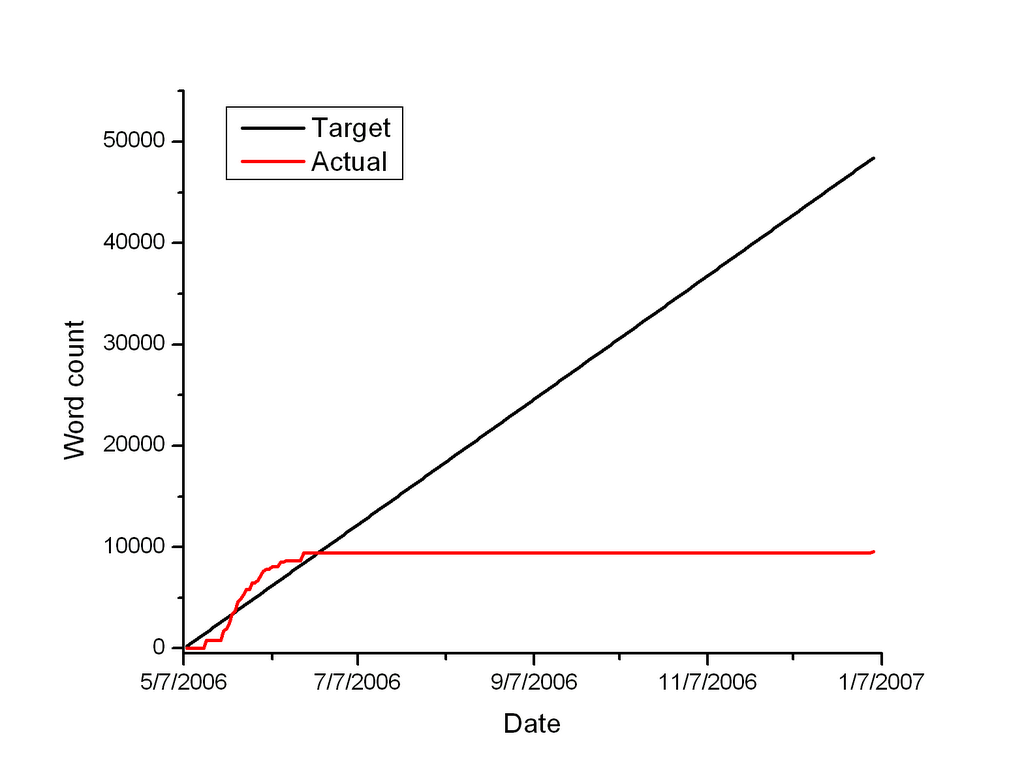 Some time last year, I wrote that I had started work on a book manuscript, on the "200 words a day equals a book in a year" theory. I worked on it a little today, for the first time in a long time. Unfortunately, the graph has reached the point that you can't see the little, teeny, tiny nudge upward at the very end of the "actual" line. So hopefully I'll start seeing the red "work done" line lifting up some more in coming months, though it'll be a tough slog to get back on target.
Now we're looking official
 In my role as Graduate Program Coordinator for the department, I found I was starting to lose track of when I'd received certain bits of paper (applications, letters of inquiry and such). I shouldn't have that problem any more now that I have -- the stamp! Bwa-hah-ha-haaaa! Good up until the end of 2013. And I can still use it when we get a Ph.D. program, since it says, "Graduate Program" rather than "Master's program."
Mathematician again?

First, I'm Isaac Newton, now this...
Your Intellectual Type is Visual Mathematician. This means you are gifted at spotting patterns — both in pictures and in numbers. These talents combined with your overall high intelligence make you good at understanding the big picture, which is why people trust your instincts and turn to you for direction — especially in the workplace. And that's just some of what we know about you from your test results.(From Tickle)
30 December 2006
Y.A.R.
Y.A.R. = Yet Another Rejection. Another grant proposal has now officially bit the big one. Which, considering we're in the last few hours of 2006, is kind of representative of the year. I can't wait to see the back end of this year. I haven't enjoyed it much. While there have been some good points professionally (mainly, having three papers come out this year; working with my students and interns), it's been otherwise very dreary on many other notes.
Roll on 2007...
Roll on 2007...
22 December 2006
Sad but important
I've written in this journal before about some of my excitement concerning the discovery of new species. (For example, here; here; here; here.)
Unfortunately, this time the news is about the reverse: the loss of a species instead of the discovery of one. Science reports that a rare Chinese river dolphin, the baiji, has not been sighted in a recent survey specifically intended to look for it. And none are alive in captivity. Which means that while it may not be formally extinct (there may be a few individuals left), it's so close to it that it's past the point of no return.
Douglas Adams wrote about the conservation efforts in his book Last Chance to See.... In the blog Another Chance to See, it's noted that the Chinese considered the dolphin a goddess of the river.
If we can't look after our gods, what hope for the rest of the life we share this planet with?
Unfortunately, this time the news is about the reverse: the loss of a species instead of the discovery of one. Science reports that a rare Chinese river dolphin, the baiji, has not been sighted in a recent survey specifically intended to look for it. And none are alive in captivity. Which means that while it may not be formally extinct (there may be a few individuals left), it's so close to it that it's past the point of no return.
Douglas Adams wrote about the conservation efforts in his book Last Chance to See.... In the blog Another Chance to See, it's noted that the Chinese considered the dolphin a goddess of the river.
If we can't look after our gods, what hope for the rest of the life we share this planet with?
19 December 2006
Christmas comes early
The new issue of The Biological Bulletin is up! You can find my new research, "Loss of Escape-Related Giant Neurons in a Spiny Lobster, Panulirus argus" here. Download it to your citation manager now! And don't forget about the journal's handy "Email this article to a friend" service.
This is good news, since some planned research I was going to do with my lead co-author on said paper, Sandra, got scuttled because of missing car keys. (Hers, not mine.)
Additional: A reprint request came in already, only three hours since the paper went onlint. Woo-hoo! That's the fastest response one of my papers has ever generated.
This is good news, since some planned research I was going to do with my lead co-author on said paper, Sandra, got scuttled because of missing car keys. (Hers, not mine.)
Additional: A reprint request came in already, only three hours since the paper went onlint. Woo-hoo! That's the fastest response one of my papers has ever generated.
15 December 2006
Ooooh, look, we're gel jockeys
 It's but a small, modest thing, but it is our own. The picture shows an agarose gel with nine columns. The two bright sets of bands on the margins are standards. The fainter columns (two so faint as to effectively be invisible, really) show faint smears. Those faint smear are DNA. Genetic material. The double helix, baby! Those smudges, unimpressive looking as they are, show that my student Sakshi and I successfully extracted DNA from some tunicates.
This is stuff that they often teach in undergraduate classes now. Very standard procedures. But for various reasons, I'd never done anything like this before. This smudgy gray picture represents the first little baby steps into some new research capabilities for me.
Now that we know we have DNA, I just have to figure out what the heck we want to do with it next...
Only about five days until the publication of my newest research paper. It's like science Santa is coming early! In the next issue of The Biological Bulletin. Accept no substitutes.
11 December 2006
Delays, delays
The Biological Bulletin is now placing the arrival time of their next issue (with my next paper in it) as 20 December.
Just in time for you last minute Christmas shoppers! Because, when you think of it, doesn't a PDF of recent research on spiny lobster giant neurons just scream, "Happy holidays!"?
Just in time for you last minute Christmas shoppers! Because, when you think of it, doesn't a PDF of recent research on spiny lobster giant neurons just scream, "Happy holidays!"?
08 December 2006
Tying the bungee cord to the ankle
I have never bungee jumped. But this week has started to take on a feel of what I imagine the moments they're tying a bungee cord to your ankle must feel like. Then someone's asking, "Ready?" and you try to say, "Not re--" [Shove]
I wish I could talk about it in more detail, but I can't post about it quite yet.
The meeting I mentioned earlier this week went about as well as I could have hoped. All involved seemed to have no preconceived ideas, and was willing to listen, which is about as much as I could hope for.
Last day of class Wednesday.
And there's only two days until the publication of The Biological Bulletin paper, which I'm psyched about.
I wish I could talk about it in more detail, but I can't post about it quite yet.
The meeting I mentioned earlier this week went about as well as I could have hoped. All involved seemed to have no preconceived ideas, and was willing to listen, which is about as much as I could hope for.
Last day of class Wednesday.
And there's only two days until the publication of The Biological Bulletin paper, which I'm psyched about.

04 December 2006
All the marbles
aIt's turning into a very eventful month. Tomorrow, for instance, may well be the most important meeting I've had in my time at this university. At least, it has the potential to be so. Myself, department chair, college dean, and two vice presidents. Yeah. No pressure.
And oh yes, less than a week until publication of the new paper.
And oh yes, less than a week until publication of the new paper.
02 December 2006
Countdowns
Just nine days to go until the publication of my new paper in The Biological Bulletin.
Meanwhile, I've had some very encouraging news yesterday. Unfortunately, I can't say more at this time because it's only encouraging and might not pan out. But I'll take it anyway.
Meanwhile, I've had some very encouraging news yesterday. Unfortunately, I can't say more at this time because it's only encouraging and might not pan out. But I'll take it anyway.
28 November 2006
More than medicine
When I was at a textbook focus group near Austin recently, one of the things I said to the authors and others present was that "Relevance is overrated." A lot of people think that students will only be interested in something if it's somehow relevance to their lives. Most instructors spend a lot of time talking about medicine.
Personally, I think this is a short-sighted approach. At the workshop, I said that we should not be afraid to say that we study things and research them because they are beautiful. (Actually, I used the phrase "fucking cool" at a few points. (Under the influence of Kevin Broidy's post, which I found though the always enlightening Kathy Sierra.)
Steven Pinker has written an excellent op-ed piece that articulates this idea much better than I did on the fly at the workshop. Some turns of phrase I particularly like:
Though I do think he could've at least slipped a "cool" in there somewhere.
Personally, I think this is a short-sighted approach. At the workshop, I said that we should not be afraid to say that we study things and research them because they are beautiful. (Actually, I used the phrase "fucking cool" at a few points. (Under the influence of Kevin Broidy's post, which I found though the always enlightening Kathy Sierra.)
Steven Pinker has written an excellent op-ed piece that articulates this idea much better than I did on the fly at the workshop. Some turns of phrase I particularly like:
(S)urely there is more to being knowledgeable in science than being able to follow the news. And surely our general science courses should aim to be more than semester-long versions of An Inconvenient Truth. ...
(T)here are methods for ascertaining the truth that can force us to conclusions which violate common sense, sometimes radically so at scales very large and very small; that precious and widely held beliefs, when subjected to empirical tests, are often cruelly falsified.
I believe that a person for whom this understanding is not second-nature cannot be said to be educated. And I think that some acknowledgment of the intrinsic value of scientific knowledge should be a goal of the general education requirement and a stated value of a university.
Though I do think he could've at least slipped a "cool" in there somewhere.
23 November 2006
Catch up day
This last week has been absolutely non-stop.
It's at least partly due to Thomson Higher Education, who invited me up to the Austin area to take part in a focus group for their upcoming textbook, Biology: The Dynamic Science.
If an out-of-town weekender wasn't enough to be distracting, that Friday, just before leaving today, I get a nice new piece of swag: a pocket PC. An HP iPaq hx2495, to be precise. I got it from... um... it fell off the back of a truck, as they say. Not that I got it through any nefarious means. No students' grades will be changed as a result of my receiving this. Completely legitimate. But I don't want other people to put pressure on my gift horse, so to speak. I had been looking at pocket PC as a possible alternative to a new laptop, since laptops are getting to be such a nuisance to travel with, particularly through airports. And lo, I get this just before a trip -- a nice test drive.
So, for instance, shortly after entering my room, I was able to write a few notes:
As you might tell, it is extremely swanky in the Hyatt Lost Pines resort and spa where we had the workshop. I had a bit of a heart stopping moment when I saw the "max room rate" on the inside of the hotel door: $595! And I was there for two nights! (Note to the Hyatt management: If you're charging someone that much, don't you think you could spring for free wi-fi?)
The day got off to a bit of a missed start when I walked into a room with my breakfast that I thought was mine. I wasn't quite paying enough attention to realize the sign outside said, "Thompson" instead of "Thomson." So I accidentally went into a room full of lawyers, I later found out. Luckily, I was not the only one to make that mistake. They laughed and said they'd met a lot of my colleagues.
It was a lot of fun meeting with other instructors, and they had three of the textbook authors there to listen to our comments.
After we finished, the lot of us got in a little bus and headed to dinner at Eddie V's. It was very good. And parts of it were -- there are not other words for it -- fucking awesome. Among the things I had were excellent hot bread, superb steak, some excellent potatoes au gratin, and (here we ramp up into awesome) a Lady Godiva molten chocolate cake with Mexican vanilla ice cream.
Anyone who knows me even casually knows I love my desserts.
That molten chocolate cake is in my lifetime top 4 list now.
It nearly robbed me of the power of speech.
By the end of the day, I felt a lot better about attending the workshop. The day before, when I was only halfway to Austin and tired and knowing I had a lot of work to do, I was doubting whether it was a good idea to go. I felt much better about the decision on the drive back. Pretty much all I was able to do after getting back was a quick round of exercise.
But then Monday, of course, the weekend away caught up with me. I forgot I had a demo to attend on some grad program recruiting and application software the university it looking at buying. I didn't quite get a quiz done for my neurobiology students.
I ran over to consult with my colleague Debbie Cole about her guest lecture to said neurobiology students, and she invited me to visit her grad class in linguistics. I did, and it turned out to be a good night to visit, as she was also hosting David Garcia Ordaz, who was reading from his book of poetry, You Know What I'm Sayin'? (available from El Zarape Press). David is a superb reader of his work -- lively, energetic and funny. Light years away from the formal, stilted way that poetry often gets read.
And that was just Monday. I had meetings Tuesday and Wednesday. I had students coming to see me. Trying to fix a figure I was helping my colleague Anita with. I have a backlog of paperwork that I'm still not through with. Barely time to think.
Today is my chance -- I hope -- to put out a few smoldering fires of work. (And blog!) The building is empty because of American Thanksgiving, and let's just say I relate to today's cartoon in Ph.D. comics. I can work through some student evaluations, play the Doctor Who Children in Need concert on my desktop speaker very loud without disturbing anyone else, you know, that sort of thing.
Enough blogging for now...
It's at least partly due to Thomson Higher Education, who invited me up to the Austin area to take part in a focus group for their upcoming textbook, Biology: The Dynamic Science.
If an out-of-town weekender wasn't enough to be distracting, that Friday, just before leaving today, I get a nice new piece of swag: a pocket PC. An HP iPaq hx2495, to be precise. I got it from... um... it fell off the back of a truck, as they say. Not that I got it through any nefarious means. No students' grades will be changed as a result of my receiving this. Completely legitimate. But I don't want other people to put pressure on my gift horse, so to speak. I had been looking at pocket PC as a possible alternative to a new laptop, since laptops are getting to be such a nuisance to travel with, particularly through airports. And lo, I get this just before a trip -- a nice test drive.
So, for instance, shortly after entering my room, I was able to write a few notes:
This is interesting. Eight pillows. Who needs eight pillows? Flat screen, Hi-Def tv with digital channels. Sweet!
It's actually rather scary and a little intimidating.
Downsides: Can't connect to the internet to blog. They have wi-fi, and I'm connected, but I'm not a T-mobile user. Drat.
As you might tell, it is extremely swanky in the Hyatt Lost Pines resort and spa where we had the workshop. I had a bit of a heart stopping moment when I saw the "max room rate" on the inside of the hotel door: $595! And I was there for two nights! (Note to the Hyatt management: If you're charging someone that much, don't you think you could spring for free wi-fi?)
The day got off to a bit of a missed start when I walked into a room with my breakfast that I thought was mine. I wasn't quite paying enough attention to realize the sign outside said, "Thompson" instead of "Thomson." So I accidentally went into a room full of lawyers, I later found out. Luckily, I was not the only one to make that mistake. They laughed and said they'd met a lot of my colleagues.
It was a lot of fun meeting with other instructors, and they had three of the textbook authors there to listen to our comments.
After we finished, the lot of us got in a little bus and headed to dinner at Eddie V's. It was very good. And parts of it were -- there are not other words for it -- fucking awesome. Among the things I had were excellent hot bread, superb steak, some excellent potatoes au gratin, and (here we ramp up into awesome) a Lady Godiva molten chocolate cake with Mexican vanilla ice cream.
Anyone who knows me even casually knows I love my desserts.
That molten chocolate cake is in my lifetime top 4 list now.
It nearly robbed me of the power of speech.
By the end of the day, I felt a lot better about attending the workshop. The day before, when I was only halfway to Austin and tired and knowing I had a lot of work to do, I was doubting whether it was a good idea to go. I felt much better about the decision on the drive back. Pretty much all I was able to do after getting back was a quick round of exercise.
But then Monday, of course, the weekend away caught up with me. I forgot I had a demo to attend on some grad program recruiting and application software the university it looking at buying. I didn't quite get a quiz done for my neurobiology students.
I ran over to consult with my colleague Debbie Cole about her guest lecture to said neurobiology students, and she invited me to visit her grad class in linguistics. I did, and it turned out to be a good night to visit, as she was also hosting David Garcia Ordaz, who was reading from his book of poetry, You Know What I'm Sayin'? (available from El Zarape Press). David is a superb reader of his work -- lively, energetic and funny. Light years away from the formal, stilted way that poetry often gets read.
And that was just Monday. I had meetings Tuesday and Wednesday. I had students coming to see me. Trying to fix a figure I was helping my colleague Anita with. I have a backlog of paperwork that I'm still not through with. Barely time to think.
Today is my chance -- I hope -- to put out a few smoldering fires of work. (And blog!) The building is empty because of American Thanksgiving, and let's just say I relate to today's cartoon in Ph.D. comics. I can work through some student evaluations, play the Doctor Who Children in Need concert on my desktop speaker very loud without disturbing anyone else, you know, that sort of thing.
Enough blogging for now...
16 November 2006
I just want the proofs
Page proofs for my upcoming article came in the mail today. There do not appear to be any typos or problems (yay!) except one or two sentences that we could have written better (oops).
They came just in time, because tomorrow I'll be driving up to the Austin region for a workshop put on by a textbook publisher for one of their forthcoming textbooks. It's just a quick trip: drive up Friday, come back Sunday.
They came just in time, because tomorrow I'll be driving up to the Austin region for a workshop put on by a textbook publisher for one of their forthcoming textbooks. It's just a quick trip: drive up Friday, come back Sunday.
Accidents will happen
My grad student Sandra is pretty much fine.
I just thought I'd put that in first before mentioning that she got in a car wreck that totalled her car. Luckily, all involved walked away. And as Launchpad McQuack always said, "Any crash you can walk away from is a good crash!"
Fortunately (?), if you had to be in a grad student in a car wreck, now is not a bad time to do it. Next week is the fall semester break (a.k.a. American Thanksgiving), which means she only has her lab classes to teach today, then has a week break, then simply has to give and mark tests. It may put a rather interesting spin on her annual committee meeting next week, though.
And the moral of the story is: Always remember to wear your seat belt!
I just thought I'd put that in first before mentioning that she got in a car wreck that totalled her car. Luckily, all involved walked away. And as Launchpad McQuack always said, "Any crash you can walk away from is a good crash!"
Fortunately (?), if you had to be in a grad student in a car wreck, now is not a bad time to do it. Next week is the fall semester break (a.k.a. American Thanksgiving), which means she only has her lab classes to teach today, then has a week break, then simply has to give and mark tests. It may put a rather interesting spin on her annual committee meeting next week, though.
And the moral of the story is: Always remember to wear your seat belt!
Science rocks!
Now this is cool (in a geeky-pretend-to-do-something-because-you-have-no-actual-talent kind of way). Basic research... put to geek use. More here.
13 November 2006
In the pipeline
My next article is now listed in the upcoming table of contents for The Biological Bulletin. Which reminds me that I should be seeing page proofs any day now.
Ironically, my new paper is right after a paper on octopus arm movements -- which is how I got my start in research as an undergraduate student in Jennifer Mather's lab in Lethbridge.
Ironically, my new paper is right after a paper on octopus arm movements -- which is how I got my start in research as an undergraduate student in Jennifer Mather's lab in Lethbridge.
Busted over cleavage
None of my developmental experiments worked this weekend. As a sort of last ditch effort, I tried to extract some DNA from the animals while the tissue was still fresh. Now I have to runs some tests to see if I succeeded, but since I never planned on being a molecular biologist, I yet again have to rely on the good will of my colleagues to let me scam a bit of their material.
One guy assured me that I must have DNA. When I told him I was using a Qiagen kit, he said, "That's the Mercedes of DNA kits."
"Maybe," I replied, "but a Mercedes driven by a giraffe is not going to be a smooth ride."
I am not convinced of the foolproofness of the kit. As Mark Twain wrote, it is impossible to make anything foolproof because fools are so ingenious."
One guy assured me that I must have DNA. When I told him I was using a Qiagen kit, he said, "That's the Mercedes of DNA kits."
"Maybe," I replied, "but a Mercedes driven by a giraffe is not going to be a smooth ride."
I am not convinced of the foolproofness of the kit. As Mark Twain wrote, it is impossible to make anything foolproof because fools are so ingenious."
11 November 2006
I want to see some cleavage!
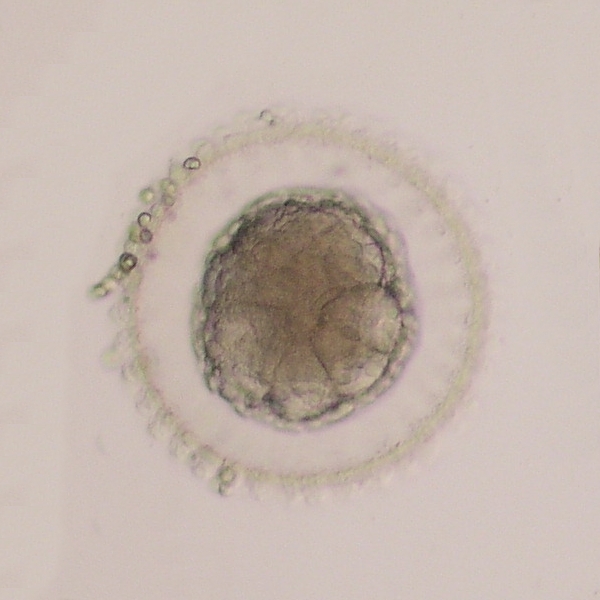 Cell division, that is.
It's 4:00 p.m. rather than a.m. this time, but otherwise, the story is much the same as my last post. I'm here again, trying to get an little experiment to work with my tunicates. I got plenty of eggs and sperm from the adults, but for some reason, the fertilized eggs are just not dividing. I must have done something wrong, but cannot think of what it might be.
It is absolutely maddening, because the number of animals is running low now, so if I don't get the data today or tomorrow, I'm back to my waiting game. When will the next rack of animals come in so I can try to do this experiment again...?
10 November 2006
Latest post ever?
 It's now about 3:15 a.m.
 Yes, I'm running an experiment.
About a week ago, I went out to the Coastal Studies Lab, and to my surprise, there were adult tunicates (Ascidia interrupta, to be exact) on the racks. I brought them back to my lab, and to my surprise and delight, they were reproductive! This is the first year since I started working with them that I've been able to get animals at two different times of the year and have them be reproductive so I can do experiments.
My work with these animals is very much hot and cold: either the animals are out in abundance, or they seem to have vanished from the Laguna Madre. Plus, they don't tend to live in the lab for terribly long periods of time. And my other commitments -- teaching, meetings, and so on -- don't conveniently stop because I have animals to work with.
So when I get them, I really try to push to get things done. Hence a late night.
I started in the lab this morning at 8:00 a.m. The design of the experiment calls for the animals to be treated and measured every two hours until they hatch into little tadpoles, and that takes about 14-16 hours for the fast ones. My student Veronica met me then and worked until 8:00 p.m., and I took over from 10:00 p.m. to now. I had little swimming tadpoles just hatching out around midnight. Now I'm just trying to stay a little longer to see if I can get a little more data.
I was hoping I could maybe start some writing, but the measuring is taking up more of the interval than I expected. I've worked a bit on today's lecture, skimmed the new issue of Science (sea urchin genome stuff looks very cool), and had a late night snack of pretzels from a vending machine. Yum.
And due to doing all of those things while writing a blog post, it's now 4:00 a.m., which means I do my last prep and head home for a snooze. Yay!
03 November 2006
I can't believe how fast it's going
The big red column that you see in a lot of the pictures on our departmental home page has not looked as advertised for many months now. The tiles started falling down, so they stripped the entire column bare to rework it. The scaffolding just went up a couple of weeks ago, and to my surprise, the thing is about two thirds finished. It'll be much nicer to look out the window and see bright red tile than the gray exposed concrete.
01 November 2006
Conference tidbits (delayed)
 Been meaning to mention a few things about the NSF regional conference in Maryland last week.
I think the tone may have been set a little on Sunday, which was a day before the conference officially started. I went to attend a workshop there. There's supposed to be a morning and afternoon workshop on the grant application system NSF uses, called Fastlane. I got told at the registration desk that the person who was supposed to give the workshop just... vanished. Went AWOL. No show, no call, no notice... nothing.
I walk around a bit, thinking maybe this will be resolved by the time the second workshop shows. I show up at the building, which -- because it's Sunday -- seems to be locked up pretty tight. I eventually find one open door, and a couple of other prospective attendees and I go into the building. The workshop room is on the fourth floor.
The elevator only lets you go up to the third floor. The fourth floor you need a special key to be allowed to access. Okay, we try the stairwells. Locked.
Eventually, the few faculty (four of us), run into a woman who was instructed to allow us to the mysterious fourth floor. She tells us she was told to let people in at 12:30 -- our notes all said workshop was at 1:30.
The speaker is still, apparently, walkabout. Nobody for us to talk to.
One of the attendees tries to get a conference organizer on her mobile phone, only to get a message that the organizers are attending the NSF region conference for the next few days. Uh-huh. Eventually, I think someone gets an organizer on a cell. They suggest we slide into a similar workshop in another building, which is mean for administrators rather than faculty, but we are assured much of the information is still the same.
One of my favourite moments was when...
Actually, to understand the next bit, you should probably view a few pictures of the buildings at the University of Maryland, where we were. Check them out here.
Go on. I'll wait.
Really, I'll be here when you get back.
Dum dee dum de dum dee dumm...
Ah, there you are. Okay. After deciding to try to hit the other workshop, we walked out and we were trying to locate the building the alternate workshop was in. The woman next to me pointed and said, "Is it that brick building?"
I just had to turn to her and say, "They're all brick!"
"Oh, wait, let's narrow it down, the brick building with the white trim!"
(They all have white trim, too.)
Another moment that made me laugh was at the very end of the conference. They gave us little conference bags to carry around notes and programs and such. The conference officially ended at 4:00 pm Tuesday.
The shoulder strap on my conference bag broke at 4:01 pm.
Things always break just after the warranty expires...
Favourite saying of the moment
"It's like I'm living in a straw factory, there's so much suckage going on."
I went out to the Coastal Studies Lab today to pick up some animals, and sort of hit two out of three. With help from a couple of the lab guys, I pulled in some fresh sand crabs, and I found brought back some tunicates.
The missing third was pretty bad, though.
All the spiny lobsters I'd ordered in from Florida died the day or two before I got there to pick a couple up. Twelve poor shelly corpses in the courtyard attracting flies instead of being studied for science.
Yeah.
I went out to the Coastal Studies Lab today to pick up some animals, and sort of hit two out of three. With help from a couple of the lab guys, I pulled in some fresh sand crabs, and I found brought back some tunicates.
The missing third was pretty bad, though.
All the spiny lobsters I'd ordered in from Florida died the day or two before I got there to pick a couple up. Twelve poor shelly corpses in the courtyard attracting flies instead of being studied for science.
Yeah.
30 October 2006
Seen at the gym: profession assassination
I seldom watch news channels, but when I'm at the gym, I can't really help it, because they have televisions in almost every place you might look. Despite the wonder that is TV B Gone, they're usually silent with subtitles, so they're not as annoying as they could be.
This Sunday I was reminded again of why I dislike news channels so much. Great vast chunks of airtime filled with pundits, people who offer opinions on anything. This time around, CNN was featuring college costs. And right before a commercial, one of the panelists talked about tenured professors who make $100,000 a year, teach two classes a week, and take the entire summer off.
Then there was some comment about how this would be fixed right up if someone with real management skills could take over.
First, most professors do not make $100,000 a year. Not even tenured full professors. Some surely do, but this is a little like saying actors make millions for a movie. Some do, but most don't.
Teaching two classes a week is probably about right for a lot of institutions. But professors do more than just teach classes. They do research, advise students, serve on committees, and much, much more.
And would you work for free? If professors take the summer off, it's probably because they have a nine month salary, and don't get paid to be around during summer. I have no information on how many "take the summer off," but many professors do work for free during summers.
Not sure how the impression of the profession can be raised, but maybe it needs it.
This Sunday I was reminded again of why I dislike news channels so much. Great vast chunks of airtime filled with pundits, people who offer opinions on anything. This time around, CNN was featuring college costs. And right before a commercial, one of the panelists talked about tenured professors who make $100,000 a year, teach two classes a week, and take the entire summer off.
Then there was some comment about how this would be fixed right up if someone with real management skills could take over.
First, most professors do not make $100,000 a year. Not even tenured full professors. Some surely do, but this is a little like saying actors make millions for a movie. Some do, but most don't.
Teaching two classes a week is probably about right for a lot of institutions. But professors do more than just teach classes. They do research, advise students, serve on committees, and much, much more.
And would you work for free? If professors take the summer off, it's probably because they have a nine month salary, and don't get paid to be around during summer. I have no information on how many "take the summer off," but many professors do work for free during summers.
Not sure how the impression of the profession can be raised, but maybe it needs it.
27 October 2006
The negative pressure continues
This week just keeps sucking. There's not too much I actively look forward to in a week. Doctor Who is one. And the stupid Sci-Fi channel has to go change the schedule without notice, so I miss part of the episode. Drat and double drat.
Back in Texas
And it's been downhill ever since.
The National Science Foundation (NSF) regional conference was okay, I suppose, but I was the wrong person to send to it. It was very much geared to people who had little to no experience dealing with the NSF, and that's not me, given that I have a dozen rejection letters to my credit. I will probably write more about it later.
Speaking of rejection, I came back to find a rejection letter waiting for me on my most recent manuscript. The reviewer claimed the experiments I did repeated some done 50 years ago. But I looked for precedent and couldn't find them, and did the reviewer provide me with a reference for the experiments? NoooOOOooo...
I am thwarted at every turn.
The National Science Foundation (NSF) regional conference was okay, I suppose, but I was the wrong person to send to it. It was very much geared to people who had little to no experience dealing with the NSF, and that's not me, given that I have a dozen rejection letters to my credit. I will probably write more about it later.
Speaking of rejection, I came back to find a rejection letter waiting for me on my most recent manuscript. The reviewer claimed the experiments I did repeated some done 50 years ago. But I looked for precedent and couldn't find them, and did the reviewer provide me with a reference for the experiments? NoooOOOooo...
I am thwarted at every turn.
21 October 2006
I'm off!
To Washington, D.C. for this little NSF Regional conference. No idea how much internet I'll have over the next few days, but promise to tell you all about it when I get back.
17 October 2006
Mammals
 This week's Raised Eyebrow Award goes to the editors of the brand new issue of PLoS Biology. One of the very interesting new articles in this release is, "Morphological evolution is accelerated among island mammals" (my emphasis) by Virginie Millien, who works at McGill, one of my old stomping grounds.
To illustrate this article on the table of contents, the editors put a very nice picture of a tortoise.
Er.
There's just one little problem.
Tortoises are not mammals.
And if that wasn't puzzling enough, try making sense of this sign.
16 October 2006
Grey October day
And when you see that headline, you probably think brown leaves, a jacket, maybe a light pair of gloves and a scarf...
Not in Texas. Still sweating like pigs here. Worse than usual, somedays, because the large amounts of rain we've had in the last month have made it very humid. Not to mention enough standing water to make it mosquito breeding season.
Looking forward to leaving this weekend for the NSF conference. I don't particularly have great expectations for the conference, but it would be nice to get out of the ever-present heat.
Not in Texas. Still sweating like pigs here. Worse than usual, somedays, because the large amounts of rain we've had in the last month have made it very humid. Not to mention enough standing water to make it mosquito breeding season.
Looking forward to leaving this weekend for the NSF conference. I don't particularly have great expectations for the conference, but it would be nice to get out of the ever-present heat.
12 October 2006
A sudden departure
Rather unexpectedly, our Research Office offered me a chance to go to a National Science Foundation conference in Maryland. Only a week and a half away -- which is rather fast. This will be the first time I'll have flown since they've cut down on carrying liquids and such on board. Electric razor, no contacts, buy toothpaste at the other end...
Another new species

Wow, the second new vertebrate species in a week! This time, a mouse in Europe. I like the point that the article mentions: "it was generally assumed that the European biodiversity had been entirely picked over by the natural history pioneers of the 19th century."
We are heavily ignorant of our natural world and the creatures that live in it. Which makes it all the more maddening that most biological research is focused on four or five species for which we have the most genetic information: mouse, fruit fly (Drosophila), the plant Arabidopsis, a little nematode worm C. elegans, and maybe zebrafish (Danio) now being the fifth.
10 October 2006
Driving birdos bonkers

Because now there's just one more for their life lists.
I love it when new species are found, particularly "charismatic" species, like this gorgeous little bird found in South America, whose discovery was announced today. I just keep hoping that these findings will drive home the point about how liitle we know about our natural world. And what behaviours might these guys have that have never been described before? A Ph.D. is just waiting for someone...
;;;;;
I was listening to this weeks's Ockham's Razor podcast , and had one of those "Aha!" moments that are always so cool: where you connect two previously unlinked facts. This episode described eminent eighteenth century scientist Francois Peron, who, when he was my age, had been dead for five years. (Apologies to Tom Lehrer for pinching that joke.) Peron did a lot of very intereesting science in many areas, not the least of which was biological surveys around Australia. The presenter mentions in passing that "many Australian species bear Peron's name as specific epiphets" (e.g., "sapiens" in Homo sapiens).
I heard that little one line comment and the light bulb went off. I suddenly realized I not only knew such an animal, I had actually published two papers about it: the slipper lobster species, Ibacus peronii.
I love not only the flash of putting two previously unconnected facts together at the moment, but also that reminder of past science as something conducted by real, breathing people with great stories to tell.
06 October 2006
Tied for best professional year yet
I received some of the editorial changes to my most recent manuscript yesterday, and it looks like the new paper will be out before the end of the year. December issue of The Biological Bulletin -- watch for it!
In practice, it wouldn't surprise me if the actual issue, particularly the printed copy, weren't on library stands until early 2007. But I kind of like the cover date, because it means I will have published three papers in 2006, which is as productive as I've ever been. The only other year I've had three papers was 1997, when three papers from my Ph.D. dissertation appeared in the span of about a month. This isn't quite the same heady feeling, since this year's papers are spread over a much longer time (first published in February, second around April, and the third in December), a wider set of topics (all different species), and wider geography (data on two of the papers were collected back in late 2000 and early 2001 in Australia).
Now, if I would just get a decision on the manuscript I have in review... I actually received an apology from the editorial office saying they were trying to get it finished a while ago. For such a short paper, it's taking a fetchin' long time to hear a yea or nay.
In practice, it wouldn't surprise me if the actual issue, particularly the printed copy, weren't on library stands until early 2007. But I kind of like the cover date, because it means I will have published three papers in 2006, which is as productive as I've ever been. The only other year I've had three papers was 1997, when three papers from my Ph.D. dissertation appeared in the span of about a month. This isn't quite the same heady feeling, since this year's papers are spread over a much longer time (first published in February, second around April, and the third in December), a wider set of topics (all different species), and wider geography (data on two of the papers were collected back in late 2000 and early 2001 in Australia).
Now, if I would just get a decision on the manuscript I have in review... I actually received an apology from the editorial office saying they were trying to get it finished a while ago. For such a short paper, it's taking a fetchin' long time to hear a yea or nay.
05 October 2006
Who doesn't love meetings?
I was in three consecutive meetings today, back to back, from 11:00 am to about 3:30 pm. There was substantial overlap between them, but it still made for a long day.
First, we had a meeting about the possibility of a marine science program at our university. Things look promising there.
Second meeting was a meeting of the Center for Subtropical Studies. This is a research center that's sort of existed on paper since before I came here. But this is the first peep I'd ever heard about the center. First meeting I knew about, first time there seemed to be any serious discussion about projects we might do. To put it another way, the Center's existed for five-plus years now, and today were were working on a draft constitution that would describe how the thing runs.
Finally, a meeting about the Coastal Studies Lab. Again, some promising things are going on here. Though you still can't tell by looking at the website. (A "last updated" tag of 1999 gives an impression we don't really want.) Updating their website was one of the items we discussed.
It'll just be nice when some of the plans we talk about come to fruition. But these are slow, slow growing seeds.
04 October 2006
Sometimes chemists cop the biology prize
As I mentioned previously, there is no Nobel prize for biology. But there are a surprising number of chemistry Nobel laureates who show up in my general biology lectures, and this year seems to be another case of that. An award to Roger Kornberg for the study of how DNA makes RNA, which I also mentioned in my previous post.
Also interesting is that this is a rare case of a family with two Nobel winners -- Roger's father Arthur Kornberg won it in 1959 for Medicine, but he was also studying genetics. I knew of one other example: the Tinbergen brothers, Jan (Economics) and one of my own intellectual heroes, Niko (Physiology or medicine, but really animal behaviour). But there are several others...
Also interesting is that this is a rare case of a family with two Nobel winners -- Roger's father Arthur Kornberg won it in 1959 for Medicine, but he was also studying genetics. I knew of one other example: the Tinbergen brothers, Jan (Economics) and one of my own intellectual heroes, Niko (Physiology or medicine, but really animal behaviour). But there are several others...
02 October 2006
There is no Nobel Prize for biology
But sometimes, physiology or medicine comes close.
This year's Nobel goes to the people who discovered RNA interference (RNAi). I never knew who developed that technique, though I've certainly heard a lot about it. Here's the deal.
In my introductory biology classes, I teach this simple little mantra: DNA makes RNA. RNA makes protein. Like so many things, that's a gross oversimplification, but it's a useful starting point. In particular, this little six word summary of what DNA does really underestimates the versatility of RNA. RNA has a structure similar to DNA, and actually binds to, and temporarily substitutes for, DNA in normal cell physiology. Or, for that matter, RNA molecules can bind together.
We know a lot about DNA. The traditional way that people figured out what different stretches of DNA did -- that is, what protein that bit of DNA ultimately made -- was to look at individual organisms with mutations. Very useful, but rather unpredictable, since it was usually hard to generate mutations at one point in the DNA only.
What RNA interference does is allows you to turn off particular bits of DNA that make particular proteins in a selective, controlled fashion.
Here's roughly how.
DNA makes RNA. A sequence of DNA has a code within it for a particular protein -- that's a gene. But DNA is stored in one place in the cell, and proteins are made somewhere else, so there has to be an intermediate. RNA is that intermediate. In particular, a type of RNA called messenger RNA binds to the DNA, makes a sort of mirror image copy of that gene. Then the messenger RNA goes off to meet with the protein making machinery. My understanding is that in RNA interference, an RNA molecule (usually experimentally chosen) binds to the messenger RNA, and breaks it apart, thus first obscuring, then destroying, the message the messnger RNA carried from the gene.
The Nobel for this discovery is interesting, because at this point, it's much more of an experimental technique than it is a basic discovery the unravelled something new about how cells work. There are definitely suggestions that RNA interference goes on in actual, living cells, but I think this is getting the prize much more because other scientists are finding it useful. In this sense, the selection is reminiscent of the award for polymerase chain reaction (PCR) some years ago.
And certainly, way down the road, it's easy to start imagining this technique being used to treat genetic disorders or perhaps certain viral infections.
Interesting.
This year's Nobel goes to the people who discovered RNA interference (RNAi). I never knew who developed that technique, though I've certainly heard a lot about it. Here's the deal.
In my introductory biology classes, I teach this simple little mantra: DNA makes RNA. RNA makes protein. Like so many things, that's a gross oversimplification, but it's a useful starting point. In particular, this little six word summary of what DNA does really underestimates the versatility of RNA. RNA has a structure similar to DNA, and actually binds to, and temporarily substitutes for, DNA in normal cell physiology. Or, for that matter, RNA molecules can bind together.
We know a lot about DNA. The traditional way that people figured out what different stretches of DNA did -- that is, what protein that bit of DNA ultimately made -- was to look at individual organisms with mutations. Very useful, but rather unpredictable, since it was usually hard to generate mutations at one point in the DNA only.
What RNA interference does is allows you to turn off particular bits of DNA that make particular proteins in a selective, controlled fashion.
Here's roughly how.
DNA makes RNA. A sequence of DNA has a code within it for a particular protein -- that's a gene. But DNA is stored in one place in the cell, and proteins are made somewhere else, so there has to be an intermediate. RNA is that intermediate. In particular, a type of RNA called messenger RNA binds to the DNA, makes a sort of mirror image copy of that gene. Then the messenger RNA goes off to meet with the protein making machinery. My understanding is that in RNA interference, an RNA molecule (usually experimentally chosen) binds to the messenger RNA, and breaks it apart, thus first obscuring, then destroying, the message the messnger RNA carried from the gene.
The Nobel for this discovery is interesting, because at this point, it's much more of an experimental technique than it is a basic discovery the unravelled something new about how cells work. There are definitely suggestions that RNA interference goes on in actual, living cells, but I think this is getting the prize much more because other scientists are finding it useful. In this sense, the selection is reminiscent of the award for polymerase chain reaction (PCR) some years ago.
And certainly, way down the road, it's easy to start imagining this technique being used to treat genetic disorders or perhaps certain viral infections.
Interesting.
30 September 2006
So much for my tipping
One point?! So much for my prediction of a blowout in this year's AFL Grand Final. Congrats to West Coast.
29 September 2006
Posters and symposium
Despite that my student won the poster competition for the HESTEC Science Symposium, the symposium this Monday was very disappointing. The big problem was a huge disconnect between the speakers and the audience.
The organizers and speakers had the idea that this was an research symposium geared to fellow academics.
The organizers had masses of high school students carted in to the symposium.
Those poor high school students. They were basically prisoners a our symposium, being forced to listen to talks on the spinach principle: "It's good for you!" The speakers did not speak to things that interested the students, so the students were bored and noisy and constantly getting shushed. It was like being back in a high school auditorium.
The speakers were average at best, and they projected their slides in such a way that they got distorted (too wide).
Then, after the morning talks, it was time for poster viewing. After being advertised there would be free lunch during the poster viewing sessions, organizers decided to tell student poster presenters and faculty that the food wasn't for them. Apparently, it was only for the high school students.
One student got told she had to provide her own mounting board for her poster because the organizers had run out.
The afternoon roundtable was not bad, although the speakers admitted that they were expecting to be talking to university students rather than high school students. And when the moderator said a couple of times they wanted to give students the chance to ask questions, Congressman Hinojosa decided to get up and talk for several minutes instead, cutting into the actual discussion that should characterize roundtables.
Finally, it was time for the students who had won the poster competition to give their talks. And shortly after that started... most of the audience left. The imported high school students had to get back on their buses and leave. So these poor students were giving these talks (the sort you'd hear at national academic conferences) to mostly empty rooms with a few stragglers who probably didn't have the background to understand a lot of what was being said. Heck, I'm an academic, and I didn't understand large chunks of most of the student talks.
The day left me very sad to have seen such a missed opportunity.
But at least my student won a laptop for her poster.
The organizers and speakers had the idea that this was an research symposium geared to fellow academics.
The organizers had masses of high school students carted in to the symposium.
Those poor high school students. They were basically prisoners a our symposium, being forced to listen to talks on the spinach principle: "It's good for you!" The speakers did not speak to things that interested the students, so the students were bored and noisy and constantly getting shushed. It was like being back in a high school auditorium.
The speakers were average at best, and they projected their slides in such a way that they got distorted (too wide).
Then, after the morning talks, it was time for poster viewing. After being advertised there would be free lunch during the poster viewing sessions, organizers decided to tell student poster presenters and faculty that the food wasn't for them. Apparently, it was only for the high school students.
One student got told she had to provide her own mounting board for her poster because the organizers had run out.
The afternoon roundtable was not bad, although the speakers admitted that they were expecting to be talking to university students rather than high school students. And when the moderator said a couple of times they wanted to give students the chance to ask questions, Congressman Hinojosa decided to get up and talk for several minutes instead, cutting into the actual discussion that should characterize roundtables.
Finally, it was time for the students who had won the poster competition to give their talks. And shortly after that started... most of the audience left. The imported high school students had to get back on their buses and leave. So these poor students were giving these talks (the sort you'd hear at national academic conferences) to mostly empty rooms with a few stragglers who probably didn't have the background to understand a lot of what was being said. Heck, I'm an academic, and I didn't understand large chunks of most of the student talks.
The day left me very sad to have seen such a missed opportunity.
But at least my student won a laptop for her poster.
A quick tip
West Coast vs. Sydney: I don't have a strong feeling for which way it'll swing, but I'm betting that it's going to be a blowout instead of a close game like last year. That was certainly the case the last time two teams (Collingwood and Brisbane) faced each other in back-to-back premierships: a close match the first year, a blowout the second.
28 September 2006
Another step towards administration
Today I found myself elected as secretary of PAUF, the local branch of the Texas Faculty Association. Being secretary also puts me on the Executive Committee for the group. I try never to pass up a chance to seize power -- I mean, work collaboratively with fellow faculty members.
Joining the YouTube craze
YouTube is one of the websites of the moment, so who am I to argue? I've been meaning to put up some video to supplement one of my recent articles, and this seemed as good a way as any.
The video shows slipper lobster digging, which I wrote about in this article in Journal of Crustacean Biology.
The video is also archived here.
Additional: But mayhap I spoke too soon...
The video shows slipper lobster digging, which I wrote about in this article in Journal of Crustacean Biology.
The video is also archived here.
Additional: But mayhap I spoke too soon...
24 September 2006
Thunderous
For the second time in as many weeks, we've had horror movie thunderstorms. Flashes of light followed by huge, explosive cracks, sheeting rain, long rolls of sound that go on and on... In my barely awake state around 7:00 am this morning, I found myself thinking, "Wow, that's really thunderous."
Well, duh. It's thunder.
;;;;;
In the cosmic coincidence category, I mentioned in my last post that I was lecturing about Otto Loewi's discovery of chemical neurotransmission on Friday. And that little science story was mentioned later that night on the season premier of Numb3rs. Eerie. I'll have to ask my students if any of them caught it.
Speaking of Numb3rs, I had previously made fun of the show for the lead character, Charlie Epps, being a professor at what seemed to me to be a ridiculously young age (26, when most academics are about half-way through grad schools). I have since learned, courtesy of the ever informative Science Show, that Epps is based on Caltech's Alexei Borden, who became a full professor at the age of... you guessed it... 26.
Math careers just aren't like biology, I guess.
Numb3rs is just one fraction (pun intended) of the reason why, in America, Friday is becoming the biggest night for TV geeks since X-Files left Fridays. Not only do we have Numb3rs, one of the few shows featureing academic science, but there's the amazing Avatar: The Last Airbender. Weeks to come will see the return of the revived Battlestar Galactica, and best of all, the second season of the new Doctor Who series. My geek cup runneth over.
Well, duh. It's thunder.
;;;;;
In the cosmic coincidence category, I mentioned in my last post that I was lecturing about Otto Loewi's discovery of chemical neurotransmission on Friday. And that little science story was mentioned later that night on the season premier of Numb3rs. Eerie. I'll have to ask my students if any of them caught it.
Speaking of Numb3rs, I had previously made fun of the show for the lead character, Charlie Epps, being a professor at what seemed to me to be a ridiculously young age (26, when most academics are about half-way through grad schools). I have since learned, courtesy of the ever informative Science Show, that Epps is based on Caltech's Alexei Borden, who became a full professor at the age of... you guessed it... 26.
Math careers just aren't like biology, I guess.
Numb3rs is just one fraction (pun intended) of the reason why, in America, Friday is becoming the biggest night for TV geeks since X-Files left Fridays. Not only do we have Numb3rs, one of the few shows featureing academic science, but there's the amazing Avatar: The Last Airbender. Weeks to come will see the return of the revived Battlestar Galactica, and best of all, the second season of the new Doctor Who series. My geek cup runneth over.
22 September 2006
I wish I was surprised...
...When I ran into my colleague Anita on the walkway, fuming. As I've mentioned previously, she was lead on a successful equipment grant we received earlier this year for a DNA sequencer. The agency gave the university the money, the university set up the account, and then didn't give Anita the right to spend it.
She was on her way to about the third consecutive office that morning, trying to get permission she needed to spend her grant money. Yup. They created an account for her but didn't give her access to it. Unfortunately, incidents like this don't surprise me any more.
I gave her a hug. Unfortunately, that was about all I could do at the moment. Later, she told me that the problem would be fixed by the end of today. We'll see if the DNA sequencer shows up next Friday as it ought.
;;;;;
Meanwhile, something that really did surprise me... My student Veronica won the award for best poster for next week's HESTEC Science Symposium. I was slightly nervous about sending out the announcement to our department, because I was also the departmental representative for the symposium, and I was worried about someone giving me a bad time about fixing the result. Not that I think anyone would say that in anything other than a joke. Because if I'd wanted to fix things, my students would have won last year's competition, too.
So now Veronica has the weekend to dust off a talk she gave at the end of summer for her HHMI symposium, hopefully improve it, and give it on Monday.
;;;;;
I was lecturing today about Otto Loewi, the Nobel laureate who first proved that neurons communicated by releasing chemicals from their synapses. The idea for the Nobel winning experiment came to him in the middle of the night on Easter Sunday. He wrote it down, got up in the morning, but couldn't read his own handwriting. He spent the day trying to remember, but couldn't. The next night, he woke up again and remembered, rushed to the lab and did the experiment in about two hours.
Great story.
I, on the other hand, spent last night dreaming about the best chess scenes in science fiction movies and television. The three that come to mind: the 3-D chessboard from the original Star Trek TV series, one of the astronauts playing chess with HAL 9000 in 2001: A Space Odyssey, and Professor Xavier and Magneto playing chess at the end of X-Men.
Hm. Don't think I'm going to get a Nobel prize out of that dream.
She was on her way to about the third consecutive office that morning, trying to get permission she needed to spend her grant money. Yup. They created an account for her but didn't give her access to it. Unfortunately, incidents like this don't surprise me any more.
I gave her a hug. Unfortunately, that was about all I could do at the moment. Later, she told me that the problem would be fixed by the end of today. We'll see if the DNA sequencer shows up next Friday as it ought.
;;;;;
Meanwhile, something that really did surprise me... My student Veronica won the award for best poster for next week's HESTEC Science Symposium. I was slightly nervous about sending out the announcement to our department, because I was also the departmental representative for the symposium, and I was worried about someone giving me a bad time about fixing the result. Not that I think anyone would say that in anything other than a joke. Because if I'd wanted to fix things, my students would have won last year's competition, too.
So now Veronica has the weekend to dust off a talk she gave at the end of summer for her HHMI symposium, hopefully improve it, and give it on Monday.
;;;;;
I was lecturing today about Otto Loewi, the Nobel laureate who first proved that neurons communicated by releasing chemicals from their synapses. The idea for the Nobel winning experiment came to him in the middle of the night on Easter Sunday. He wrote it down, got up in the morning, but couldn't read his own handwriting. He spent the day trying to remember, but couldn't. The next night, he woke up again and remembered, rushed to the lab and did the experiment in about two hours.
Great story.
I, on the other hand, spent last night dreaming about the best chess scenes in science fiction movies and television. The three that come to mind: the 3-D chessboard from the original Star Trek TV series, one of the astronauts playing chess with HAL 9000 in 2001: A Space Odyssey, and Professor Xavier and Magneto playing chess at the end of X-Men.
Hm. Don't think I'm going to get a Nobel prize out of that dream.
Poor NASA
I'm afraid this article -- "Conspiracy theorists must face the truth of Mars hill" -- is a triumph of hope over experience. Conspiracy theorists do not change their minds in response to evidence. This is one of the things that make them both fascinating and scary at the same time.
It's an excellent example of why, if I were still in psychology, I'd probably be studying the psychology of belief. I find it absolutely fascinating that we have some beliefs based on experience and evidence, some beliefs for which there is not evidence either way, and how some people form beliefs depite evidence to the contrary.
;;;;;
In an earlier post, I mentioned I had a paper accepted for pulication this week. For what it's worth, it'll be:
No big surprise there, as I've had abstracts about it published in 2004 (Society for Neuroscience meeting) and 2005 (Society for Integrative and Comparative Biology meeting). I'm expecting it'll be out early 2007. Ack, that means I'l have been working on this simple project for how long? Four years?
One thing I'm pleased about it that the three first authors all worked on the project as undergraduates, and the first, Sandra, has also worked on it as a graduate student.
It's an excellent example of why, if I were still in psychology, I'd probably be studying the psychology of belief. I find it absolutely fascinating that we have some beliefs based on experience and evidence, some beliefs for which there is not evidence either way, and how some people form beliefs depite evidence to the contrary.
;;;;;
In an earlier post, I mentioned I had a paper accepted for pulication this week. For what it's worth, it'll be:
Espinoza SY, Breen A, Varghese N, Faulkes Z. Loss of escape-related giant neurons in spiny lobsters, Panulirus argus. The Biological Bulletin: in press.
No big surprise there, as I've had abstracts about it published in 2004 (Society for Neuroscience meeting) and 2005 (Society for Integrative and Comparative Biology meeting). I'm expecting it'll be out early 2007. Ack, that means I'l have been working on this simple project for how long? Four years?
One thing I'm pleased about it that the three first authors all worked on the project as undergraduates, and the first, Sandra, has also worked on it as a graduate student.
18 September 2006
Papers and puppies
It's a good day today for my student and myself. First, we got a final acceptance letter on a manuscript we'd been working on, and revising for what seems like forever. It means that I made some work for myself, because I had to update my tenure binder, which was supposed to be "set" and submitted last Friday. But that's a nice problem to have, because it pushes a "key performance indicator" (number of papers published) away from the minimum.
Second, she'd had her apartment broken into late last week, and had lots of things stolen, not the least of which was her new puppy! Stealing a puppy? That's low. Fortunately, police work were able to catch suspects, and much of her stolen goods -- including her puppy -- were returned.
(Who says I never write feel goods stories on my blog?)
Second, she'd had her apartment broken into late last week, and had lots of things stolen, not the least of which was her new puppy! Stealing a puppy? That's low. Fortunately, police work were able to catch suspects, and much of her stolen goods -- including her puppy -- were returned.
(Who says I never write feel goods stories on my blog?)
15 September 2006
Breaking my heart
It's been heavy on my heart to read about the Dawson College shooting the last couple of days. There are just so many little ties and memories... I used to live in Montreal. I was going to graduate school when the L'Ecole Polytechnique shooting occurred, and was so sad to hear about another shooting at a institute of higher learning. One of the things I hate about living in Texas is seeing signs on building about carrying guns into it. I hope I never see those signs when I go back to Canada.
Time's up
In my email box today:
My tenure clock has now timed out. I either get tenure and promotion or I get fired.
Looking at where I was hoping to be when I interviewed and where I am?
I was expecting that we would have a Ph.D. program by now. When I interviewed, several people said, "Ph.D. in biology in about five years." Here it is, five years later, and we're further from a Ph.D. than when I interviewed.
I really thought that I would have an external grant by now. I suppose I sort of do, since I'm co-PI on an equipment grant, but I thought I would have some sort of money of my own. Unfortunately, I have no promising leads in that department. No encouragement at all.
I thought I would have more research papers published. I've been publishing consistently, but a lot of that was getting stuff out where the data were actually collected during my highly productive last post-doc. I've published two papers based on stuff since moving to Texas (which is the minimum required), and only one of them has actual data. I do have two papers on editor's desks under review, however, and that makes me feel a little better, though not much. I had expected to have the final word on one of them by now; it would be nice to be slightly higher then the minimum. Apparently, I can update by folder before final review.
And I haven't worked on my book mauscript in months.
This is a friendly reminder that your tenure "folders" are due by 5:00 PM today.
My tenure clock has now timed out. I either get tenure and promotion or I get fired.
Looking at where I was hoping to be when I interviewed and where I am?
I was expecting that we would have a Ph.D. program by now. When I interviewed, several people said, "Ph.D. in biology in about five years." Here it is, five years later, and we're further from a Ph.D. than when I interviewed.
I really thought that I would have an external grant by now. I suppose I sort of do, since I'm co-PI on an equipment grant, but I thought I would have some sort of money of my own. Unfortunately, I have no promising leads in that department. No encouragement at all.
I thought I would have more research papers published. I've been publishing consistently, but a lot of that was getting stuff out where the data were actually collected during my highly productive last post-doc. I've published two papers based on stuff since moving to Texas (which is the minimum required), and only one of them has actual data. I do have two papers on editor's desks under review, however, and that makes me feel a little better, though not much. I had expected to have the final word on one of them by now; it would be nice to be slightly higher then the minimum. Apparently, I can update by folder before final review.
And I haven't worked on my book mauscript in months.
08 September 2006
07 September 2006
In the "What were they thinking?" department
The Age has a report on scientific conference entertainment here.
I've been to enough scientific conferences in places like New Orleans to know that scientists are not averse to having a good time. Even good times of a decidedly adult nature. But never as part of the official conference.
I can't believe nobody said, "This may not be a good idea...".
I've been to enough scientific conferences in places like New Orleans to know that scientists are not averse to having a good time. Even good times of a decidedly adult nature. But never as part of the official conference.
I can't believe nobody said, "This may not be a good idea...".
04 September 2006
In honour of Labour Day...
I laboured. At least part of the day, anyway. I started and more or less finished a poster for the HESTEC science symposium. Then I went out and saw a movie.
02 September 2006
Nothing like the original
It's a good month for cinema geek purists.
This month sees the DVD release of a couple of movies that I've been waiting to buy in their original versions. The Japanese release of Godzilla and the 1977 version of Star Wars. Both have been available before—the Americanized Godzilla with Raymond Burr, and the special edition version of the first three Star Wars movies, but I resisted buying earlier releases, because I wanted the original.
But it's not a great month for television geek purists. I was disappointed to read plans to redo the original Star Trek series. Hopefully, they will go the route taken by Star Wars and some of the DVDs of classic Doctor Who series and have an option where you can choose to view the original version or the new version.
I'm not opposed to tinkering with works of art in all cases. I went excitedly to the theatre when the Star Wars trilogy special edition was released, and the new effects and such were cool. But I don't want the originals to be lost.
Does this post have anything to do with science? Sort of. In Beautiful Evidence, Edward Tufte talks about summarizing as a potential source of corruption of evidence. The market for summaries in science is huge. You only need to think about textbooks. They repackage and summarize.
There are many notorious cases of errors being perpetuated because textbooks copy from each other. Stephen Jay Gould wrote an essay about the "fox terrier clone" about how, in text after text, small prehistoric horses were compared in size to fox terriers, rather than any other dog (Gould, 1988). In one draft of a textbook I reviewed, I spotted another error that has been perpetuated by copying: a somatosensory map of the nervous system where the homonculus has a left hand attached to the right side of the body.
But even if the information is correct, quite often important context is lost. For example, some introductory biology books talk about the "Z scheme" when discussing photosynthesis to describe the energy levels of electrons. But many well known textbooks show it like below.
 The "Z scheme" is shown by the yellow.
Do those yellow lines trace the letter Z?
They most emphatically do not.
At least in my world, that's an N, not a Z.
Never mind confusing the students, I have no idea why the heck the thing is called a Z scheme when faced with a diagram like that.
I strongly suspect that the diagram in the original scientific article describing electron energy in photosynthesis was rotated 90°, but I haven't been able to track it down to confirm. So I'm left with mysterious name I have to teach that is divorced from its original context, and makes no sense as a result.
I am really pleased to see is that more and more old research articles are becoming scanned and posted to the web, thanks to sites like JSTOR. More and more, I am able to read what the original authors thought and see the original evidence.
References
Gould, S.J. 1988. The case of the creeping fox terrier clone. Natural History 96(1): 16-24. (Also collected in: Gould, S.J. 1991. Bully for Brontosaurus: Reflections in Natural History, pp. 155-167. New York, W.W. Norton & Co.)
This month sees the DVD release of a couple of movies that I've been waiting to buy in their original versions. The Japanese release of Godzilla and the 1977 version of Star Wars. Both have been available before—the Americanized Godzilla with Raymond Burr, and the special edition version of the first three Star Wars movies, but I resisted buying earlier releases, because I wanted the original.
But it's not a great month for television geek purists. I was disappointed to read plans to redo the original Star Trek series. Hopefully, they will go the route taken by Star Wars and some of the DVDs of classic Doctor Who series and have an option where you can choose to view the original version or the new version.
I'm not opposed to tinkering with works of art in all cases. I went excitedly to the theatre when the Star Wars trilogy special edition was released, and the new effects and such were cool. But I don't want the originals to be lost.
Does this post have anything to do with science? Sort of. In Beautiful Evidence, Edward Tufte talks about summarizing as a potential source of corruption of evidence. The market for summaries in science is huge. You only need to think about textbooks. They repackage and summarize.
There are many notorious cases of errors being perpetuated because textbooks copy from each other. Stephen Jay Gould wrote an essay about the "fox terrier clone" about how, in text after text, small prehistoric horses were compared in size to fox terriers, rather than any other dog (Gould, 1988). In one draft of a textbook I reviewed, I spotted another error that has been perpetuated by copying: a somatosensory map of the nervous system where the homonculus has a left hand attached to the right side of the body.
But even if the information is correct, quite often important context is lost. For example, some introductory biology books talk about the "Z scheme" when discussing photosynthesis to describe the energy levels of electrons. But many well known textbooks show it like below.
 The "Z scheme" is shown by the yellow.
Do those yellow lines trace the letter Z?
They most emphatically do not.
At least in my world, that's an N, not a Z.
Never mind confusing the students, I have no idea why the heck the thing is called a Z scheme when faced with a diagram like that.
I strongly suspect that the diagram in the original scientific article describing electron energy in photosynthesis was rotated 90°, but I haven't been able to track it down to confirm. So I'm left with mysterious name I have to teach that is divorced from its original context, and makes no sense as a result.
I am really pleased to see is that more and more old research articles are becoming scanned and posted to the web, thanks to sites like JSTOR. More and more, I am able to read what the original authors thought and see the original evidence.
References
Gould, S.J. 1988. The case of the creeping fox terrier clone. Natural History 96(1): 16-24. (Also collected in: Gould, S.J. 1991. Bully for Brontosaurus: Reflections in Natural History, pp. 155-167. New York, W.W. Norton & Co.)
01 September 2006
Google knows I'm typing this
This article picks up on something that has been worrying about. Many academic journals have started to use Google Scholar to link to other articles. There are similar, public databases -- like PubMed -- but Google Scholar does a lot that others don't, probably has more coverage of articles. It's worrying to me, though, that a private company has so much control over our ability to find scientific content. And nobody seems to notice. I think I will have more to say about this later, as it links up with some thinking I'm having about dispersing scientific information.
Shout, shout, let it all out
I love scientific passion, so was actually pleased to read this description (in this week's Science) about the debate about Pluto's status as a planet:
Of course, maybe that is a little over the top, but I don't know if I completely agree with this:
Sometimes I think scientists need to be more emotionally involved, demonstrably so. It’s not like cold rational arguments have made a heck of a lot of headway against people denying global warming or evolution or other scientific matters.
To Gingerich’s argument that the proposal rested on physical criteria, asteroid researcher Andrea Milani of the University of Pisa in Italy, literally screamed, “Dynamics is not physics?” Other astronomers protested the committee's neglect of extrasolar planets, only to be angrily silenced by outgoing IAU President Ronald D. Ekers, who declared such issues to be “out of order!”
Of course, maybe that is a little over the top, but I don't know if I completely agree with this:
“It should never have become this emotional,” says astronomer George Miley of Leiden University in the Netherlands.
Sometimes I think scientists need to be more emotionally involved, demonstrably so. It’s not like cold rational arguments have made a heck of a lot of headway against people denying global warming or evolution or other scientific matters.
28 August 2006
Abbrev. commod.
I've spent the last three of four days making revisions to my most recent manuscript, which is getting shipped overnight to the editorial office today. Yay! In doing so, however, I spent a lot of time thinking, "There must be an easier way."
First, this journal has incredibly stringent guidelines for digital art. The guidelines for their artwork are on the authors' instructions now, but I'm not sure if they were back at the beginning of the year when I first submitted the article. In any case, this meant reworking every figure for fussy things like making sure the pictures were in TIFF format rather than JPG, had a sufficient number of dots per inch, were in CYMK rather than RGB format, and various other things that matter to professional printers. Oh, and printing off a high quality copy on glossy photo paper (in case the digital versions were wonky). Tedious, but fortunately, it didn't take as long as I was fearing.
Second, I spent a fair amount of time worrying about journal abbreviations. For those of you who are not regular readers of scientific journals, referencing is a big deal in several ways. Highly referenced papers are indicative of important findings, and in some places, can be used as evidence for things like promotion. Heck, that I had papers referencing my work was important in proving that I was a bona fide international scientist when I was applying for premanent residency in the United States.
Making sure the reference list is correct is one of the most tedious portions of the writing and proofing process.
Part of this tediousness is that different journals have different rules for referencing. Each one is a punctuation nightmare. For instance, here's how one of my papers might look if it was cited in The Biological Bulletin:
Here's the same one as it would appear in Brain, Behavior and Evolution:
And here it is in The Journal of Experimental Biology:
Each one is just a little bit different. But I want to draw your attention in particular to the name of the journal this article was published in. I daresay that few journals list the entire name of a journal in the references; instead, most use some sort of abbreviation. I think the original idea was to cut down on the number of printed pages, and possibly even the number of letters a typesetter had to set. Before the advent of computers, typesetting was a highly specialized craft.
Looking above, you'll notice that one journal abbreviates with periods, another without.
That's the easy difference.
But think about this a little further. This journal has a fairly struaghtforward name. Still, why is it "J Crust Biol" instead of "J Crust Bio" (no "L" at the end)? For that matter, how do you decide how to abbreviate some really obscure journal, or one that is published in a foreign language?
It turns out that there are massive lists of journal title abbreviations. Actually, make that competing lists of abbreviations. There's one standard called MEDLINE for medical related journals. There's an abbreviation standard that used to be called ISI. Apparently there is a World List of Scientific Periodicals which also has abbreviations. And those are just a few that I'm aware of from my dealings in biology. Heaven only knows what the chemists or engineers do, let alone people in the humanities.
The journal that I am submitting to asks for BIOSIS abbreviations (except they list a few exceptions to the way BIOSIS abbreviates, adding even more complexity).
How do you get a list of BIOSIS journal abbreviations?
You have to buy it.
This is around the point where my head starts to hurt. It strikes me as completely bizarre that abbreviations are a commodity (hence my title for this entry).
Many have remarked on how more and more, people are being restricted from doing things because of intellectual property concerns. For an excellent discussion of this, you could do worse than to listen to "Free Culture" presentation by Lawrence Lessig, then head over the Creative Commons website.
Science is supposed to have been about sharing of ideas. Obviously, there are various limits to that, but I'm still trying to figure out how we've ended up in the weird situation where I can't get information I need to write a paper properly, or even figure out what journal something was published in if it was abbreviated.
Why make something harder to understand by using cryptic abbreviations? Are there still some great hidden advantage to using abbreviations in the digital age? Do we save that many pages, or time, or effort?
Journal abbreviations are broken.
One solution is blindingly obvious, of course. Don't abbreviate journal titles. But are editors and publishers willing to take the lead?
Coming soon: My rant against "et al."
First, this journal has incredibly stringent guidelines for digital art. The guidelines for their artwork are on the authors' instructions now, but I'm not sure if they were back at the beginning of the year when I first submitted the article. In any case, this meant reworking every figure for fussy things like making sure the pictures were in TIFF format rather than JPG, had a sufficient number of dots per inch, were in CYMK rather than RGB format, and various other things that matter to professional printers. Oh, and printing off a high quality copy on glossy photo paper (in case the digital versions were wonky). Tedious, but fortunately, it didn't take as long as I was fearing.
Second, I spent a fair amount of time worrying about journal abbreviations. For those of you who are not regular readers of scientific journals, referencing is a big deal in several ways. Highly referenced papers are indicative of important findings, and in some places, can be used as evidence for things like promotion. Heck, that I had papers referencing my work was important in proving that I was a bona fide international scientist when I was applying for premanent residency in the United States.
Making sure the reference list is correct is one of the most tedious portions of the writing and proofing process.
Part of this tediousness is that different journals have different rules for referencing. Each one is a punctuation nightmare. For instance, here's how one of my papers might look if it was cited in The Biological Bulletin:
Faulkes, Z. 2006. Digging mechanisms and substrate preferences of shovel nosed lobsters, Ibacus peronii (Decapoda: Scyllaridae). J. Crust. Biol. 26: 69-72.
Here's the same one as it would appear in Brain, Behavior and Evolution:
Faulkes Z (2006) Digging mechanisms and substrate preferences of shovel nosed lobsters, Ibacus peronii (Decapoda: Scyllaridae). J Crust Biol 26:69-72.
And here it is in The Journal of Experimental Biology:
Faulkes, Z. (2006). Digging mechanisms and substrate preferences of shovel nosed lobsters, Ibacus peronii (Decapoda: Scyllaridae). Journal of Crustacean Biology 26, 69-72.
Each one is just a little bit different. But I want to draw your attention in particular to the name of the journal this article was published in. I daresay that few journals list the entire name of a journal in the references; instead, most use some sort of abbreviation. I think the original idea was to cut down on the number of printed pages, and possibly even the number of letters a typesetter had to set. Before the advent of computers, typesetting was a highly specialized craft.
Looking above, you'll notice that one journal abbreviates with periods, another without.
That's the easy difference.
But think about this a little further. This journal has a fairly struaghtforward name. Still, why is it "J Crust Biol" instead of "J Crust Bio" (no "L" at the end)? For that matter, how do you decide how to abbreviate some really obscure journal, or one that is published in a foreign language?
It turns out that there are massive lists of journal title abbreviations. Actually, make that competing lists of abbreviations. There's one standard called MEDLINE for medical related journals. There's an abbreviation standard that used to be called ISI. Apparently there is a World List of Scientific Periodicals which also has abbreviations. And those are just a few that I'm aware of from my dealings in biology. Heaven only knows what the chemists or engineers do, let alone people in the humanities.
The journal that I am submitting to asks for BIOSIS abbreviations (except they list a few exceptions to the way BIOSIS abbreviates, adding even more complexity).
How do you get a list of BIOSIS journal abbreviations?
You have to buy it.
This is around the point where my head starts to hurt. It strikes me as completely bizarre that abbreviations are a commodity (hence my title for this entry).
Many have remarked on how more and more, people are being restricted from doing things because of intellectual property concerns. For an excellent discussion of this, you could do worse than to listen to "Free Culture" presentation by Lawrence Lessig, then head over the Creative Commons website.
Science is supposed to have been about sharing of ideas. Obviously, there are various limits to that, but I'm still trying to figure out how we've ended up in the weird situation where I can't get information I need to write a paper properly, or even figure out what journal something was published in if it was abbreviated.
Why make something harder to understand by using cryptic abbreviations? Are there still some great hidden advantage to using abbreviations in the digital age? Do we save that many pages, or time, or effort?
Journal abbreviations are broken.
One solution is blindingly obvious, of course. Don't abbreviate journal titles. But are editors and publishers willing to take the lead?
Coming soon: My rant against "et al."
23 August 2006
Back in place
 The trip to Science Park was reasonably successful on several levels. Got some new slides for a manuscript my student Sandra and I are revising; figured out that no, we weren't doing anything stupid on our techniques; got to visit my good friend Virginia; saw how the other half lives (that is, saw lots of expensive scientific equipment that we don't have); and the change of scenery was nice.
Meanwhile, there were a whole bunch of meetings which I missed. I am not sad I missed them. Our president Bambi spoke for a whopping two and a half hours at a general university convocation this morning. The convocation saw the debut of the university's new logo.
I am not wild about it. Rectangles around a star. Whooooo.
It's a bland, generic, geometric design. It says nothing to me about the institution. At least the old one had a palm tree, which gave a hint about our location -- someplace warm. The new logo also reminds me of a swastika. Swastikas have a long and honourable tradition in many cultures, but still has bad connotations. But maybe other people won't see any such resemblance.
20 August 2006
Road trip!
In mere moments, I should be off to Science Park to, well, do science. Will be back late Tuesday. A day of meetings and preparation, then classes start Thursday. Never raining, just pouring.
18 August 2006
Start to finish
Sometime in the year 2000, I walked into the Queen Victoria Market and saw one of the seafood stores had live spanner crabs, which I had been very interested in seeing. I bought some and did some experiments with them.
That project was sort of officially laid to rest this last Wednesday. That was the day I got the actual printed reprints from the journal article I published about them in Crustaceana.
So what happened in between?
I moved across the Pacific and got a new job in September 2001. I worked on the manuscript off and on, and finally submitted it to the first journal #1 in May 2005. It was rejected in June 2005, but comments suggested it might be appropriate for a different journal.
Taking the reviewers' cue, I resubmitted that same month. The reprint I received incidated they got their copy on 5 July 2005. The reprint also notes the final version of the manuscript came in 19 October, so the external review, my revisions and corrections, and editorial decision took about three and a half months.
From there, the paper was actually published in the February issue of Crustaceana, but I didn't see anything in electronic form on the web until May 2006. I'd be interested to know when libraries actually got their copies in the mail. And that makes another three months from online publication to printing and shipping of actual reprints.
Coincidentally, I also finally received a copy of Crustacean Experimental Systems in Neurobiology. I have a chapter in that book, and it was published four years ago now. But it has an average price tag for specialty academic books (triple digits), so it's not the sort of thing you go out and buy on a whim. Buying it was a little reward to myself I got with the money I got for teaching a grad class this summer.
That project was sort of officially laid to rest this last Wednesday. That was the day I got the actual printed reprints from the journal article I published about them in Crustaceana.
So what happened in between?
I moved across the Pacific and got a new job in September 2001. I worked on the manuscript off and on, and finally submitted it to the first journal #1 in May 2005. It was rejected in June 2005, but comments suggested it might be appropriate for a different journal.
Taking the reviewers' cue, I resubmitted that same month. The reprint I received incidated they got their copy on 5 July 2005. The reprint also notes the final version of the manuscript came in 19 October, so the external review, my revisions and corrections, and editorial decision took about three and a half months.
From there, the paper was actually published in the February issue of Crustaceana, but I didn't see anything in electronic form on the web until May 2006. I'd be interested to know when libraries actually got their copies in the mail. And that makes another three months from online publication to printing and shipping of actual reprints.
Coincidentally, I also finally received a copy of Crustacean Experimental Systems in Neurobiology. I have a chapter in that book, and it was published four years ago now. But it has an average price tag for specialty academic books (triple digits), so it's not the sort of thing you go out and buy on a whim. Buying it was a little reward to myself I got with the money I got for teaching a grad class this summer.
11 August 2006
One more year
I got the paperwork appointing me for the 2007 fiscal year today. And I got a 3.3% raise. I think that's above inflation, except maybe for gasoline.
Meanwhile, I've been spending most of the day thinking about undergraduate research, as I am banging away on the fourth attempt to land an NSF Research Experience for Undergraduates grant. Three other times, they liked it and encouraged revision and resubmission. That I'm writing it a fourth time is a testimony to the triumph of hope over experience.
Meanwhile, I've been spending most of the day thinking about undergraduate research, as I am banging away on the fourth attempt to land an NSF Research Experience for Undergraduates grant. Three other times, they liked it and encouraged revision and resubmission. That I'm writing it a fourth time is a testimony to the triumph of hope over experience.
09 August 2006
Expertise
As an academic, you're a professional expert. But sometimes you think, "But why does this take so long?" Bachelor's degree, graduate work, post docs more often than not. One answer may be because that it takes about ten years of hard study to become truly expert in anything, according to this article in Scientific American online.
That's the bad news. The good news seems to be that innate talent doesn't seem to be the deciding factor in developing expertise: continued study is.
On a somewhat related note, expertise -- not to mention passion and intelligence and lots of other good things -- are on glorious display at the TED website. The talks are wonderful, sometimes astonishing, must visit links. The blog has plenty of excellent tidbits as well.
That's the bad news. The good news seems to be that innate talent doesn't seem to be the deciding factor in developing expertise: continued study is.
On a somewhat related note, expertise -- not to mention passion and intelligence and lots of other good things -- are on glorious display at the TED website. The talks are wonderful, sometimes astonishing, must visit links. The blog has plenty of excellent tidbits as well.
04 August 2006
Another week, another talk
Yesterday we had our first symposium for our HHMI students. We're just finishing up the second year of a four year undergraduate research grant funded by the HHMI, and this was something we'd said we'd do. The first year, we were just getting geared up and so it didn't happen. But it went reasonably yesterday.
There were ten students who gave presentations, with a couple of double acts. Some were students who'd already been in the program, and some were just starting. My student, Veronica, gave hers in the afternoon and was fine. Even though her moron supervisor (me) gave her a mislabelled slide. For the record, I know that morula stage comes before gastrula, not after. I can make fun of myself now because luckily, if anyone caught it, they were too polite to mention the gaffe during the talk.
I also found out a few other things that I'd not been completely aware of. Like, that we have a dedicated webpage about our HHMI program. Also found out about some of the stuff going on in our core lab facility, and toured our big mobile lab bus for the first time. The bus is a working molecular biology lab on wheels, which goes out to schools to show kids things like DNA technology. They've already had something like 5,000 kids go through it since it started earlier this year.
We also brought back three previous seminar speakers to provide evaluations of the program. And they took that role very seriously during the day, before they went out drinking -- I mean, to dinner -- with us that night.
There were ten students who gave presentations, with a couple of double acts. Some were students who'd already been in the program, and some were just starting. My student, Veronica, gave hers in the afternoon and was fine. Even though her moron supervisor (me) gave her a mislabelled slide. For the record, I know that morula stage comes before gastrula, not after. I can make fun of myself now because luckily, if anyone caught it, they were too polite to mention the gaffe during the talk.
I also found out a few other things that I'd not been completely aware of. Like, that we have a dedicated webpage about our HHMI program. Also found out about some of the stuff going on in our core lab facility, and toured our big mobile lab bus for the first time. The bus is a working molecular biology lab on wheels, which goes out to schools to show kids things like DNA technology. They've already had something like 5,000 kids go through it since it started earlier this year.
We also brought back three previous seminar speakers to provide evaluations of the program. And they took that role very seriously during the day, before they went out drinking -- I mean, to dinner -- with us that night.
If I had a nickel...
 In 2005, the United States put a picture of North American bison on their nickel. It wasn't the first time they'd done so -- it had been on the nickel back around the 1920s. The U.S. Mint did this was done to commemorate the Lewis and Clark expedition.
I got to thinking, though, about how the bison represents just how much of an ecological disaster the settlement of North American caused. Bison, of course, used to be incredibly abundant. They numbered in the tens of millions (here). In the 1800s, they were brought to the verge of extinction. Fortunately, things were -- maybe not put right exactly, but at least outright disaster was averted for bison.
I wonder if the U.S. Mint ever thought they would be commemorating a huge ecological mistake. It would be like putting cod on Canadian coins. Or, if you wanted a social equivalent, like putting slave ship on a coin. There's another big mistake that played a significant role in American history that is no longer done. Somehow, I don't think the U.S. Mint would have put that image on a coin.
01 August 2006
Looking forward to teen rejection
Twelfth grant rejection from the National Science Foundation this morning.
Subscribe to:
Posts (Atom)