09 June 2014

Zombie (scientific paper) outbreak!

Many papers from the parasite symposium I co-organized with Kelly Weinersmith back in January at the Society for Integrative and Comparative Biology conference in Austin are now available as pre-prints at the Integrative & Comparative Biology advance access page. We’ve got nine available now, with a few more to come.

The following is the slated list of papers, in the order they should appear in in the journal. They should all be out in August in volume 54, issue number 2, if all goes well. I’ll update this to include DOI links for the other papers as they arrive.

This is a good time to thank the National Science Foundation once again for supporting this symposium!


Weinersmith K, Faulkes Z. Parasitic manipulation of hosts’ phenotype, or how to make a zombie—an introduction to the symposium. Integrative & Comparative Biology: in press. http://dx.doi.org/10.1093/icb/icu028

Joseph M, Faulkes Z. Nematodes infect but do not manipulate digging by, sand crabs, Lepidopa benedicti. Integrative & Comparative Biology: in press. http://dx.doi.org/10.1093/icb/icu064 Open access

Paranjpe DA, Medina D, Nielsen E, Cooper RD, Paranjpe SA, Sinervo B. Spatio-temporal dynamics of side-blotched lizards (Uta stansburiana) and their micro-parasites. Integrative & Comparative Biology: in press. http://dx.doi.org/10.1093/icb/icu069

Kaushik M, Knowles SCL, Webster JP. What makes a feline fatal in Toxoplasma gondii’s fatal feline attraction? Infected rats choose wild cats. Integrative & Comparative Biology: in press. http://dx.doi.org/10.1093/icb/icu060

Libersat F, Gal R. Wasp voodoo rituals, venom-cocktails, and the zombification of cockroach hosts. Integrative & Comparative Biology: in press. http://dx.doi.org/10.1093/icb/icu006

Carreon N, Faulkes Z. Position of larval tapeworms, Polypocephalus sp., in the ganglia of shrimp, Litopenaeus setiferus. Integrative & Comparative Biology: in press. http://dx.doi.org/10.1093/icb/icu043 Open access

Fredensborg BL. Predictors of host specificity among behavior-manipulating parasites. Integrative & Comparative Biology: in press. http://dx.doi.org/10.1093/icb/icu051

Adamo SA. Parasitic aphrodisiacs: manipulation of the hosts’ behavioral defenses by sexually transmitted parasites. Integrative & Comparative Biology: in press. http://dx.doi.org/10.1093/icb/icu036

de Bekker C, Merrow M, Hughes DP. From behavior to mechanisms: an integrative approach to the manipulation by a parasitic fungus (Ophiocordyceps unilateralis s.l.) of its host ants (Camponotus spp.). Integrative & Comparative Biology: in press. http://dx.doi.org/10.1093/icb/icu063

Boze BGV, Moore J. The effect of a nematode parasite on feeding and dung-burying behavior of an ecosystem engineer. Integrative & Comparative Biology: in press. http://dx.doi.org/10.1093/icb/icu017

Weinersmith K, Warinner C, Tan V, Harris D, Mora A, Kuris A, Lafferty K, Hechinger R. A lack of crowding? Body size does not decrease with density for two behavior-manipulating parasites. Integrative & Comparative Biology: in press. http://dx.doi.org/10.1093/icb/icu081

Mauck KE, De Moraes CM, Mescher MC. Evidence of local adaptation in plant virus effects on host–vector interactions. Integrative & Comparative Biology: in press. http://dx.doi.org/10.1093/icb/icu012

Hughes, DP. On the origins of parasite-extended phenotypes. Integrative & Comparative Biology: in press. http://dx.doi.org/10.1093/icb/icu079

11 June 2014: Added two more. Two to go...

15 June 2014: Added link to second last paper. Just one more for you to see!

19 June 2014: And now we’ve got the last one up!

External links

SICB parasite symposium page
SICB 2014 meeting page
Symposium: Parasitic manipulation of host phenotype, or how to make a zombie
ICB special issue on parasite manipulation
Integrative and Comparative Biology, volume 54, number 2

06 June 2014

Self-fulfilling prophecies, academic publishing edition


From the “The Top 100 Things I’d Do If I Ever Became An Evil Overlord”:

I will dress in bright and cheery colors, and so throw my enemies into confusion.

In other words, if you are an Evil Overlord, you don’t need to act the part so obviously.

The academic publisher Taylor & Francis would do well to heed this lesson. If you want to talk about a self-fulfilling prophecy, read this article. We learn that a journal article, critical of the business practices of academic publishers, was delayed and held up by, wait for it, the academic publisher of the journal in question.

(T)he non-appearance of the journal in September was followed, two months later, by a letter from a senior manager at Taylor & Francis demanding that more than half of the proposition article be cut. ... (W)hen the edition was finally published, Taylor & Francis unilaterally added a long disclaimer to each article warning that “the accuracy of the content should not be relied upon”.

It is rare to have such obvious meddling over such an obvious conflict of interest.

Despite my joking about publishers as Evil Overlords, this isn’t just about academic publishers. This is about the conflicts of interest that can arise any time you have gatekeepers. Open access publishing in and of itself wouldn’t solve this problem. (The article in question is open access.) Nor would having journals published by scientific societies solve this problem. An editor could be just as difficult and unreasonable as a publisher. So can reviewers.

Hat tip to Brembs.

Update, 24 June 2014: Taylor & Francis have apologized for their behaviour... albeit in a weak way:

Professor Macdonald said it had taken “hours” to agree a version of the letter with which he was satisfied and which avoided words the publisher was unwilling to use, such as “sorry”, “mistake” or “censorship”.

I’m not sure if it counts as an apology if you’re not willing to say “sorry.” C’mon, Taylor & Francis. Say, “Sorry.” It won’t kill you.

The article critical of publishers has become the most read thing in the journal Prometheus ever.

Hat tip to Mike Taylor on this update.

Reference

Harvie D, Lightfoot G, Lilley S, Weir K. 2013. Publisher, be damned! From price gouging to the open road. Prometheus: Critical Studies in Innovation 31(3): 229-239. DOI:

External links

Peter’s Evil Overlord list
Resignations threat over Taylor & Francis ‘censorship’
Taylor & Francis apologises after ‘censorship’ debate

Picture from here.

How many species have you worked on? 2014 edition


A point of pride with me is that I have published papers on many different species. When last I checked, four years ago, I was at original data on thirteen different species. It’s time for an update! This time, I’ve tried to list them more by taxonomy than by chronology of my papers (that is, crustaceans together). And I’ve still excluded a ascidian survey paper.

  1. Spiny sand crab, Blepharipoda occidentalis (paper)
  2. Pearly sand crab, Lepidopa californica (paper)
  3. Sand crab, Lepidopa benedicti (paper; pictured above)
  4. Sand crab, Lepidopa websteri (paper in press in Crustaceana)
  5. Mole crab, Emerita analoga (paper)
  6. Squat lobster, Munida quadrispina (paper)
  7. Signal crayfish, Pacifastacus leniusculus (paper)
  8. Red swamp crayfish, Procambarus clarkii (paper)
  9. Marmorkrebs, Procambarus fallax f. virginalis (paper)
  10. Yabby, Cherax destructor (paper)
  11. Spiny lobster, Panulirus argus (paper)
  12. Balmain bug, Ibacus peronii (paper)
  13. Slipper lobster, Ibacus alticrenatus (paper)
  14. White shrimp, Litopenaeus setiferus (paper)
  15. Grass shrimp, Palaemonetes sp. (paper)
  16. Spanner crab, Ranina ranina (paper)
  17. Cricket, Teleogryllus oceanicus (paper)
  18. Tapeworm, Polypocephalus sp. (paper)
  19. Nematode, classification unknown (paper in press in Integrative and Comparative Biology)
  20. Sea squirt, Ascidia interrupta (paper)

Twenty! I don’t know whether I can increase that number any more in the next few years. But I will have fun trying.

Related posts

How many species have you worked on?
How many species have you published on? Update!

Picture by Jessica Murph.

04 June 2014

1,017 days: when publishing the paper takes longer than the project

At. Last.

Long ago, in a distant land, I, Zen, a sand crab biologist, unleashed an NSF grant for undergraduate research upon my department. And students applied to this.

In the third REU cohort, Jessica Murph (pictured) ended up working with me. Jessica was looking for a project that involved field work. She asked just at the right time, because I’d been digging up the local sand crab species (Lepidopa benedicti) for a while. I realized how little we knew about the basic biology. People would ask me things like, “How long to they live? What do they eat?” And I’d say, “No idea.”

Because I wasn’t trained as an ecologist, I couldn’t quite figure out how to go about studying the basics of a little animal that was completely concealed in the sand. Ultimately, my former colleague Anita Davelos Baines gave me the idea of digging transects. As long as we did it consistently, we might be able to get some meaningful information.

I asked Jessica to start collecting sand crabs for her REU project. She did, and between her efforts and mine, we got a year’s worth of data, which took her out to the end of her time with the REU program.

I compiled all her data, and was getting ready to write it up and submit it... but I balked. It’s that gut instinct you have to develop as a researcher about whether your own papers are ready. I knew that if I was reviewing this paper, I would say, “One year of data is not enough.” So I continued making monthly trips and collecting sand crabs myself for another year.

Then, I submitted the manuscript to what I thought would be an appropriate journal. This was regional natural history kind of stuff, and fortunately, there is exactly a regional journal dedicated to just such research: The Southwestern Naturalist.

When I mentioned this to one of my colleagues, he groaned a little and said, “They take forever.” I sort of shrugged and said, “I’m not in a hurry.” It’s not as though I am worried about getting scooped on this project: ecology of an obscure species of digging crustacean? Not exactly a “hot” research field. But in retrospect, I wish I had checked the “submitted” and “accepted” dates in a recent issue more closely.

I submitted the paper on 22 August 2011. No, that is not a typo.

When I finally got the page proofs, it chafed my chaps to see the “submitted” date at the end of the paper: “26 September 2011.” Apparently, nobody even looked at this manuscript for over a month.

I got my reviews back on 24 May 2012. That’s nine months there. I sent back the revision one week later, and I hadn’t thought the revisions were that major.

Time passes. Sound of crickets chirping.

My patience ran out around the ten month mark (we’re at February 2013 now). I emailed the associate editor about the status of my manuscript. He emailed me back to say:

I am no longer an editor for the Southwestern Naturalist.

I was gobsmacked. It seemed to me that a logical thing to do when an editor leaves would be to email the authors for correspondence to say, “This person is leaving; please direct your inquiries on your manuscript to this editor.”

I finally heard back that the article has been recommended for publication, and should appear in the December 2013 issue of the journal. This made me happy, because I thought it would be out by the end of the year, and I hadn’t had a lot of papers out in 2013.

In early November, I get an email that I should get page proofs for my article in January... which is already after December, dashing that hope that the article would be out before the end of the year.

With all that’s happened so far, I suppose I should not have been surprised that, having been told to expect proofs in January, I actually get them mid March. I sent them back quickly, in hope that the December, 2013 issue might be out around the end of March, 2014.

In the waiting time between when the paper was supposed to be published and when it actually was published alone, I submitted articles to three other journals, had them accepted, and proofed. I’m not trying to boast here, just contrasting my experience with this journal with others.

The paper has finally seen the light, and it has taken substantially longer to get this article through the editorial and production process (2.75 years) than it did to collect the data and write the paper (two years). I should have seen this coming, because the journal does list the initial submission and acceptance dates. But even those dates underestimate the publication time. My “received” date was a month after I submitted, and the publication date on the cover of the issue, December 2013, was months before the issue actually hit the web.

And, by the way, did I mention that there was a $320 page charge for all of this? And it’s a paywalled subscription journal, with no open access options?

Speaking of costs, I got an email on 19 May 2014 allowing me to order reprints. The paper still wasn’t available on the journal website, but I thought it was at least a promising sign that it hadn’t been forgotten. I clicked on the link, and was stunned to see this part of the ordering form:


They wanted $69.68 from me so that I could have a PDF of my own paper. I had never had a journal want to charge me for a PDF before.

I was also stunned to see that a copy on CD would be more than another $10, when the cost of a blank CD from Staples can be as little as 18 cents. It feels like a money grab. And I can’t remember the last PDF I needed or wanted in CD format. And why would you need a DVD (another $13) for a single journal article PDF?

The paper was finally available online on 4 June 2014. That’s 1,017 days – or two years, nine months, and thirteen days from submission to publication.

This whole process has soured me on submitting to some of these niche journals. That is a shame.

I submitted this article to The Southwestern Naturalist because it seemed to be the most appropriate journal for the paper. I see value in topical journals; it makes things easier to find. I think many researchers have certain journals they check regularly. But after this experience, I think I would have been much better off submitting this paper to PLOS ONE or PeerJ or a similar venue.

Except... wait, PeerJ didn’t exist when I submitted this paper. With publications like PeerJ, journals like The Southwestern Naturalist are going to be in trouble soon.

I feel bad for the staff at The Southwestern Naturalist. They clearly don’t have enough resources. I don’t know whether they don’t have enough people, enough pages, or something else, but these time frames are not signs of a healthy scientific journal. And, as I said, I do think journals like this can serve an important purpose! I want to support the journal. I do.

I’m pleased that the paper is out. Because of this paper, my co-author, Jessica, is more excited and positive looking back on her research experience now than she was when she was doing the work, I think. It gaves me a chance to add another UTPA success story to the REU Bio website. And it is the first to provide any sort of basic ecology for any species in this family. It’s a cute little paper. I love it for what it is: a little natural history on organisms that only a few people in the world care about.

But it’ll be a long time before I think more about the science in the paper than the frustrations and delays in publishing the paper.

Additional, 11 June 2014: The printed copy of the journal arrived today, which is reasonably quickly following the online publication.

Additional, 28 April 2016: I got an email today from the president of Southwestern Naturalists:

On the publication front, [the editors] are well on their way to getting The Southwestern Naturalist back on track. It is anticipated that by the end of 2016, we will be back to our normal publication schedule of 4 issues a year mailed in March, June, September, and December. HOWEVER, we need your help. It seems that some authors have shied away from submitting manuscripts to The Southwestern Naturalist over the past year or so because it was behind in publication. This is no longer the case, so I encourage you to consider submitting to the SWAN and I hope you will pass that word that The Southwestern Naturalist is back!

Reference

Murph JH, Faulkes Z. 2013. Abundance and size of sand crabs, Lepidopa benedicti (Decapoda: Albuneidae), in South Texas. The Southwestern Naturalist 58(4): 431-434. http://dx.doi.org/10.1894/0038-4909-58.4.431

(And yes, I’m annoyed to have to put that 2013 date in the citation when we’re months into 2014.)

External links

Never go against your gut
Some Things Last A Long Time

03 June 2014

Tuesday Crustie: Wide open


Photo by Klaus Stiefel on Flickr, used under a Creative Commons license. Klaus wrote about getting this great photo of a blue swimmer crab:

This crab, with a wingspan of about 80 cm, was buried in the sand and jumped out when I swam over it. It then ran around with it's arms stretched out like this, visibly nervous. Sorry, crab.

02 June 2014

Glam sticks: the next crystal ball for academic success

A new paper by van Dijk and colleagues claims to have figure out how to predict “success on the academic job market,” according to the title. Given how tight the academic job market is, you might expect this paper to get a lot of downloads.

But the paper’s title promises waffles and the paper delivers pancakes.

If you have a paper that claims to be able to predict success in the job market, you might expect that the authors have measure things like how many people in their pool get tenure-track job offers, how many are awarded tenure, and so on. They don’t measure employment at all.

This paper says it measures the probability of someone becoming a principle investigator. That term is mostly user in reference to grants, so you might think that they are looking through award databases to see what people have gotten grants. They don’t measure granting success, either.

What this paper measures is how people become last author on papers. There is an assumption here that the last author is the “boss” of the paper. This isn’t a bad assumption, but authorship is a compleicated game, and people don’t always follow expected conventions for authorship (Shapiro et al. 1994).

van Dijk and company dug into PubMed, and tracked the publication records of many thousands of individual authors. They were careful to try to remove people who have similar names, so that each record is a single author. Using PubMed as a data source has its limitations, since PubMed’s purpose is to archive biomedical literature. It is an open question whether the patterns van Dijk and colleagues find would hold for other fields, like physics, social sciences, or even non-medical biology.

They find some very interesting patterns. The best predictor of quickly becoming last author on a series of papers is the Impact Factor of the journals you publish in early in your career. Frankly, this is extremely depressing news for those of us interesting in breaking the back of Impact Factor into a thousand pieces, because it shows, “Glam sticks.”

There is hope, though: if you can’t publish in the glamor magazines, you can publish a lot. People could also make the transition to last author by publishing a lot of papers, although the effect wasn’t as big as Impact Factor.

The authors also show that – to almost nobody’s surprise – it helps to be a guy. And it helps to have a degree from a fancy university. I’m still trying to work out if there are any confounds in their discussion of university rankings, however. The universities are partly ranked using the same publication metrics that they use elsewhere in the paper, so it’s not surprising that the university rankings are correlated with other features they include in their prediction algorithm.

If you are willing to accept the authors’ peculiar definition of “PI” as a proxy for “academic success,” there is a lot of interesting stuff in this paper.

Additional, 3 June 2014: If you want to play around with the authors’ prediction algorithm, they have a website called PI Predictor. It is a bit reassuring to know that the odds were in my favour.


Also, I’m quoted in this Nature News piece about the article.

Reference

Shapiro DW, Wenger NS, Shapiro MF 1994. The contributions of authors to multiauthored biomedical research papers. JAMA 271: 438-442. http://dx.doi.org/10.1001/jama.1994.03510300044036

van Dijk D, Manor O, Carey LB 2014. Publication metrics and success on the academic job market. Current Biology 24(11): R516-R517. DOI:

External links

Van Noorden R. 2014. Computer model predicts academic success. Nature. http://dx.doi.org/10.1038/nature.2014.15337
Bohannon J. 2014. Science Moneyball: The Secret to a Successful Academic Career
Bohannon J. 2014. Want to Be a PI? What Are the Odds? Science Careers http://dx.doi.org/10.1126/science.caredit.a1400136
Bohannon J. 2014. Career moneyball. Science Careers. http://dx.doi.org/10.1126/science.caredit.a1400135

21 May 2014

The big #SciFund analysis

A new manuscript detailing what we learned from the first three rounds of #SciFund is up at PeerJ!

Much of the analysis you will have seen at the SciFund blog, and the manuscript is in review right now.

I’ve never had a manuscript up as a pre-print before. I will be very curious to see what sorts of feedback. And yes, someone already found an error. Sigh.

External links

To crowdfund research, scientists must build an audience for their work

20 May 2014

Tuesday Crustie: Googly

In case you didn’t know, there is an entire Tumblr of deep sea creatures with googly eyes.


This photo of Mysis relicta seems to have come that way naturally.

Photo by Per Harald Olsen/NTNU on Flickr; used under a Creative Commons license.

16 May 2014

Can we get a bullet train?

The UTPA and UTB community had its first chance to meet the presumptive first president of UTRGV, Guy Bailey, today.

He was at Brownsville in the morning and Edinburg in the afternoon, and had three meetings, with faculty, staff, and students at each.

I pointed out that he had a bit of a drive from Brownsville to Edinburg, and asked how he envisioned UTRGV working with the distances between all the various facilities. Interestingly, he didn’t just fall back on the “technology” answer that has been the usual one from administrators talking about UTRGV. He said, “There has to be transportation.”

When he said that, I asked, “Can we get a bullet train?” I hadn’t thought of it before that moment, but I’m glad I did.

If you’re talking about effective transportation to unify campus facilities and maximize productivity, a lot of person vehicles or buses won’t cut it. When I go out to the Coastal Studies Lab, it’s about a three hour round trip. That pretty much chews up a whole day.

There are several trains in service that do 200 miles an hour and more.

Google Maps tells me that the distance from UTPA to UTB is about 65 miles. That would be a mere 20 for a 200 mile an hour bullet train. That’s a reasonable commute between campuses. Heck, you could even add in 10-15 minutes for stopping along the way.

Comments for first half of May 2014

Pascale Lane went to Randy Olson’s narrative workshop and reports back on what she heard.

14 May 2014

Squid nociception helps them beat their predators


I currently still have my head down, writing, writing, and doing more writing, but I took a little time to talk to Jane Lee, who was reporting on a new paper by Robyn Crook and colleagues in Current Biology about invertebrate nociception.

I said:

This study is one of the few experiments that have looked at pain in a context closer to real-world conditions, says Zen Faulkes, an animal behavior researcher at the University of Texas-Pan American in Edinburg, Texas, who was not involved in the project. Specifically, the study looked at pain in the context of a predator-prey interaction rather than as an isolated sensation in an individual.

It’s a very interesting and cool paper. This is the key figure:

The left two columns are uninjured squid. A squid with no injuries has about a 75% chance of escaping fish predators.

The right two are injured squid. An injured squid 50% chance of escaping hungry fish.

But if the squid has injury, and is given a painkiller (IA in rightmost column = injured with analgesic, or a painkiller), the squid only have about a 25% chance of escaping a predator. In other words, the nociception system is helping the squid do better in the wild than if it didn’t have that sensory information.

References

Crook R, Dickson K, Hanlon, RT, Walters ET. 2014.Nociceptive Sensitization Reduces Predation Risk. Current Biology: in press. http://dx.doi.org/10.1016/j.cub.2014.03.043

External links

Pain's Benefit to Squid May Hold Clues to Chronic Human Pain, Scientists Say

13 May 2014

Tuesday Crustie: Signage


Painting on the wall of a bait shop on South Padre Island. I was there yesterday, buying – surprise, surprise! – shrimp to carry on the work I started with Nadia Carreon and Brian Fredensborg.

You can read a pre-print of the latest shrimp paper, co-authored by Nadia, online at Integrative and Comparative Biology now! It’s open access and everything!


01 May 2014

Comments for second half of April 2014

Joan Strassman looks at author credits.

This bycatch inforgraphic looks nice, but on its own, lacks credibility. Citations, please!

More on peer review at the PubChase blog. When you’re talking about long-standing problems, suggesting that one year old websites are the solution may be a bit... optimistic.

Paige brown ask, “How do you decide what to write about when you’re a science blogger?” This leave me wondering what a “news peg” is, but never mind my own ignorance!

Scholastica plotted the same data on Elsevier’s costs to universities that I did. They did an infographic; I did traditional plots. Compare and contrast...

Craig McClean compiles playful acknowledgements. I add a couple more.

29 April 2014

Tuesday Crustie: Plush

It’s return of Kiwa hirsuta, the yeti crab. How much do I love yeti crabs? Have you seen them dancing? But this time, it’s in huggable soft toy form!


You can find the pattern and instructions here.

External links

Meet Tasty, the stuffed Kiwa hirsuta

28 April 2014

Reverse empathy

“But what if they’re different?”

Empathy is the ability to realize what someone else experiences, because it would be what you would experience in that situation. Philip K. Dick used empathy as the standard for being human in Do Androids Dream of Electric Sheep? (dramatized as Blade Runner).

Another thing that can be important is reverse empathy: the ability to realize that what someone else experiences may be dramatically different from your experience in that situation.

This is something that comes into play all the time as a neurobiologist. Jakob von Uexküll was on that track when he coined the concept of Umwelt, or “sensory world.” von Uexküll realized that animals’ sensory abilities may be dramatically different to our own, and we can’t assume that something invisible to us is invisible to other species... or that what we can perceive, every other species can perceive.

It’s important in academia and mentoring, too. A common pattern is that someone says, “This is what I went through,” and someone else jumps in to nay say it. “I can’t believe that would happen.” “That’s not been my experience at all.” “Are you sure you didn’t misunderstand?” This is particularly prone to happen if the person describing their experience is female, minority, or otherwise seen as not very powerful.

We’re told to be empathetic, but maybe we should also practice asking ourselves, “But what if their experience isn’t like mine?”

24 April 2014

Cost of Elsevier journals by university enrolment

Tim Gowers has a long post on the cost of Elsevier journals. My contribution to the discussion is to plot data he showed in tables relating Elsevier subscription costs (bundles of journals) to university enrolment.

Whether university enrollment is the right predictor for subscription costs is a good question, but one that should be directed at Gowers, not me! I just plotted the data.

Here are the data for American universities (dashed line in linear regression, dotted lines are 95% confidence intervals, and a couple of outliers labeled). You can click to enlarge:


And here are data for UK universities:


I’m interested in the differences in slope of these two lines.

Update: Due to a request, here’s both countries plotted on the same graph. I converted pounds to American dollars using the current exchange rate on XE.com.


Now we can see that despite huge differences in enrolment, the price being paid by Cambridge and Arizona for the bundle of Elsevier journals are... not that different.

And for the truly geeky, here’s the linear regression for each.

United States: Y = 326185.525 + 33.96366 × X, r = 0.93621, n = 23, p < 0.0001

United Kingdom: Y = 363131.99382 + 36.07912 × X, r = 0.46124, n = 19, p = 0.04684

More updates: And because Richard Van Noorden posted more data on university income in the UK, I get to  make another graph:


“Because I was asked” update: Erika Saloman asked for this graph, showing cost as a function of university income per student:


Update, 28 April 2014
: The Scholastica blog makes an infographic out of Gowers’s data. It’s not terrible looking, but I like my graphs better than theirs.

22 April 2014

Top down hiring decision

Faculty searches at universities are usually driven by the faculty. Even if a dean or other administrator usually makes the offer, the search is usually run by faculty, who vote and make very strong recommendations for who to extend the offer to.

Which is why this is a surprise.

The University of Texas Board of Regents has, apparently, hired Dr. Abdullah (Faiz) Rahman as faculty member to join our department. It’s on page 355 in the meeting minutes.

And they’ve awarded him tenure, at the full professor level, up front.

And at a salary 66% higher than any other full professor in the department; about double the average for our tenured full professors (budget data here).

Dr. Rahman interviewed as part of the Valley STARS program, described here:

The ValleySTARs program will permit UTB and UTPA to request funding to cover faculty salary and benefits for no more than three years in support of their recruitment efforts for new “star” faculty to teach in STEM fields. Recruited faculty will be appointed to full-time, tenured positions. It is essential that the quantity and quality of teaching and learning in STEM fields is enhanced by state of the art teaching concepts and technology employed by scholar teachers.

The thing is: the faculty in our department never voted on this. We never voted on whether he met our tenure requirements. Apparently, neither did our equivalent department at University of Texas at Brownsville, who will also be part of the UTRGV in a little over a year.

It’s a very unusual move. And perhaps not one that will build bridges and engender the most good will.

External links

Faiz Rahman

Tuesday Crustie: “Wait... that’s no coconut!”

It would be quite a shock to be walking along in a forest, then look up...


Not a coconut, but a coconut crab, which is featured in this Wired piece a few months back.

External links


21 April 2014

Alternative metrics, but mainstream happiness

Because I am starved for attention, I have been obsessively watching the altmetric score for my article on post publication peer review in Neuron last week. It’s performed well from day one. But I’m screen grabbing this today:


“Other articles of a similar age in Neuron: Ranks 1st.”

Thanks to all who read the piece, tweeted, and shared it. I am grateful for your attention.

18 April 2014

The varieties of peer review

I’ve been very pleased with the response to my Neuron article on post-publication peer review. (Read more about the backstory here). The commentary on PubPeer got me thinking some more about the different kinds of peer review. In particular, the topic of pre-print servers like arXiv came up. I noted that arXiv is “moderated by experts”... which sounds kind of like peer review.

This lead me to thinking about the continuum from traditional pre-publication peer review to post-publication peer review, from “sanity test” to predicting “impact” or “importance.” Before you know it, I made this (click to enlarge):


Everyone wants peer review to be thorough and rigorous, so that’s the horizontal X axis. Because my last article was on post-publication peer review, the time relative to widespread distribution is the vertical Y axis.

Some points (like the two points for “Conference” and “Peer review”) are separated in the vertical Y axis to make the text legible, not because one always happens before the other. Likewise, each point should be a smear indicating a range, not a point. But this is just a first pass. Maybe this can help characterize the different kinds of peer review and commentary.

Additional: To answer a question posed by Jason Goldman, by “blog posts,” I had in mind blog posts by scientists.

Related posts

Kabuki theatre versus the mosh pit: notes from my Neuron article on post-publication peer review

16 April 2014

Kabuki theatre versus the mosh pit: notes from my Neuron article on post-publication peer review


I have a new article in Neuron! This is a pleasant surprise to me, because I never thought I would ever get anything in that journal.

One of the Neuron editors emailed me out of the blue in December, asking if I would be interested in doing an opinion piece for them about social media. (In this journal, opinion pieces are called “NeuronView.”) After a follow-up phone call, it became clear that she was interested not just in social media, but particularly how people are using it for post-publication peer review.

I wanted to do it, because it’s nice to be asked. As I said... Neuron!? Neuron! Being asked to write this article is an example of what is one of the most important points in it:

One of the most profound things about social media is that it has lowered the barrier to creating and spreading conversations.

Without social media, I don’t think someone like me would have had a shot at being asked to write a feature like this. There would be too many obstacles for me to start conversations: there are geographic barriers (physical isolation), disciplinary barriers (I’d never published in Neuron), and so on.

Even so, I was initially a little reluctant. I was in the middle of writing my Manuscript of Desperation (more on that one later). I was in the thick of prepping for the parasite symposium I was co-organizing with Kelly Weinersmith, and I knew manuscripts from that would be due early in the new year. I asked when it would be due. “End of February.” I decided I could probably make that happen.

I managed to get the article submitted a little early and exactly on length. From there, the editorial and proofing process was very fast and completed in early April.

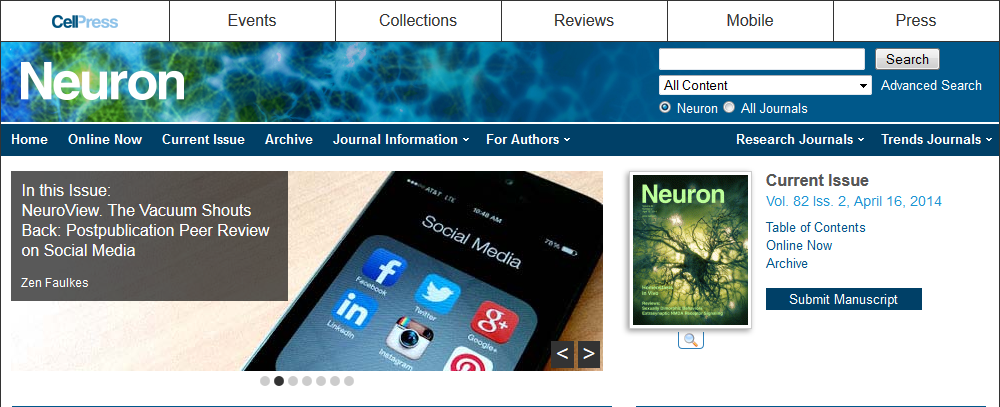
My last task was to create an image for the Neuron home page (shown above). The production team decided they didn’t want to use an image with the Creative Commons credit text on it, but used it as a template to create a new image:


The problem with writing an article like this is that no matter how fast you write it, and how quickly it’s published, there will be things coming out after you sent in the article that you wish you could have talked about.

For instance, the day after I sent back the checked page proofs, I read this article about how blogging about a research paper leads to increased corrections.

I thought of adding in at the eleventh hour was a mention of the current STAP stem cell kerfuffle. When I submitted the article, this story hadn’t really taken off, but during the intervening time of reviewing, production, and proofreading, it just got bigger by the day. Bigger by the hour, almost. But I decided that the STAP case didn’t yet have any clear lessons for post-publication peer review that wasn’t shown by examples already in the paper.

Then, I learned of this story by Haier and colleagues concerning the editorial process at Neuron, the journal I had just written for (my piece was in press by then). The short version is that authors had been asked to write a preview piece. Haier and company submitted a critical article, and the journal pulled the plug on it. Commentary on the Neuroskeptic blog ensues (Haier et al. link to the blog, but not the specific article, which is here), which includes remarks from someone who had knowledge of the typically anonymous review process.

This is an excellent example of one of the issues I talk about in my Neuron article: the difficulty of getting critical commentary published. Haier and colleagues started this process in the second half of 2012, and only more a year later, in April 2014, are they able to detail their concerns about the editorial process.

I could have talked about the importance of sites like ScienceSeeker, Faculty of 1000, and Researchblogging in providing portals for post-publication peer review. ResearchBlogging was certainly critical to my own development as a science blogger.

But despite all that, I’m pretty happy about this piece. Sometimes, when you keep having to re-read something you wrote, you get a little sick of it. I’ve had to re-read this one quite a lot, and there are some turns of phrase in it that I still quite like.

Now, I’m looking forward to the post-publication peer review of my own paper! Whether you think I had anything interesting to say or whether you think I was wrong, wrong, wrongity wrong, please comment here on the blog, tweet your thoughts to me (@DoctorZen), write your own blog post, or whatever form of social media turns your crank.

Meanwhile, I’m going to enjoy seeing this on the home page of Neuron for the next two weeks:


Additional: The cycle begins... my article gets post-publication peer review on PubPeer. And thanks to those who have tweeted so far!

Update, 17 April 2014:  My article is open access at the Neuron home page here, but, weirdly, paywalled at Science Direct.

After a little after one day, I’m also very happy to see this article’s Altmetric score:

(T)his article has done particularly well and is in the 98th percentile: it’s in the top 5% of all articles ever tracked by Altmetric.

It is not surprising that an article about social media does particularly well on social media. But, as I said, it is nice nevertheless.

I’ve also created a Storify of some of the responses so far.

Reference

Faulkes Z. 2014.The vacuum shouts back: post-publication peer-review on social media. Neuron 82(2): 258-260. http://dx.doi.org/10.1016/j.neuron.2014.03.032

External links

The new dilemma of online peer review: too many places to post?
Online exposure ‘leads to higher research paper correction rate’
What can we do about junk science?
How intelligent is IQ?
Stick to Your Ribs: The Problems With Calling Comments “Post-Publication Peer-Review”
A guide to post publication peer review

Comments for first half of April 2014

Impact Story looks at what people consider to be obstacles publishing in “megajournals” like PLOS ONE. Their list is good, but it doesn’t have the number one reason I’ve heard for people not submitting there: $$$

Excusion Set looks at cranks and the deficit model of science communication. In other words, how can you communicate with someone who thinks you’re wrong?

I make a cameo appearance in this post at The Molecular Ecologist on why people sign their reviews of research papers.

ImpactStory looks at ORCIDs and why they should become as common as DOIs. Poster session organizers should ask for them, too!

15 April 2014

If I’m to be skeptical of open access publishing, I’d like to have good reasons

A.A. Agrawal (whose alliterative name I envy) has penned a letter saying the people should be skeptical of open access publishing. In brief, his reasons are:

1. “Some are for profit!” Just like most traditional scientific publishers. While Agrawal says this creates a conflict of interest, the profit incentive can also move journals to provide more and better services for authors at lower prices; see this interview with open access publisher Ahmed Hindawi.

Hindawi’s argument seems to be that in a subscription market librarians have no choice but to buy access to an entire journal in order to provide their institution’s researchers with access to any single article in it — since no other journal can substitute for the one in which the desired article has been published.

In an OA world, by contrast, authors will have the choice of taking their papers to a number of different publishers (i.e. shop around). And since the paper will be freely available to all once it is publisher, there can be no monopoly on access. This, says Hindawi, will drive prices down.

2. “Most don’t copy edit.” Data or citation needed.

3. “There isn’t a citation advantage.” This is the point that is most annoying, because it shows poor scholarship. Agrawal cites one study that finds no citation for advantage, but there have been many others. It’s worth having a look through this summary of many projects testing this hypothesis. Not all of them show an open access advantage, but many do. Picking one study alone, even if it’s a good one, smacks of confirmation bias.

4. “People care about journal prestige,” Alas, the “prestige” argument this is probably one of the main reasons that people will not consider particular open access journals. However, it ignores the prospects for article level metrics. And I am not impressed with an argument that can be rephrased as, “Your peers are lazy.”

Hat tip to Prof-like Substance.

Reference

Agrawal AA. 2014. Four more reasons to be skeptical of open-access publishing. Trends in Plant Science 19(3): 133.

Reposted at Always Researching, with a link here but not credit (yet). Hat tip to Ross Mounce for noticing.

Tuesday Crustie: Hello, world!


World, meet Gramastacus lacus. Gramastacus lacus, world.

This is an interesting new burrowing crayfish species. For one, it’s only the second in its genus. Second, it has an unusual way of walking on land. (I started my scientific career doing locomotion, so this fascinates me.)

There is a unique forward movement via a series of rhythmic plunges. The crayfish raises the cephalothorax and both claws up with its legs and then moves forward overbalancing and plunges down and forward then repeats the movement. This up and forward movement is unusual, but the crayfish easily moves up, forward and down without “missing a beat”.

I would love to see a video of this!I emailed the author, Robert McCormack, and he doesn’t have any yet. He tells me he’s put recording it, and putting it up on YouTube, onto his research agenda.

Not surprisingly, the headlines are focusing on things that don’t seem so notable. They are not really that small. The technical paper calls them “robust and strong” compared to the other species in their genus. The description on NBC news referring the “cannibal” nature of the crayfish is weird, given that pretty much every crayfish will make a meal out of another if the opportunity arises.

Hat tip to David Shiffman.

Reference

McCormack R. 2014. The eastern swamp crayfish Gramastacus lacus sp. n. (Decapoda, Parastacidae) a new species of freshwater crayfish from coastal New South Wales, Australia. ZooKeys 398:53-67. http://dx.doi.org/10.3897/zookeys.398.7544

External links


08 April 2014

Tueday Crustie: Eat my ride


From the Aquatilis Expedition (on Twitter here):

Hyperia galba is a small crustacean which uses jellyfish as its home and a source of food simultaneously.

Hat tip to Miss Mola Mola.

04 April 2014

Publishing may be a button, but publishing isn’t all we need

I’m hearing a lot of people say, “Publishing is a button” as a simple argument against scientific publishers and, to a lesser extent, journals: some scientists argue that both are completely unnecessary and have outlived their usefulness. This is a paraphrase of Clay Shirky; what he actually wrote was:

Publishing is going away. Because the word “publishing” means a cadre of professionals who are taking on the incredible difficulty and complexity and expense of making something public. That’s not a job anymore. That’s a button. There’s a button that says “publish,” and when you press it, it’s done.

Much like Stuart Brand’s quote “Information wants to be free” is often thrown out without acknowledging that the next line is “Information also wants to be expensive,” the Shirky sound bite overlooks something in his following paragraphs (my emphasis).

The question is, what are the parent professions needed around writing? Publishing isn’t one of them. Editing, we need, desperately. Fact-checking, we need. For some kinds of long-form texts, we need designers.

For scientific publishing, there are are least three things that are not just “buttons.” They need to be done by humans.

Quality control. Shirky alluded to this in his paragraph above. For academics, the major aspect of quality control means peer review. Some argue that pre-publication peer review doesn’t improve papers, but I think that’s a rare opinion. Most researchers who’ve been to this rodeo a few times will admit, however grudgingly, that reviewers have improved papers. For various reasons, I am not a fan of only post-publication review doing the job; more on this in an article that I will have out in Neuron in a couple of weeks. (Update, 21 April 2014: That article is here.)

Archiving. This is one of my biggest concerns with the “just stick it all on the web” approach, as I’ve mentioned before. I find so much link rot in my own blog. We need institutions that will outlast individual researchers, and currently, journals do that. Anyone who wants to get rid of scientific journals needs to pay attention to what institutions will take their place in curation and archiving. Björn Brembs has identified university libraries as a possible alternative for archiving, but we are a long way from that point yet.

Publicity and public relations. Some might argue that this wouldn’t be necessary in an ideal world. But even in this age of “help yourself to information” via search engines, lots of folks recognize that you can benefit a lot by thinking and working on “search engine optimization” (SEO). Putting something on the web does not guarantee people can find it. Publicizing research findings can be valuable. Some new research might have health or policy implications. Some we want to publicize because it’s cool, and it can help increase public understanding of science. And then there are the more limited but pragmatic considerations of individual scientists who want to enhance their reputation.

5 April 2014: In thinking about this a little more, I think Shirky’s idea might have been better expressed as, “Distribution is a button.” Printing things on paper and physically hauling it around the country, that’s largely been supplanted. But when you say “publishing” to most people, they are thinking about the things that Shirky still says are necessary: editors, designers, etc.

Related posts

Self archiving science is not the solution
Taxonomists as science survivalists
Scientific publishing and tree-shaped frosted sugar cookies

External links

How We Will Read: Clay Shirky
Publishing is a button: what Clay Shirky didn’t say 

01 April 2014

Tuesday Crustie: Taxi!


This is a Cape River crab (Potamonautes perlatus)... with passengers. A new paper by Badets and Du Preez (2014) shows how these crabs act as taxis for leeches (seen in the inset). While we often think of leeches as bloodsuckers, in this case, they are not harming the crab at all. They are simply using the crab as a way to be spread around in hope of finding their preferred host, the clawed frog (Xenopus laevis).

Reference

Badets M, Du Preez L. 2014. Phoretic interaction between the kangaroo leech Marsupiobdella africana (Hirudinea: Glossiphoniidae) and the cape river crab Potamonautes perlatus (Decapoda: Potamonautidae). International Journal for Parasitology: Parasites and Wildlife 3(1): 6–11. http://dx.doi.org/10.1016/j.ijppaw.2013.10.001

External links

ScienceShot: Kangaroo Leeches Use Horny Male Crabs as Taxicabs

Comments for second half of March 2014

Retraction Watch covers the graphical abstracts train wreck at Journal of Proteomics, which I wrote about here.

Terry McGlynn says scientists know how to communicate with the public.

I make a cameo in Mike Taylor’s post about putting more information in citations.

31 March 2014

Fifty-nine noes

When I was on the academic job market, I read somewhere that successful applicants sent out around sixty applications.

That was pretty much in line with my experience. I think I sent out over fifty applications before I got the phone interview that ultimately led to this job. And because of the delays, I ended up sending out more applications after I had done the on-site interview.

It’s a frustrating process, because there’s no progress bar. You send this off, and you rarely have any idea of when it’s received, whether a shortlist has been made, or when a decision is expected.

I was surprised by how many applications just... vanished. Many search committees didn’t feel compelled to inform candidates of the outcome. Not even a simple, “No thank you.”

I think it starts to suck hard somewhere around the forty mark. Particularly if none of them has even yielded a lead, like an on-site interview.

The job market wasn’t great when I was in it, and it’s probably worse now. This means that you have to be ready to take a lot of rejection.

But the moral of the story is that the number of noes is almost irrelevant. Because all it takes is one “Yes.”


Photo by nathangibbs on Flickr; used under a Creative Commons license.

28 March 2014

“Teen upstages adults” never gets old

Printing pages using the Garamond typeface will save money, and CNN is on it! This is a popular story, judging from the error message I got when I tried to go to the journal reporting this:

Bandwidth Limit Exceeded
The server is temporarily unable to service your request due to the site owner reaching his/her bandwidth limit. Please try again later.

They are only, oh, about five years late to the party. Matt Robinson showed us that five years ago:


Other news organizations have pointed out that good typeface choice can save money before, too.

Why is this making the news rounds today? Because the person pointing out the savings, Suvir Mirchandani, is a teenager. News agencies, and the public, love “teen genius” stories. See Jack Andraka (cancer test), Boyan Slat (ocean clean-up) and Aidan Dwyer (solar power).

(Off the top of my head, I can’t think of many teenage girls who have achieved similar press coverage).

All of these teens put out a flashy claim that... well... remains to be seen if it will yield anything interesting. But I see their stories circulating in social media for years.

This is a great example of the power of narrative. People love underdog stories, and teens are underdogs in almost every way. People want to believe that teens can make big breakthroughs in science and technology, and I think a lot of critical appraisal is dialed down, if not shut off.

I doubt any of these stories would have received much media attention if the person making the claim was 20 or older.

Update, 1 April 2014: Oh, as I might have expected: the flashy claim from Mirchandani is being criticized.

External links

Journal of Emerging Investigators
Teen to government: Change your typeface, save millions
Measuring type

Luis Colom, the peer I never met

Luis Colom, a professor at University of Texas Brownsville, has died from cancer.

Dr. Colom and I were hired the same year, 2001. I was hired by The University of Texas-Pan American. Dr. Colom was hired down the road at University of Texas-Brownsville.

We both did neuroscience. I think it’s fair to say we were the first people doing neuroscience in the Lower Rio Grande Valley. But despite this, we never had any serious interactions. This was probably because his research was distinctly biomedical and mammalian, whereas mine is emphatically not. I think I saw him make some opening remarks at an NSF workshop I attended at Brownsville.

A missed opportunity.

This message from UT Brownsville makes it clear he did a lot for their institution. I once heard that he had been denied tenure at another institution. I have no idea if that’s correct, but if it is, it certainly is a lesson in how people can not make it in one place, but do well in another.

It’s shame he did not live to see the opening of The University of Texas Rio Grande Valley. Because he was obviously the sort of person who helped make that transition possible, and he would probably have enjoyed the challenge of working in a new university.

Update, 13 May 2014: Another thing we had in common was a student, Nadia Carreon. Nadia worked with me as an undergraduate, and Dr. Colom as a master’s student. Nadia and I were working on our second paper together when Dr. Colom died, so we dedicated the paper to his memory.

External links

Remembering Luis Colom

27 March 2014

The nicest acceptance letters I’ve ever had

And now, a moment of gloating celebration.


I mentioned a while back that I was up to my eyeballs in writing. Between Christmas Eve and mid March, I submitted seven pieces of academic writing to editors.

In the past two weeks, I’ve had two of those article accepted for publication. This make me very happy. What has made me happier was that they were accepted without revisions. Papers accepted “as is” are the baby pigeons of academia: you know that logically they must exist, but you might go your whole life without seeing one.

And the editor’s comments made me bounce up and down. First this:

I don’t know when I have enjoyed reading a paper so much!

Then this:

I have to say that I am not often in the position of having no changes to suggest, but I really like the piece and don’t want to muck with it.

What’s the secret? These two papers had an advantage: neither was a data-driven, experimental paper with original research. That made the reviewing process easier.

I post this not to gloat. (Well, not just to goat, I guess. A teensy little bit of gloating.) You know, scientific publishing is so often so long and so hard, that I just felt compelled to point out that occasionally, you win one.

25 March 2014

Tuesday Crustie: Squidhiker


On the CRUST-L discussion list, Daniel Abed-Navandi shared this picture. He stumbled upon this large flat isopod clinging to the mantle of a squid he was prepping for the dinner plate. He suspects is belong to Seroloidea.